
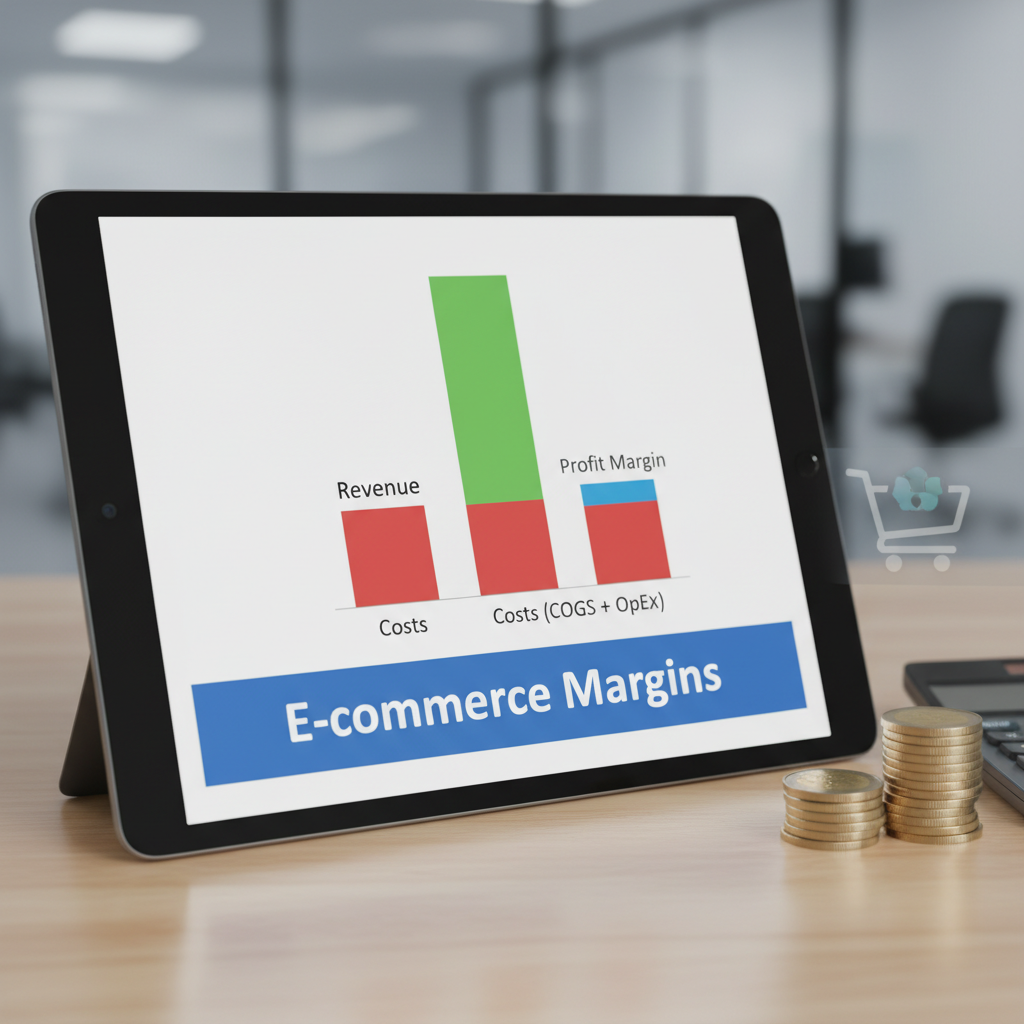
Understanding Ecommerce Profitability: Why Margins Matter
In the highly competitive digital marketplace, simply making sales is not enough. True success hinges on profitability. The question that keeps every ecommerce entrepreneur awake at night is: What is a good profit margin for ecommerce business?
Profit margins are the lifeblood of any retail operation, but they are particularly complex in the world of ecommerce due to fluctuating shipping costs, high return rates, and ever-increasing digital advertising expenses. Understanding your margins is the difference between operating a profitable enterprise and running an expensive hobby.
Before diving into benchmarks, it’s crucial to distinguish between the two primary types of margins:
- Gross Profit Margin: This is your revenue minus the Cost of Goods Sold (COGS). It tells you how efficiently you are sourcing and manufacturing your product before considering operational overhead.
- Net Profit Margin: This is your gross profit minus all operating expenses (marketing, salaries, rent, software, shipping fees, etc.). This metric represents the actual percentage of revenue you keep as profit. When discussing a sustainable and good profit margin for ecommerce business, we are usually focused on the net margin.
“Revenue is vanity, profit is sanity, and cash is reality.” – Often attributed to business strategists, this maxim underscores the importance of focusing on margin over sheer sales volume.
What Defines a Good Profit Margin for Ecommerce Business?
The definition of a “good” margin is highly dependent on your industry, product complexity, business model, and competitive landscape. A 5% margin might be excellent for a high-volume electronics retailer, while it would spell disaster for a niche luxury brand.
However, we can establish general benchmarks to determine what represents a healthy and sustainable financial position for most online retailers.
The Low-Margin Reality (10% – 15% Net)
This range is typical for businesses dealing in high-volume, standardized, or commodity goods, such as basic electronics, mass-market apparel, or inexpensive consumables. Success here relies entirely on scale, efficient logistics, and razor-sharp cost control.
The Standard Margin Goal (20% – 35% Net)
For most direct-to-consumer (DTC) brands, 20% to 35% is considered a sustainable and good profit margin for ecommerce business. This range allows for reinvestment in marketing, product development, and handling unexpected costs like returns or inventory write-offs.
The High-Margin Nirvana (40%+ Net)
Achieved primarily by businesses selling proprietary, branded, or digital products (like courses or software), or highly specialized luxury goods where perceived value significantly exceeds COGS. These margins offer substantial resilience and rapid growth potential.
If your net profit margin consistently falls below 10%, your business is likely facing significant structural issues that need immediate attention, often revolving around high customer acquisition costs (CAC) or inefficient supply chain management.
Calculating Your Target Profit Margin for Ecommerce Business
To move beyond estimation, you need precision. Margin calculation involves detailed tracking of every expense. The standard formula for Net Profit Margin is:
Net Profit Margin = (Net Income / Revenue) x 100
Net Income is calculated after deducting COGS, operating expenses, taxes, and interest. To get precise figures quickly, utilize an effective tool like the Ecommerce Profit Margin Calculator, which simplifies complex calculations and helps model different pricing scenarios.
Strategies to Increase Your Good Profit Margin for Ecommerce Business
Maximizing profitability isn’t about cutting corners; it’s about strategic optimization across the entire value chain. Here are proven strategies to push your margins into the healthy zone.
1. Optimize the Cost of Goods Sold (COGS)
The fastest way to improve gross margin is to reduce COGS without compromising quality. This involves:
- Volume Discounts: Negotiate better terms with suppliers by committing to larger minimum order quantities (MOQs).
- Sourcing Alternatives: Explore suppliers in different geographic regions. While quality control is paramount, moving production closer to materials can drastically reduce costs.
- Streamlining Packaging: Reduce extraneous packaging components that add weight and material cost. Lighter packages also reduce shipping fees.
2. Master Pricing Strategy
Pricing should reflect not just cost, but perceived value and competitive positioning. Avoid the temptation to always undercut competitors, which often leads to a ‘race to the bottom.’
Value-Based Pricing
Price your product based on the unique value it provides to the customer, not just its cost. If your product solves a significant problem or offers superior quality, justify a premium price.
Dynamic Pricing Models
Implement software that adjusts prices in real-time based on demand, inventory levels, and competitor pricing. This ensures you capture the highest possible margin during peak periods.
Bundling and Upsells
Increase the Average Order Value (AOV). Selling two complementary items together often incurs only marginally higher fulfillment costs but significantly boosts gross revenue per transaction.
3. Drastically Improve Marketing Efficiency
Customer Acquisition Cost (CAC) is often the single biggest killer of a potentially good profit margin for ecommerce business. You must ensure your marketing spend is generating a positive return on ad spend (ROAS).
- Focus on High LTV Customers: Prioritize channels and campaigns that bring in customers with a high Lifetime Value (LTV). A customer who makes multiple purchases can justify a higher initial CAC.
- Conversion Rate Optimization (CRO): Even a small increase in conversion rate (e.g., from 2% to 2.5%) means you are effectively lowering your CAC without reducing ad spend. If conversion rates are low due to slow performance, optimizing the customer journey using tools like a free page load time tester can indirectly boost profitability by maximizing the return on traffic acquisition.
- Retention Marketing: Email marketing and loyalty programs are typically much cheaper than acquiring new customers. A strong retention strategy is essential for margin health.
Common Pitfalls That Decimate Ecommerce Margins
Even businesses with high gross margins can find their net profitability eroded by operational inefficiencies. Identifying and plugging these leaks is crucial for maintaining a sustainable financial structure.
Hidden Costs of Returns and Reverse Logistics
Free returns are a customer expectation, but they are expensive. The cost of a return often includes return shipping, inspection, repackaging, and the potential loss of value if the item cannot be resold as new. To mitigate this:
- Improve Product Detail Pages: Use highly accurate sizing charts, detailed videos, and extensive customer reviews to minimize ‘fit’ or ‘expectation’ related returns, particularly in apparel.
- Charge for Returns Strategically: While full refunds remain, consider charging a small fee for return shipping unless the item was defective, thereby filtering out ‘serial returners.’
Inventory Management Failures
Holding too much inventory ties up capital and risks obsolescence. Holding too little inventory leads to stockouts, resulting in lost sales and frustrated customers.
Effective inventory management requires accurate forecasting and understanding economic order quantity (EOQ). Improper tracking of inventory valuation and the costs associated with holding inventory (warehousing, insurance) can severely distort reported margins. According to the U.S. Small Business Administration (SBA), managing inventory carefully is one of the pillars of small business success, directly impacting cash flow and profitability. Learn more about financial management best practices from the SBA.
Shipping and Fulfillment Overspend
Shipping costs are notorious margin killers. Always negotiate with multiple carriers and explore third-party logistics (3PL) providers if your volume is substantial. Furthermore, ensure you are accurately calculating dimensional weight (DIM weight) to avoid unexpected surcharges.
It is also vital to correctly account for all costs associated with getting the product to the customer. This includes duties, tariffs, and handling fees, which must be factored into the COGS calculation, not just operating expenses, to get a true picture of the gross margin. For a deeper understanding of how these costs are categorized, Investopedia provides a clear breakdown of Cost of Goods Sold components.
Leveraging Technology for Optimal Margins
Modern ecommerce platforms and tools offer unparalleled opportunities to automate cost control and optimize pricing, ensuring you sustain a good profit margin for ecommerce business.
Automated Repricing Tools
These tools constantly monitor competitor pricing and market demand, adjusting your selling price dynamically to maximize profit capture without losing competitive edge.
Advanced Analytics and Reporting
Utilize robust analytics to track profitability down to the SKU level, identifying which products are true ‘profit drivers’ and which are ‘margin sinks’ that might need phasing out or significant cost reduction.
Subscription Models
Implementing subscription services increases LTV and creates predictable recurring revenue, which smooths out cash flow and reduces the variable cost of customer acquisition over time.
Sustaining high margins is not a one-time fix; it requires continuous auditing, process refinement, and a commitment to leveraging data. The most successful ecommerce businesses treat margin optimization as an ongoing operational priority, constantly seeking incremental improvements that compound over time.
Conclusion: Making Profitability Your Priority
Determining a good profit margin for ecommerce business is a nuanced exercise, but aiming for a net margin of 20% to 35% provides a solid foundation for sustainable growth and resilience. Achieving this requires a holistic approach: optimizing COGS through smart sourcing, using data-driven pricing strategies, and ruthlessly managing operational costs, especially customer acquisition and fulfillment.
By treating profitability metrics with the same urgency as sales figures, ecommerce entrepreneurs can transition from merely surviving in the competitive landscape to truly thriving.
FAQs
Gross margin is the profit expressed as a percentage of the revenue (selling price). Markup is the profit expressed as a percentage of the cost (COGS). For example, if an item costs $50 and sells for $100, the Gross Margin is 50% ($50/$100), but the Markup is 100% ($50/$50).
A 15% net profit margin is generally considered acceptable, particularly for high-volume or highly competitive industries like consumer electronics. However, most DTC brands should aim for 20% or higher to ensure adequate capital for reinvestment, handling unexpected costs, and maintaining a healthy buffer against economic downturns.
A high return rate significantly erodes profit margins because the business incurs costs multiple times: initial shipping, return shipping, inspection/repackaging labor, and potential markdown if the product cannot be resold as new. A typical return can wipe out the profit on two to three successful sales.
One of the most commonly overlooked costs is inventory holding cost, often called carrying cost. This includes the cost of warehousing, insurance, obsolescence (products that go out of date), and the opportunity cost of having capital tied up in stock rather than invested elsewhere.
This depends on your current market position. If your product is highly differentiated and you are undercutting competitors, raising prices is often the fastest path to improved margins. If your product is a commodity, focusing on aggressive cost reduction (especially COGS and fulfillment) will likely be more sustainable, as the market may not tolerate significant price increases.
Read Also:
- How to Check Domain Age and Authority: A Comprehensive Guide for SEO Success
- The Ultimate Guide to SSL Verification: How to Use a Check If Website Is Safe Tool and Protect Your Data
- Ovulation Tracking Mastery: Finding Your Peak Fertility Window and Using a ‘When is the Best Time to Get Pregnant Calculator’
- Leap Year Fundamentals: Why 2026 is Not a Leap Year and Essential Calendar Facts
- Blogs
- Denomination Calculator: Count Cash Accurately in 2026
- Linear Yard vs. Yard: Your 2026 Guide
- Trapezoid Volume Calculator: The Pro’s Field Guide for 2026
- The Ultimate 2024 Guide: How to Convert Hands to Ft Accurately
- Backlink Checker: 7 Ways to Dominate SEO – Visual Story
- Watts to Hz: Why You Can’t Convert Them (Guide for 2026)
- Supercharge Your SEO with Meta Tags in 2026
- Hz vs. Watts: Your 2026 Tech Guide
- Unlock Your 2026 Collage Superpowers