
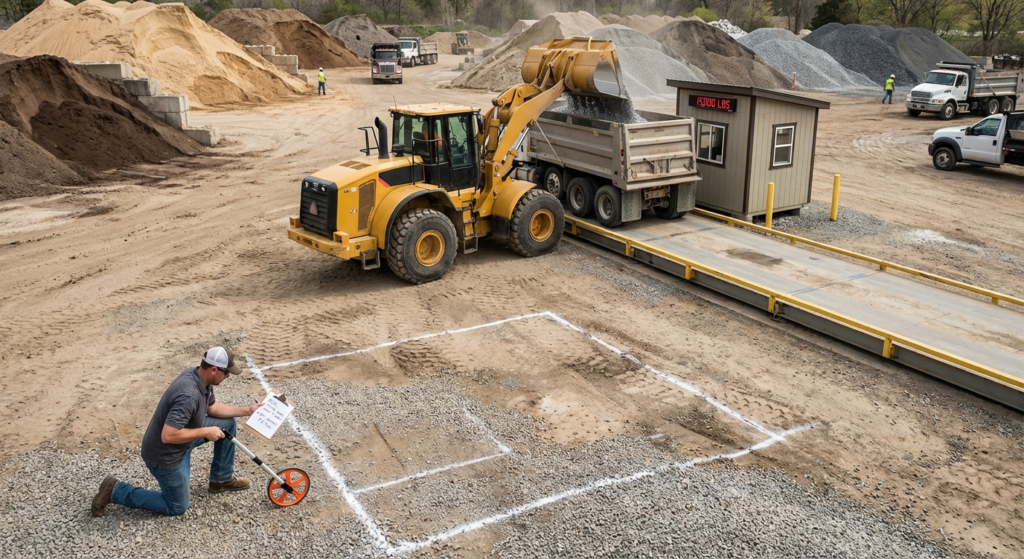
Picture this: It’s Saturday morning. You’ve rented the skid steer, your crew (or your buddies) are ready to work, and the dump truck pulls up to deliver the gravel for your new driveway. The driver hits the lever, the rocks slide out, and… it’s a pile about half the size you expected.
Panic sets in. You didn’t order enough.
Now you’re looking at a halted project, a second delivery fee, and a wasted weekend. I’ve seen this scenario play out dozens of times on job sites, and it almost always comes down to one simple math error: failing to correctly convert square yards into tons.
Here’s the thing. You measure your lawn or driveway in two dimensions (area). But the quarry sells material by weight (mass). Bridging that gap isn’t just about plugging numbers into a generic calculator; it requires understanding density, depth, and the “fluff factor.”
In this guide, we’re going to ditch the guesswork. I’m going to walk you through the exact process professional estimators use to calculate tonnage in 2026, ensuring you order exactly what you need—no more, no less.
📑 What You’ll Learn
The Disconnect: Why Area Doesn’t Equal Weight
Before we get to the math, you need to understand the physics. Trying to convert square yards directly to tons is like asking, “How many pounds is a mile?” They measure completely different things.
Square yards measure a flat surface—like a sheet of paper. Tons measure how heavy a pile of material is. To get from point A to point B, you need to turn that flat sheet into a 3D block (volume) and then determine how heavy that block is (density).
If you cover 100 square yards with feathers, it weighs nothing. Cover it with lead, and you need a heavy-duty crane. That’s why the specific material you choose is the single most critical variable in your equation.
🎯 Key Takeaway
You cannot convert square yards directly to tons without two extra pieces of data: the depth of the material (to get volume) and the density of the material (weight per cubic yard).
The 3-Step Formula to Convert Square Yards into Tons
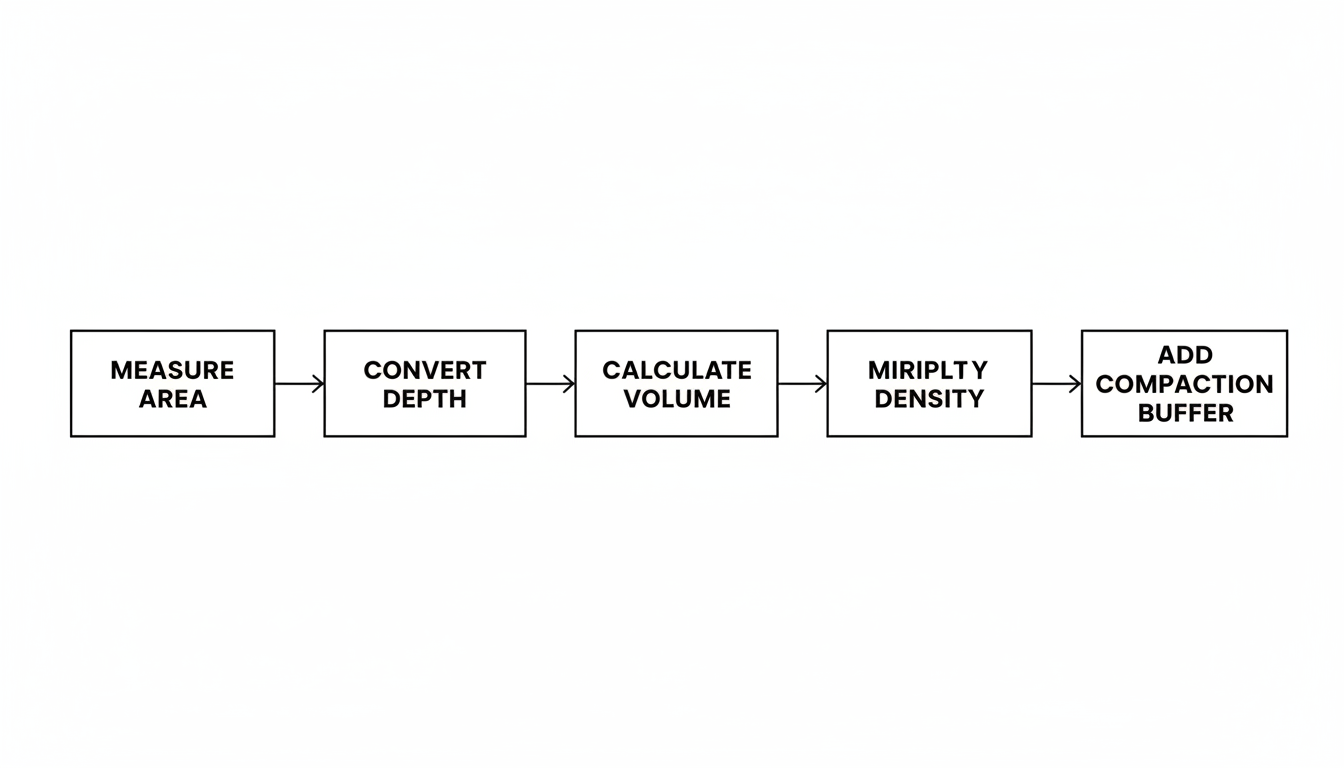
Forget complex calculus. In the field, we use a straightforward three-step workflow. While online calculators are handy, knowing this manual formula saves you when your phone dies or when you need to double-check a supplier’s quote.
Step 1: Determine the Volume (Cubic Yards)
You likely measured your project in feet or yards, but you’re probably thinking about depth in inches. We need to get everything into the same unit: Yards.
- The Depth Trick: Divide your depth (in inches) by 36.
- Example: 4 inches ÷ 36 = 0.111 yards.
Next, multiply your Area (Square Yards) by that new Depth (Yards). This gives you Cubic Yards.
Step 2: Find Your Material Density
This is where most DIYers mess up. They assume “dirt is dirt.” It’s not. A cubic yard of loose topsoil weighs significantly less than a cubic yard of wet, compacted crusher run. You need the specific density multiplier (measured in Tons per Cubic Yard).
Step 3: The Final Multiplication
Multiply your Cubic Yards (from Step 1) by the Density (from Step 2). The result is your required tonnage.
💡 Pro Tip
Always round up your depth slightly. If you plan for 3 inches, the ground is rarely perfectly level. You might have dips that are 4 or 5 inches deep. Calculating for 3.5 inches ensures you don’t run short due to uneven sub-grade.
Material Density Charts: The Key Variable
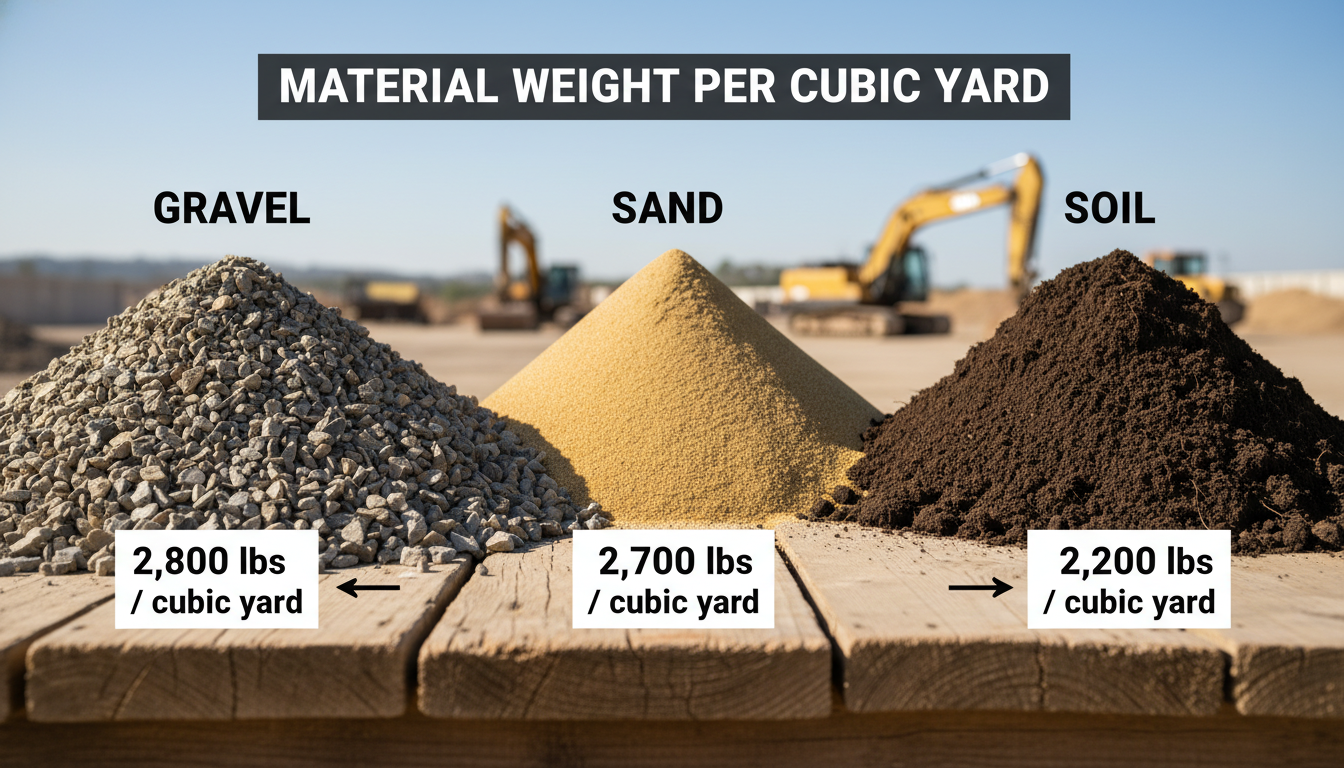
This is the most valuable section of this guide. Below are the standard industry densities used in 2026. However, keep in mind that moisture content changes everything. Wet sand can weigh 20% more than dry sand.
According to data from the U.S. Geological Survey (USGS), aggregate weights fluctuate based on the rock type (limestone vs. granite), but these averages are safe for estimating.
| Material Type | Condition | Density (Tons per Cubic Yard) | Use Case |
|---|---|---|---|
| General Gravel (#57) | Dry / Loose | 1.35 – 1.45 | Driveways, Drainage |
| Crusher Run / ABC | Compacted | 1.45 – 1.55 | Base material, Pavers |
| Sand | Dry | 1.25 – 1.35 | Playgrounds, Masonry |
| Sand | Wet | 1.45 – 1.60 | Concrete mixing |
| Topsoil | Loose / Dry | 1.00 – 1.20 | Garden beds, Lawns |
| Asphalt (Hot Mix) | Compacted | 2.00 – 2.05 | Paving |
| Mulch | Shredded | 0.25 – 0.40 | Landscaping (Sold by CY, not ton) |
Note: Mulch is the outlier. It is almost always sold by the cubic yard, not the ton, because its weight varies wildly depending on rain.
The “Compaction Factor” Trap
If you take nothing else from this article, remember this: Loose material shrinks when you smash it.
When you order gravel or soil, it comes “loose” in the truck. But once you spread it on your driveway and run a plate compactor over it (which you absolutely should do for stability), the volume decreases. The air pockets collapse.
This is called the Compaction Factor. If you need 4 inches of finished, compacted gravel, you actually need to lay down about 5 inches of loose material.
⚠️ Watch Out
The 15% Rule: For gravel and crushed stone projects, always add 10% to 15% to your final tonnage calculation. For topsoil, which settles significantly over time, add up to 20%. It is much cheaper to have a little extra gravel left over than to pay a $150 delivery fee for one missing ton.
Real-World Scenario: The Driveway Project
Let’s apply this to a real job. You are re-graveling a driveway.
The Specs:
- Area: 85 Square Yards.
- Desired Depth: 4 inches.
- Material: Crusher Run (Density approx. 1.5 tons/cy).
The Calculation:
- Convert Depth: 4 inches ÷ 36 = 0.111 yards.
- Get Volume: 85 sq yards × 0.111 yards = 9.435 cubic yards.
- Get Base Weight: 9.435 cu yards × 1.5 tons/cu yard = 14.15 tons.
- Add Compaction (15%): 14.15 tons × 1.15 = 16.27 tons.
The Order: You would call the quarry and order 16 to 17 tons.
Why round up to 17? Because most dump trucks have a capacity between 18 and 22 tons. If you order 16.27, you’re paying for a full truck anyway. You might as well fill it up. For more on truck capacities and logistics, check out resources from the National Asphalt Pavement Association regarding hauling standards.
Handling Irregular Shapes
Life rarely happens in perfect rectangles. If you’re working on a kidney-bean-shaped garden bed or a winding path, don’t panic. Break the shape down.
Divide your project into smaller squares, rectangles, and triangles. Calculate the square yardage for each “zone” individually, then add them together. For circular patios, use the formula $Area = pi times r^2$ (where $r$ is the radius in yards). If you need a refresher on geometry formulas, MathIsFun offers excellent visual guides that simplify these calculations.
Conclusion
Converting square yards into tons isn’t just busy work—it’s the difference between a profitable, smooth project and a logistical nightmare. By respecting the variables of density and compaction, you ensure that your project stands the test of time (and weight).
Remember: Measure twice, calculate once, and always—always—order a little extra for the compaction factor. Now, go get that project started.
❓ Frequently Asked Questions
How many tons is 100 square yards of gravel?
It depends on the depth. At a standard 2-inch depth, 100 square yards requires about 7.7 tons of gravel. At 4 inches deep, you would need approximately 15.4 tons. This assumes a standard gravel density of 1.4 tons per cubic yard.
What is the formula to convert square yards into tons?
The formula is: (Area in Sq Yards × Depth in Yards) × Material Density = Tons. Remember to convert your depth from inches to yards first by dividing by 36.
Does wet gravel weigh more than dry gravel?
Yes, significantly more. Water adds weight without adding volume. If it has rained heavily at the quarry, your material could weigh 5-10% more per cubic yard. Most reputable suppliers account for this, but it’s worth asking about.
How much does a cubic yard of asphalt weigh?
Asphalt is very dense. One cubic yard of hot mix asphalt typically weighs roughly 2.0 tons (4,000 lbs). This is much heavier than standard soil or gravel.
How do I calculate tons for a circular driveway?
First, find the area of the circle in square yards using the formula Pi × Radius × Radius. Once you have the square yardage, proceed with the standard conversion: multiply by depth (in yards) to get volume, then multiply by density to get tons.
Read Also:
- How to Make a Time Stamp in YouTube: The Ultimate 2026 Guide
- 50x70cm to Inches: The Ultimate 2026 Conversion & Framing Guide
- Blogs
- Watts to Hz: Why You Can’t Convert Them (Guide for 2026)
- Hack Your Habits: The 2026 Guide
- Split PDFs Like a Pro in 2026
- Unlock Image SEO with AI in 2026
- Hz to Watts: The 2026 Tech Myth Busted
- Random Number Generator: Uses in Security, Gaming & More – Visual Story
- 50x70cm to Inches: The Ultimate 2026 Framing & Conversion Guide
- Convert Sq Yards to Tons: The Ultimate 2026 Pro Guide

