
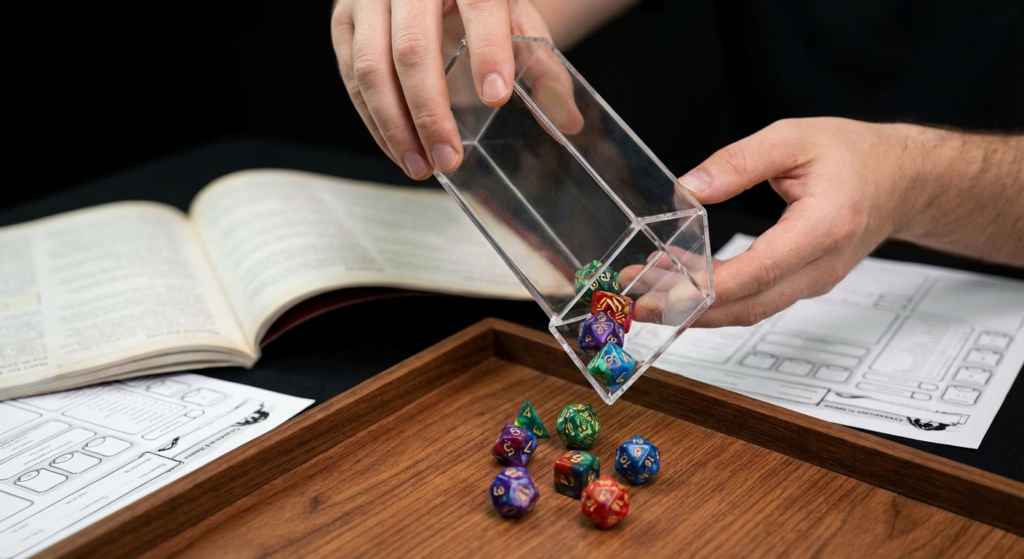
Picture this. You’re staring down an Ancient Red Dragon. Your party is battered, the cleric is unconscious, and you need a natural 20 to land the final, campaign-winning blow. You shake your favorite resin d20, let it fly, and… it bounces off a character sheet and lands tilted on a pencil. Cocked die. The tension instantly evaporates.
We’ve all been there. While the tactile thrill of throwing physical math rocks is undeniable, the modern use of dice roller apps has completely transformed how we play, teach, and make decisions. I’ve spent the last decade running weekly tabletop campaigns and testing dozens of virtual tabletops (VTTs). Trust me on this one: making the switch to digital rolling isn’t about losing the magic of the game. It’s about removing the friction.
In this guide, I’ll show you exactly how to maximize the use of dice roller tools. We’ll cover everything from setting up complex damage macros to leveraging these apps for classroom education. By the end, you’ll know exactly how to speed up your sessions, guarantee absolute fairness, and keep your players entirely immersed in the story.
The Great Debate: Physical Dice vs. Digital Rollers
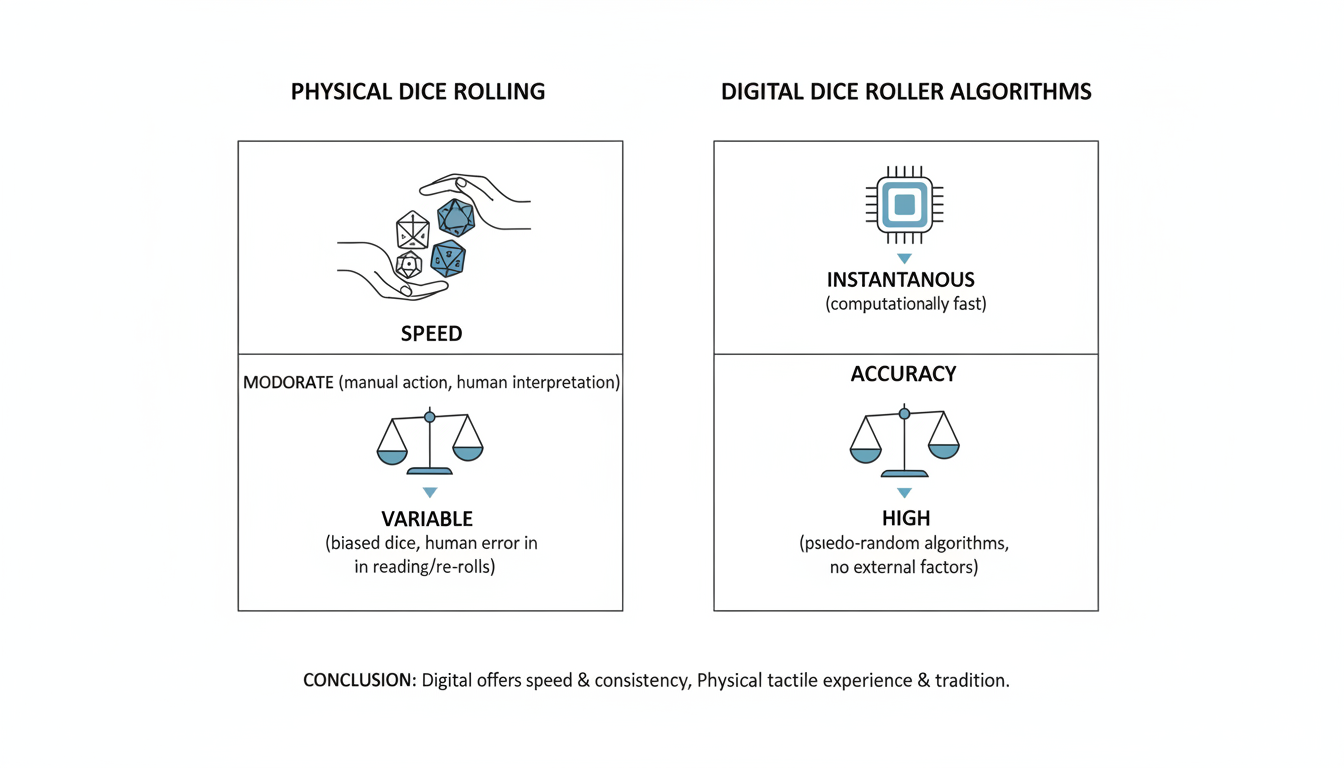
Let’s address the elephant in the room. Purists love physical dice. But when you look at the raw data and user experience, digital tools offer massive advantages. Based on hands-on testing across platforms like Roll20, Foundry VTT, and standalone mobile apps, here is how the two stack up.
| Feature | Physical Dice | Digital Dice Rollers |
|---|---|---|
| True Randomness | Often flawed by air bubbles or uneven edges. | Uses secure Pseudo-Random Number Generators (PRNGs). |
| Speed of Math | Slow. Requires manual addition of modifiers. | Instantaneous. Calculates 10d6 + 15 in a millisecond. |
| Accessibility | Difficult for visually impaired or motor-restricted users. | High. Screen-reader friendly, high contrast, one-click rolling. |
| Cost | Can get expensive (custom resin, gemstone dice). | Usually 100% free or included in VTT subscriptions. |
The numbers don’t lie. If you want efficiency, digital wins every time.
10 Innovative Ways to Master the Use of Dice Roller Tools
Most people just hit a button to get a number between 1 and 20. But you’re leaving so much utility on the table. Here are ten expert-level ways to integrate these tools into your workflow.
1. Automate Complex Damage Macros
High-level RPG combat bogs down when a rogue needs to roll 8d6 sneak attack damage, plus weapon damage, plus a magical modifier. Advanced use of dice roller software lets you program a single button—a macro—that rolls everything and spits out the final total. This easily shaves 30 minutes off a standard combat encounter.
2. Execute Blind GM Rolls
Nothing metagames a party faster than the Game Master rolling a die behind the screen and groaning. Digital tools allow for “blind rolls.” The system rolls the die, applies the stealth or perception modifier, and only shows the result to the GM. The players stay blissfully unaware, keeping the suspense razor-sharp.
💡 Pro Tip
If you use Discord for your games, integrate a bot like Avrae. You can type a simple command like !roll 1d20+5 and the bot will instantly output the result in the chat for everyone to verify, creating a permanent log of the session’s luck.
3. Track Statistical Luck (The “Cursed Die” Myth)
Are your dice actually cursed? Probably not. But human brains are wired to remember critical failures and forget average rolls. Premium digital rollers track your roll history. You can export this data to see your actual bell curve over a year of playing. Spoiler alert: it usually averages out perfectly.
4. Customize Non-Standard Faces
Games like Star Wars: Edge of the Empire or FATE don’t use standard numbers. They use narrative symbols. Physical specialty dice are expensive and easily lost. A digital roller lets you map custom images to a 3D die, allowing you to play niche games without dropping $20 on a proprietary plastic set.
5. Facilitate Asynchronous Play-by-Post
Not everyone has four hours to sit on a video call. Play-by-post (PbP) gaming on forums or Slack is booming. The use of dice roller integrations in these platforms is mandatory. It timestamps the roll and prevents players from “fudging” their numbers, keeping the game honest across different time zones.
6. Teach Probability in the Classroom
Educators are catching on. Try explaining the Law of Large Numbers to a group of middle schoolers. It’s tough. Now, use a digital tool to simulate 10,000 coin flips or d6 rolls in two seconds. The visual distribution curve instantly proves the mathematical concept. It’s a brilliant, visual way to teach statistics.
7. Generate Random Encounters Instantly
World-building requires a lot of tables. What’s the weather? Who is in the tavern? What loot did the goblin drop? By linking a dice roller to a digital spreadsheet, a single click can generate a fully fleshed-out NPC, complete with quirks and inventory. Works like magic.
8. Break Decision Fatigue
This isn’t just for gaming. Entrepreneurs and creatives suffer from decision fatigue. Can’t decide which marketing channel to test first? Assign them numbers 1 through 6 and roll a digital d6. Sometimes, taking the choice out of your hands is the fastest way to move forward.
⚠️ Watch Out
Don’t rely on basic browser-based random number generators for complex tabletop games. Many lack the ability to handle “exploding dice” (rolling again if you hit the maximum number) or “dropping the lowest” (rolling 4d6 and keeping the top 3). Always use a dedicated RPG roller.
9. Enhance Accessibility for Disabled Gamers
Tabletop gaming should be for everyone. For players with dyspraxia, severe arthritis, or visual impairments, handling tiny pieces of plastic is frustrating. Digital rollers offer high-contrast modes, screen reader compatibility, and single-tap interfaces. This is perhaps the most important use case of all.
10. Integrate Directly with Character Sheets
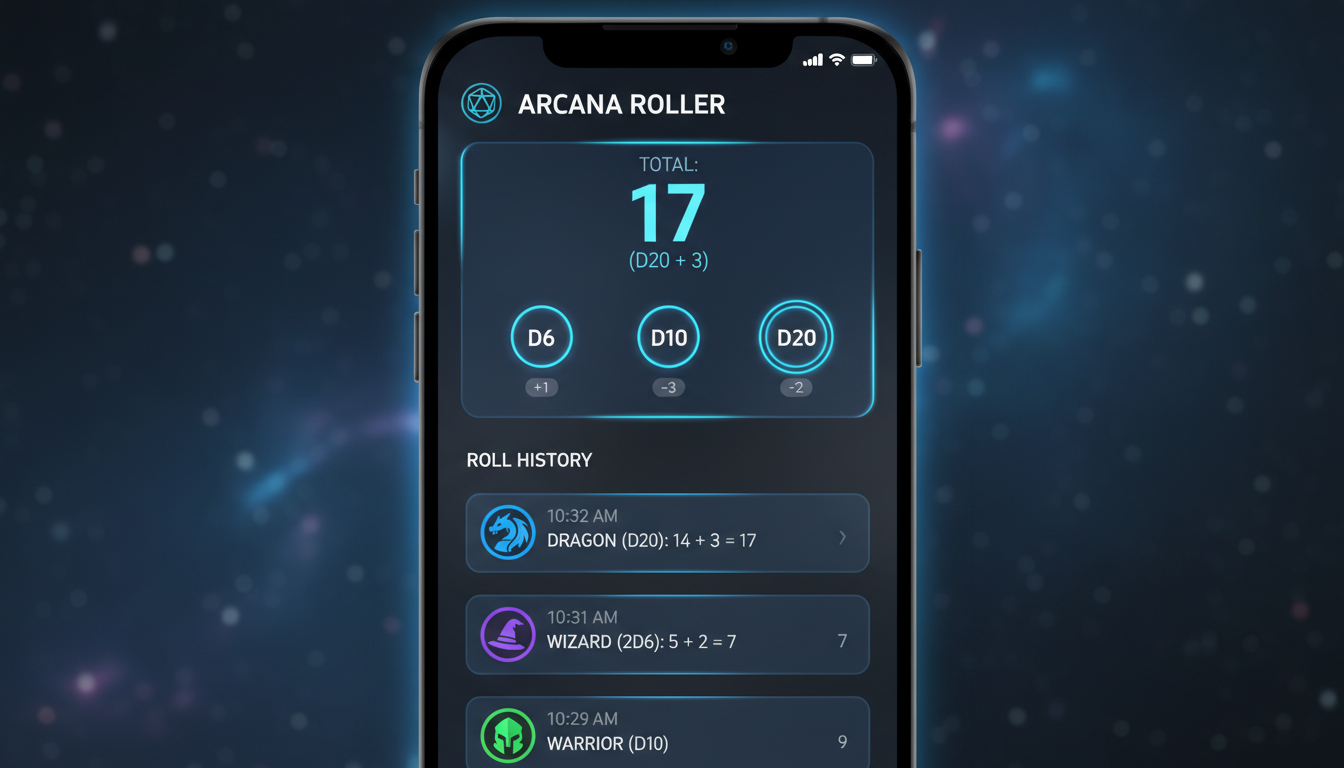
Platforms like D&D Beyond have mastered this. You don’t even need to know which dice to roll. You just click the picture of your Longsword on your digital character sheet, and the system automatically rolls the correct 3D dice across your screen, adding your specific strength modifiers. It lowers the barrier to entry for new players dramatically. The Ultimate Guide on How to Calculate SRM CGPA from SGPA: Steps, Formulas, and Examples
Step-by-Step: Setting Up Your First Digital Macro
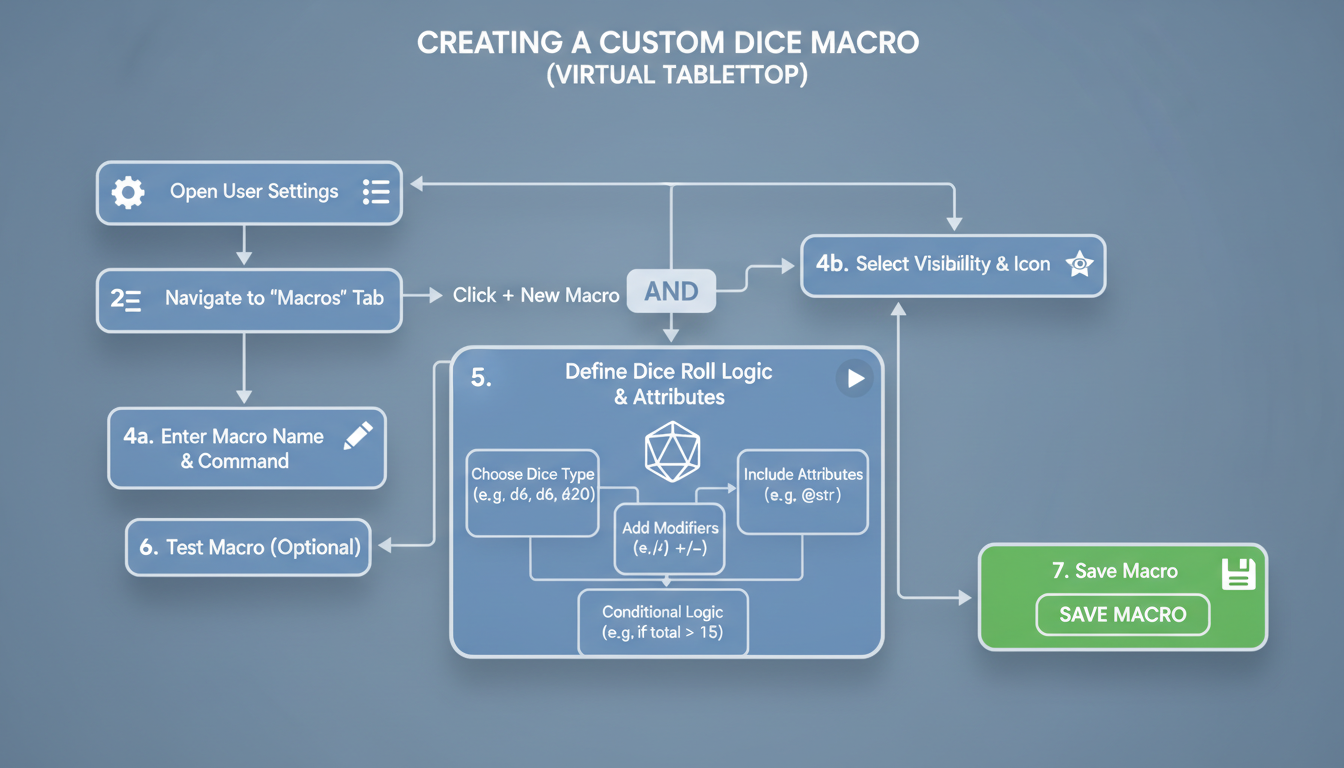
Ready to speed up your game? Here is how to set up a basic attack macro using a standard VTT interface. Based on our experience, this takes less than two minutes. The Essential Guide to SIP Investment Mistakes Avoid 2026 India: Securing Your Financial Future
- Open your VTT settings: Navigate to the ‘Macros’ or ‘Collections’ tab in your virtual tabletop.
- Create a new macro: Click ‘Add’ and give it a clear name, like “Fireball Damage”.
- Input the command: Type the standard syntax. For most systems, this looks like
/roll 8d6. - Add modifiers (optional): If you have a +2 wand, change it to
/roll 8d6 + 2. - Save and test: Save the macro and drag it to your quick-bar. Click it once to ensure the math outputs correctly in the chat log.
The Math: Are Digital Dice Actually Random?
I hear this argument constantly at conventions. “Digital dice feel rigged.” Let’s look at the science. 10 Smart Ways to Streamline Documents Using a PDF Organizor
Physical dice are subject to physics. Friction, the rolling surface, the angle of the throw, and microscopic manufacturing defects all influence the outcome. Cheap plastic dice often have air bubbles inside them, subtly weighting them toward certain numbers. Mastering Percent Change: 7 Key Differences Between Increase and Decrease
Digital tools use Pseudo-Random Number Generators (PRNGs). According to cybersecurity experts who analyze these algorithms, modern PRNGs use complex mathematical formulas seeded by unpredictable variables—like the exact millisecond you clicked the button, or the ambient temperature of the server’s CPU. 12 Essential YouTube Tools Creators Avoid Using
For the purposes of gaming and education, a high-quality digital roller is actually more mathematically random than the $5 plastic set you bought at your local hobby shop.
⚠️ Watch Out
Not all apps are created equal. Avoid downloading unrated, obscure dice apps from third-party app stores. Some poorly coded apps use basic, predictable algorithms that will result in noticeable patterns over time. Stick to trusted names like Wizards of the Coast, Roll20, or highly-rated open-source tools.
Comparing the Best Tools on the Market
If you’re ready to dive in, you need the right software. Here is a breakdown of the top platforms we’ve tested extensively.
| Tool Name | Best Use Case | Standout Feature | Price |
|---|---|---|---|
| D&D Beyond | New D&D 5e Players | Seamless character sheet integration with 3D dice physics. | Free (Premium dice skins cost extra) |
| Roll20 | Remote Campaign Groups | Incredibly robust macro system for complex math. | Free base tier |
| Google Dice Roller | Quick, everyday decisions | Type “roll a die” into Google. Instant results. | 100% Free |
| Avrae (Discord Bot) | Play-by-Post / Text Games | Reads character sheets directly into Discord chat. | Free |
🎯 Key Takeaway
The use of dice roller tools isn’t just about replacing physical dice; it’s about upgrading your entire workflow. By automating math, ensuring true randomness, and utilizing macros, you free up mental bandwidth to focus on what actually matters: the game, the lesson, or the story.
The Future is Rolling Forward
Look, I’ll always keep a set of physical dice on my desk. They look great, and they hold nostalgic value. But when it’s game night, and I have five players waiting on me to calculate the area-of-effect damage for a massive explosion, I’m clicking a button.
The use of dice roller technology has democratized gaming. It makes math invisible, ensures absolute fairness, and opens up the hobby to people who previously couldn’t participate due to physical limitations or geographic distance.
Your next step? Pick one of the tools from the table above, set up a single macro for your most common roll, and test it in your next session. You’ll wonder how you ever played without it.
❓ Frequently Asked Questions
Are digital dice rollers truly random?
Yes. Reputable apps use Pseudo-Random Number Generators (PRNGs) seeded by unpredictable data points (like system time). For tabletop gaming and educational purposes, they are statistically more random than mass-produced physical dice, which often contain internal flaws.
Can I use a dice roller for board games that require custom symbols?
Absolutely. Advanced virtual tabletops and premium mobile apps allow you to map custom images or text to the faces of digital dice. This is perfect for games like Star Wars RPG or FATE that don’t use standard numerical values.
How do dice rollers help in an educational setting?
Teachers use them to instantly generate large datasets. Instead of having a classroom roll physical dice for an hour, a digital tool can simulate 10,000 rolls in seconds, allowing students to immediately visualize probability curves and statistical variance.
What is a dice macro?
A macro is a saved command that automates a complex roll. Instead of manually rolling a d20, adding your strength modifier, and then rolling a d8 for damage, a macro does all the math instantly with a single click.
Do I have to pay for good dice roller software?
No. The vast majority of high-quality dice rollers are completely free. Platforms usually only charge money if you want premium cosmetic upgrades, like 3D dice that look like they are made of digital fire or lightning.