
You just dropped some serious cash on a killer new amplifier and a subwoofer that could shake a house. You’re ready for chest-thumping bass and crystal-clear highs. There’s just one problem: your car’s factory dashboard looks like a sealed fortress, and the stock stereo has zero RCA outputs. So, how do you connect your powerful new gear?
Don’t panic. You don’t need to rip out that sleek, integrated infotainment system.
The answer lies in a small, unassuming box that is arguably the most important component in modern car audio upgrades: the line output converter (LOC). Think of it as the universal translator between your factory gear and your aftermarket ambitions. It’s the key to unlocking your car’s true audio potential without sacrificing the features you love.
In this deep dive, you’ll learn exactly what a line converter is, the critical differences between the types, and how to choose the perfect one for your system. No fluff, just the expert advice you need to get it right the first time.
📑 What You’ll Learn
What a Line Converter Actually Does (And Why You Need One)
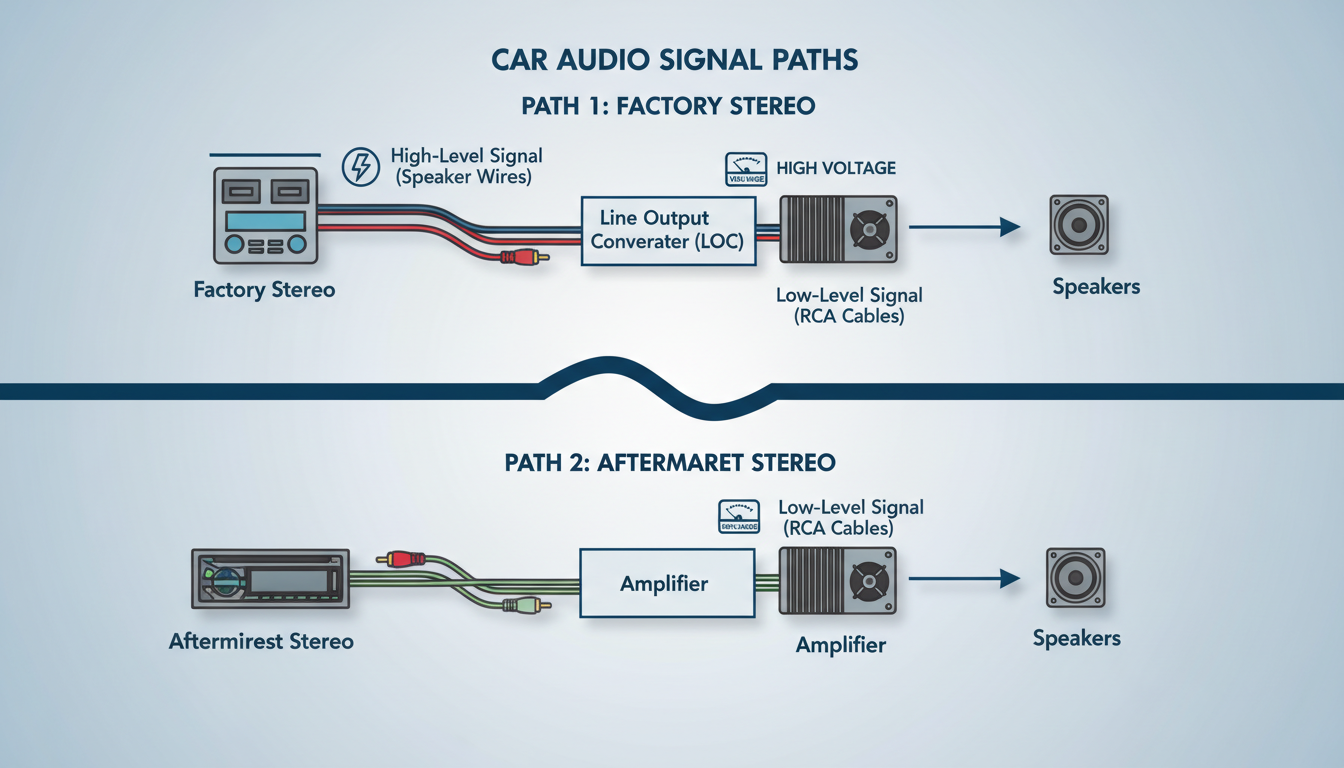
At its core, a line converter solves one fundamental problem: a signal mismatch. Your factory car stereo sends out a high-level (or speaker-level) signal. This is a powered signal designed to drive the cheap paper speakers in your doors directly. Your new aftermarket amplifier, however, is designed to accept a low-level (or line-level) signal via RCA cables. This is a clean, unamplified signal, often called a “pre-amp” signal.
Trying to connect a high-level speaker wire directly to a low-level RCA input is like trying to fill a water glass with a fire hose. You’ll get a massively distorted, clipped signal that sounds terrible and can permanently damage your new amplifier. It’s a recipe for disaster.
A line output converter simply and safely takes that high-voltage speaker signal and “steps it down” to the low-voltage line-level signal your amp needs. It’s the essential bridge that makes modern system building possible.
The bottom line: If you’re adding an amplifier to a factory stereo system that lacks RCA outputs, a line converter isn’t just recommended—it’s mandatory.
Passive vs. Active: The Critical Choice
Okay, so you need an LOC. But a quick search reveals two distinct families: passive and active. They do the same basic job, but how they do it—and the results they deliver—are worlds apart. Choosing the right one is the single most important decision you’ll make in this process.
Based on our experience installing hundreds of these, the choice directly impacts your system’s noise floor, bass response, and overall fidelity.
Passive Line Converters: Simple and Budget-Friendly
A passive LOC is the most basic type. It uses a set of small transformers to reduce the signal voltage. It requires no power connection to work—you just wire it in. Simple.
They’re cheap and easy to install, which makes them tempting for quick subwoofer additions. But that simplicity comes with trade-offs. They can be susceptible to picking up noise and can sometimes struggle with the power from premium factory amplified systems. More importantly, they can’t fix common audio problems baked into your factory system.
Active Line Converters: The Smart Choice for Quality Sound
An active LOC is a more sophisticated piece of electronics. It requires a 12-volt power and ground connection to run its internal circuitry. This powered design allows it to do much more than just convert the signal. It actively processes, cleans, and strengthens the signal before sending it to your amplifier.
This results in a much stronger, cleaner output that’s far more resistant to noise. Plus, active LOCs open the door to a world of advanced features that can dramatically improve your sound.
⚠️ Watch Out: The Factory Bass Roll-Off Trap
Most factory stereos are programmed to reduce bass frequencies as you turn up the volume. Why? To protect the cheap factory speakers from blowing. This is called bass roll-off. If you feed this compromised signal to your new subwoofer amp, your bass will seem to disappear when you crank it up. A simple passive LOC can’t fix this. You need an active LOC with a feature like AudioControl’s AccuBASS or Kicker’s FIT2+ to restore those missing low notes.
Here’s a breakdown of how they stack up:
| Feature | Passive Line Converter | Active Line Converter |
|---|---|---|
| Power Required | No (uses signal power) | Yes (12V power & ground) |
| Signal Quality | Good, but can be noisy | Excellent, strong, and noise-resistant |
| Cost | $15 – $40 | $50 – $250+ |
| Best For | Simple, low-power subwoofer additions on a tight budget. | Full system upgrades, high-quality bass, or any system where sound quality is a priority. |
| Key Features | Basic signal conversion. | Signal sensing turn-on, bass restoration, signal summing, equalization, higher voltage output. |
💡 Pro Tip
Trust me on this one: if you’re spending more than $200 on your amplifier, don’t cripple it with a $20 passive LOC. The extra cost for a quality active line converter is the best money you’ll spend on your entire system. It ensures your new amp gets the cleanest, most robust signal possible, which is the foundation of great audio.
How to Choose the Perfect Line Converter in 2026
Ready to pick one? Don’t just grab the first box you see. Matching the LOC’s features to your specific car and audio goals is crucial. Here’s what to look for.
1. Number of Channels
This is straightforward. How many amplifier channels are you running?
- 2-Channel: Perfect for adding a monoblock amplifier for a single subwoofer.
- 4-Channel: The choice for running a 4-channel amp to power your front and rear speakers.
- 6+ Channels: For more complex active systems with dedicated amps for tweeters, mid-range drivers, and subwoofers.
2. Power Handling
Check the specs. The LOC must be able to handle the maximum wattage output of your factory stereo (or amplifier, if your car has one). Most factory head units output 15-25 watts RMS per channel. If you have a “premium” factory system (Bose, JBL, etc.), it likely has a separate amplifier, and you’ll need an LOC that can handle 40-60 watts per channel or more.
3. Must-Have Features
This is where active LOCs shine. Look for features that solve specific problems:
- Signal-Sensing Turn-On: This is a lifesaver. It detects a signal from the stereo and generates a 12V remote turn-on signal for your amplifier. This saves you from the headache of finding and tapping into an accessory wire in your car’s fuse box.
- Bass Restoration: As mentioned before, this is non-negotiable if you want powerful bass at high volumes. Look for brand names like AccuBASS (AudioControl), FIT2+ (Kicker), or Epicenter (AudioControl).
- Signal Summing: Some premium factory systems send only bass to the door speakers and only highs to the dash tweeters. If you tap only one set of wires, you get an incomplete signal. An LOC with signal summing intelligently recombines these separate signals into one full-range signal for your amp.
Here’s a quick decision-making guide:
| Your Goal | Recommended LOC Type | Key Features to Look For |
|---|---|---|
| “I just want to add a small sub.” | Passive or Basic Active | 2-Channels, Signal-Sensing Turn-On |
| “I want to add a powerful sub and get great bass.” | Active | 2-Channels, Bass Restoration, Signal-Sensing Turn-On |
| “I’m amplifying my front and rear speakers.” | Active | 4-Channels, Signal-Sensing Turn-On |
| “I have a premium factory system and want an audiophile setup.” | Advanced Active / DSP | 4+ Channels, Signal Summing, Bass Restoration, Equalization |
🎯 Key Takeaway
A line converter is the essential link for adding an amplifier to a factory stereo. For the best sound quality and to overcome common factory system limitations like bass roll-off, an active line converter is almost always the superior investment over a simpler passive model.
Step-by-Step: How to Install a Line Converter
While we always recommend following the specific instructions for your model, here’s a general guide to the installation process. Safety first: always disconnect the negative terminal of your car battery before you begin.
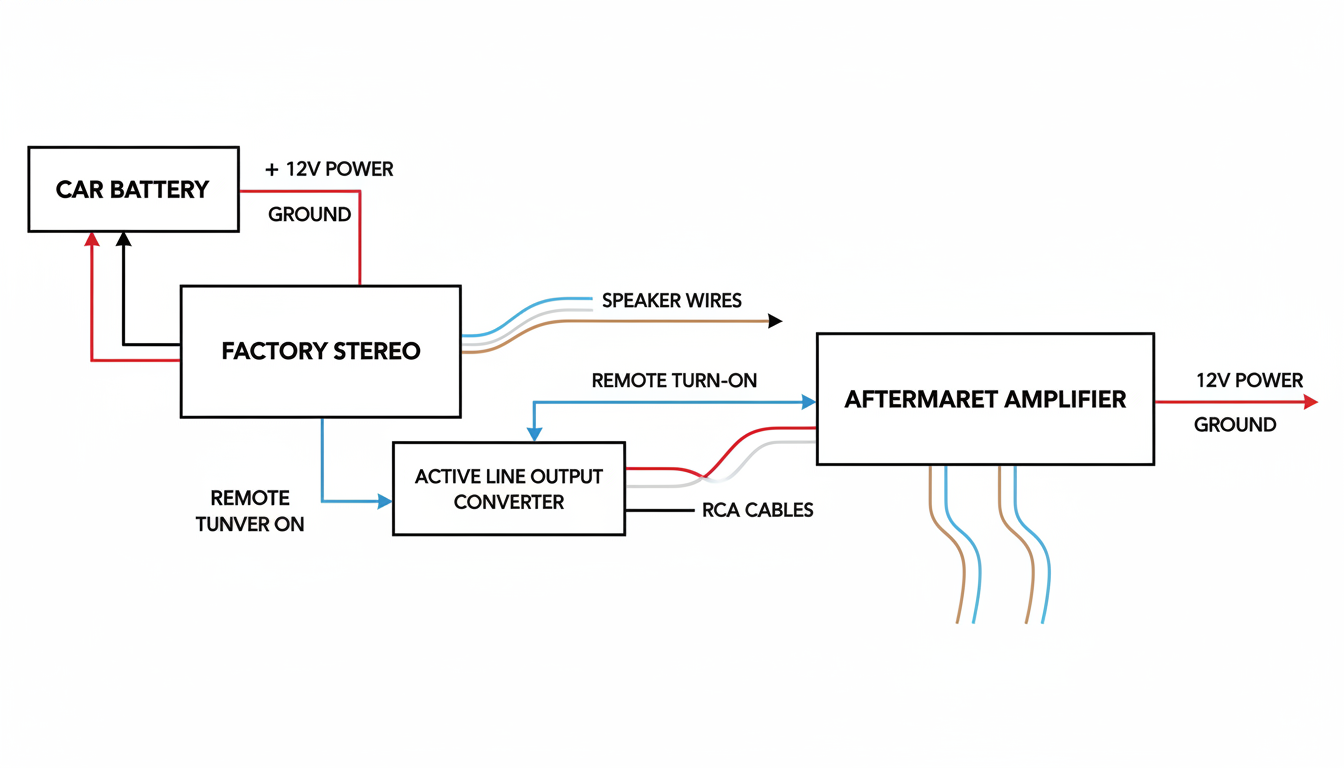
- Access the Speaker Wires: You need to tap into the speaker-level outputs from your factory stereo. The easiest place is usually right behind the head unit itself. You’ll need to find a wiring diagram for your specific vehicle online to identify the correct wire colors for front/rear and left/right speakers.
- Tap the Wires: Once identified, carefully tap into the positive and negative wires for each channel you’re using. While T-taps are quick, we’ve found that soldering and heat-shrinking the connections provides a far more reliable, noise-free connection for the long term.
- Connect to the LOC: Connect the speaker wires to the corresponding high-level inputs on your line converter. Pay close attention to polarity (+ and -).
- Power and Ground (Active LOCs Only): This is a critical step.
- Power: Connect the 12V power wire to a constant power source, like the power wire for your head unit or directly to the battery (with an inline fuse).
- Ground: Find a bare metal bolt connected to the car’s chassis. Scrape away any paint to ensure a solid metal-to-metal connection. According to car audio installation experts, a poor ground is the #1 cause of system noise.
- Connect RCA and Remote Wires: Run a quality pair of RCA cables from the LOC’s low-level outputs to your amplifier’s inputs. If your LOC has a remote output, run that wire to the remote input terminal on your amp.
- Set the Gains: This is crucial for sound quality. Start with the gain knobs on the LOC turned all the way down. Turn on your stereo and play a clean, dynamic music track you know well. Turn the head unit volume up to about 75% of its maximum. Now, slowly turn up the gain on the LOC until you hear the slightest hint of distortion, then back it off just a touch. You’ve now matched the output of the LOC to your stereo.
💡 Pro Tip: Finding Speaker Wires
Don’t have a wiring diagram? You can use a 9-volt battery to identify speaker wires. Disconnect the speaker and briefly tap the battery terminals to the wires. If you hear a static “pop” from the speaker, you’ve found a pair. This old-school trick has saved us hours in the workshop.
Troubleshooting Common LOC Problems (Like Engine Whine)
Even with a careful install, issues can pop up. Here’s how to tackle the most common ones.
- Problem: A high-pitched whine that changes with engine RPM.
Solution: This is classic alternator whine, and 99% of the time, it’s a bad ground. Re-check your ground connection for the LOC and the amplifier. Make sure it’s on a clean, paint-free chassis point. If the ground is solid, try routing your RCA cables away from the car’s main power wires. - Problem: No sound or the amp won’t turn on.
Solution: If you’re using a signal-sensing LOC, it might not be detecting a signal from your factory stereo, especially at low volumes. Some LOCs have a switch for DC offset or audio-based sensing; try the other setting. Also, double-check your 12V power, ground, and remote output connections with a multimeter. - Problem: The sound is distorted, even at low volumes.
Solution: Your gain structure is off. The gain on your line converter is likely set too high, sending a clipped signal to your amplifier. Repeat the gain-setting process (Step 6 above), ensuring you set the LOC gain first, then move on to setting the gain on your amplifier. For a deeper understanding of audio signals, the Wikipedia page on Line level provides excellent foundational knowledge.
⚠️ Watch Out: Don’t Blame the Box (Usually)
From real-world campaigns and countless installs, we can tell you that it’s rare for a quality line converter to be “bad” out of the box. Before you blame the hardware, meticulously re-check your wiring, especially the ground connection. A simple mistake here is the root of most noise and performance issues.
❓ Frequently Asked Questions
Do I need a line converter if my amp has high-level inputs?
While many amps have this feature, a dedicated active line converter is almost always better. It provides a cleaner, more powerful signal and offers crucial features like bass restoration and signal summing that the amp’s built-in converter lacks. For the best possible sound, a separate, high-quality LOC is the way to go.
Can a cheap line converter make my system sound bad?
Absolutely. A cheap passive LOC can introduce noise, limit frequency response (especially bass), and struggle to handle the power from some factory systems, leading to distortion. As the experts at Crutchfield emphasize, a clean signal is the foundation of good sound, and a quality LOC is what provides it.
Where is the best place to install a line converter?
Ideally, install it as close to the signal source (the factory stereo) as possible to keep the high-level speaker wire runs short, which minimizes the chance of picking up noise. Behind the dashboard or in the glove box are common, accessible spots. Keep it away from sources of heat or moisture.
Does an active line converter drain the car battery?
No. An active LOC is designed to turn on and off with your stereo system, either via a remote input wire or its signal-sensing feature. When your car is off, its standby current draw is incredibly low (microamps) and will not drain a healthy battery.
What’s the difference between a line converter and a DSP?
A line converter’s primary job is to convert the signal type. A Digital Signal Processor (DSP) does this too, but also gives you powerful, granular control over the audio signal, including time alignment, detailed equalization for every channel, and crossover adjustments. An LOC is a necessary tool; a DSP is an audiophile’s ultimate tuning weapon.
Your Key to Unlocking Incredible Sound
The humble line converter is the unsung hero of modern car audio. It’s the one device that empowers you to build the sound system of your dreams while keeping the sophisticated, fully-integrated head unit you rely on every day.
You no longer have to settle for muddy, lifeless factory sound. By understanding the difference between passive and active models and choosing the one with the right features for your goals, you’re not just adding a component—you’re laying the foundation for a truly immersive and powerful listening experience.
So, take stock of your system, identify your needs, and invest in the right line converter. It’s the smartest first step you can take on the road to amazing sound.
Read Also:
- Watch Hurawatch Offline? Your 2026 Guide
- Convert TIFF to PDF: 5 Pro Methods for Flawless Results (2026)
- Supercharge Your Links in 2026
- 12 Expert Tips to Master Any Online Converter Tool for Maximum Efficiency – Visual Story
- Blogs
- Collage Hacks for Viral Visuals in 2026
- Hack Your Habits: The 2026 Guide

