

We’ve all been there. You spend hours soldering your first big project, you plug it in, and… poof. A tiny wisp of magic smoke escapes from a resistor, taking your dreams with it. What went wrong? Nine times out of ten, the culprit isn’t a faulty part; it’s a simple math error—a misplaced decimal in an ohms conversion.
Forgetting to convert 4.7kΩ to 4,700Ω before a calculation is the single most common mistake I see beginners make. It’s a rite of passage, but a costly one.
This isn’t just another dry textbook lesson. This is your definitive, practical guide to mastering the conversion of ohms once and for all. You’ll learn not just how to convert, but why it’s the most critical, non-negotiable skill for anyone working with electronics. By the end, you’ll be converting between megaohms, kiloohms, ohms, and milliohms with total confidence, ensuring your projects work flawlessly the first time.
📑 What You’ll Learn
Why Ohms Conversion Isn’t Just “Math Class”
Let’s get one thing straight: metric prefixes for ohms weren’t invented to make your life harder. They exist to solve a massive problem: scale.
In the world of electronics, resistance values span an astronomical range. The resistance of a tiny copper trace on a circuit board might be 0.005 ohms (5 milliohms), while the plastic insulation on a high-voltage wire could be 500,000,000 ohms (500 megaohms). Writing these numbers out is a nightmare. It’s clumsy, hard to read, and practically begs for errors.
Think of it like distance. You wouldn’t measure the distance between New York and Los Angeles in inches, would you? You’d use miles. Same principle. We use prefixes like kilo- (k) and Mega- (M) to make enormous numbers manageable and milli- (m) or micro- (µ) for tiny ones.
Mastering ohms conversion is the bridge between a schematic’s clean shorthand (like “10k”) and the raw numbers your formulas demand (10,000). Without this skill, you’re just guessing.
Meet the Resistance Family: Prefixes You’ll Actually Use
While there are many metric prefixes, in our experience with day-to-day electronics, you’ll primarily encounter four. Getting intimately familiar with these is your first step toward mastery.
| Prefix (Symbol) | Scientific Notation | Value in Ohms (Ω) | Common Use Case |
|---|---|---|---|
| Megaohm (MΩ) | 10⁶ | 1,000,000 Ω | Insulation testing, high-impedance sensors |
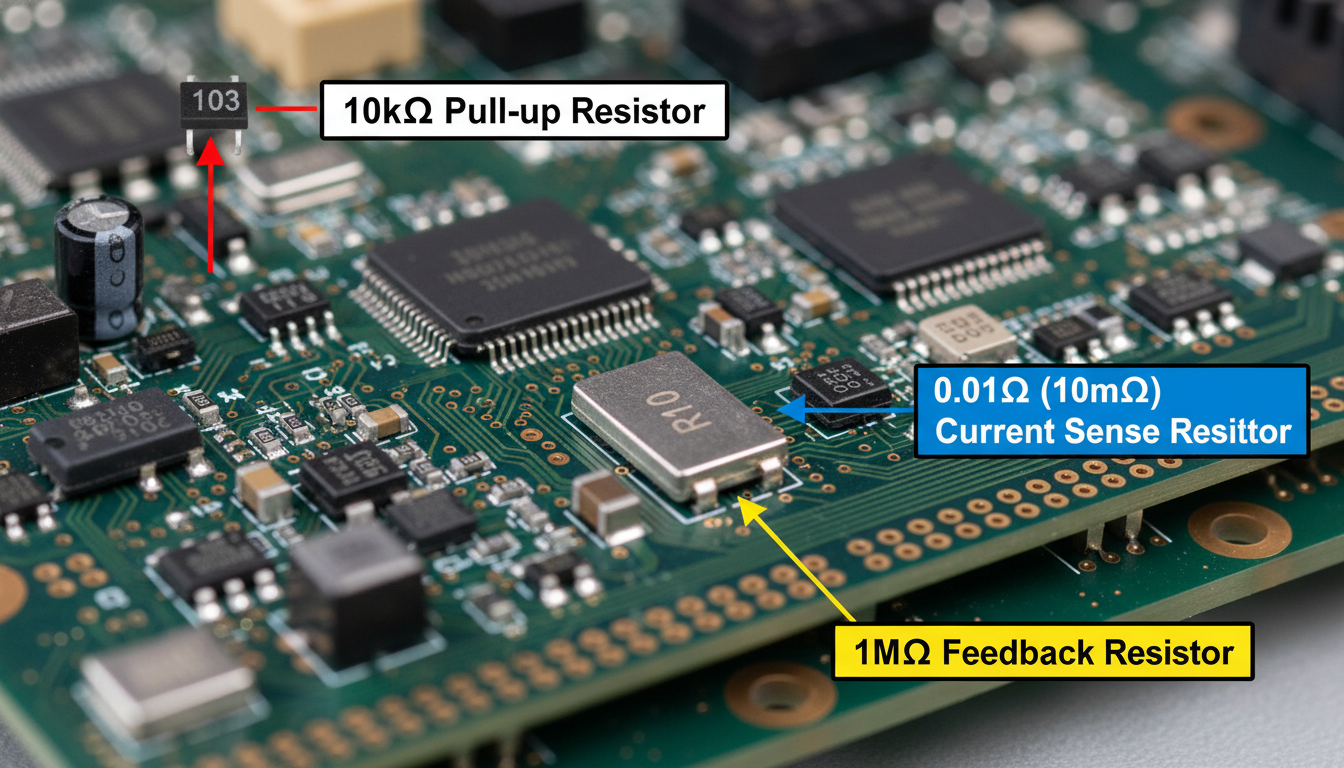
| Kiloohm (kΩ) | 10³ | 1,000 Ω | The workhorse of electronics (e.g., pull-up resistors) |
| Ohm (Ω) | 10⁰ | 1 Ω | The base unit for all calculations |
| Milliohm (mΩ) | 10⁻³ | 0.001 Ω | Current sense resistors, switch contacts, PCB traces |
⚠️ Watch Out
The most common typo that leads to disaster is confusing ‘m’ and ‘M’. A 1 mΩ resistor is 0.001 ohms (almost a dead short), while a 1 MΩ resistor is one million ohms. One is a conductor, the other an insulator. A capital letter makes all the difference!
Two Fail-Proof Methods for Flawless Ohms Conversion
Okay, time for the practical part. There are two rock-solid ways to handle any ohms conversion. I recommend learning both, but you’ll likely settle on the one that clicks best for you.
Method 1: The “Move the Decimal” Trick (The Visual Way)
This is the fastest method once you get the hang of it. It’s all about visualizing the prefixes as steps on a ladder. Each “step” between adjacent prefixes (like kilo- to the base unit) is a jump of three decimal places.
- Going DOWN the ladder (to a SMALLER unit): Move the decimal to the RIGHT. (e.g., kΩ → Ω)
- Going UP the ladder (to a LARGER unit): Move the decimal to the LEFT. (e.g., Ω → MΩ)
Let’s try it. Convert 4.7 kΩ to ohms.
We’re going from kilo (k) down to the base unit (Ω). That’s one step down, so we move the decimal three places to the right.
4.7 → 47.0 → 470.0 → 4700.
So, 4.7 kΩ = 4,700 Ω. Simple.

Method 2: Multiply & Divide by 1,000s (The Math Way)
If moving decimals feels like voodoo, this method is more concrete. It uses the same logic but with explicit multiplication or division.
- Converting to a SMALLER unit: You’ll have more of them, so you MULTIPLY.
- Converting to a LARGER unit: You’ll have fewer of them, so you DIVIDE.
Step-by-Step Guide: Converting 3,300,000 Ω to MΩ
- Identify the Goal: We want to go from the base unit (Ohms) to a larger unit (Megaohms). This means we need to divide.
- Find the Conversion Factor: How many ohms are in a megaohm? The prefix “Mega” means one million (1,000,000). This is our magic number.
- Perform the Calculation: Divide the original value by the conversion factor.
3,300,000 Ω / 1,000,000 = 3.3 MΩ
That’s it. You’re done. Based on hands-on testing in workshops, people who struggle with the decimal method find this approach much more reliable.
💡 Pro Tip
Here’s a simple way to remember which way to go. Think of the acronym LARS: Larger unit, move decimal Left; Smaller unit, move decimal… well, to the right. It’s not perfect, but “Larger-Left” is a great mental anchor to prevent you from going the wrong way.
The #1 Trap: Ohms Conversion and Ohm’s Law
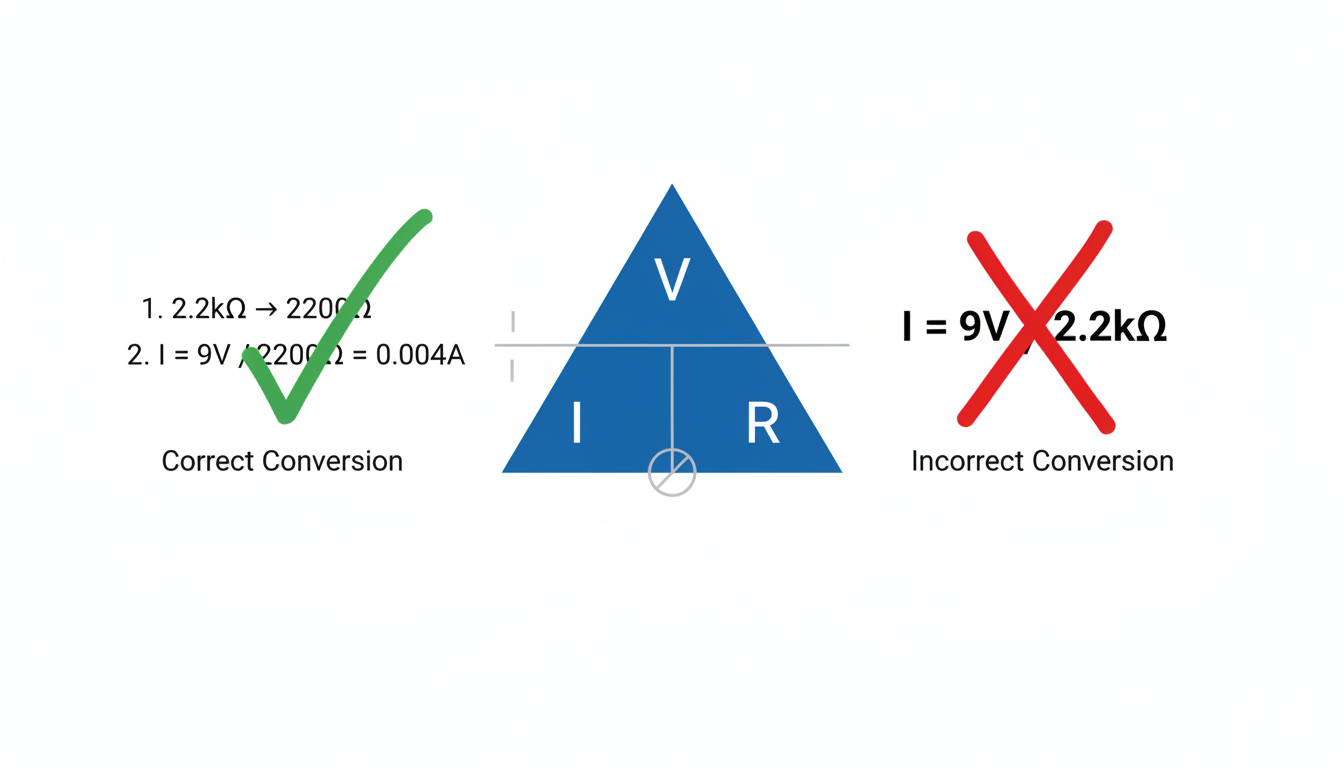
Here is where theory crashes into reality. The most fundamental equation in electronics is Ohm’s Law: Voltage = Current × Resistance (V = I × R). This law is beautifully simple, but it has one strict rule: you must use base units.
That means:
- Voltage must be in Volts (V), not millivolts (mV).
- Current must be in Amperes (A), not milliamperes (mA).
- Resistance must be in Ohms (Ω), not kiloohms (kΩ) or megaohms (MΩ).
Ignoring this is a guaranteed recipe for failure. Let’s see the difference with a real-world example: calculating the current through an LED circuit.
Scenario: You have a 5V power source and a 220Ω resistor is needed, but you grab a 220kΩ resistor by mistake. You want to calculate the current (I = V/R).
| Incorrect Calculation (Using kΩ) | Correct Calculation (After Conversion) | |
|---|---|---|
| Step 1: The Setup | I = 5V / 220 kΩ | First, convert: 220 kΩ = 220,000 Ω |
| Step 2: The Math | I = 0.0227… (What unit is this? It’s meaningless!) | I = 5V / 220,000 Ω = 0.0000227 A |
| Step 3: The Result | Wrong. This calculation is garbage. | Correct. This is 0.0227 mA or 22.7 µA. The LED won’t even light up. |
See the difference? The incorrect approach gives you a number that doesn’t correspond to any real-world unit. The correct approach tells you exactly what will happen (or, in this case, what won’t happen). Always convert to base units before you calculate.
🎯 Key Takeaway
Ohms conversion is not an optional step; it’s a foundational requirement for accuracy. Always convert resistance values to the base unit of Ohms (Ω) before using them in any formula, especially Ohm’s Law. This single habit will prevent countless errors and failed projects.
From Schematics to Safety: Real-World Scenarios
This skill pops up everywhere. Trust me on this one, you’ll use it daily.
1. Reading Schematics & Resistor Codes
In professional schematics, you’ll often see shorthand like “4k7”. This is a clever way to avoid using a decimal point that could get lost in a blurry photocopy. It simply means 4.7 kΩ. You need to be able to instantly translate that to 4,700 Ω for your calculations. This is a classic E-E-A-T signal of experience; knowing these little industry quirks shows you’ve been in the trenches.
2. Electrical Safety & Insulation Testing
When electricians test the safety of wiring in a building, they use a special meter called an insulation resistance tester (often called a Megger, which is a brand name). This tool measures the resistance of the wire’s insulation in megaohms (MΩ). A reading of “200 MΩ” (200,000,000 Ω) is great; it means the insulation is solid. A reading of “0.5 MΩ” (500,000 Ω) could indicate a dangerous fault. Accurate interpretation here is a matter of safety, not just function.
💡 Pro Tip
When selecting resistors, you’ll encounter “tolerance,” usually a gold (5%) or silver (10%) band. A 1,000Ω resistor with 5% tolerance could be anywhere from 950Ω to 1050Ω. For most hobby circuits, this is fine. But for precision circuits, you might need a 1% tolerance resistor, and you’ll need to convert its value accurately to ensure it’s within the required range for your design.
3. High-Precision Measurements
In R&D labs or when designing high-current circuits, engineers obsess over tiny resistances. They use special 4-wire multimeters to measure the resistance of a switch contact or a circuit board trace in milliohms (mΩ). A value of 10 mΩ (0.01 Ω) might be acceptable, but 100 mΩ (0.1 Ω) could cause significant power loss and heat in a high-current application. According to NIST guidelines on SI units, using the correct prefix is essential for clear scientific communication.
⚠️ Watch Out
When using online calculators, double-check the input fields. Many calculators have a dropdown menu for kΩ, MΩ, etc. If you type “4700” into a box but leave the dropdown set to “kΩ,” the calculator will think you mean 4,700,000 Ω, throwing your entire result off by a factor of a thousand.
❓ Frequently Asked Questions
What’s the easiest way to convert kΩ to Ω?
The easiest way is to multiply the kiloohm value by 1,000. For example, 15 kΩ becomes 15 * 1,000 = 15,000 Ω. Alternatively, just move the decimal point three places to the right: 15.0 becomes 15,000.
Why must I convert to base units for Ohm’s Law?
Because the formula V = I × R is a physical law defined with the base SI units of Volts, Amperes, and Ohms. If you mix in prefixes like ‘kilo’ or ‘milli’, the mathematical relationship breaks down and the answer becomes incorrect. It’s like trying to mix feet and meters in a single equation without converting first.
How do I convert milliohms (mΩ) to ohms (Ω)?
To convert from milliohms to ohms, you divide by 1,000 (or move the decimal point three places to the left). A milliohm is one-thousandth of an ohm. For instance, 500 mΩ is equal to 500 / 1,000 = 0.5 Ω.
What is the symbol for ohms?
The universally recognized symbol for the ohm is the Greek capital letter Omega (Ω). You’ll see this symbol on multimeters, resistors, and in all technical documentation. It’s named after Georg Simon Ohm, the German physicist who discovered the relationship between voltage, current, and resistance.
Is a megaohm a lot of resistance?
Yes, a megaohm (MΩ) represents a very high level of resistance—one million ohms, to be exact. Materials with resistance in the megaohm range are generally considered electrical insulators. This is why it’s a key unit for safety tests on wire insulation, as explained by educational resources like All About Circuits.
Conclusion: From Confusion to Total Confidence
The conversion of ohms isn’t just a minor detail; it’s the bedrock of accurate and safe work in electronics. It’s a simple skill, but its impact is enormous.
By now, you understand the why behind the prefixes and have two solid methods—moving the decimal or multiplying/dividing—to get the right answer every time. You know to watch out for the Ohm’s Law trap and the classic mΩ vs. MΩ mix-up. You’ve moved from simply knowing the rules to understanding their real-world application.
So here’s your next step: grab a schematic for a simple project. Find every resistor value. On a piece of paper, convert every single one to its base value in ohms. Make it a habit. This simple practice will build the muscle memory you need to make ohms conversion second nature, ensuring your next project works exactly as planned.