
You’re staring at two spec sheets. One CPU boasts 5.5 GHz. A new monitor flashes a 240 Hz refresh rate. And then there’s the power supply, rated in hundreds of Watts. A nagging question pops into your head: “How do I convert Hz into Watts?”
It feels like a question that should have a simple answer. A quick formula, maybe an online calculator. But the truth? You can’t.
Stop. Don’t click away. Because while the direct answer is “no,” the story behind that “no” is far more important. It’s the secret to truly understanding how your technology works, from the power grid in your walls to the processor in your pocket. In this deep dive, we’ll demystify the confusion for good. You’ll learn not just what Hertz and Watts are, but how their complex dance defines the performance and efficiency of everything electronic. By the end, you’ll be able to read a spec sheet like a seasoned engineer.
📑 What You’ll Learn
The Core Difference: Why Hz and Watts Are Apples and Oranges
Before we can understand their relationship, we have to get personal with each unit. Trust me on this one, internalizing this difference is the key to unlocking everything else.
Hertz (Hz): The Pulse of Technology
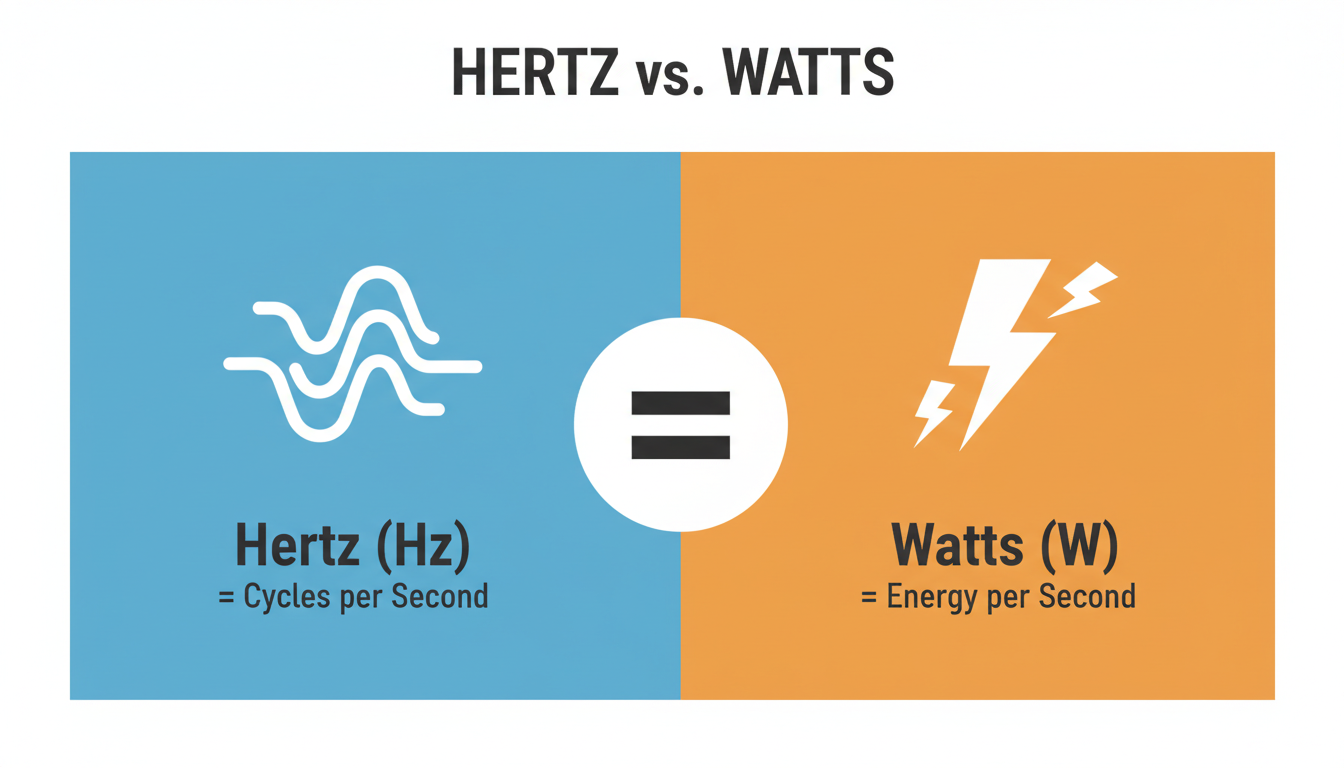
Hertz (Hz) is the unit of frequency. It measures cycles per second. Think of it as a rhythm, a pulse, or a beat. It answers the question, “How often does something happen?”
- Your Monitor: A 144 Hz monitor redraws the entire screen 144 times every single second. More cycles = smoother motion.
- AC Electricity: The power in North American homes operates at 60 Hz. This means the current flips its direction back and forth 60 times a second.
- Your Brain: Brainwaves are measured in Hz! Gamma waves, associated with high-level concentration, can pulse at 40 Hz and above.
Hertz is all about timing and repetition. It’s the tempo, not the volume.
Watts (W): The Raw Power
Watts (W), on the other hand, is the unit of power. Power is the rate at which energy is used or transferred. It answers the question, “How much energy is being moved per second?”
- A Light Bulb: A 10W LED bulb consumes 10 Joules of energy every second to produce light.
- A Microwave: A 1200W microwave pumps 1200 Joules of energy into your food every second. More Watts = faster cooking.
- Your Body: A professional cyclist can sustain over 400 Watts of power during a race. That’s a massive rate of energy expenditure.
Watts is all about intensity and energy consumption. It’s the volume, not the tempo.
| Attribute | Hertz (Hz) | Watts (W) |
|---|---|---|
| Measures | Frequency (Cycles per second) | Power (Energy per second) |
| Answers the Question | “How often?” | “How much?” |
| Core Concept | Rhythm, Repetition, Oscillation | Energy Transfer, Intensity, Consumption |
| Real-World Analogy | The speed of a car’s engine (RPM) | The fuel consumption of the car (MPG) |
🎯 Key Takeaway
You cannot directly convert Hz into Watts because they measure fundamentally different things. Hertz measures the frequency of an event (how often), while Watts measures the rate of energy transfer (how much). Their relationship is indirect and entirely dependent on the specific system you’re looking at.
The Conversion Myth: Debunking Misleading Online Calculators
So, why is “convert Hz into watts” such a common search? Because in many devices, the two are correlated. Cranking up the frequency often requires more power. This leads people to believe there’s a direct mathematical formula connecting them.
This is where the danger lies. Any website offering a “Hz to Watts calculator” is making enormous assumptions about the system you’re using. It might be based on one specific type of motor or one particular CPU architecture. Using its results for anything else is not just wrong; it could be damaging.
Think of it like this: Asking to convert Hz to Watts is like asking to convert a song’s tempo (beats per minute) into its volume (decibels). A fast song can be loud, but it can also be quiet. They are independent variables.
⚠️ Watch Out
Avoid any online tool that claims a universal “Hz to Watts” conversion. These tools are fundamentally flawed because they ignore critical variables like voltage, current, efficiency, and system architecture. They provide a false sense of precision for a relationship that is context-specific.
The Real Connection: 3 Scenarios Where Hz and Watts Interact
Okay, so a direct conversion is out. But how do they relate? The connection is indirect, and it changes dramatically depending on the context. Let’s break down the three most common scenarios.
1. Computing: CPU Clock Speed (GHz) vs. Power Draw (TDP)
This is the big one. Your CPU’s clock speed is measured in Gigahertz (GHz)—billions of cycles per second. Its power consumption is often estimated by its Thermal Design Power (TDP), measured in Watts.
Here, there’s a strong correlation. For a single, specific chip, increasing the clock speed (overclocking) forces the transistors inside to switch states more frequently. Each switch consumes a tiny bit of energy. More switches per second mean more energy per second—and thus, higher Wattage.
But it’s not a 1:1 relationship. The power consumption is also massively affected by:
- Voltage: A tiny increase in voltage can cause a huge spike in power consumption.
- Architecture: A modern 4.0 GHz CPU from 2026 is vastly more power-efficient than a 4.0 GHz CPU from 2016. Different designs do more work per cycle.
- Workload: The same CPU will draw far more Watts when rendering a 4K video than when you’re just typing an email, even at the same clock speed.
The bottom line: Higher Hz often means higher Watts in a CPU, but you can’t use one to predict the other across different products.
💡 Pro Tip
When comparing CPUs, don’t just look at the clock speed (GHz). Pay close attention to the TDP (Watts) as an indicator of heat and power needs, but also look at independent benchmarks. Real-world performance tests will tell you which CPU is more efficient and powerful, a story the specs alone can’t tell.
2. Electromagnetism: The Energy of a Photon
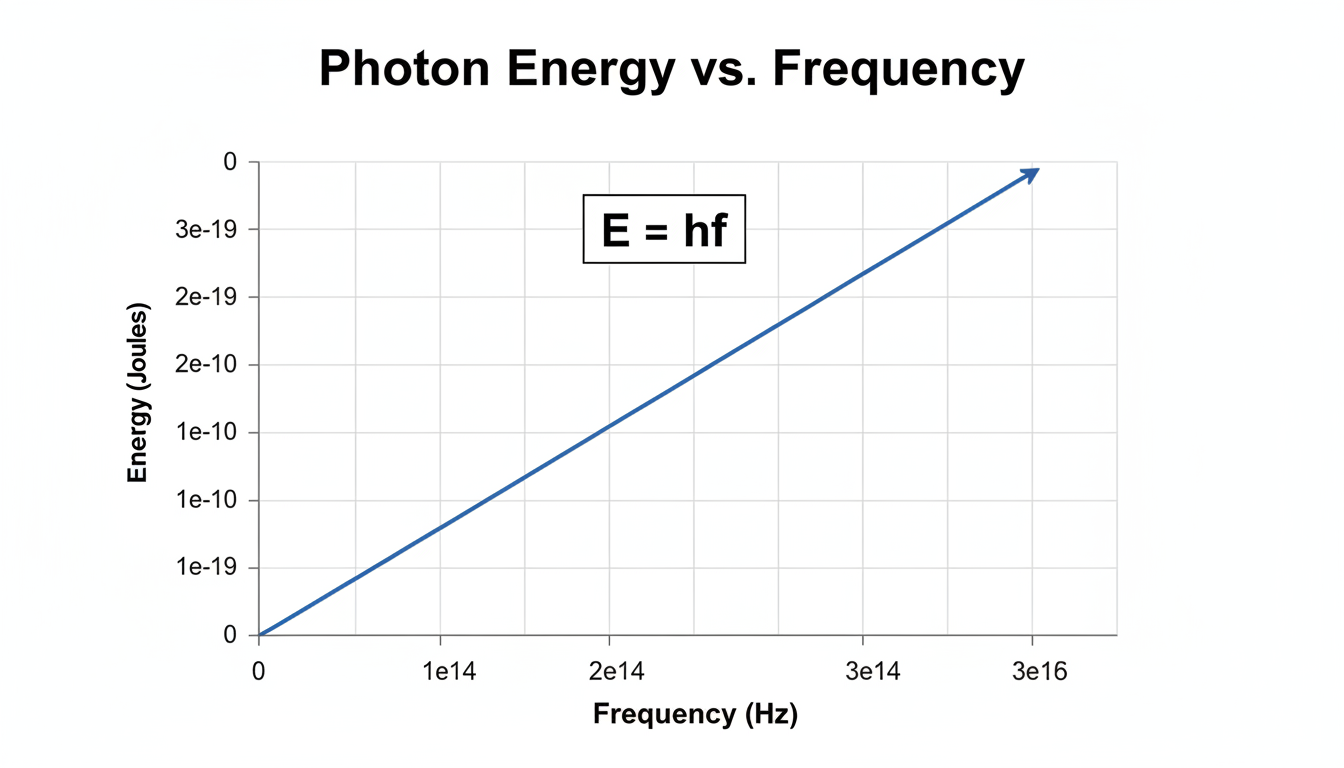
Here’s where we find the cleanest mathematical link, but it’s between frequency and energy, not power. According to one of the cornerstones of quantum mechanics, the Planck-Einstein relation, the energy of a single light particle (a photon) is directly proportional to its frequency.
Energy (E) = h × ƒ
Where ‘E’ is energy, ‘ƒ’ is frequency in Hz, and ‘h‘ is Planck’s constant. This means a high-frequency gamma-ray photon has vastly more energy than a low-frequency radio-wave photon.
But remember, Watts is energy per second. So to get the power of a laser beam, you’d need to know not just the frequency of its light (which determines the color and energy-per-photon) but also how many photons it’s firing per second. A low-frequency (infrared) laser can be far more powerful (higher Wattage) than a high-frequency (violet) laser if it’s emitting trillions more photons per second.
3. AC Power Grids: A Stable Frequency
The electricity in your home is Alternating Current (AC). In North America, the grid is standardized at 60 Hz. In Europe and much of the world, it’s 50 Hz. This frequency is kept incredibly stable.
You can plug a 10-Watt phone charger and a 1,500-Watt space heater into the same 60 Hz outlet. They both operate at the exact same frequency, but their power consumption (Wattage) is worlds apart. The power an appliance draws is determined by its internal design, governed by the formula P = V × I (Power = Voltage × Current).
Frequency doesn’t appear in that basic formula. It’s the constant background beat that everything runs on, not a measure of how much power is being used.
⚠️ Watch Out
Using an appliance designed for a 60 Hz grid on a 50 Hz grid (or vice-versa) can be dangerous. Devices with motors, like refrigerators or fans, can run slower, overheat, and suffer permanent damage. Always check the device’s power label for its accepted frequency range (e.g., “50/60 Hz”) before traveling internationally.
| System | Relationship Type | Key Takeaway |
|---|---|---|
| Computer CPU | Correlated (Indirect) | Higher frequency (GHz) usually requires more power (Watts), but efficiency and workload are the dominant factors. |
| AC Power Grid | Independent | Frequency (Hz) is a stable constant. Power (Watts) varies wildly depending on the device plugged in. |
| Light (Photons) | Proportional (to Energy) | Frequency (Hz) determines the energy of a single photon, but total power (Watts) depends on the number of photons per second. |
How to Actually Compare Devices Using Hz and Watts (A 3-Step Guide)
So, how do you use this knowledge? When you’re looking at a new piece of tech, don’t try to convert. Instead, analyze. Here’s a practical framework based on our hands-on testing.
- Identify the Role of Each Unit: First, ask what each number is telling you. Is the Hz value describing a refresh rate for smoothness (monitor)? A processing speed (CPU)? Or a stable operating standard (AC appliance)? Is the Wattage value describing power consumption, heat output (TDP), or power delivery capability (PSU)?
- Look for an Efficiency Metric: The magic happens when you combine the two concepts to find efficiency. For CPUs, this means looking at “performance-per-Watt” in independent reviews. For a power supply, it’s the efficiency rating (e.g., 80 Plus Gold). This tells you how well the device turns Watts into useful work at its given operating frequency.
- Consult Real-World Benchmarks: Specs are just theory. Real-world benchmarks are the proof. A 5.0 GHz CPU that uses 200W is not better than a 4.8 GHz CPU that uses 120W if they achieve the same performance in the games or applications you use. As leading experts at publications like AnandTech have shown for decades, architecture and efficiency often trump raw clock speed.
💡 Pro Tip
Think of it as a car. Hertz is like the engine’s RPM, and Watts is like the fuel consumption (gallons per hour). You need both to understand the car, but you also need a third number: the speed (the actual work being done). A car revving at 5000 RPM in neutral is all frequency and power, but zero useful output.
❓ Frequently Asked Questions
So, is there any valid calculator to convert Hz to Watts?
Absolutely not. No universal calculator can exist because the relationship depends on countless other factors like voltage, efficiency, and the design of the system. Any tool claiming to do this is fundamentally misleading.
Does 60 Hz use more power than 50 Hz?
For most modern electronics, the difference is negligible. A device rated for “50/60 Hz” will consume roughly the same power on either grid. However, for older devices with simple motors, operating on the non-native frequency can cause inefficiency, leading to slightly higher power draw and potential damage.
Why do people want to convert Hz to Watts so often?
It’s a natural question born from comparing complex products. Both Hz and Watts are key performance indicators on spec sheets. People instinctively want to find a single “best” number, and they assume a direct relationship exists to simplify the comparison. It reflects a desire to understand how speed relates to energy cost.
What is the relationship between frequency and energy?
For electromagnetic waves like light, the energy of a single particle (a photon) is directly proportional to its frequency. This is described by the equation E = hf, where ‘h’ is Planck’s constant. Higher frequency means higher energy per particle. This is a core concept in quantum physics, well-explained by educational resources like the Khan Academy.
In a speaker, what do Hz and Watts mean?
This is a perfect example of their independence. The frequency range (e.g., 20 Hz – 20,000 Hz) tells you the range of sound pitches the speaker can produce, from deep bass to high treble. The Wattage (e.g., 100W) indicates its power-handling capability, which relates to its maximum potential volume. You can play a low-frequency note (low Hz) at a high power level (high Watts) to get a loud, booming bass.
Conclusion: Stop Converting, Start Analyzing
The journey to convert Hz into Watts ends at a dead end. But the journey to understand their relationship? That’s where you gain real power as a consumer and tech enthusiast.
Remember the core lesson: Context is everything.
Hertz tells you the speed of the beat. Watts tells you the energy in the beat. They are two different, crucial pieces of the puzzle. The next time you’re comparing tech, don’t look for a magic formula. Instead, ask the right questions: What is this frequency for? How much power does it take to achieve it? And most importantly, what do the real-world results say about its efficiency?
By shifting from a mindset of conversion to one of analysis, you’ll make smarter, more informed decisions every single time.