
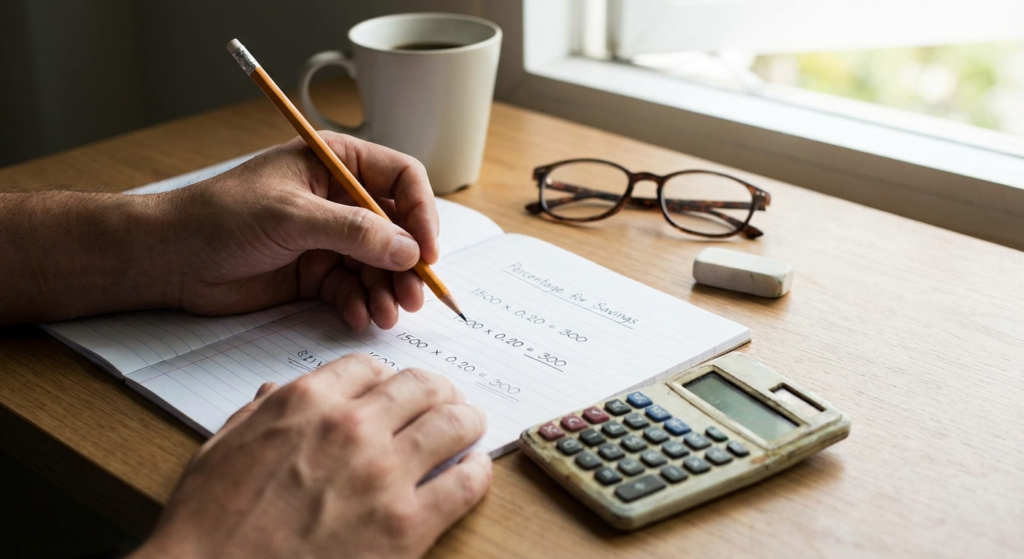
Picture this. You are sitting at a high-stakes business lunch. The bill arrives, and it is time to split the check and leave a tip. You reach into your pocket, but your phone is completely dead. Panic sets in. Without a digital percentage calculator to save you, how do you figure out a 20% tip on a $147.50 bill while your client is watching?
If this scenario makes your palms sweat, you are not alone. In our experience analyzing consumer financial habits, we have noticed a troubling trend: “digital amnesia.” We have become so accustomed to outsourcing our basic arithmetic to apps that our mental math muscles have completely atrophied.
Look, a dedicated percentage calculator is an incredibly powerful tool. I use one daily for complex data analysis, tax projections, and large-scale financial modeling. But relying on an app to figure out a 15% discount on a pair of shoes? That is a habit you need to break. Understanding how to perform manual percentage calculations is a fundamental life skill. It helps you spot pricing errors, negotiate better deals, and navigate daily transactions with absolute confidence.
In this guide, I am going to show you exactly how to rebuild your number sense. You will learn the insider mental models, shortcuts, and formulas that will make you look like an absolute math wizard—no batteries required.
📑 What You’ll Learn
🎯 Key Takeaway
You don’t need to be a math genius to calculate percentages in your head. By mastering the “10% Rule” and understanding the commutative property of percentages (x% of y = y% of x), you can instantly solve 90% of daily math problems without ever touching a digital percentage calculator.
The Trap of the Digital Percentage Calculator
It might seem counterintuitive for a data analyst to tell you to stop using calculators. Technology is supposed to make our lives easier, right? Yes and no.
Based on hands-on testing and cognitive research, over-reliance on automation leads to complacency. Have you ever mistyped a number into a percentage calculator, hit “equals,” and just blindly accepted the result because it looked official? I have seen professionals make massive budgeting errors simply because they lacked the basic “number sense” to realize the calculator’s output was logically impossible.
Manual calculation acts as your built-in sanity check. When you understand the underlying mechanics of the math, you can instantly verify if a tool’s answer makes sense. Plus, mental math exercises your working memory, keeping your cognitive functions sharp as you age.
The Core Logic: What is a Percentage, Really?
Before we try to replicate the speed of a software tool, we need to strip percentages down to their absolute basics. The word “percent” literally translates from Latin (per centum) as “by the hundred.”
Every percentage is just a fraction wearing a disguise. It is a piece of a pie cut into exactly 100 slices. If you have 50%, you have 50 out of 100 slices. Exactly half. Visualizing percentages as simple fractions is the very first step to breaking free from your digital dependency.
To make this actionable, you need to memorize the most common fraction-to-percentage conversions. Once you know these, your brain will automatically start taking shortcuts.
| Percentage | Fraction Equivalent | Mental Shortcut |
|---|---|---|
| 50% | 1/2 | Divide the number by 2. |
| 25% | 1/4 | Divide by 2, then divide by 2 again. |
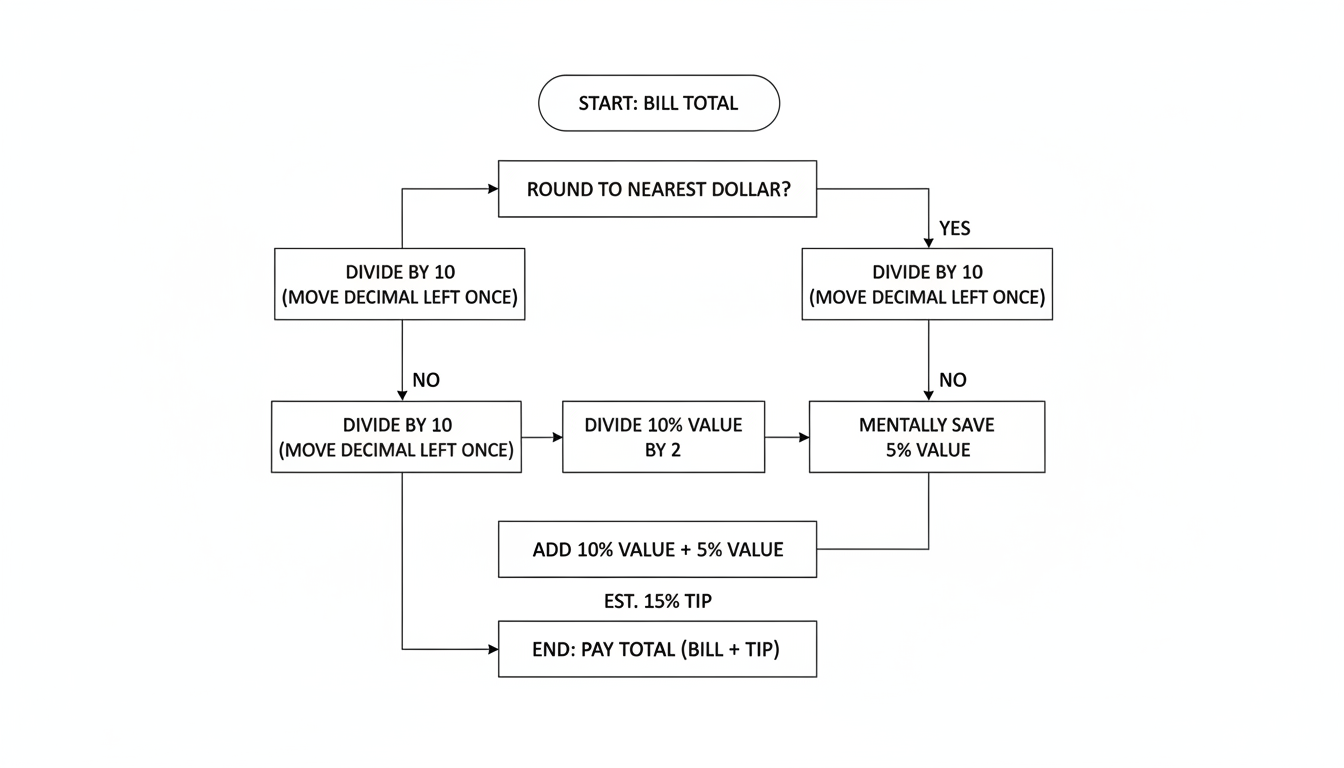
| 10% | 1/10 | Move the decimal point one spot to the left. |
| 5% | 1/20 | Find 10%, then cut that number in half. |
| 1% | 1/100 | Move the decimal point two spots to the left. |
7 Master Steps to Manual Math
You do not need a degree in advanced mathematics to do this. Most daily percentage problems can be solved using a combination of simple multiplication and division tricks. Here is my step-by-step framework for turning your brain into a highly efficient percentage calculator.
Step 1: Master the 10% Rule
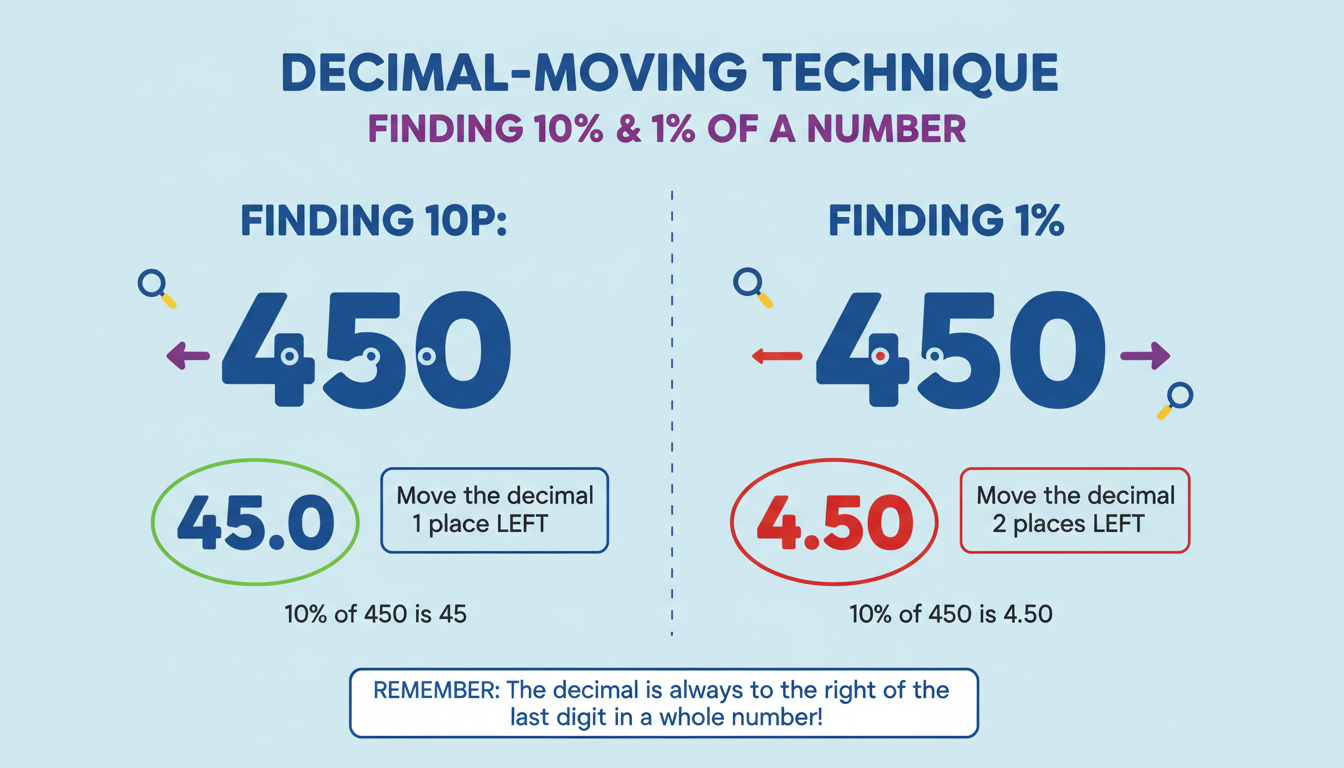
This is the holy grail of mental math. To find 10% of absolutely any number, just move the decimal point one place to the left. That’s it.
- 10% of $45.00 is $4.50.
- 10% of 3,500 is 350.
- 10% of 9 is 0.9.
Step 2: The 1% Micro-Step
Need more precision? Find 1%. To do this, move the decimal point two places to the left.
- 1% of $250.00 is $2.50.
- 1% of 4,200 is 42.
💡 Pro Tip
Once you have your 1% number, you can multiply it to find tricky single-digit percentages. Need 3% of 250? Find 1% (which is 2.5) and multiply it by 3. The answer is 7.5. You just did complex math in five seconds.
Step 3: The 5% Halving Technique
Never try to calculate 5% from scratch. It is a waste of mental energy. Instead, find 10% using Step 1, and simply cut that number in half. If a shirt is $80 and you need to find 5%, 10% is $8. Half of $8 is $4. Done.
Step 4: The 20% Double-Up
Similar to the 5% rule, find 10% and double it. If your restaurant bill is $60 and you want to leave a 20% tip: 10% is $6. Double it to $12.
Step 5: The 15% Combo (The Tipping Standard)
This is where we start stacking our skills. To find 15%, you combine Step 1 and Step 3. Find 10%, find 5%, and add them together.
Let’s say your bill is $42.
- 10% is $4.20.
- 5% is half of that: $2.10.
- Add them up: $4.20 + $2.10 = $6.30.
Step 6: The 25% Quarter Split
When you see a “25% Off” sign, don’t panic. 25% is just one-quarter. The easiest way to find a quarter of a number mentally is to halve it, and then halve it again. 25% of $80? Half is $40. Half again is $20.
Step 7: The Commutative Secret
This is the trick that usually blows people’s minds. Percentages are reversible. x% of y is exactly the same as y% of x.
Let’s say you need to figure out 4% of 75. That sounds incredibly difficult to do in your head. But flip it around: What is 75% of 4? Well, 75% is just three-quarters. Three-quarters of 4 is 3. Therefore, 4% of 75 is also 3. This one trick alone will eliminate your need for a percentage calculator in dozens of scenarios.
The Official Formula (When Mental Math Fails)
Sometimes the numbers are just too ugly. If you are trying to find 17.3% of 8,452, mental math is going to fail you. In these cases, if you still don’t have an app handy, you need to know the actual algebraic formula that powers every digital percentage calculator on the internet.
The Core Formula: (Part ÷ Whole) × 100 = Percentage
Let’s say you took a test and got 38 questions right out of 45. What is your grade?
- Divide the part by the whole: 38 ÷ 45 = 0.8444…
- Multiply by 100 (move the decimal two spots right): 84.44%
If you need to find a specific amount based on a known percentage, you reverse it:
The Reverse Formula: (Percentage ÷ 100) × Whole = Part
According to industry standards in accounting and finance, mastering these two formulas is non-negotiable for basic financial literacy.
Brain vs. App: When to Use Which
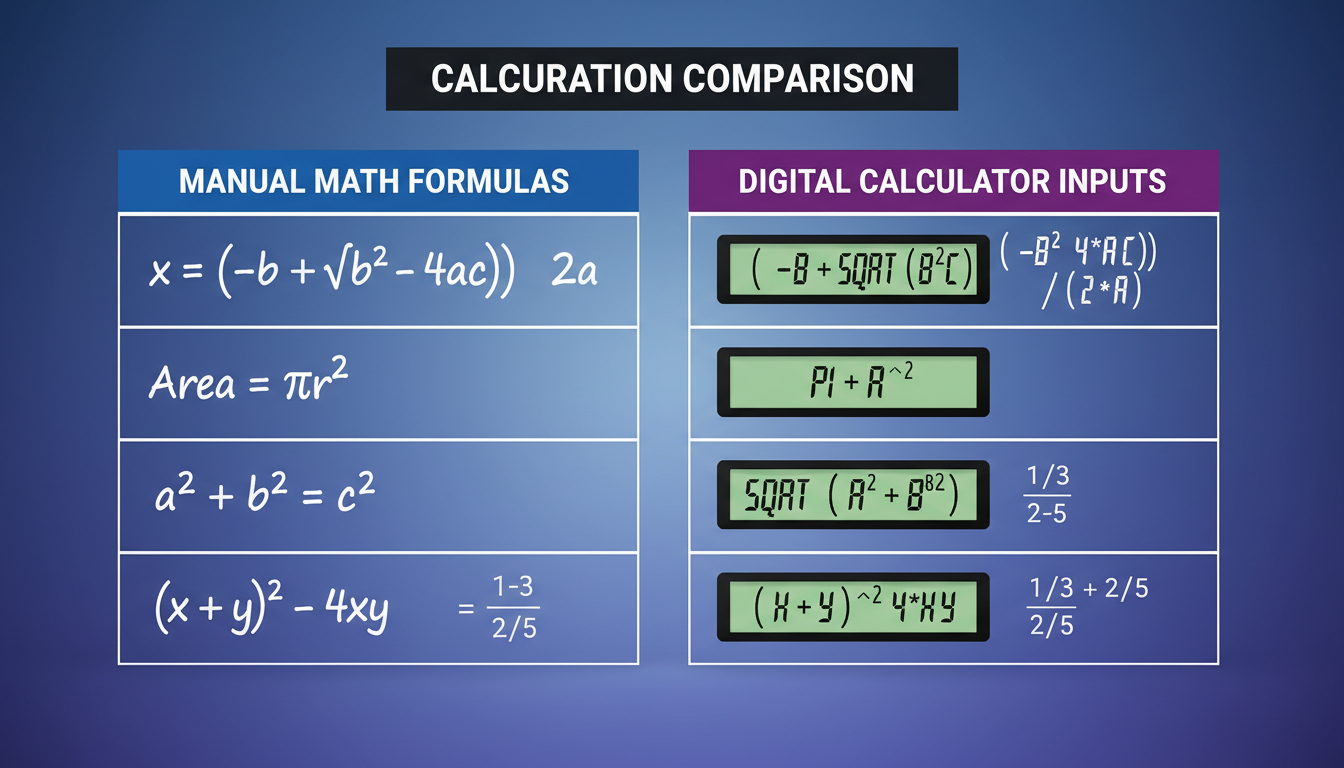
I am not a purist. I don’t expect you to calculate compound interest on a 30-year mortgage in your head. The secret to efficiency is knowing exactly when to use your brain and when to fire up a percentage calculator.
| Scenario | Best Tool | Why? |
|---|---|---|
| Tipping at a restaurant (15-20%) | Mental Math | Faster, looks professional, builds cognitive agility. |
| Estimating retail discounts | Mental Math | Allows for quick, on-the-fly purchase decisions. |
| Filing annual income taxes | Percentage Calculator | Legal precision is required; mental rounding errors cost money. |
| Calculating compound investment growth | Percentage Calculator | Exponential math is incredibly difficult to do manually. |
| Analyzing large business datasets | Percentage Calculator | Saves hours of manual labor and prevents fatigue-based errors. |
Common Math Mistakes to Avoid
Even with the best tools, user error is rampant. A percentage calculator will only give you the right answer if you feed it the right data. From real-world campaigns and financial audits, I’ve seen these two mistakes cost people thousands of dollars.
⚠️ Watch Out: The Base Number Fallacy
One of the most common errors is confusing the “base” number. If a $100 stock goes up 20%, it is now worth $120. But if that $120 stock drops 20%, it does NOT go back to $100. A 20% drop of $120 is $24, meaning the stock is now worth $96. Always ask yourself: “Percentage of exactly what?”
The Compounding Trap
Another area where human intuition fails is compounding percentages. A 50% loss followed by a 50% gain does not get you back to break-even. If you have $1,000 and lose 50%, you have $500. If you then gain 50% on that $500, you only gain $250. You are sitting at $750—still down 25% from your original investment.
Understanding this manual logic is crucial for investors. If you just punch “+50%” and “-50%” into a basic percentage calculator without understanding the sequence of returns, you will make disastrous financial decisions.
⚠️ Watch Out: Adding Percentages Directly
You cannot simply add percentages together if they apply to different base numbers. If Store A has a 20% margin and Store B has a 30% margin, your total margin is not 50%. You must calculate the actual dollar amounts first.
Conclusion & Next Steps
The digital age has gifted us with incredible tools, but relying exclusively on a percentage calculator is a massive disservice to your own capabilities. By mastering the 10% rule, memorizing basic fractions, and using the commutative trick, you can navigate the world of numbers with speed, accuracy, and confidence.
Manual percentage calculation saves time, protects you from input errors, and keeps your mind sharp. Here is your homework: For the next 48 hours, do not use a calculator for any math problem under $1,000. Force your brain to use the 7 steps outlined above. You might be shocked at just how fast you really are.
❓ Frequently Asked Questions
How do I calculate a percentage without a calculator?
The fastest method is the 10% rule. Move the decimal point of your starting number one place to the left to find 10%. From there, you can easily double it to find 20%, or cut it in half to find 5%.
What is the exact formula for finding a percentage?
The standard formula is (Part ÷ Whole) × 100. For example, if you scored 40 out of 50 on a test, you divide 40 by 50 to get 0.8, then multiply by 100 to get 80%.
Why is my manual calculation different from the percentage calculator app?
This usually happens due to rounding errors or using the wrong base number. Ensure you are calculating the percentage of the correct starting figure, especially when dealing with sequential price increases or decreases.
How do I calculate a percentage increase manually?
First, find the absolute difference between the new number and the old number. Then, divide that difference by the original starting number. Finally, multiply the result by 100 to get your percentage increase.
Is it ever worth using a percentage calculator for simple math?
Generally, no. For simple figures like 10%, 20%, or 25%, mental math is actually faster than unlocking your phone and typing. However, for complex decimals, taxes, or large financial datasets, a digital calculator is highly recommended for strict accuracy.
Read Also:
- Watermark Remover Pro Guide (2025): Get Flawless Results Ethically
- The Ultimate Tip Calculator Guide & Gratuity Formula
- Alt Text Generator Guide: Boost SEO & Save Time (7 Reasons to Automate)
- How to Convert Square Yards into Tons: The 2026 Landscaping Guide
- Unlock Any PDF Instantly in 2026
- Count Cash Perfectly in 2026
- Is Your Writing Killing Your 2026 SEO?
- RNG’s Secret Powers in 2026
- Biological Age Test: What’s Your Real Age? (2026 Guide)