
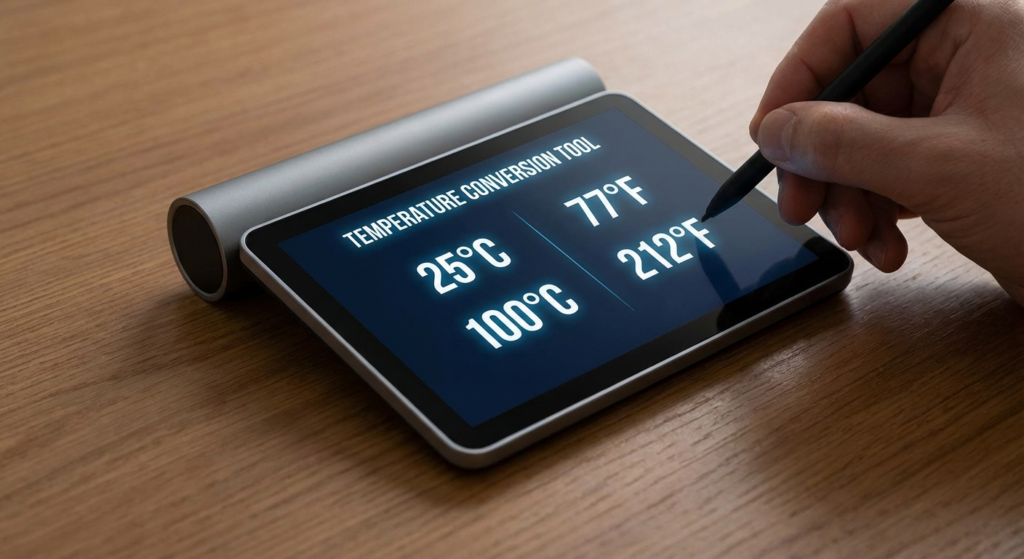
Have you ever tried to follow an international recipe only to find the oven settings confusing? Or perhaps you are planning a trip abroad and cannot decide whether packing a heavy coat or a light jacket is appropriate because the weather forecast uses a different scale? This is where a reliable Temperature Converter becomes an indispensable tool in your digital arsenal. Temperature is a fundamental physical quantity that affects nearly every aspect of our lives, from the comfort of our homes to critical scientific research.
Despite the world becoming increasingly connected, we still rely on different systems to measure heat. The United States clings to Fahrenheit, most of the world utilizes Celsius, and the scientific community operates on Kelvin. Navigating these differences without a proper Temperature Converter can lead to burnt dinners, uncomfortable travel experiences, or even critical errors in laboratory settings.
In this comprehensive guide, we will explore the history of these scales, the mathematics behind the conversions, and why using a digital Temperature Converter is often safer and faster than doing the math in your head.
Understanding the Need for a Temperature Converter
Temperature is more than just a number on a weather app; it is a measurement of the average kinetic energy of the particles in a substance. However, how we interpret that energy depends entirely on the scale we use. A Temperature Converter bridges the gap between these distinct systems, allowing for seamless communication and understanding across borders and disciplines.
When you use a Temperature Converter, you are essentially translating a language of thermodynamics. Just as you would translate English to Spanish to communicate, you convert Celsius to Fahrenheit to understand the environment. Without this conversion, “30 degrees” could mean a pleasant summer day (Celsius) or freezing cold weather (Fahrenheit).
The Celsius Scale
Used by: Almost every country worldwide.
Basics: Water freezes at 0°C and boils at 100°C.
Best For: Daily weather, cooking, and general science.
The Fahrenheit Scale
Used by: United States, Bahamas, Cayman Islands.
Basics: Water freezes at 32°F and boils at 212°F.
Best For: Precise air temperature sensitivity for humans.
The Kelvin Scale
Used by: Physicists and Chemists.
Basics: Starts at Absolute Zero (0 K). No negative numbers.
Best For: Scientific calculations and thermodynamics.
The History Behind the Scales
To appreciate the utility of a Temperature Converter, it helps to understand the origins of the scales. Anders Celsius, a Swedish astronomer, created the centigrade scale in 1742. Interestingly, his original scale was reversed, with 0 as the boiling point and 100 as the freezing point. It was later flipped to the metric-friendly version we know today.
On the other hand, Daniel Gabriel Fahrenheit developed his scale in 1724 based on a brine solution. This historical divergence is why we face the confusion today. While Celsius fits perfectly with the metric system (0 to 100), Fahrenheit offers a broader range of integers for ambient air temperature, which some argue makes it more intuitive for human comfort. Regardless of which you prefer, the modern world requires us to be fluent in both, usually via a Temperature Converter.
Why Accuracy Matters in a Temperature Converter
In many scenarios, a rough estimate is acceptable. Knowing that 20°C is roughly 68°F is enough for deciding what to wear. However, there are specific sectors where precision is non-negotiable, and a high-precision Temperature Converter is required.
Culinary Perfection
Baking is chemistry. The difference between a soft cookie and a burnt puck can be a matter of degrees. Many professional recipes are written in Celsius (common in Europe), while American appliances use Fahrenheit. Using a precise Temperature Converter ensures your oven is set to the exact degree required for the chemical reactions to occur properly.
Medical Applications
In healthcare, body temperature is a critical vital sign. A fever of 38°C indicates infection, but if a parent reads a thermometer incorrectly or fails to convert it to Fahrenheit for a doctor who uses that scale, it could lead to confusion. Medical professionals rely on standard conversions to ensure patient safety.
Scientific Research
For students and researchers, the Kelvin scale is king. Unlike Celsius and Fahrenheit, Kelvin is not measured in “degrees” but in units. It is an absolute scale. A scientific Temperature Converter is essential for converting experimental data into Kelvin to perform thermodynamic calculations, where negative numbers (found in C and F) would break the mathematical formulas.
Formulas: How a Temperature Converter Works
While online tools are convenient, understanding the math behind the tool empowers you. Here is the logic that powers every digital Temperature Converter.
Celsius to Fahrenheit
Multiply by 1.8 (or 9/5) and add 32.
Formula: (°C × 9/5) + 32 = °F
Fahrenheit to Celsius
Subtract 32 and multiply by 0.5556 (or 5/9).
Formula: (°F − 32) × 5/9 = °C
Celsius to Kelvin
Simply add 273.15 to the Celsius value.
Formula: °C + 273.15 = K
It is evident that while the math isn’t impossible, it is cumbersome to do mentally, especially with decimals. This complexity highlights why a digital Temperature Converter is so popular—it eliminates human error and provides instant results.
Choosing the Right Online Temperature Converter
Not all online tools are created equal. When selecting a converter, you want speed, accuracy, and a user-friendly interface. Just as you would research how to choose online tools for other tasks, you should look for specific features in a temperature tool.
- Decimal Precision: Does the tool round off numbers? For science, you need decimal points; for weather, integers are fine.
- Instant Calculation: The best tools convert as you type, saving you from clicking “submit” buttons repeatedly.
- Mobile Responsiveness: You are likely using the converter on your phone while cooking or traveling.
- Multi-Scale Support: A robust Temperature Converter should handle Kelvin, Rankine, and Newton scales, not just C and F.
Global Implications and Travel
Traveling exposes you to the reality of the “Temperature Divide.” If you travel from the US to Europe, or vice versa, you will immediately encounter this hurdle. A hotel thermostat in London set to 21 might feel broken to an American expecting 70, until they realize 21°C is a comfortable 70°F.
For digital nomads and remote workers, understanding local metrics is part of the adaptation process. Just as you might use a tool for managing time zones and measurements, keeping a conversion tab open helps you dress appropriately and plan your day effectively in a new environment.
Advanced Uses: The Kelvin Scale in Depth
While Celsius and Fahrenheit dominate daily life, the Temperature Converter finds its most rigorous use in the scientific community through the Kelvin scale. The Kelvin scale is the primary unit of temperature measurement in the physical sciences.
Why No Degrees?
You will notice a Temperature Converter output for Kelvin does not use the degree symbol (°). This is because Kelvin is an absolute unit of measurement derived from absolute zero, the theoretical point where all molecular motion stops. Understanding this conversion is crucial for fields ranging from cryogenics to astronomy.
According to the National Institute of Standards and Technology (NIST), the definition of the Kelvin has recently been refined to be based on the Boltzmann constant, linking it directly to energy. This makes accurate conversion tools even more vital for students and professionals to ensure their data aligns with international standards.
Common Myths About Temperature
There are several misconceptions regarding temperature that a good Temperature Converter can help clarify.
- Myth: Fahrenheit is less accurate than Celsius.
Fact: Neither is “more accurate.” Fahrenheit actually has smaller degrees (1.8°F = 1°C), which allows for more precise integer descriptions of air temperature without using decimals. - Myth: 0°F is the coldest possible temperature.
Fact: 0°F is simply the temperature of a specific brine solution Fahrenheit used. Absolute zero is -459.67°F. - Myth: You can feel a 1-degree difference.
Fact: Most humans cannot detect a change of 1 degree Fahrenheit, and certainly not 1 degree Celsius, without a thermometer.
The Future of Measurement
Will the world ever unite under one scale? It is unlikely in the near future. The United States is deeply entrenched in the Imperial system for daily life, while the rest of the world and the scientific community stand by Metric/SI units. This dichotomy guarantees that the Temperature Converter will remain a necessary utility for generations to come.
For further reading on the fascinating history and standardization of these scales, resources like Encyclopedia Britannica offer deep dives into how humanity learned to quantify heat.
Conclusion
Whether you are a master chef perfecting a soufflé, a student calculating thermodynamic variance, or a traveler trying to pack the right clothes, understanding temperature scales is essential. While the math exists to convert these figures manually, it is prone to error and time-consuming.
A digital Temperature Converter is not just a convenience; it is a bridge between cultures, sciences, and industries. By utilizing these tools, we ensure precision, safety, and comfort in our daily lives. So, the next time you see a temperature reading that doesn’t make sense, don’t guess—convert it.
FAQs
For a rough estimate without a digital Temperature Converter, multiply the Celsius temperature by 2 and add 30. For example, 20°C × 2 = 40, plus 30 = 70°F. The actual answer is 68°F, so this method gets you very close for weather purposes.
Scientists use Kelvin because it is an absolute scale starting at absolute zero. This means there are no negative numbers, which simplifies calculations in physics and chemistry regarding gas laws and energy.
Yes, this is the unique crossover point where the two scales intersect. -40°C is exactly equal to -40°F. If you plug -40 into a Temperature Converter, the output will be identical.
Most reputable online tools are extremely accurate, calculating to many decimal places. However, for critical scientific work, ensure the tool uses the standard formulas provided by NIST.
Absolutely. Cooking is one of the most common uses for these tools. Converting 350°F to roughly 175°C or 180°C is essential for following international recipes correctly.