
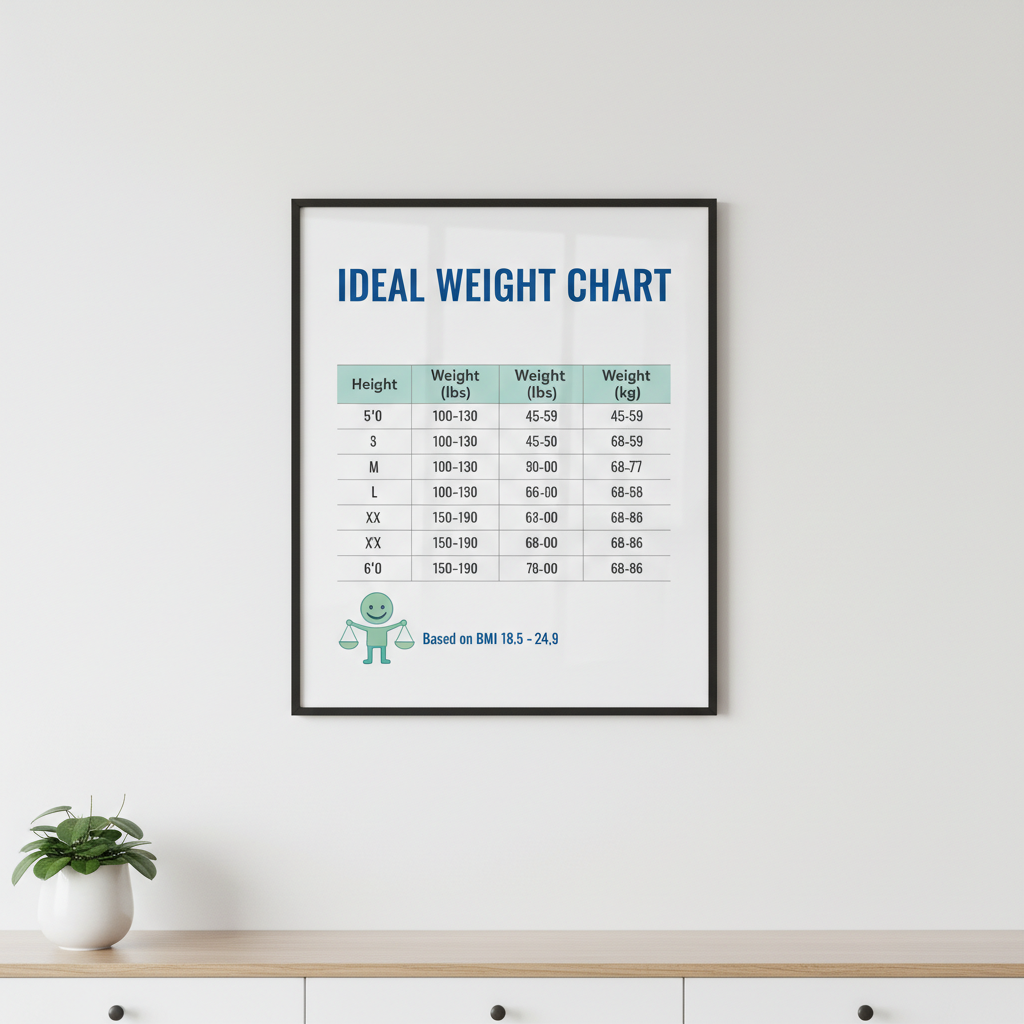
Why Understanding the ideal weight for height and age chart is Crucial
For decades, society has placed a strong emphasis on achieving an “ideal weight.” While the number on the scale is often treated as the ultimate indicator of health, the reality is far more complex. Finding your optimal weight isn’t just about fitting into a predetermined category; it’s about minimizing health risks and maximizing vitality. Many people turn to the ideal weight for height and age chart as a starting point, but understanding how to interpret these metrics—and when to look beyond them—is key to a successful health journey.
This guide dives deep into the science behind these charts, exploring the primary metrics used, their limitations, and the holistic factors that truly define a healthy body composition. We aim to provide an authoritative, yet easy-to-understand, perspective on achieving and maintaining a weight that supports long-term well-being.
The Foundations: Key Metrics in the ideal weight for height and age chart
When searching for an ideal weight for height and age chart, you will invariably encounter two primary calculation methods: Body Mass Index (BMI) and Ideal Body Weight (IBW) formulas. Both rely on height as the main variable but serve slightly different purposes.
Body Mass Index (BMI): The Standard Screening Tool
BMI is a widely used screening tool that assesses weight relative to height. It is calculated by dividing a person’s weight in kilograms by the square of their height in meters (kg/m²). The resulting number places individuals into categories that correlate with potential health risks:
- Underweight: Below 18.5
- Normal (Healthy) Weight: 18.5 to 24.9
- Overweight: 25.0 to 29.9
- Obesity: 30.0 and above
While simple to calculate, BMI is often criticized for its inability to differentiate between muscle mass and fat mass, making it an imperfect measure for athletes or individuals with high muscle density.
Ideal Body Weight (IBW) Formulas
Unlike BMI, which provides a range, IBW formulas attempt to pinpoint a specific target weight. These formulas, such as the Devine, Hamwi, and Robinson methods, were originally developed in the mid-20th century primarily for calculating drug dosages, but they are now commonly used in clinical settings to estimate a reasonable weight goal.
The Devine Formula (The Clinical Standard)
This is arguably the most common IBW formula. It starts with a base weight for a certain height and adds a fixed amount for every inch over that height. For example, for men, the base is often set at 106 lbs for the first five feet of height.
- Pros: Quick, easy to apply, and widely accepted in pharmacy and medicine.
- Cons: Does not account for bone structure or body frame size.
The Hamwi Formula (Rapid Estimation)
Similar to Devine, the Hamwi method provides a rapid estimate of IBW. It is slightly older and often results in a marginally higher ideal weight, especially for women, depending on the height inputs.
- Pros: Excellent for quick, ballpark estimates in non-critical scenarios.
- Cons: Less precise than modern methodologies incorporating body composition.
The Robinson Formula (Refined Calculation)
This formula is a modification of the Devine formula, designed to be slightly more accurate by adjusting the weight increment per inch, attempting to better reflect modern population data.
- Pros: A more contemporary adaptation of the classic IBW calculation.
- Cons: Still fundamentally limited by focusing solely on height and sex.
The Limitations of the ideal weight for height and age chart
While charts provide valuable guidance, relying solely on a fixed ideal weight for height and age chart can be misleading. A healthy weight is defined not just by the gravitational pull of your body, but by what your body is made of and how it functions. Ignoring these physical nuances can lead to unrealistic goals or misdiagnosis.
For instance, two people of the same height and weight may have vastly different health profiles. One might be a bodybuilder with dense muscle mass, while the other might have a high percentage of visceral fat. Both could technically fall into the ‘overweight’ BMI category, yet their health risks are entirely different.
The Centers for Disease Control and Prevention (CDC) notes that BMI is a good population measure but should not be used as the sole determinant of individual health status. You can learn more about the limitations of BMI here.
Why Age and Frame Size Require Consideration
Age plays a significant role because metabolism naturally slows down over time. As we age, muscle mass tends to decrease (a condition known as sarcopenia), and body fat often increases and redistributes, typically around the abdomen. Therefore, the ideal weight range for a 20-year-old may not be optimal for the same person at 60, even if their height remains constant.
Furthermore, frame size (small, medium, or large bone structure) dictates how much weight your body can comfortably carry without impacting joint health or requiring excessive muscle mass. A person with a large frame will naturally weigh more than someone of the same height with a small frame, purely due to bone density.
Calculating Your Ideal Weight: Practical Applications
To move beyond simple height-weight charts, it’s beneficial to utilize tools that can quickly process these formulas. If you are looking for a quick and accurate estimate based on validated formulas, you can use an Ideal Weight Calculator that incorporates multiple variables.
However, understanding how to roughly assess your frame size can add context to the raw numbers provided by these tools. A common method involves measuring wrist circumference relative to height:
Frame Size Assessment (Women)
Measure wrist circumference (in inches).
- Height under 5’2”: Large frame if wrist > 5.75″, Small frame if wrist < 5.5"
- Height 5’2” to 5’5”: Large frame if wrist > 6.25″, Small frame if wrist < 6.0"
- Height over 5’5”: Large frame if wrist > 6.5″, Small frame if wrist < 6.25"
Frame Size Assessment (Men)
Measure wrist circumference (in inches).
- Height under 5’5”: Large frame if wrist > 6.75″, Small frame if wrist < 6.0"
- Height 5’5” to 5’8”: Large frame if wrist > 7.0″, Small frame if wrist < 6.25"
- Height over 5’8”: Large frame if wrist > 7.5″, Small frame if wrist < 6.5"
Beyond the Numbers: A Holistic Approach to Weight Management
The most insightful indicators of health often go beyond mere weight. A healthy lifestyle is reflected in body composition, fat distribution, and overall fitness level, all of which are critical components missing from the standard ideal weight for height and age chart.
Body Fat Percentage (BFP)
BFP measures the proportion of fat compared to lean mass (muscle, bone, water). This is a far superior metric for assessing health risk than BMI, as it directly quantifies stored energy reserves.
- Healthy Range (Women): 21% to 35% (depending on age and activity level).
- Healthy Range (Men): 8% to 24% (depending on age and activity level).
Methods like DEXA scans, bioelectrical impedance analysis (BIA), or caliper testing are needed to accurately determine BFP.
Waist Circumference: Assessing Visceral Fat
Where fat is stored is often more important than how much fat is stored. Excess visceral fat—the fat stored deep around abdominal organs—is strongly linked to chronic diseases like type 2 diabetes, heart disease, and hypertension. Measuring waist circumference is a simple, actionable way to assess this risk, regardless of your weight on the scale.
Expert Insight: “Waist circumference is one of the most practical and powerful tools we have. High abdominal fat is a clear metabolic hazard, even if the BMI falls within the ‘normal’ range.” — Based on findings from metabolic health specialists.
The National Institutes of Health (NIH) suggests that a high-risk waist circumference is:
- Over 35 inches for non-pregnant women.
- Over 40 inches for men.
The Role of Age and Longevity
Research suggests that maintaining weight stability, especially as we enter middle age, is linked to better longevity. A large cohort study published by the NIH and AARP found that maintaining a moderate weight (not necessarily the lowest possible weight) throughout adulthood correlated with the lowest risk of mortality. This reinforces the idea that gradual, sustainable health habits are more important than obsessively hitting a single, often arbitrary, number dictated by a chart. The AARP provides guidelines on healthy living as we age, emphasizing nutrient density and stable weight.
Actionable Steps for Sustainable Weight Management
Whether your goal is to reach your calculated ideal weight or simply improve your health metrics, consistency is paramount. Here are essential steps for achieving a weight that supports your optimal health:
- Prioritize Protein and Fiber: These nutrients promote satiety, help maintain muscle mass, and stabilize blood sugar, which is crucial for managing weight and metabolism as age factors into the equation.
- Incorporate Resistance Training: Since muscle mass naturally declines with age, resistance training (lifting weights, bodyweight exercises) is essential. Muscle tissue burns more calories at rest than fat tissue, directly impacting your metabolic rate.
- Focus on Sleep Quality: Poor sleep disrupts hunger hormones (ghrelin and leptin), leading to increased appetite and cravings for energy-dense foods. Aim for 7-9 hours of quality sleep nightly.
- Manage Stress: Chronic stress elevates cortisol, a hormone that encourages the body to store fat, particularly visceral fat around the abdomen. Implement stress-reduction techniques like meditation or walking.
Ultimately, the numbers provided by any ideal weight for height and age chart should serve as a guideline, not a strict dictator. True health is a blend of favorable body composition, functional fitness, positive mental well-being, and sustained energy.
Conclusion
The journey to finding your ideal weight is deeply personal. While the ideal weight for height and age chart provides a useful framework based on metrics like BMI and IBW formulas, a comprehensive assessment of health requires looking deeper. By considering factors like body fat percentage, frame size, waist circumference, and overall lifestyle habits, you can establish a healthy weight goal that supports genuine wellness and longevity, rather than just chasing a number on the scale. Consult with a healthcare professional or registered dietitian to tailor these guidelines to your unique physiological needs and health history.
FAQs
The most accurate approach is holistic. Start with a calculation like the Devine formula or BMI (using an Ideal Weight Calculator), but then cross-reference this with body fat percentage measurement (e.g., DEXA scan or bioelectrical impedance), and waist circumference. For clinical accuracy, consult a medical professional who can assess blood work and overall health markers.
Age is a crucial factor because metabolism slows down as we get older, primarily due to the natural loss of muscle mass (sarcopenia). Additionally, hormonal shifts change where the body stores fat, often favoring abdominal storage. Therefore, maintaining the same weight at 50 as you did at 20 might be less realistic or necessary for optimal health, and the health risk associated with certain weight ranges can shift with age.
For highly muscular individuals (like bodybuilders or elite athletes), BMI can be misleadingly high, potentially categorizing them as ‘overweight’ or ‘obese’ even if their body fat levels are very low. In these cases, BFP (Body Fat Percentage) and waist circumference are far more relevant indicators of metabolic health than BMI alone.
Frame size accounts for bone density and structure. Individuals with a large frame naturally have heavier bones and broader shoulders/hips, meaning their true healthy weight range will be higher than someone of the same height with a small frame. This adjustment helps ensure the calculated ‘ideal weight’ is biologically achievable and comfortable for the individual’s structure.
Yes. The ‘healthy range’ is a statistical average, not a rigid boundary. If your body fat percentage, waist circumference, blood pressure, cholesterol, and blood sugar levels are all within healthy limits, being slightly above the charted ideal weight may pose minimal risk. Functional fitness and metabolic health are often better indicators than the scale reading.
Read Also:
- The Ultimate Guide to Choosing and Using a Cash Counter Calculator India
- Find the Best App to Split Bills with Friends: Ultimate Comparison Guide for Seamless Group Expenses
- Maximizing Returns: A Comprehensive Guide to Post Office FD Interest Rates 2025 Calculator and Schemes
- Decoding the Ideal Weight for Height and Age Chart: A Comprehensive Guide to Healthy Ranges
- Measure Any Room Like a Pro: 2026
- cm to hh Conversion: The 2026 Guide to Measuring Horse Height