
Securing Your Future: Why Planning with the Post Office FD Interest Rates 2025 Calculator is Essential
In an environment where market volatility is the norm, many investors prioritize stability and government backing. Post Office Time Deposits (POTD), often simply referred to as Post Office FDs, remain one of the most trusted and popular savings avenues in India. These deposits offer assured returns, backed entirely by the Government of India, making them a cornerstone of conservative financial planning.
However, simply knowing today's rates isn't enough for long-term planning. If you are scheduling a major expense or aiming for a specific corpus in the coming years, you need foresight. Understanding the projected post office fd interest rates 2025 calculator inputs and outputs is crucial for effective wealth management. This comprehensive guide will walk you through the current rate structure, the variables that influence future revisions, and practical steps to estimate your potential maturity value for 2025 and beyond.
Understanding the Mechanics of Post Office Time Deposits (POTD)
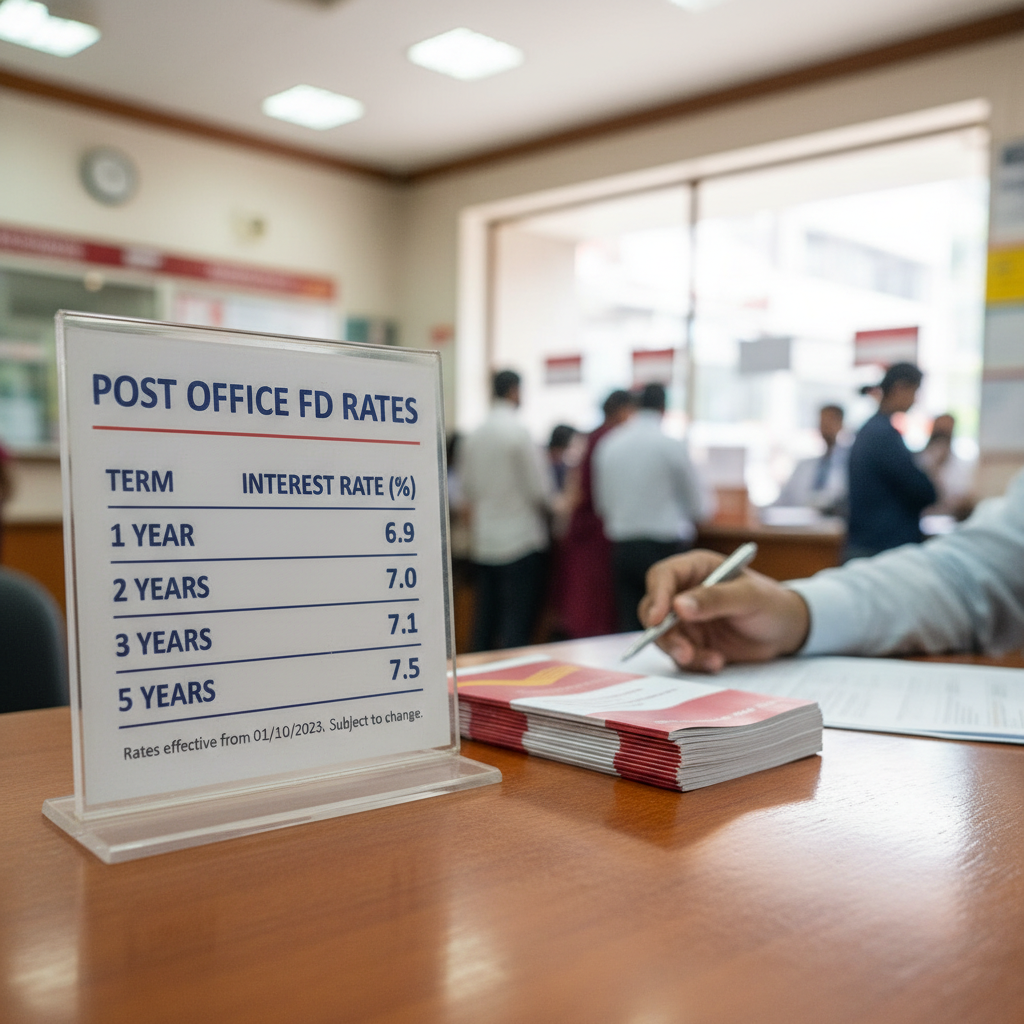
Post Office Time Deposits function similarly to bank Fixed Deposits but fall under the purview of the Department of Posts and the Ministry of Finance. These schemes are reviewed quarterly, and the rates are often benchmarked against Government Securities (G-Secs) of comparable maturity, with a slight spread added. The current structure typically offers deposit terms of 1, 2, 3, and 5 years, with the 5-year deposit usually offering the highest rate and qualifying for tax benefits under Section 80C of the Income Tax Act.
Current Landscape of Post Office FD Interest Rates
The interest rates offered on POTDs are fixed for the entire duration of the deposit once booked. While the rates are reviewed quarterly by the government, the rate applicable to your existing deposit remains constant. This predictability is a major advantage. To accurately utilize any post office fd interest rates 2025 calculator, we must first establish the current baseline rates (as of the recent quarterly review). The 5-year term is particularly attractive due to its compounding frequency and tax benefits.
“Small Savings Schemes like Post Office FDs are vital indicators of the government's commitment to financial inclusion and providing risk-free avenues for the common citizen. Their stability often outweighs the slightly higher returns offered by market-linked instruments.”
Key Factors Influencing Post Office FD Interest Rates 2025 Calculator Projections
Predicting the exact rates for 2025 is impossible, as they depend on government policy decisions. However, we can analyze the major economic indicators and policy levers that drive these decisions. The Ministry of Finance revises rates based on the recommendations of the Shyamala Gopinath Committee formula, which links these rates to the yields of corresponding G-Secs.
RBI Monetary Policy Stance
If the Reserve Bank of India (RBI) adopts a hawkish stance (raising repo rates) to curb inflation, the general interest rate environment tends to rise. This often pressures the government to increase small savings rates, including POTD, to keep them competitive.
Inflation Trends
High retail inflation erodes the real return on fixed deposits. If inflation is projected to remain elevated into 2025, the government may increase the post office fd interest rates 2025 calculator inputs to ensure savers receive a positive real rate of return.
G-Sec Yields Correlation
The primary benchmark for POTD rates is the yield on Government Securities of similar maturity. If long-term G-Sec yields rise due to increased government borrowing or market sentiment, expect POTD rates to follow suit in subsequent quarterly reviews.
Government's Revenue Needs
Small savings collections are a significant source of funding for the government. If the government needs to boost collections to fund infrastructure or welfare projects, they might offer slightly higher rates to incentivize deposits.
How to Use a Post Office FD Interest Rates 2025 Calculator Effectively
A calculator is only as good as the data you input. Since no official government calculator offers projected 2025 rates, a robust online tool allows you to plug in assumed future rates to model your returns. This is essential for scenario planning.
To start your modeling, use a reliable tool like the Post Office FD Calculator. This tool helps visualize the power of quarterly compounding over various tenures.
Here’s the core process for leveraging the post office fd interest rates 2025 calculator for future planning:
- Determine the Initial Investment: Decide the principal amount you plan to invest (e.g., ₹1,00,000).
- Select the Tenure: Choose the duration (1, 2, 3, or 5 years). For maximum benefit, the 5-year option is usually preferred.
- Input the Assumed Interest Rate: This is the crucial step for 2025 projections. Instead of using today's rate, input a slightly increased rate (e.g., 7.8% instead of 7.5%) to see the impact of a potential rate hike.
- Calculate Maturity Value: The calculator will show the total interest earned and the final maturity amount, allowing you to gauge if your investment meets your 2025 financial goals.
Step-by-Step Calculation Example Using Potential 2025 Rates
Let's assume an investor decides to open a 5-year POTD in early 2025. Currently, the rate is 7.5% (compounded quarterly). However, based on high inflation projections, experts predict the rate might increase to 7.8% by Q1 2025.
Scenario Input
- Principal: ₹5,00,000
- Tenure: 5 Years
- Assumed Rate (2025): 7.8% p.a.
Calculation Result (Approximate)
- Interest Earned: ₹2,38,000 (Approx.)
- Maturity Value: ₹7,38,000 (Approx.)
Comparison (Current 7.5%)
- Interest Earned (7.5%): ₹2,25,000 (Approx.)
- Difference: ₹13,000 more interest earned with the projected rate.
By using the post office fd interest rates 2025 calculator with a forward-looking rate assumption, you immediately quantify the potential upside or downside of future policy changes.
Comparing POTD with Bank FDs: Why Stability Matters
While banks might occasionally offer marginally higher rates, especially for short durations or promotional periods, the Post Office Time Deposit provides unparalleled security and consistency. This difference is often summarized in the concept of "sovereign guarantee."
Security Guarantee
POTD: Backed fully by the Government of India. Zero risk of default, offering a sovereign guarantee.
Bank FD: Insured up to ₹5 Lakh per customer by the Deposit Insurance and Credit Guarantee Corporation (DICGC), a subsidiary of the RBI. Security is high but capped.
Rate Revision Frequency
POTD: Rates are revised quarterly by the Ministry of Finance based on G-Sec yields. However, the booked rate is fixed for the term.
Bank FD: Rates are dynamic, determined by individual bank liquidity needs and RBI policy changes. They can change daily.
Tax Benefits
POTD: 5-year deposit qualifies for tax deduction under Section 80C.
Bank FD: Only specific 5-year tax-saver FDs qualify for Section 80C benefits.
For investors prioritizing the absolute safety of their principal, POTD often wins, regardless of minor fluctuations in the competitive bank FD landscape. You can learn more about the stability of these schemes directly from the India Post official website.
Analyzing Potential Scenarios for Post Office FD Interest Rates 2025
To maximize the utility of the post office fd interest rates 2025 calculator, we must consider three potential macroeconomic pathways for the period leading up to 2025 and model returns based on these assumptions:
Scenario 1: Optimistic (High Growth/Moderate Inflation)
If economic growth accelerates significantly, and the RBI maintains a neutral or slightly accommodative stance, the government might slightly increase rates to attract capital, potentially leading to rates in the range of 7.7% to 8.0% for the 5-year tenure.
Scenario 2: Stable (Current Trends Continue)
If inflation remains within the RBI's comfort zone and G-Sec yields stabilize, the rates might continue around the current level (e.g., 7.4% to 7.6%). This is the most likely scenario unless major geopolitical or domestic policy shifts occur.
Scenario 3: Pessimistic (Recessionary Pressure/Rate Cuts)
If global recessionary fears lead to sharp cuts in the RBI's repo rate, G-Sec yields will fall. In this environment, the Ministry of Finance would likely reduce small savings rates, pushing the 5-year POTD rate possibly below 7.3%. This is a crucial scenario to model if capital preservation is the only goal.
The Importance of Compounding and Tenure Selection
Post Office FDs compound interest quarterly, even if the interest is paid annually or at maturity (depending on the tenure). This quarterly compounding is a significant factor in wealth accumulation, especially for longer tenures. The longer the tenure, the more frequently your interest earns interest, leading to higher effective yields. Always check the compounding frequency when using the post office fd interest rates 2025 calculator to ensure accuracy.
It is worth noting that the government's policy regarding small savings schemes is often guided by the need for financial stability and social welfare, ensuring that the returns remain attractive relative to inflation. For detailed analysis on policy decisions influencing interest rates, reference materials from the Reserve Bank of India (RBI) provide deep context.
Maximizing Returns on Your Post Office FD Investment
While the interest rate is fixed by the government, investors can adopt strategies to maximize their overall returns and efficiency:
- Timing Your Investment: If you anticipate a rate hike (based on G-Sec yield trends), wait for the quarterly review before locking in a long-term deposit. Conversely, if rate cuts are expected, invest immediately.
- Using the 5-Year Tax Benefit: Always prioritize the 5-year POTD if you utilize Section 80C deductions. The tax saved effectively increases your net return.
- Laddering Deposits: Instead of investing a lump sum in one 5-year deposit, stagger your investments across multiple 1, 2, or 3-year FDs. This strategy ensures liquidity (some funds mature annually) and allows you to capitalize on potential rate hikes without breaking a large deposit prematurely.
- Nomination and Accessibility: Ensure proper nomination is completed. Post Office schemes are generally highly accessible, making them suitable even for rural investors.
Effective financial planning requires detailed scenario analysis. Whether you are using a standard energy convertor for unit calculations or a sophisticated financial calculator, the principle remains the same: garbage in, garbage out. Accurate input regarding the principal, tenure, and, most importantly, the assumed interest rate, will determine the usefulness of the projection.
Conclusion: Strategic Planning for 2025 Returns
The Post Office Time Deposit remains an indispensable tool for risk-averse investors seeking guaranteed returns. While the exact post office fd interest rates 2025 calculator input value is subject to quarterly government review, financial acumen allows us to model likely scenarios based on inflation and RBI policy. By using an online calculator with forward-looking assumptions and understanding the macroeconomic drivers, you can strategically position your savings today to meet your financial goals in 2025 and beyond. Always prioritize the 5-year tenure for the dual benefits of higher compounding and tax savings.
FAQs
Post Office FD interest rates (Small Savings Schemes) are reviewed and potentially revised quarterly by the Ministry of Finance, based on the prevailing yields of Government Securities of similar maturity.
No. Once you open a POTD, the interest rate applicable on that specific deposit is locked in and fixed for the entire tenure (1, 2, 3, or 5 years), regardless of subsequent quarterly revisions.
A calculator cannot predict exact future earnings because the 2025 interest rate is unknown. However, you can use the calculator effectively for scenario planning by inputting projected or assumed rates (e.g., higher or lower than the current rate) to estimate potential maturity values.
Post Office FDs carry a sovereign guarantee, meaning they are fully backed by the Government of India, offering the highest level of security. Bank FDs are insured up to ₹5 Lakh per customer by DICGC. While both are very safe, the POTD offers an unlimited government guarantee.
Yes, the interest earned on Post Office FDs is fully taxable as 'Income from Other Sources' according to your income tax slab. However, investments made in the 5-year POTD qualify for a tax deduction under Section 80C of the Income Tax Act.
Read Also:
- Mastering Your Intake: A Definitive Guide on How Many Calories Should I Eat a Day to Lose Weight
- Mastering the Math: A Comprehensive Guide on How to Convert SGPA to Percentage
- Ovulation Tracking Mastery: Finding Your Peak Fertility Window and Using a ‘When is the Best Time to Get Pregnant Calculator’
- Mastering SIP Returns: A Deep Dive into How to Calculate SIP Returns with Inflation for Real Wealth Growth
- 10 Powerful Benefits of Using an Invoice Generator for Small Business Success
- CSS Gradient Generator
- µg/L to PPB: Your 2026 Water Safety Guide
- Your Text, Real Handwriting: The 2026 Trick
- Laughing Emoji PNG: The Ultimate Guide for Marketers (2026)
- Change Case in Excel: 5 Pro Methods for Flawless Data (2026) – Visual Story