
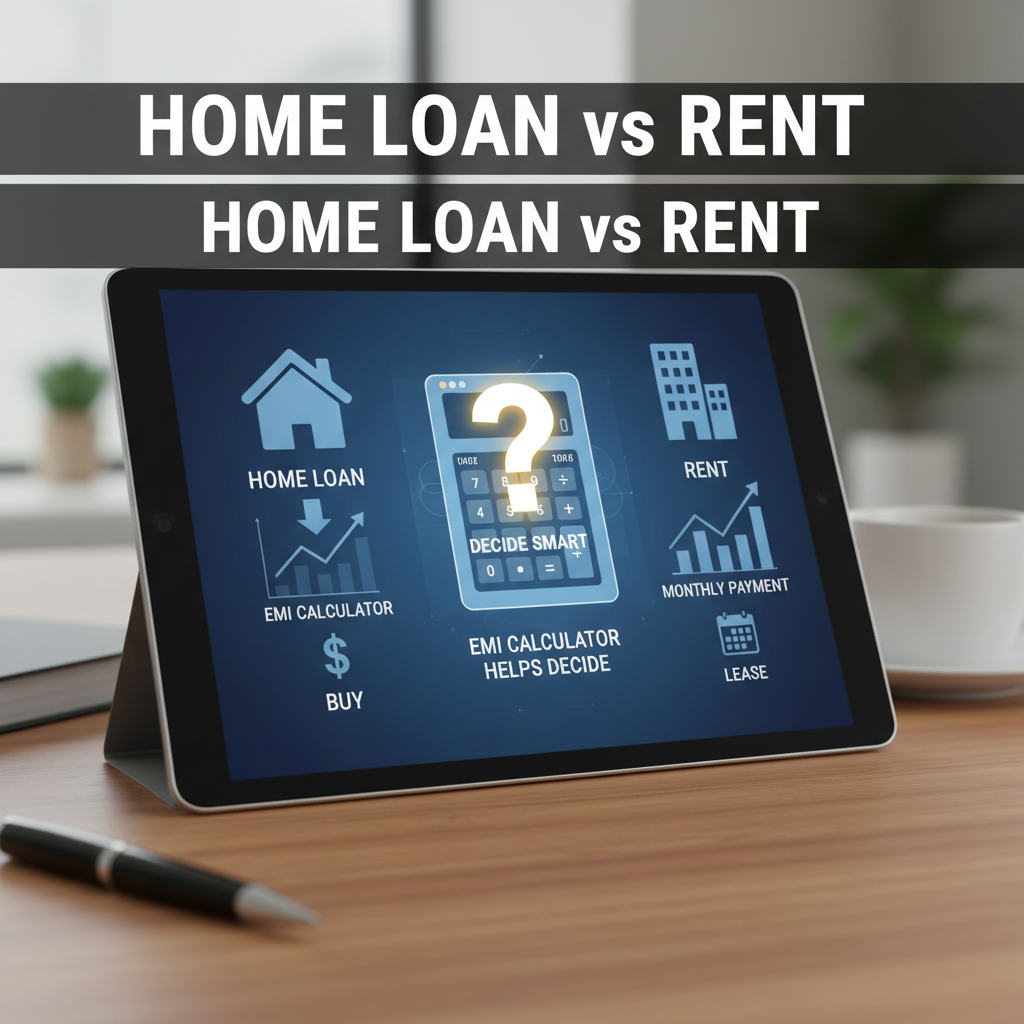
Navigating the Great Housing Debate: Rent or Buy?
For many, the choice between paying monthly rent and committing to a mortgage is one of the most significant financial milestones of adulthood. It is not just a question of where you want to live, but how you want to manage your wealth over the next several decades. Making a sound home loan vs rent emi calculator decision requires more than just a gut feeling; it demands a deep dive into interest rates, property appreciation, and the opportunity cost of your capital. In a world where real estate prices fluctuate and interest rates shift, having a data-driven approach is essential for long-term financial security.
Many people assume that renting is ‘throwing money away,’ while others argue that the flexibility of renting allows for better investment opportunities elsewhere. To cut through the noise, you need to look at the hard numbers. By leveraging tools like a Home Loan Calculator, you can visualize exactly how much of your monthly payment goes toward building equity versus how much is lost to interest and maintenance. This article will guide you through the complexities of this choice, ensuring you make an informed decision that aligns with your lifestyle and financial goals.
Making the Home Loan vs Rent EMI Calculator Decision: A Financial Guide
The core of the home loan vs rent emi calculator decision lies in the comparison of monthly outflows. When you rent, your monthly payment is straightforward: you pay the landlord, and you receive housing in return. When you buy, your monthly Equated Monthly Installment (EMI) is split between the principal amount and the interest charged by the bank. In the early years of a home loan, a significant portion of that EMI goes toward interest, which can feel very similar to paying rent.
However, the fundamental difference is the eventual ownership of an asset. Real estate has historically been a hedge against inflation. According to reports from Investopedia, the decision to buy often hinges on the ‘Price-to-Rent Ratio.’ If the cost of buying a home is significantly higher than 20 times the annual rent for a similar property, renting might actually be the more fiscally responsible move in the short term. Conversely, if the ratio is lower, buying becomes the clear winner.
The Case for Renting
Renting offers unparalleled flexibility. You aren’t tied to a specific location, and you aren’t responsible for property taxes, homeowners’ insurance, or major repairs. This allows you to invest your ‘down payment’ money into high-yield stocks or mutual funds.
The Case for Buying
Buying a home provides stability and forced savings. Every month you pay down your principal, you are increasing your net worth. Additionally, you benefit from any appreciation in the property’s market value over time.
The Hybrid Approach
Some choose to rent where they live and buy a property elsewhere as an investment. This allows them to enjoy the benefits of property appreciation while maintaining the lifestyle flexibility of a renter.
Key Factors Influencing Your Home Loan vs Rent EMI Calculator Decision
When you sit down to finalize your home loan vs rent emi calculator decision, you must account for the ‘unseen’ costs. Renting involves a security deposit and monthly rent, but buying involves a down payment, registration fees, stamp duty, and recurring maintenance costs. If you plan to stay in a city for less than five years, the transaction costs of buying and selling a home will likely eat up any equity you build.
Furthermore, one must consider the tax implications. In many jurisdictions, the interest paid on a home loan is tax-deductible up to a certain limit. This effectively reduces the ‘real’ cost of your EMI. On the other hand, renters in some corporate structures can claim House Rent Allowance (HRA) benefits, which lowers their taxable income. A comprehensive calculator helps you weigh these tax breaks against each other to see which path leaves more money in your pocket at the end of the fiscal year.
Understanding Interest Rates in Your Home Loan vs Rent EMI Calculator Decision
Interest rates are the most volatile variable in this equation. A 1% difference in your mortgage rate can result in thousands of dollars in extra payments over a 20-year tenure. When rates are low, the home loan vs rent emi calculator decision usually tilts toward buying. When rates are high, the cost of borrowing might exceed the benefits of ownership, making renting and investing the surplus the smarter play. As noted by Forbes Advisor, current market trends and central bank policies play a massive role in timing your entry into the property market.
Why Data Drives the Home Loan vs Rent EMI Calculator Decision
Emotional bias often clouds our judgment regarding real estate. We are taught that ‘owning a home is the American dream’ (or a global equivalent), but dreams don’t pay the bills. The home loan vs rent emi calculator decision should be based on a cold analysis of your debt-to-income ratio and your long-term career trajectory. If your career requires frequent relocation, the ‘buy’ option becomes a liability rather than an asset.
Using a calculator allows you to perform ‘what-if’ scenarios. What if property prices only grow at 3% instead of 7%? What if rent increases by 10% every year? By plugging these variables into a calculator, you can see the ‘break-even point’—the exact year when the cost of buying becomes cheaper than the cumulative cost of renting. Usually, this point occurs between years 5 and 10 of homeownership.
Long-term Wealth and the Home Loan vs Rent EMI Calculator Decision
The ultimate goal of any housing strategy is wealth accumulation. If you rent and spend the difference between your rent and a potential EMI on lifestyle luxuries, you are losing out. However, if you rent a modest apartment and aggressively invest the surplus in a diversified portfolio, you might end up with a higher net worth than a homeowner. The home loan vs rent emi calculator decision is therefore as much about your spending habits as it is about the real estate market.
Maintenance Costs
Homeowners should budget 1% of the home’s value annually for repairs. From leaky roofs to broken HVAC systems, these costs add up and are often overlooked in simple comparisons.
Opportunity Cost
The 20% down payment you put into a house is money that isn’t earning interest elsewhere. A calculator helps you compare the ROI of a house vs. the ROI of the stock market.
Final Checklist for Your Home Loan vs Rent EMI Calculator Decision
Before you sign a lease or a mortgage deed, run through this final checklist to ensure your home loan vs rent emi calculator decision is airtight:
- Duration of Stay: Do you plan to live there for at least 7-10 years?
- Market Conditions: Is it currently a buyer’s or a seller’s market?
- Emergency Fund: Do you have 6 months of EMIs saved up in case of job loss?
- Total Cost of Ownership: Have you factored in property taxes, insurance, and HOA fees?
- Lifestyle Preferences: Do you value the freedom to move or the freedom to renovate?
Remember, there is no one-size-fits-all answer. A young professional in a tech hub might benefit from the mobility of renting, while a growing family might prioritize the stability of a permanent home. The home loan vs rent emi calculator decision is a personal one, but it must be rooted in mathematical reality.
Conclusion: The Path to Financial Clarity
Choosing between a home loan and renting is a marathon, not a sprint. While the emotional appeal of owning a home is strong, the financial implications are vast and long-lasting. By using a structured approach and a reliable calculator, you strip away the uncertainty and replace it with a clear roadmap. Whether you choose to build equity in a home or build a portfolio through disciplined investing while renting, the key is to stay informed and proactive. Use the tools available to you, keep an eye on market trends, and make your housing choice a cornerstone of your financial success.
FAQs
No, it depends on several factors including the local real estate market, how long you plan to stay, and the current interest rates. In some high-cost cities, renting and investing the difference can lead to greater wealth over time.
The 5% rule suggests that the unrecoverable costs of homeownership (property tax, maintenance, and cost of capital) are roughly 5% of the home’s value annually. If you can rent a similar place for less than 5% of its purchase price per year, renting may be better.
An EMI calculator helps you see the total interest you will pay over the life of a loan. By comparing this total cost (plus maintenance and taxes) against the total cost of rent and the potential returns on invested savings, you get a clear financial winner.
Financial experts generally recommend that your total debt obligations, including your home loan EMI, should not exceed 35-40% of your take-home pay to ensure you have enough for savings and other living expenses.
Renting provides you with a place to live, which is a service. It is no more a ‘waste’ of money than buying groceries or paying for electricity. The decision is about which method of obtaining shelter is most efficient for your specific financial situation.
Read Also:
- Mastering Your Finances: Personal Loan EMI Calculator Comparison India Guide
- Credit Card Generator
- Color Convertor
- The Ultimate YouTube Tag Extractor Video SEO Guide for 2024+
- Flip Your Text, Hack Attention in 2026
- Lap Time Calculator: Find Your True Race Pace in 2026
- Upper and Lower Case Alphabet: The Ultimate Guide for 2026
- Master the X Card Validator in 2026: Get Perfect Previews
- TikTok Emoji PNGs: The Ultimate Guide for 2026
- How to Convert Meter to Square Meter (m to m²) in 2026
- Surface Area of a Pipe Calculator: The Pro’s Guide (2026)
- Fix Word Case Errors Fast in 2026
- Shrink JPEGs to 50KB: 2026 Web Speed Guide
- Lap Time Calculator: The Ultimate 2026 Guide to Getting Faster
- Your 2026 Guide to Image SEO