
You’re staring at two invoices, both for over $100 a month. One says Semrush. The other, Ahrefs. A little voice in your head asks the question every marketer eventually faces: Am I paying for the right tool? Or am I just paying for features I never use?
It’s a high-stakes decision. Choosing the wrong SEO platform isn’t just a waste of money; it’s a waste of time and a direct handicap on your growth. These aren’t just tools anymore. They’re complex ecosystems of data that dictate strategy, shape content, and ultimately determine who wins on Google.
Forget the generic feature lists you’ve seen before. This is a deep-dive analysis from the trenches. We’re breaking down the core philosophies, the hidden strengths, and the frustrating weaknesses of Semrush, Ahrefs, and the ever-reliable Moz. By the end, you won’t just know which tool is “better”—you’ll know, with absolute certainty, which one is right for you.
📑 What You’ll Learn
- The Quick Verdict: Which Tool Wins for You?
- Understanding the Core Philosophy: It’s Not Just About Features
- The Feature Showdown: Where the Real Battles Are Won
- Usability & Workflow: Which Platform Feels Like Home?
- Pricing vs. ROI: Getting the Most Bang for Your Buck
- How to Choose Your SEO Platform in 5 Steps
🎯 Key Takeaway
The Semrush vs Ahrefs debate isn’t about which tool has more features. It’s a strategic choice: Semrush is an all-in-one marketing suite perfect for teams needing SEO, PPC, and content tools in one place. Ahrefs is a pure, data-obsessed SEO engine for specialists who demand the absolute best link and keyword data.
The Quick Verdict: Which Tool Wins for You?
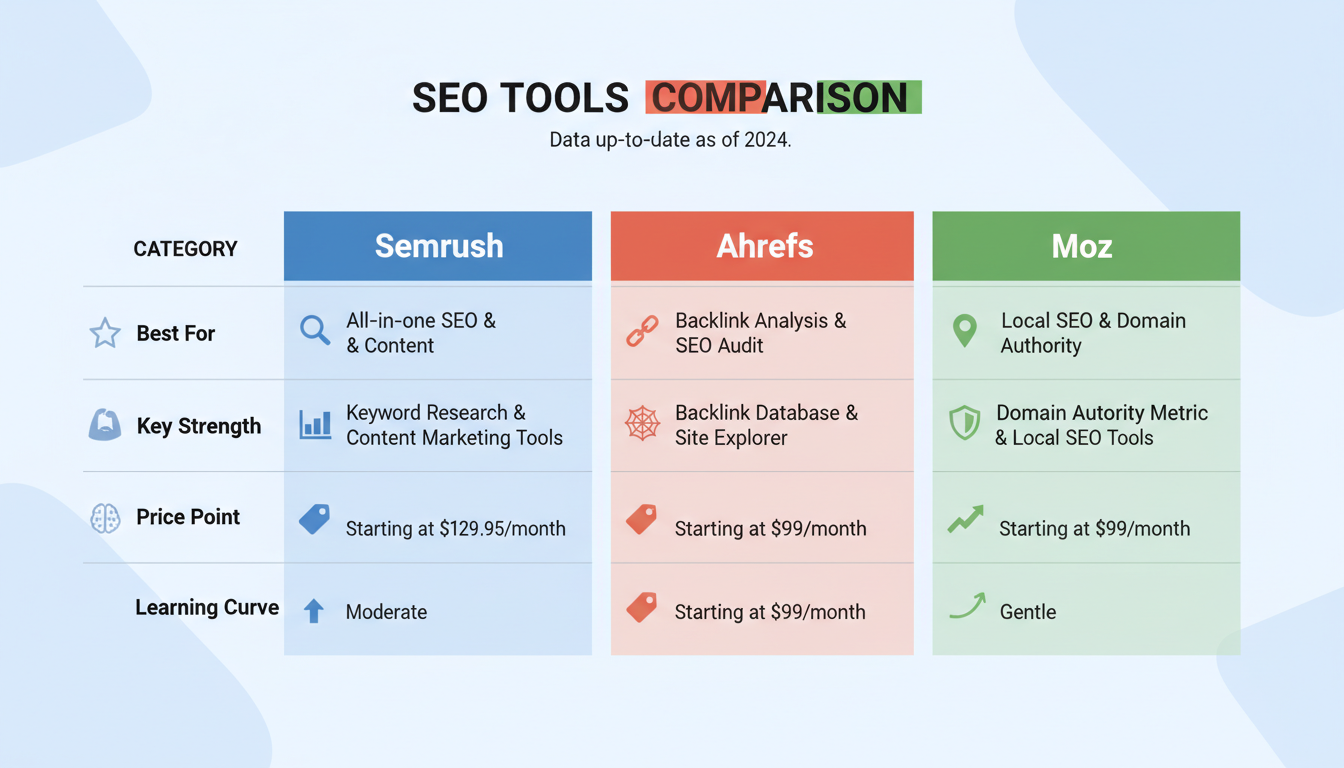
Let’s cut to the chase. You’re busy. If you only have 30 seconds, this table breaks down our findings from years of hands-on testing with all three platforms.
| Use Case | 🏆 Winner | Why It Wins |
|---|---|---|
| All-in-One Marketing Teams | Semrush | Combines powerful SEO with robust PPC, social media, and content marketing tools. It’s a true marketing OS. |
| SEO Specialists & Link Builders | Ahrefs | Its backlink index is legendary for a reason. The crawler is faster, and the core SEO data feels more granular and actionable. |
| Local Businesses & SMBs | Moz Pro | Excellent local SEO features and a much gentler learning curve. Its Domain Authority (DA) metric is still a valuable benchmark. |
| Beginners & Solopreneurs | Ahrefs (Slight Edge) | While Moz is simpler, Ahrefs’ clean, intuitive UI makes complex data surprisingly easy to navigate for newcomers. |
Understanding the Core Philosophy: It’s Not Just About Features
Before we dive into keywords and crawlers, you have to understand how each company thinks. Their philosophy shapes every tool, every report, and every price point. Getting this is key to avoiding buyer’s remorse.
Semrush: The All-in-One Marketing Command Center
Semrush isn’t just competing with Ahrefs anymore. It’s competing with HubSpot, with social media schedulers, and with content optimization tools. Their goal is to be the single subscription that runs your entire digital marketing department.
Think of it this way: If your team has one person for SEO, another for paid ads, and a third for content, Semrush creates a unified language and workspace for all of them. This integration is its killer feature. In our experience, this is a massive win for agencies managing multiple clients with diverse needs.
Ahrefs: The SEO Purist’s Data Engine
Ahrefs, on the other hand, has doubled down on being the absolute best-in-class tool for search engine optimization. They live and breathe data. Their crawler is the second most active on the internet, right behind Google’s. They obsess over data accuracy, from backlink discovery to clickstream data.
They aren’t trying to manage your social media. They’re trying to give you the most precise, actionable SEO data on the planet. If you’re a dedicated SEO professional, this focus is incredibly refreshing. You’re not paying for features you’ll never touch.
Moz: The Trusted Guide for a Complex World
Moz has always been about making SEO accessible. They pioneered concepts like Domain Authority that gave marketers a simple, directional metric to track. While some experts argue their data isn’t as vast as the other two, their strength lies in clarity, education, and a rock-solid foundation in local SEO.
For a small business owner trying to rank their plumbing company in three different zip codes, Moz Pro is often a much better, less overwhelming fit than the data firehose of Ahrefs or Semrush.
The Feature Showdown: Where the Real Battles Are Won
Okay, let’s get granular. When you’re in the weeds, trying to find that one keyword or that one toxic link, which platform delivers? We’ve run hundreds of campaigns using these tools. Here’s our honest breakdown.
Keyword Research: Breadth vs. Clicks
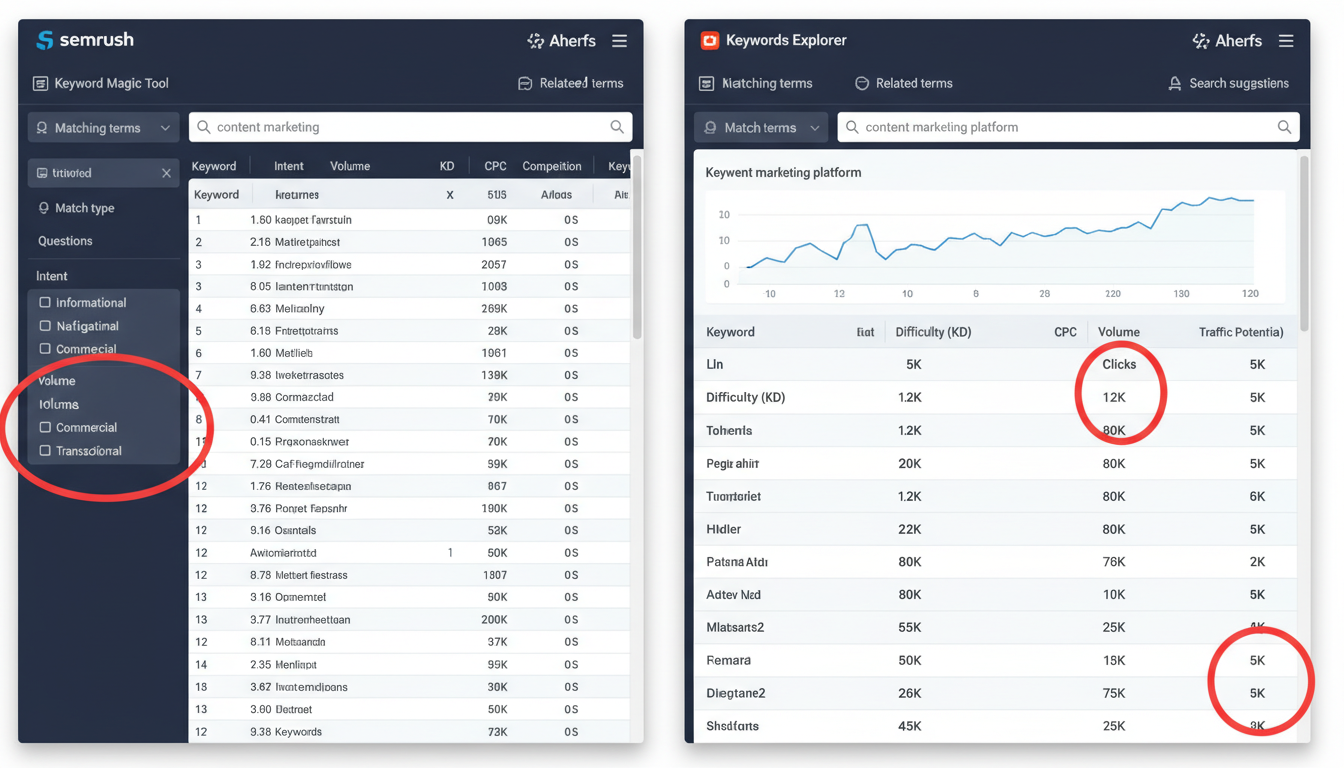
This is the classic matchup. Semrush’s Keyword Magic Tool is a beast, boasting a database of over 25 billion keywords. Its greatest strength is its intent filtering. With one click, you can isolate informational (“how to fix a leaky faucet”) from transactional (“plumbers near me”) keywords. It’s a massive time-saver for content planning.
Ahrefs’ Keywords Explorer counters with a killer metric: Clicks. In a world of zero-click searches and featured snippets, knowing search volume isn’t enough. Ahrefs tells you how many people actually click a result. A keyword with 50,000 searches but only 1,000 clicks is a trap. Ahrefs helps you spot it. It’s a more sophisticated approach that, for pure SEO, often yields better targets.
💡 Pro Tip
In Semrush, use the “SERP Features” filter in the Keyword Magic Tool to find keywords that trigger People Also Ask boxes or Featured Snippets. Targeting these can give you “position zero” visibility, even if you can’t rank #1 in the traditional blue links.
Backlink Analysis: The Undisputed King and the Worthy Challenger
For years, this wasn’t even a competition. Ahrefs was, and largely still is, the king of backlink data. Their crawler finds new links with terrifying speed. Their Link Intersect tool, which shows you sites linking to your competitors but not you, is the gold standard for link building outreach.
However, Semrush has closed the gap significantly. Where it truly shines is with its Backlink Audit tool. It integrates directly with Google Search Console and uses a toxicity score to help you find and disavow harmful links that could be suppressing your rankings. So, the dynamic is simple:
- For building new links: Ahrefs is your weapon of choice.
- For protecting your existing link profile: Semrush has the edge.
⚠️ Watch Out
Don’t get obsessed with the total number of backlinks. Industry research consistently shows that the relevance and authority of a single link from a top-tier site are worth more than hundreds of low-quality links. Use these tools to find quality, not just quantity.
Technical SEO & Site Audits
Both platforms offer fantastic site audit tools that will crawl your site and flag hundreds of potential issues, from broken links to missing alt tags. They’re both excellent.
The differences are in the details. Semrush’s audit provides a simple “Health Score” which is great for reporting to clients who don’t want to get into the weeds. It also offers a unique Log File Analyzer, a power-user feature that lets you see exactly how Googlebot is crawling your site. This is invaluable for diagnosing complex indexation issues.
Ahrefs’ Site Audit is cloud-based, meaning it won’t slow your computer down on massive crawls. Its visualizations, especially the Site Structure report, are brilliant for understanding how link equity flows through your website. For massive e-commerce sites, Ahrefs often handles the scale a bit more gracefully.
Usability & Workflow: Which Platform Feels Like Home?
Data is useless if you can’t find it. The user experience (UX) is a major differentiator.
Ahrefs is clean. Minimalist. Logical. Most SEOs I know find its interface more intuitive. Reports are easy to find, the data is presented clearly, and there’s very little clutter. It’s a tool designed for specialists to work in, day in and day out.
Semrush is powerful, but it can be overwhelming. Because it does so much—SEO, PPC, social, content—the navigation has a lot more menus and sub-menus. New users often feel a bit lost. But here’s the thing: once you tame it, the workflow is incredible. Jumping from a keyword gap analysis to building a PPC campaign for those same keywords is something Ahrefs simply can’t do.
Pricing vs. ROI: Getting the Most Bang for Your Buck
Let’s talk money. Both platforms have moved to complex credit-based systems and per-user pricing, which can make a direct comparison tricky. A standard plan for either will run you between $130 and $150 per month.
The real question is about Return on Investment (ROI). Which tool provides more value for that monthly fee?
| User Profile | Best ROI | Justification |
|---|---|---|
| Freelance SEO Consultant | Ahrefs | You’re paid for pure SEO results. Ahrefs gives you the best core data without making you pay for extra marketing tools you won’t use for your clients. |
| Full-Service Digital Agency | Semrush | The ability to manage SEO, PPC, and social media reporting from one dashboard is a massive efficiency gain. It replaces 2-3 other tools, making the price a bargain. |
| In-House Marketing Manager | Semrush | The competitive intelligence and market analysis tools (like Market Explorer) provide strategic insights that go far beyond SEO, helping you justify your budget to the C-suite. |
⚠️ Watch Out
Be mindful of credit limits and seat costs. Ahrefs, in particular, has become stricter with how many reports you can pull on lower-tier plans. Before you buy, map out your team’s daily usage to ensure you don’t get hit with surprise overage fees or the need for an expensive upgrade.
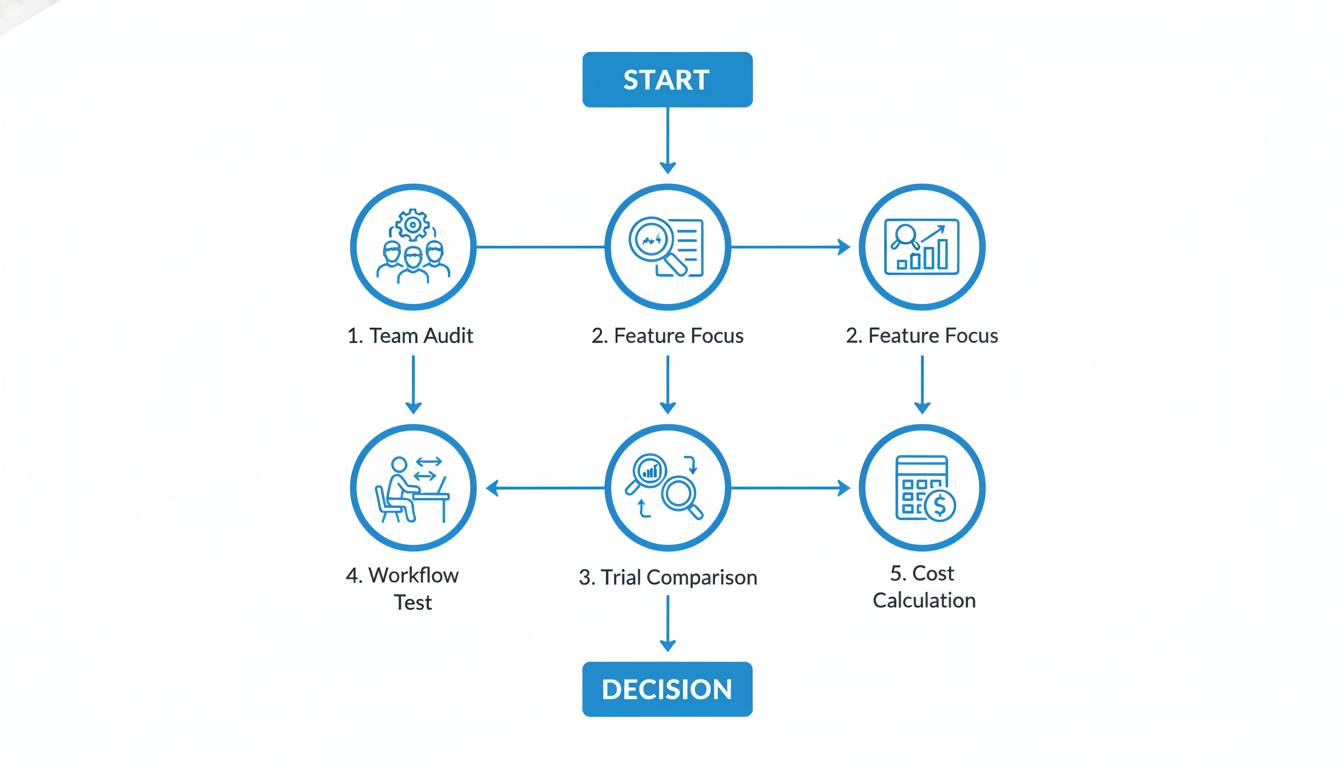
How to Choose Your SEO Platform in 5 Steps
Feeling stuck? Don’t just flip a coin. Follow this battle-tested process we use at our agency to make the right call.
- Audit Your Team’s Core Function: Are you a team of SEO specialists, or are you a broader marketing department? If it’s the latter, Semrush starts with a strong lead.
- Define Your “Must-Have” Feature: What is the one task you do most? If it’s hardcore link building, lean Ahrefs. If it’s holistic competitor analysis across paid and organic, lean Semrush.
- Run a Head-to-Head Trial: Don’t skip this. Sign up for trials for both platforms. Run the exact same domain and keywords through each. Compare the data side-by-side. Which one feels more accurate? Which one uncovers insights the other missed?
- Evaluate the Workflow: During the trial, pay attention to how it feels to use the tool. Can you find what you need quickly? Does the layout make sense to you? A tool you hate using is a tool you won’t use.
- Calculate the True Cost: Look at the pricing tiers. How many user seats do you need? How many projects? How many keywords will you track? Calculate the annual cost for the tier you actually need, not just the advertised starting price.
💡 Pro Tip
When on a trial, use the tool’s “Content Gap” (or “Keyword Gap”) feature. Enter your domain and 2-3 of your top competitors. This will instantly show you the high-value keywords they rank for that you don’t. It’s one of the fastest ways to prove the tool’s value and build a content strategy.
❓ Frequently Asked Questions
Which tool is better for beginners, Semrush or Ahrefs?
While Moz is often cited as the easiest, between the big two, Ahrefs’ cleaner interface is generally more intuitive for beginners to grasp. However, Semrush provides a wider array of tutorials and educational content within its platform.
Is Ahrefs still the undisputed best for backlinks?
Yes. Based on multiple industry studies and our own hands-on testing, Ahrefs maintains the largest and fastest-updating backlink index. For pure link prospecting and analysis, it remains the industry leader.
Does Semrush offer better value for the money?
For many businesses, yes. Because a single Semrush subscription can replace separate tools for PPC analysis, social media scheduling, and content optimization, its total value proposition is often higher for integrated marketing teams.
Can I just use Google Search Console instead?
Google Search Console is essential, but it’s not a replacement. GSC tells you how your site is performing. Tools like Semrush and Ahrefs tell you what your competitors are doing and identify new opportunities for growth. You need both.
Is it crazy to pay for both Semrush and Ahrefs?
Not at all. Many top-tier agencies and enterprise SEO teams subscribe to both. They use Ahrefs for its superior backlink and keyword data and Semrush for its competitive intelligence, site audits, and content marketing toolkit. It’s expensive, but it gives you the best of both worlds.
The Final Verdict: It’s Not the Tool, It’s the Strategist
Look, there’s no magic bullet. The best SEO tool on the planet won’t get you results if you don’t have a sound strategy. The Semrush vs Ahrefs debate ends here: they are both phenomenal, enterprise-grade platforms that can deliver incredible results.
The choice comes down to your focus.
- Choose Semrush if you’re a marketer who does SEO. You need a versatile, all-in-one platform that connects your efforts across multiple channels.
- Choose Ahrefs if you’re an SEO who does marketing. You live and die by the quality of your data and need the sharpest, most powerful tool dedicated to search.
- Choose Moz if you’re a business owner who needs to focus on local visibility without an overwhelming feature set.
Your next step is simple. Don’t just read another review. Pick the one that aligns with your goals, start a trial, and put it to the test on your own website. The data you uncover in the next seven days will tell you everything you need to know.
Read Also:
- 7 Proven Strategies to Merge PDF Files Online: The Ultimate Guide
- How to Convert Square Yards into Tons: The 2026 Landscaping Guide
- Your 2026 Guide to Image SEO
- Stop PDF Chaos: Your 2026 Guide
- Boost Your Biz with QR Codes in 2026
- Supercharge Your Invoicing Game in 2026
- Image Resizer Tool: The Ultimate Guide to Boost SEO (2024) – Visual Story
- Watch Hurawatch Offline? Your 2026 Guide
- Reclaim Your Time: 2026 Tracking Secrets
- AI Alt Text: Your 2026 SEO Secret Weapon
- Your 2026 Loan Secret Weapon: Revealed
- Username Generator: Create a Unique Handle in Seconds – Visual Story
- Stop Guessing: Your 2026 Torque Secrets