
Someone gets a tattoo. It’s meant to say “Fearless Warrior” in the ancient, guttural tongue of the Anglo-Saxons. Instead, thanks to a shoddy online translator, it says “Afraid Mongoose.”
I’ve seen it happen. This isn’t just about tattoos; it’s about writers seeking authenticity, students grappling with epic poetry, and history buffs wanting a genuine connection to the past. The desire to translate to Anglo-Saxon, or Old English, is a journey to the very roots of our language. But here’s the hard truth: it’s nothing like translating Spanish or French. You can’t just swap words.
Forget the quick-fix apps. They don’t work.
This guide, grounded in years of hands-on work with historical texts, will give you the exact, scholar-approved method to translate modern concepts into authentic Old English. You’ll learn the structure, the pitfalls, and the tools that separate a genuine translation from embarrassing gibberish.
📑 What You’ll Learn
Why Old English Is a Different Beast Entirely
So, why can’t you just pop a phrase into a generator and get a perfect Old English equivalent? Because Old English is an inflected language, and modern English is not. That’s the whole game, right there.
In modern English, word order is king. “The man sees the wolf” means something completely different from “The wolf sees the man.” The order of the words tells us who is doing what to whom.
Old English laughs at this simplicity. It uses a case system, where words change their endings (inflections) to show their grammatical role. The subject, the object, the possessor—they all get different tags. This means the word order could be much more flexible, often for poetic emphasis. It’s a fundamentally different way of building a sentence.
Here’s a snapshot of the core differences. It’s critical to grasp this before you even think about translating.
| Feature | Modern English | Old English (Anglo-Saxon) |
|---|---|---|
| Meaning Conveyed By | Strict Word Order (Subject-Verb-Object) | Word Endings (Inflections/Cases) |
| Nouns | No grammatical gender (a ship is ‘it’) | Three grammatical genders: masculine, feminine, neuter (e.g., se stān, ‘the stone,’ is masculine) |
| Cases | Largely lost (only in pronouns like I/me, he/him) | Four main cases: Nominative, Accusative, Genitive, Dative |
| Adjectives | Do not change (e.g., ‘a good man,’ ‘good men’) | Must agree with the noun in gender, number, and case (e.g., ‘gōd mann‘ vs. ‘gōdne mann‘) |
| Vocabulary | Heavy Latin and French influence | Purely Germanic, with some Latin borrowings for religious concepts |
⚠️ Watch Out
Do not trust generic online “Old English Translators.” They are notoriously bad. They fail because they cannot process the case system or grammatical gender, resulting in a meaningless string of dictionary words. For any serious purpose, they are worse than useless—they’re actively misleading.
Assembling Your Scholar’s Toolkit for 2026
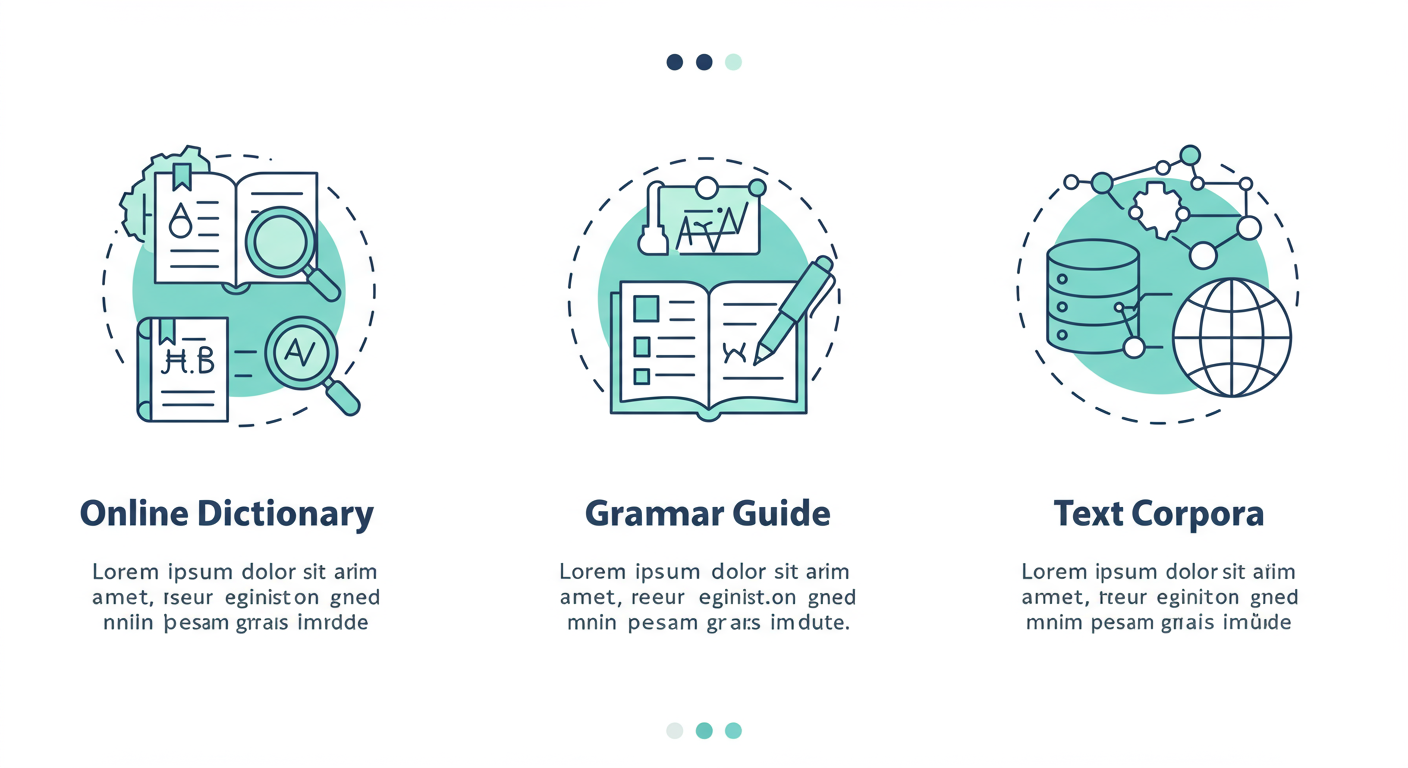
You wouldn’t try to build a car with just a hammer. Likewise, you can’t translate a dead language without the right academic tools. Forget the app store; your best resources are digital archives of scholarly work. Based on our experience, a hybrid approach using these tools is most effective.
1. The Dictionary: Your Word-Hoard
This is non-negotiable. Your primary resource must be the Bosworth-Toller Anglo-Saxon Dictionary. It’s the most comprehensive lexicon ever compiled, and it’s available online for free. It doesn’t just give you a word; it gives you definitions, usage examples from real texts, and crucial grammatical information.
2. The Grammar Guide: Your Blueprint
A dictionary gives you the bricks, but a grammar guide teaches you how to build the house. Peter S. Baker’s Introduction to Old English is the gold standard for learners. It’s clear, comprehensive, and built for self-study. You need it to understand how to conjugate verbs and decline nouns—the heart of the translation process.
3. The Corpus: Your Context-Checker
How do you know if a phrase “sounds right”? You check it against what actual Anglo-Saxons wrote. A corpus is a searchable database of Old English texts. It allows you to see how a word was actually used, what other words it appeared with, and in what context. This is an advanced step, but it’s what separates good translations from great ones.
💡 Pro Tip
When using a dictionary, don’t just grab the first definition. Read the full entry. A modern word like ‘man’ could be wer (adult male, warrior), mann (person, human being), or guma (a more poetic term). Context is everything, and the dictionary entries provide the clues you need to choose correctly.
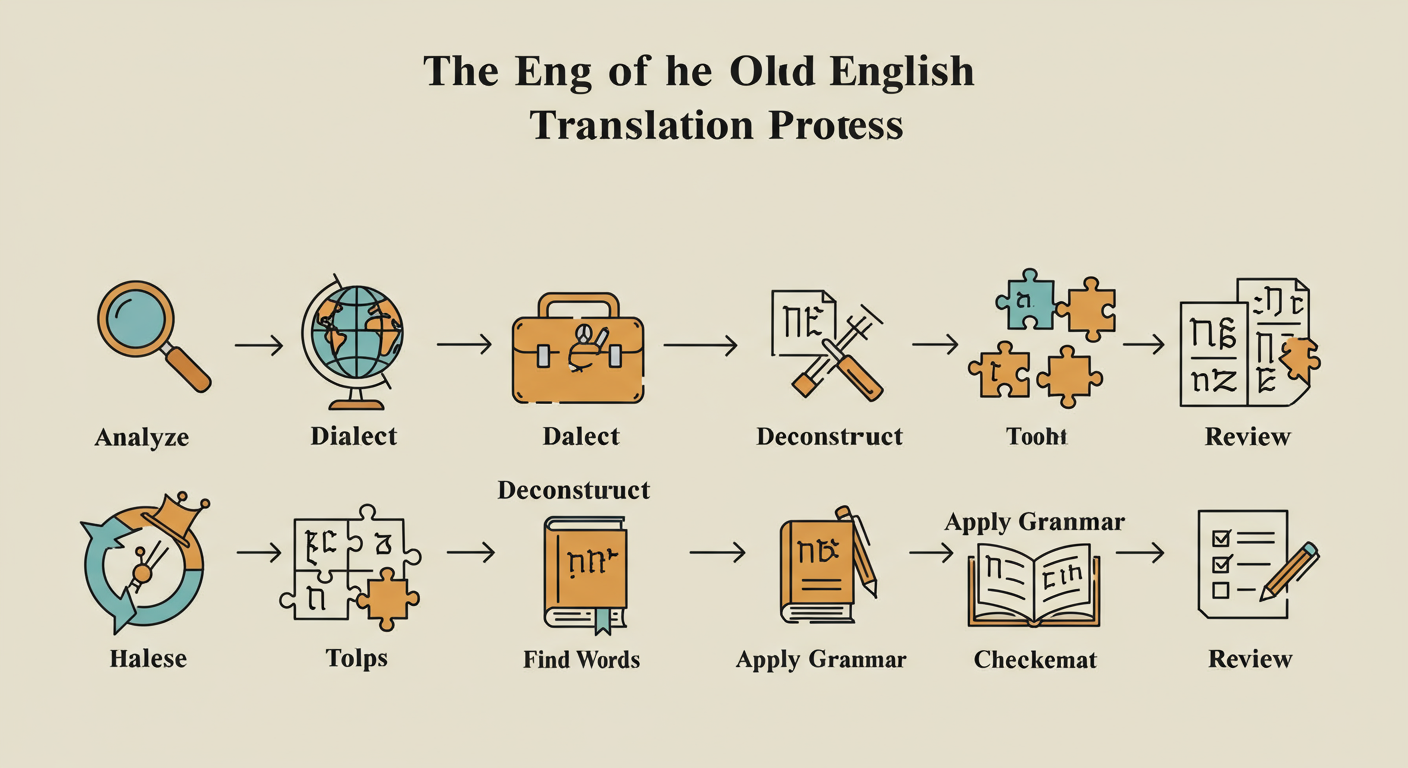
The 7-Step Method to Translate to Anglo-Saxon
Ready to get your hands dirty? This is the methodical process that scholars use. Rushing this guarantees mistakes. Follow the steps, and you’ll build a translation on a solid foundation.
Step 1: Interrogate Your Modern Sentence
Before you touch an Old English dictionary, dissect your source text. What does it really mean? Are you using idioms or modern concepts? A phrase like “let’s touch base” is meaningless for a literal translation. You have to rephrase it to its core meaning: “we should speak later.” Identify and eliminate any concepts that wouldn’t exist in 10th-century England (e.g., ‘internet,’ ‘democracy,’ ‘stress’).
Step 2: Pick Your Dialect (The Easy Choice)
There wasn’t just one “Anglo-Saxon.” There were four major dialects. For 99% of learners, the choice is simple: Late West Saxon. It’s the dialect of King Alfred the Great and the form in which most major texts, including the famous Beowulf manuscript, were preserved. All the best learning resources are based on it.
Step 3: Deconstruct the Grammar
Map out your modern sentence. Identify the subject, the verb, the direct object, the indirect object, and any adjectives or adverbs. This grammatical blueprint is what you’ll reconstruct in Old English.
Example: “The brave warrior gives the king a sharp sword.”
- Subject: The brave warrior
- Verb: gives
- Indirect Object: the king
- Direct Object: a sharp sword
Step 4: Hunt for the Right Words
Now, open Bosworth-Toller. Look up each core word (warrior, give, king, sword). Pay close attention to the notes. Is the noun masculine, feminine, or neuter? Is the verb “strong” or “weak”? This information is vital for the next step. Write down the “dictionary form” of each word (the nominative singular for nouns, the infinitive for verbs).
Step 5: Apply the Grammar (The Hard Part)
This is where the magic happens. Using your grammar guide, you must correctly inflect every word based on the blueprint from Step 3.
- The Subject stays in the nominative case.
- The Direct Object must be put into the accusative case.
- The Indirect Object must be put into the dative case.
- Adjectives must agree with the noun they describe in case, gender, and number.
- The Verb must be conjugated to agree with the subject (e.g., third-person singular).
Trust me on this one: this step takes patience. You’ll be flipping back and forth between your grammar tables and your sentence. It’s supposed to be slow.
Step 6: Assemble the Sentence
Arrange your newly inflected words. While Old English word order is flexible, a common pattern is Subject-Verb-Object (SVO) or putting the verb at the end (SOV). For clarity, starting with SVO is safest for learners.
Step 7: Review and Refine
Read your sentence aloud. Does it flow? Check your work against examples in your grammar guide. Did you match the adjective endings to the noun endings correctly? A single wrong letter can change the meaning entirely. This is your quality control step.
A Practical Walkthrough: Translating a Sentence Step-by-Step
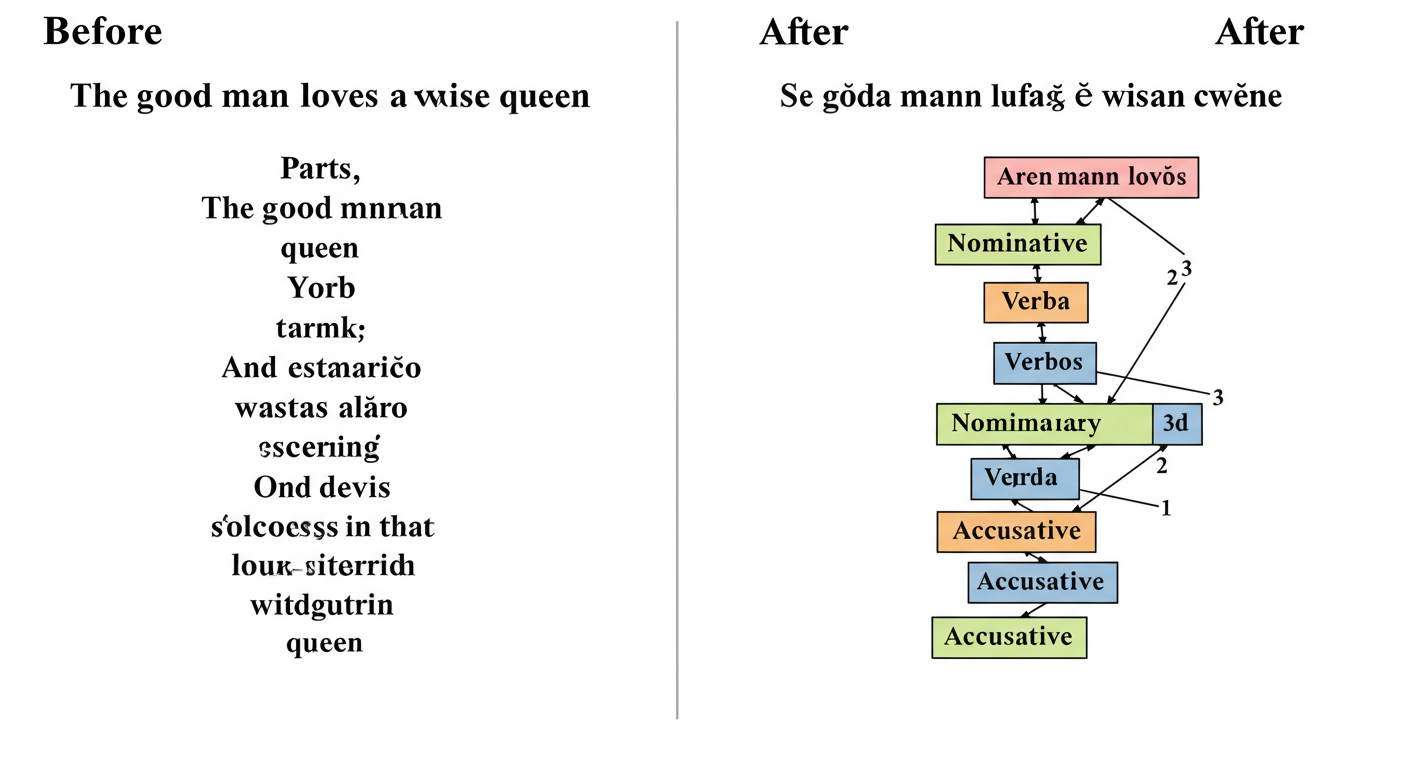
Let’s put it all together. Our sentence: “The good man loves the wise queen.”
1. Deconstruct:
- Subject: The good man
- Verb: loves
- Direct Object: the wise queen
2. Word-Finding & Grammar Notes:
- man: mann (masculine noun)
- good: gōd (adjective)
- love: lufian (weak verb, class 2)
- queen: cwēn (feminine noun)
- wise: wīs (adjective)
3. Apply Inflections:
- Subject: “The good man” is the subject, so it’s in the nominative case. The masculine nominative singular forms are: se gōda mann.
- Verb: “loves” is third-person singular present. For lufian, this is lufaþ.
- Direct Object: “the wise queen” is the direct object, so it needs the accusative case. The feminine accusative singular forms are: þā wīsan cwēne.
Notice how everything changes? sēo (the, fem. nom.) becomes þā (the, fem. acc.). wīs becomes wīsan. cwēn becomes cwēne.
4. Assemble:
Putting it all together, we get: Se gōda mann lufaþ þā wīsan cwēne.
This process demonstrates that translation is an act of reconstruction, not just substitution.
🎯 Key Takeaway
To accurately translate to Anglo-Saxon, you must abandon modern English word order as your guide. Instead, focus on learning the case system to change word endings correctly. This grammatical reconstruction, supported by scholarly tools, is the only path to an authentic translation.
The Most Common Translation Traps (and How to Avoid Them)
After helping countless learners, I’ve seen the same mistakes trip people up again and again. Being aware of them is half the battle.
| The Trap (Common Mistake) | The Fix (Correct Approach) |
|---|---|
| Literal Idiom Translation | Rephrase the idiom into its core, literal meaning before you start translating. “Raining cats and dogs” becomes “raining heavily” (hit rīneþ swīðe). |
| Ignoring Word Gender | Always check the gender (m, f, n) of a noun in the dictionary. The gender determines which endings its articles and adjectives will take. It’s often not logical! |
| Mixing Dialects | Stick to one dialect, almost always Late West Saxon. Mixing words from Northumbrian and Kentish sources will create an incoherent and historically inaccurate sentence. |
| Using Modern Syntax | While SVO is acceptable, study real Old English texts to get a feel for poetic word order, like placing the verb at the end (SOV). This adds a layer of authenticity. |
⚠️ Watch Out
Be extremely careful with abstract concepts. Words like ‘freedom’ (frēodōm) existed, but they carried different cultural weight. Concepts like ‘science’ or ‘technology’ did not. You can’t find a one-to-one word. You must describe the idea using the available vocabulary (e.g., ‘knowledge of nature’ or ‘skill of crafting’).
💡 Pro Tip
When in doubt, simplify. A complex modern sentence with multiple clauses is incredibly difficult to translate well. Break it down into two or three shorter, simpler sentences. Clarity and grammatical correctness are far more important than trying to replicate complex modern syntax.
❓ Frequently Asked Questions
Can I use Google Translate for Anglo-Saxon?
Absolutely not. Google Translate and similar AI tools do not support Old English. Any third-party site claiming to offer this service is using a flawed algorithm that cannot handle the complex grammar and will produce incorrect, often nonsensical, results.
What’s the difference between ‘Anglo-Saxon’ and ‘Old English’?
They refer to the same language. ‘Old English’ is the term preferred by modern linguists and academics as it shows the language’s place in the historical timeline (Old -> Middle -> Modern English). ‘Anglo-Saxon’ is an older term that is still widely used and understood, often referring to the people and culture as well as the language.
Is Old English the same as Old Norse?
No, though they are related. Both are Germanic languages and share some vocabulary, but their grammar and phonology are distinct. Old English was spoken in England, while Old Norse was the language of the Vikings. They influenced each other heavily, especially in the north of England, but a speaker of one could not easily understand the other.
How long does it take to learn to translate to Old English?
It depends on your dedication. To translate simple sentences accurately, expect to spend several months studying the grammar. Achieving a high level of proficiency can take years of practice. According to language acquisition research, having experience with another inflected language, like German, Latin, or Russian, can significantly speed up the process.
What’s the best book for learning Old English grammar?
For self-learners, the consensus among experts is Peter S. Baker’s Introduction to Old English. It is exceptionally well-structured, provides clear explanations, and includes exercises to test your knowledge. It’s the resource I recommend to everyone starting out.
Your Journey into the Word-Hoard
To translate to Anglo-Saxon is to become a linguistic detective. It’s a puzzle, a challenge, and a profound way to connect with the minds that shaped our world a millennium ago. It demands patience and a respect for the intricate science of the language.
Don’t look for shortcuts. Embrace the process. Start with the right tools—a solid dictionary and a grammar guide—and follow the methodical steps. Break down your sentences, honor the case system, and check your work.
Your first translations might be simple, but they will be real. And that authenticity is a reward far greater than any instant, inaccurate result from a faulty generator. Now, go open the word-hoard. Wæs þū hāl! (Be thou well!)

