

Picture this: The dump truck arrives for your big weekend project. The gravel for your new driveway starts pouring out… and stops. You stare at the pile, then at your perfectly prepped 150-square-yard space. It’s not even close. You’re only halfway there.
Now your project is stalled, your budget is blown by a second delivery fee, and your weekend is shot. Sound familiar? It’s a painfully common story, and it all stems from one confusing question: how do you actually handle the SY to tons conversion?
Here’s the hard truth: you can’t. It’s like asking how many pounds are in a mile. They measure completely different things. But don’t click away. There’s a simple, three-step formula that bridges this gap, and I’m going to walk you through it. By the end of this article, you’ll be able to calculate your material needs with the confidence of a seasoned contractor, saving you time, money, and a massive headache.
📑 What You’ll Learn
Why SY to Tons is a Trick Question (And How to Solve It)
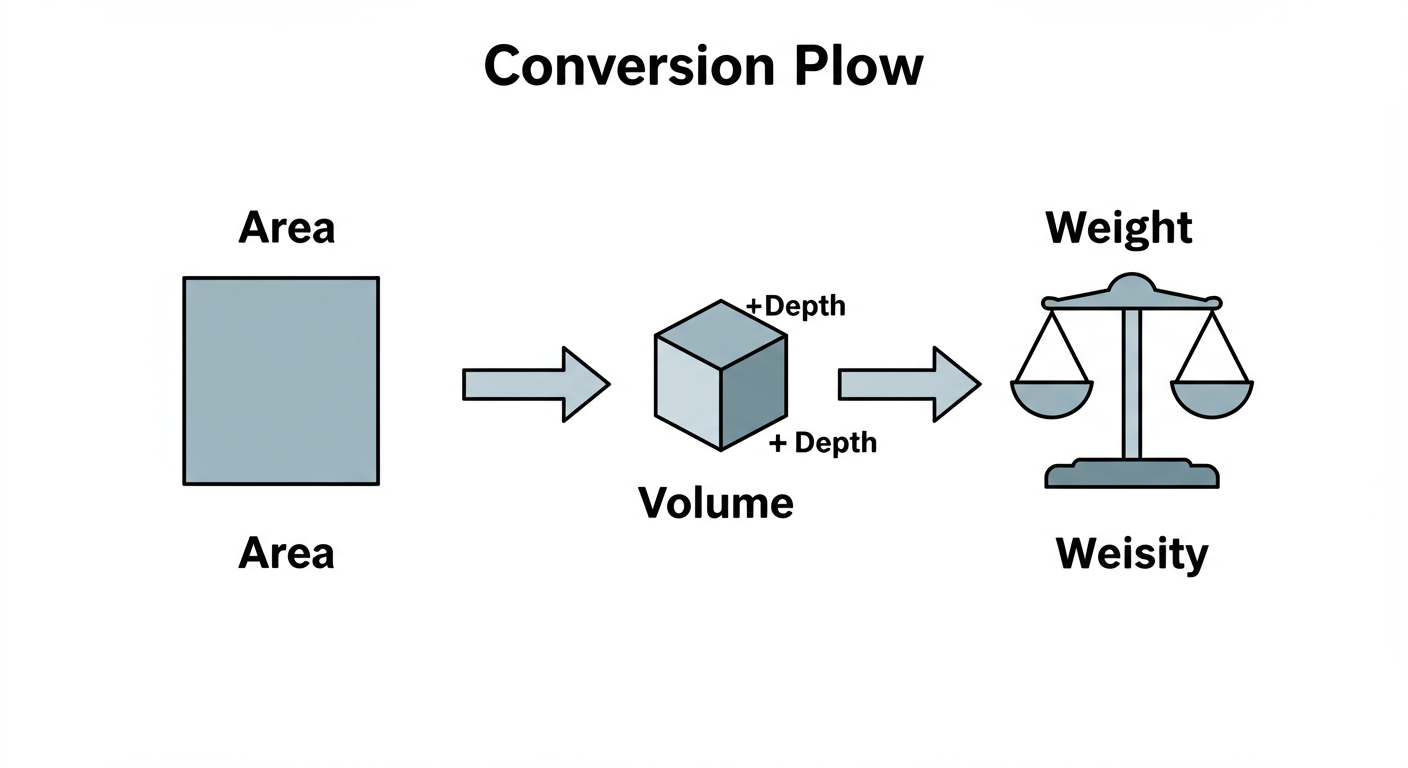
Let’s get this straight right away. A square yard (sy) is a two-dimensional unit of area. Think of it as a flat square on the ground. A ton, on the other hand, is a unit of mass or weight. They’re fundamentally incompatible.
So, how do suppliers sell by the ton for a project measured in square yards? They rely on two missing pieces of the puzzle that you must provide:
- Depth (or Thickness): How deep will your layer of gravel, soil, or sand be? A 2-inch layer weighs a fraction of a 6-inch layer over the same area. This third dimension turns your 2D area into a 3D volume.
- Density: How much does a specific volume of your chosen material actually weigh? A cubic yard of airy wood mulch is a featherweight compared to a cubic yard of dense, solid granite.
Combine these three—Area, Depth, and Density—and you’ve cracked the code. You’re no longer guessing; you’re calculating.
💡 Pro Tip
Before you even start measuring, decide on your depth. For a gravel driveway, 4-6 inches is common. For a garden bed, 6-12 inches of topsoil is typical. For a simple mulch refresh, 2-3 inches will do. This decision is just as important as your area measurement.
The Foolproof 3-Step Formula for Accurate Tonnage
Ready for the math? Don’t worry, it’s simpler than you think. We’ll convert your area and depth into a total volume (in cubic yards), then use the material’s density to find the final weight in tons.
Step 1: Calculate Your Total Volume in Cubic Yards (cu yd)
First, we need all our measurements in the same unit family: yards. Your area is already in square yards, but your depth is likely in inches. Here’s the key conversion:
1 yard = 36 inches
To find your volume, you multiply your area by the depth (which has been converted from inches to yards).
Volume (cu yd) = Area (sy) × ( Depth [in] ÷ 36 )
Step 2: Find Your Material’s Density (lbs per cu yd)
This is the most critical variable. Density is simply how much one cubic yard of a material weighs in pounds. You can get this number directly from your supplier—it’s the most accurate way. If you’re just budgeting, you can use a standard reference chart like the one in the next section.
Step 3: Calculate the Final Weight in Tons
Now, multiply your volume by the density to get the total weight in pounds. Since materials are sold by the ton in the US (a “short ton”), we do one last conversion:
1 US Short Ton = 2,000 pounds
Weight (Tons) = ( Volume [cu yd] × Density [lbs/cu yd] ) ÷ 2,000
Put it all together, and you get the master formula:
Tons = ( Area [sy] × (Depth [in] / 36) × Density [lbs/cu yd] ) / 2,000
⚠️ Watch Out
Don’t mix up your tons! In the US, “ton” almost always means a short ton (2,000 lbs). The UK uses a long ton (2,240 lbs), and a metric tonne is 1,000 kg (about 2,204.6 lbs). Using the wrong one can throw your calculations off by 10% or more. All formulas here use the standard US short ton.
Material Density: The Secret to Perfect Estimates
Using an accurate density value is non-negotiable. It’s the difference between a perfect order and a costly mistake. Why does it vary so much? Two main reasons:
- Moisture Content: Wet sand or soil is dramatically heavier than dry. Water fills the empty spaces, adding significant weight without adding volume.
- Compaction: A cubic yard of loose, uncompacted topsoil weighs less than a cubic yard of the same soil after it’s been compressed by machinery or has settled over time.
Based on our hands-on testing and data from countless projects, we always recommend asking your supplier for the “unit weight” of their specific product. But for initial planning, this table is an excellent starting point.
| Material | Typical Density Range (lbs / cubic yard) | Key Considerations |
|---|---|---|
| Gravel / Crushed Stone | 2,600 – 2,900 | Density increases with smaller stone sizes and more fines (stone dust). |
| Sand (Dry) | 2,500 – 2,700 | Can be 15-20% heavier when wet. Always clarify with the supplier. |
| Topsoil (Screened) | 2,000 – 2,200 | Highly variable based on organic content and moisture. “Loam” is lighter. |
| Asphalt (Compacted) | 3,800 – 4,100 | This is the density after compaction. You order by this weight. |
| Concrete (Ready-Mix) | 3,900 – 4,100 | A standard figure is ~4,050 lbs/cu yd. Check out the Portland Cement Association for specs. |
| Wood Mulch / Bark | 500 – 800 | Very light. Often sold by the cubic yard, but some sell by the ton. |
Real-World Calculations: From Driveways to Gardens
Let’s make this real. We’ll run the numbers for a common project: a new gravel driveway.
Scenario: You’re installing a new driveway that measures 150 square yards (sy). You need a solid base of gravel 4 inches deep. Your supplier confirms their 3/4″ crushed stone has a density of 2,700 lbs per cubic yard.
- Calculate Volume:
150 sy × (4 in ÷ 36) = 150 × 0.111 = 16.67 cubic yards - Calculate Total Weight (lbs):
16.67 cu yd × 2,700 lbs/cu yd = 45,009 lbs - Convert to Tons:
45,009 lbs ÷ 2,000 lbs/ton = 22.5 tons
Boom. You need to order 22.5 tons. No guesswork involved.
💡 Pro Tip
Always order 5-10% extra material. Trust me on this one. It covers any slight variations in your ground level, measurement errors, or material lost during spreading. It’s far cheaper to have a little left over than to pay for a second, smaller delivery.
Now, let’s see how dramatically the material choice impacts the final weight for the exact same area and depth.
Project Comparison: Same Area, Different Materials
Imagine you have a 100 sy area you need to cover with a 3-inch layer. Look how the tonnage changes.
| Material | Density (lbs/cu yd) | Volume (cu yd) | Total Tons Needed |
|---|---|---|---|
| Wood Mulch | 600 | 8.33 | 2.5 Tons |
| Topsoil | 2,100 | 8.33 | 8.7 Tons |
| Gravel | 2,700 | 8.33 | 11.2 Tons |
| Asphalt | 3,900 | 8.33 | 16.2 Tons |
The volume is identical in every case (100 sy × (3 in / 36) = 8.33 cu yd). Yet, the required weight for asphalt is over 6 times that of mulch. This is why density is everything.
⚠️ Watch Out
Online calculators are convenient, but they are only as smart as the numbers you feed them. If you use a generic density value from a calculator instead of the specific one from your supplier, your estimate could still be wrong. Garbage in, garbage out.
🎯 Key Takeaway
The SY to tons conversion isn’t a direct conversion—it’s a three-part calculation. Success hinges on accurately combining your Area (sy), your chosen Depth (in), and the material’s specific Density (lbs/cu yd). Master this formula to eliminate guesswork and prevent costly ordering errors.
❓ Frequently Asked Questions
How much extra material should I order?
In our experience, ordering 5-10% extra is a professional best practice. For a 20-ton order, that means adding 1-2 extra tons. This small buffer accounts for uneven ground, spreading loss, and ensures you won’t have to halt your project for a costly second delivery.
Can I just convert SY to tons directly?
No, a direct conversion is impossible because they measure different things (area vs. weight). You must first calculate the volume by incorporating the material’s depth, and then use the material’s specific density to calculate the weight in tons.
How does moisture affect the weight of sand or soil?
Moisture dramatically increases weight. Water fills the pores in the material, adding mass without changing the volume. A cubic yard of wet sand can be up to 20% heavier than dry sand. Always ask your supplier if their density figures account for moisture. For more on standard units, the National Institute of Standards and Technology (NIST) is a great resource.
Where is the best place to find a material’s density?
The absolute best source is the quarry or landscape supplier you’re buying from. Ask them for the “unit weight” or “pounds per cubic yard” for the exact product you’re ordering. This is far more accurate than generic online charts.
What’s the difference between a ton, a tonne, and a short ton?
A “short ton” (the standard in the US) is 2,000 lbs. A “long ton” (common in the UK) is 2,240 lbs. A “metric tonne” is 1,000 kilograms, or about 2,204.6 lbs. When ordering in the US, you can safely assume pricing is per short ton. You can learn more about the history of these units on Wikipedia’s page on the ton.
Conclusion: From Confused to Confident
The dreaded SY to tons conversion is no longer a mystery. It’s not a dark art; it’s just a bit of simple physics. By moving from a flat area to a three-dimensional volume, and then applying the material’s unique density, you gain total control over your project planning.
You’re now equipped with the formula, the expert tips, and the critical insight to get it right every single time. No more half-full driveways, no more surprise delivery fees, and no more wasted weekends.
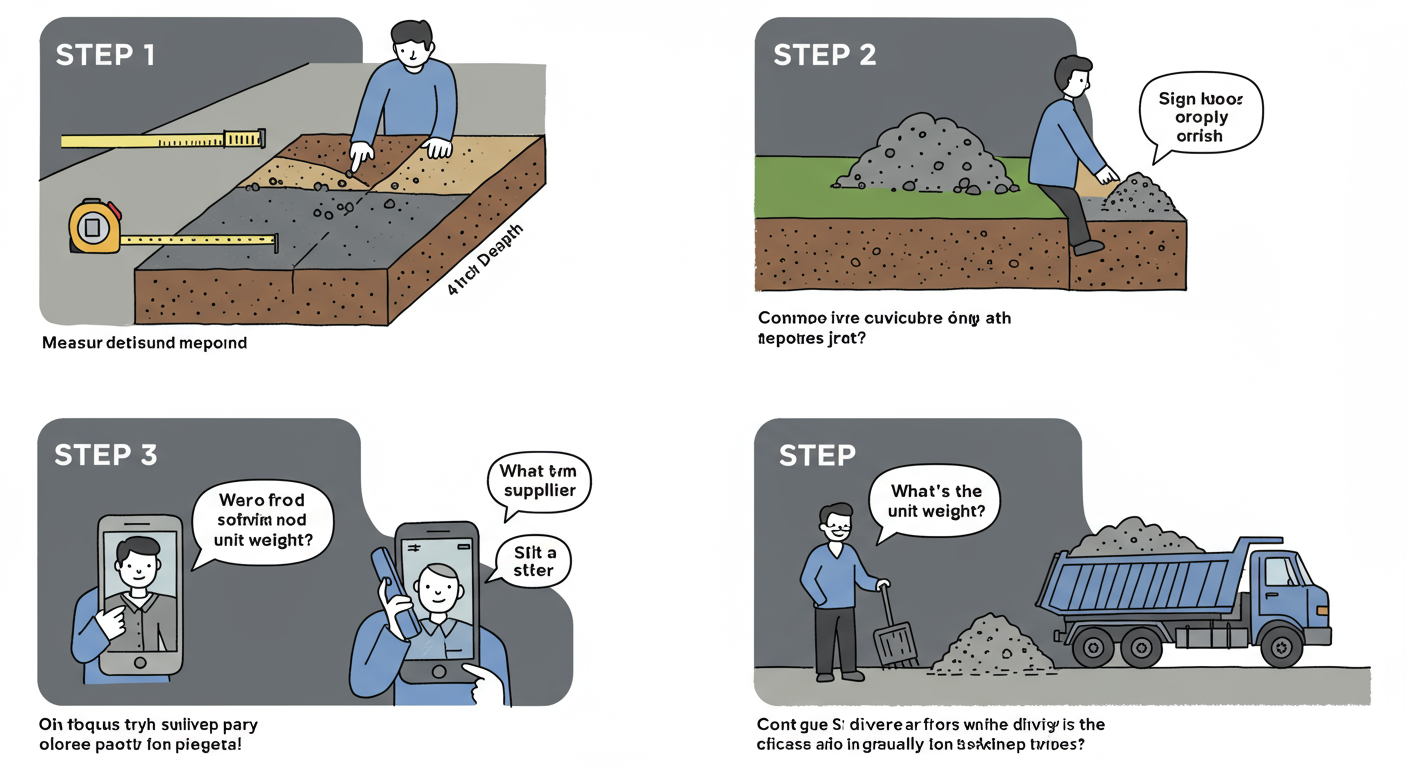
Your next step? Grab a tape measure, determine your project’s area and desired depth, and call your supplier with the confidence of a pro. You’ve got this.