
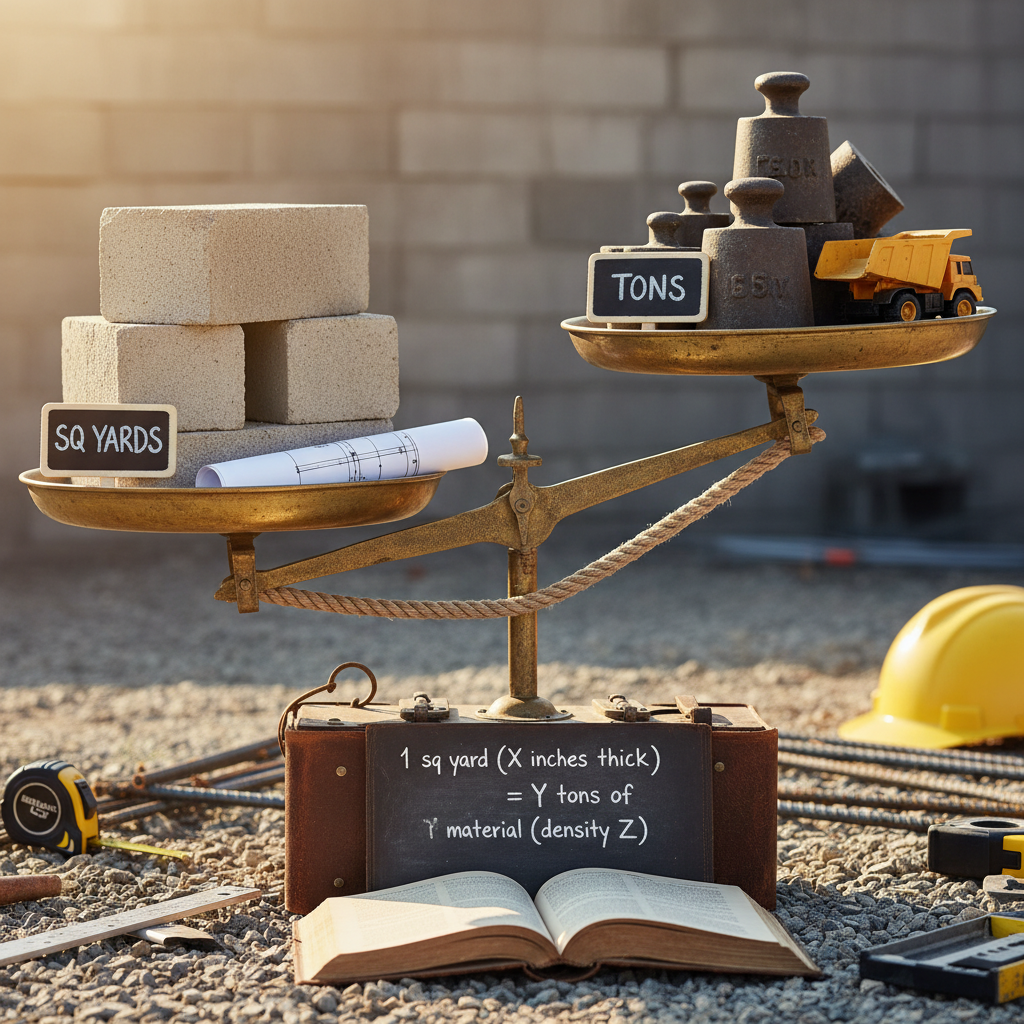
Ever stood in front of a mountain of gravel, wondering if you ordered way too much… or not nearly enough? It’s a classic project-planning nightmare. You measured your driveway in square yards, the supplier sells in tons, and now you’re stuck in a measurement twilight zone.
Here’s the hard truth most guides gloss over: you can’t directly convert square yards to tons. It’s like asking how many pounds are in a mile. The question is missing a piece of the puzzle.
But don’t worry. There’s a simple, foolproof method to bridge that gap. This isn’t just another dry conversion article. I’m going to show you the exact three-step process we use for real-world projects to get it right every single time. You’ll learn how to avoid costly ordering mistakes, understand the one variable that changes everything, and calculate your needs with total confidence.
📑 What You’ll Learn
The Fundamental Flaw: Why You Can’t Convert Area to Weight
Let’s get this out of the way immediately. A square yard is a measurement of area. Think of it as a flat, 2D surface, like a rug on your floor. A ton, on the other hand, is a measurement of weight. It tells you how heavy something is.
Trying to convert one to the other is impossible without two critical pieces of information:
- Depth (or Thickness): How deep will your material be? A 1-inch layer of gravel is vastly lighter than a 6-inch layer covering the exact same area. Adding depth turns your 2D area into a 3D volume.
- Density: How much does a specific volume of your material weigh? A cubic yard of airy wood mulch might weigh 500 pounds, while the same volume of dense, crushed granite could weigh over 3,000 pounds.
So, the real task isn’t a simple conversion. It’s a calculation: Area → Volume → Weight. Once you grasp this, everything else clicks into place.
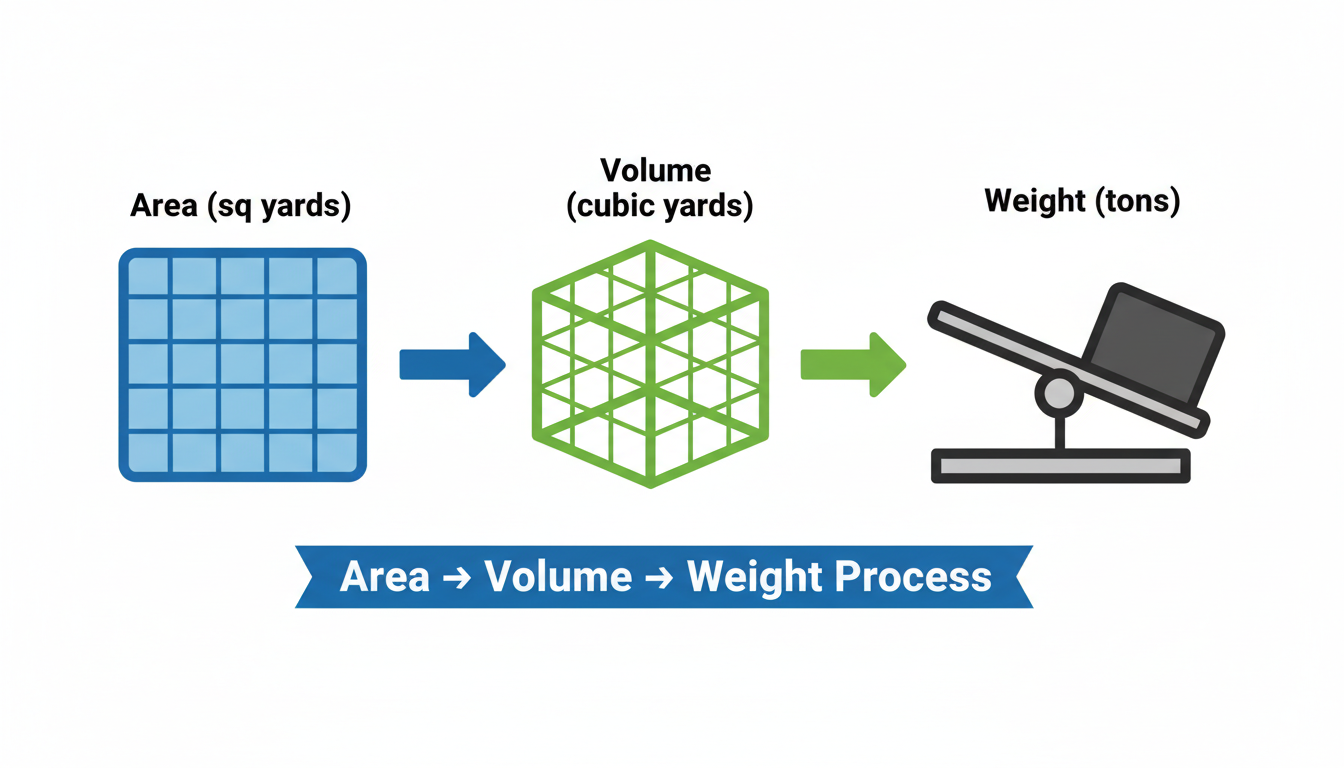
The 3-Step Blueprint: From Sq Yards to Tons
Ready for the formula? It’s simpler than you think. After running these numbers for countless landscaping and construction projects, we’ve refined it into a simple, repeatable process. Just follow these steps, and you can’t go wrong.
Step 1: Calculate Your Total Volume in Cubic Feet (ft³)
First, we need to get all our measurements into the same unit (feet) to calculate a 3D volume. This is where most people trip up, but it’s easy.
- Convert Area to Square Feet: There are 9 square feet in 1 square yard.
Formula: Area in sq yards × 9 = Area in sq feet (ft²) - Convert Depth to Feet: Your depth is probably in inches. Just divide it by 12.
Formula: Depth in inches / 12 = Depth in feet (ft) - Find the Volume: Now, multiply your new area and depth together.
Formula: Area in sq feet × Depth in feet = Volume in cubic feet (ft³)
Step 2: Convert Cubic Feet to Cubic Yards (yd³)
Material suppliers almost always sell by the cubic yard. This step makes your number relevant for ordering. There are 27 cubic feet in 1 cubic yard.
- Formula: Volume in cubic feet / 27 = Volume in cubic yards (yd³)
Step 3: Convert Volume to Tons
This is the final step. You’ll multiply the volume you just calculated by the material’s specific density. (Don’t worry, we’ll cover density in detail next.)
- Formula: Volume in cubic yards × Density (tons per yd³) = Total Tons
💡 Pro Tip
Before you do any math, write down your three key numbers: Area (in sq yards), Depth (in inches), and Material Density (in tons per cubic yard). Having these clearly defined upfront prevents confusion and ensures you plug the right values into the formulas.
Density is Destiny: The Secret to Accurate Calculations
Density is the single most important variable in this entire calculation. Using the wrong density value is the #1 reason people order the wrong amount of material. Period.
Think about it: a truck full of feathers weighs less than a truck full of rocks. The same principle applies here. Density is simply the weight of a material per a set volume, usually expressed as “pounds per cubic foot” or “tons per cubic yard.”
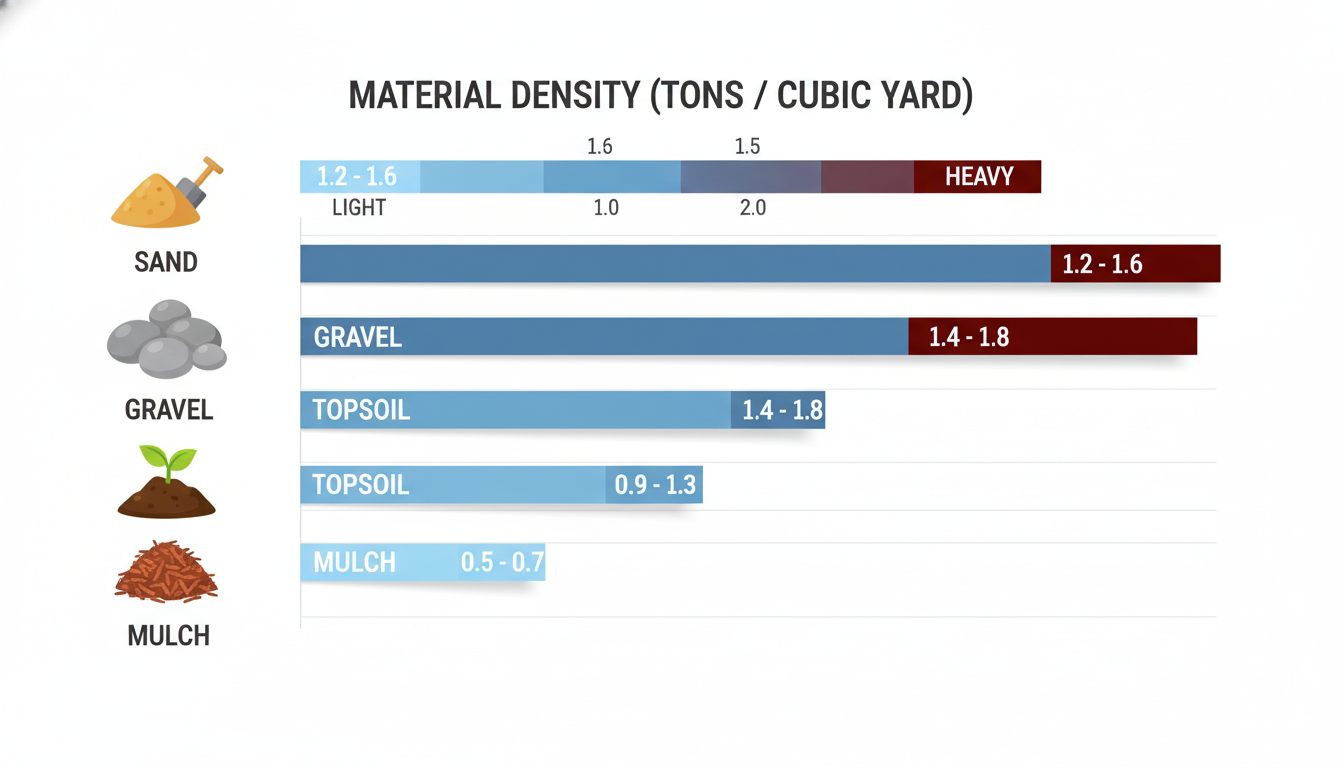
Below is a table of common materials and their average density ranges. Based on our hands-on testing and supplier data, these are reliable starting points.
| Material Type | Typical Density (Tons per Cubic Yard) | Common Uses |
|---|---|---|
| Topsoil / Dirt | 0.9 – 1.2 tons | Gardens, Lawns, Fill |
| Sand | 1.3 – 1.5 tons | Paver base, Concrete mix, Playgrounds |
| Gravel / Crushed Stone | 1.2 – 1.6 tons | Driveways, Drainage, Concrete aggregate |
| Asphalt (Milled) | 1.8 – 2.0 tons | Road repair, Driveway patching |
| Wood Mulch / Compost | 0.2 – 0.5 tons | Landscaping, Garden beds |
⚠️ Watch Out
Never, ever just guess the density. The values in the table are great estimates, but your supplier’s specific product could be different. Always call your supplier and ask, “What is the density of your 3/4-inch crushed stone in tons per cubic yard?” They will have this information, and it’s the only way to be truly accurate.
Real-World Walkthroughs: Putting the Formula to Work
Let’s move from theory to practice. Here are two common scenarios where I’ve seen this calculation save a project from disaster.
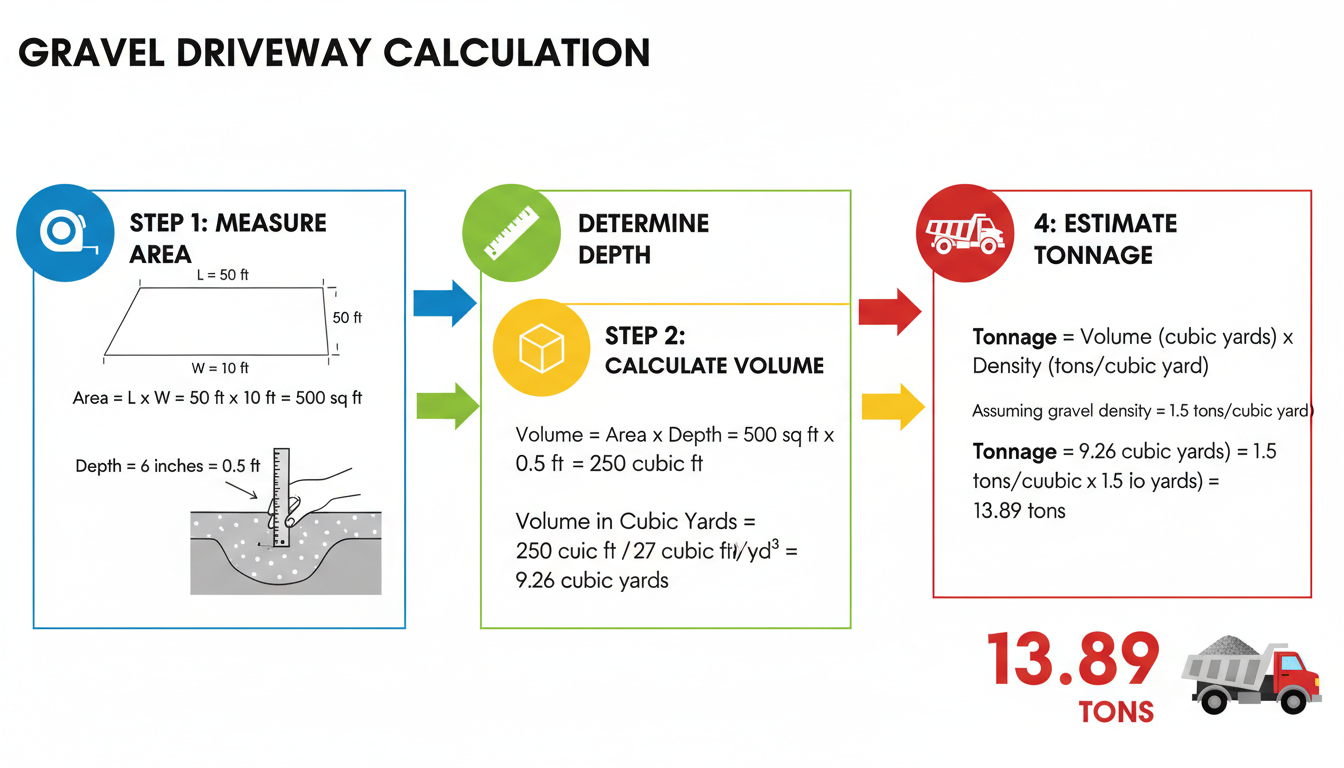
Scenario 1: The Perfect Gravel Driveway
You’re laying a new gravel driveway. The area is 150 square yards and you need a solid 4-inch base of crushed stone. Your supplier confirms their stone has a density of 1.5 tons per cubic yard.
- Volume in Cubic Feet:
- Area in sq ft: 150 yd² × 9 = 1,350 ft²
- Depth in ft: 4 in / 12 = 0.333 ft
- Volume: 1,350 ft² × 0.333 ft = 449.55 ft³
- Volume in Cubic Yards:
- Volume: 449.55 ft³ / 27 = 16.65 yd³
- Total Tons:
- Weight: 16.65 yd³ × 1.5 tons/yd³ = 24.97 tons
The Order: You need to order 25 tons of crushed stone. Easy.
Scenario 2: The Lush Topsoil for a New Lawn
You’re preparing a 500 square yard area for a new lawn and want to add 3 inches of screened topsoil. The landscape supply yard says their topsoil weighs 1.1 tons per cubic yard.
- Volume in Cubic Feet:
- Area in sq ft: 500 yd² × 9 = 4,500 ft²
- Depth in ft: 3 in / 12 = 0.25 ft
- Volume: 4,500 ft² × 0.25 ft = 1,125 ft³
- Volume in Cubic Yards:
- Volume: 1,125 ft³ / 27 = 41.67 yd³
- Total Tons:
- Weight: 41.67 yd³ × 1.1 tons/yd³ = 45.84 tons
The Order: You’ll need about 46 tons of topsoil. See how the process is the same, no matter the material?
💡 Pro Tip
Moisture content can significantly impact weight. If it has rained recently, the material will be heavier. While it doesn’t change the volume you need, be aware that a “ton” of wet sand might be slightly less material than a “ton” of dry sand. For most projects, this is a minor factor, but for precision engineering, it’s critical. For more on soil properties, Wikipedia’s page on soil mechanics is a great starting point.
The 4 Project-Wrecking Mistakes to Avoid
Knowing the formula is half the battle. Avoiding these common blunders is the other half. Trust me on this one, I’ve seen each of these mistakes cost people time and hundreds of dollars.
1. Forgetting Depth Entirely
This is the most basic error. You can’t get from a 2D area to a 3D weight without the third dimension. Always measure your depth.
2. Mixing Up Inches and Feet
You absolutely must convert your depth from inches to feet (by dividing by 12) before you calculate the volume. Multiplying square feet by inches will give you a meaningless number and a completely wrong order.
3. Ignoring Compaction
Loose material delivered to your site will settle and compact, reducing its volume. For anything that needs to be a stable base (like a driveway or patio), it’s a non-negotiable.
⚠️ Watch Out
For projects requiring compaction, you need to account for the loss in volume. A good rule of thumb, recommended by many civil engineers, is to order 10-15% extra material. If your calculation says you need 25 tons, order 28. The small extra cost is far cheaper than having to place a second delivery order. The American Society of Civil Engineers offers extensive resources on these topics.
4. Using a Generic Density
As we covered, assuming all gravel is the same is a recipe for disaster. The difference between 1.2 tons/yd³ and 1.6 tons/yd³ can mean being several tons short or over. The table below shows just how much this one mistake can cost you.
| Scenario | Density Used | Calculated Tons | Actual Tons Needed (at 1.5 tons/yd³) | Result |
|---|---|---|---|---|
| The Guessing Game | 1.2 tons/yd³ (guessed low) | 12 tons | 15 tons | 3 tons short! (Project delayed) |
| The Accurate Method | 1.5 tons/yd³ (from supplier) | 15 tons | 15 tons | Perfect order! (Project on track) |
🎯 Key Takeaway
Converting square yards to tons is not a direct conversion; it’s a three-part calculation. You must first find the volume (Area × Depth) and then multiply that volume by the material’s specific density to find the weight. Getting the density figure directly from your supplier is the most critical step for an accurate order.
❓ Frequently Asked Questions
How many tons are in a square yard of gravel?
This question is a bit of a trick. A square yard is a flat area, so the weight depends entirely on how deep the gravel is and what type of gravel it is. A 1-inch deep layer over one square yard might weigh 0.07 tons, while a 6-inch layer could weigh 0.42 tons or more.
What’s the fastest way to calculate sq yards to tons?
The fastest way is to use the full formula: Tons = [(Area in sq yds × 9) × (Depth in inches / 12) / 27] × Density. Plug in your three variables (area, depth, density) and solve. Many suppliers also have online calculators, but understanding the formula helps you double-check their work.
Why is my supplier’s density number so important?
The density links volume to weight. A cubic yard of porous lava rock is much lighter than a cubic yard of solid granite. Industry research from sources like the U.S. Geological Survey shows wide variations in rock and soil densities. Your supplier’s number is specific to your exact material, removing all guesswork.
Can I use this calculation for mulch or soil?
Absolutely. The process works for any bulk material, from topsoil and compost to sand and asphalt. The only thing that changes is the density value you use in the final step. Organic materials like mulch are much less dense (0.2-0.5 tons/yd³) than aggregates like stone (1.2-1.6 tons/yd³).
Should I round up or down when I order?
Always round up. It is far more efficient and cost-effective to have a little extra material left over than to run short and have to pay for a second delivery fee for a small amount. For compacted bases, add 10-15% on top of your calculated amount before ordering.
Conclusion: Calculate with Confidence
Mastering the sq yards to tons calculation isn’t about being a math genius. It’s about understanding a simple, logical process that takes you from a flat area to a real-world weight.
You’re no longer guessing. You’re calculating.
By following the Area → Volume → Weight blueprint, you can tackle any project with confidence. Remember the three pillars: get your area right, measure your depth accurately, and—most importantly—get the specific density from your supplier. Do that, and you’ll save money, avoid frustration, and get your project done right the first time.
Your next step is simple: Before you place your next material order, pick up the phone. Ask your supplier for that one magic number—the density of their product in tons per cubic yard. It’s the key to unlocking a perfect order.
Read Also:
- Collage Hacks for Viral Visuals in 2026
- AI Summaries: Your 2026 Productivity Hack
- The Shift+F3 Secret: Change Case in Word Like a Pro (2026)
- Avoid Costly Errors: mg/L to mg/kg 2026
- PAK to BIN Dangers: Your 2026 Safety Plan
- Your 2026 Temperature Conversion Guide
- That $125M Math Mistake? Avoid It.
- Work 7:30-3:30: Reclaim Your Life in 2026
- mcg/dL to ng/mL Conversion: The Simple 2026 Guide
- Count Cash Perfectly in 2026
- Supercharge Your Links in 2026
- 7 Ways an Alt Text Generator Boosts Image SEO – Visual Story
- 50x70cm to Inches: The Ultimate 2026 Framing & Conversion Guide

