
![5 Key Uses for a Tenths to Inches Calculator [Ultimate Guide]](https://toolsriver.com/wp-content/uploads/2026/03/Tenths-to-Inches-Calculator-1772884168.png)
One misplaced decimal. That’s all it took.
A multi-day CNC run on a $50,000 block of aerospace-grade titanium, destined for a jet engine, was now scrap metal. The culprit? Confusing five-thousandths of an inch (0.005″) with five-tenths (0.0005″). A tiny error that cost a fortune. This isn’t a scare story; it’s a reality on shop floors worldwide. And it all comes down to mastering one of the most misunderstood units in precision work: the “tenth.”
Forget everything you think you know about the word “tenth.” In the high-stakes world of engineering, machining, and science, it doesn’t mean 0.1. Not even close.
This guide will make you fluent in the language of precision. You’ll learn not just how to convert tenths to inches in seconds, but why this single skill separates the amateurs from the pros, saving you from costly errors and elevating the quality of your work. Let’s dive in.
📑 What You’ll Learn
What Exactly *Is* a “Tenth”? (And Why It’s Not 0.1 Inches)
Here’s the number one source of confusion, and we need to clear it up immediately. When a machinist or an engineer says “a tenth,” they are using shop-floor shorthand for one ten-thousandth of an inch.
Let that sink in. It’s not a tenth of an inch (0.1″). It’s a ten-thousandth.
- One Tenth (shop talk) = 0.0001 inches
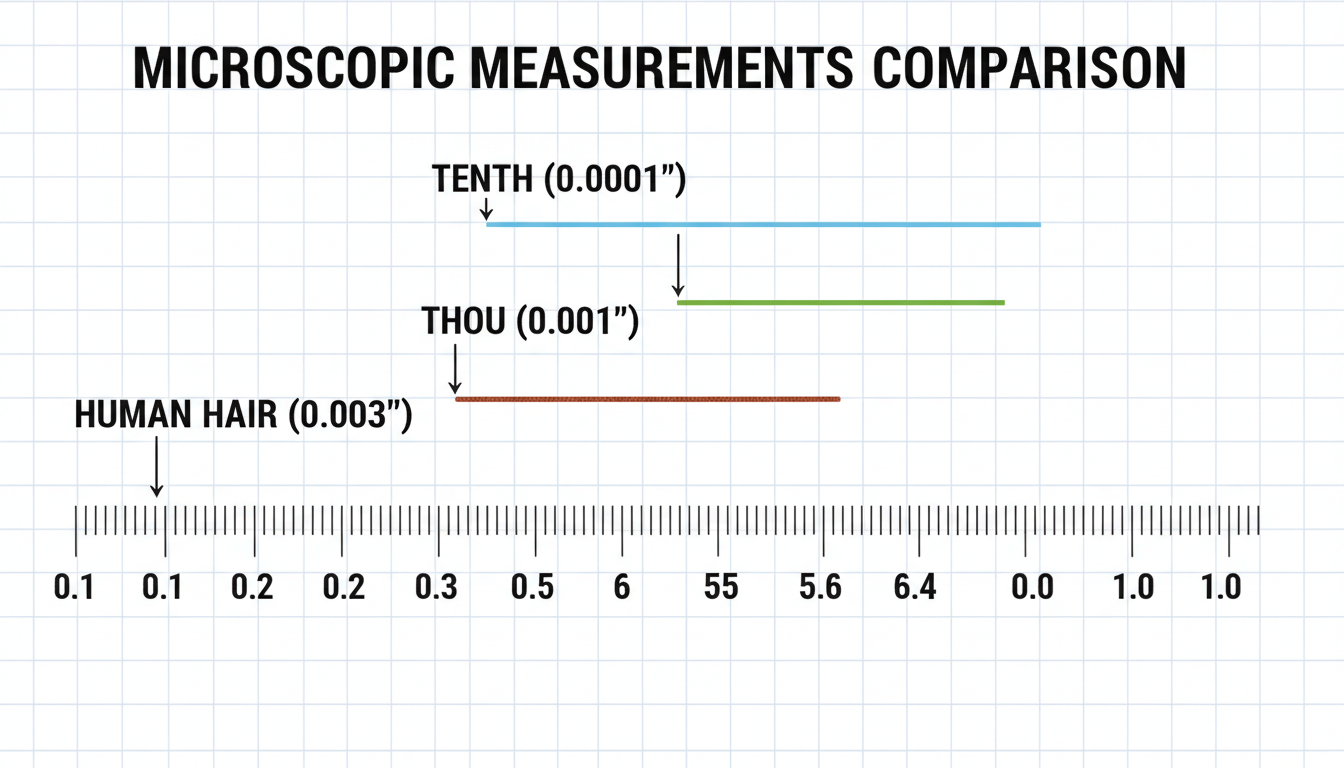
To put that into perspective, the average human hair is about 0.003 inches thick. That means a single “tenth” is 30 times smaller than the width of a human hair. It’s a measurement that is felt, not seen. This is the world of high-tolerance manufacturing, where components must fit together with microscopic perfection.
To make sense of this micro-world, you have to understand the vocabulary. Let’s break down the key players in the imperial measurement system.
| Unit Name | Common Nickname(s) | Value in Inches | Primary Application |
|---|---|---|---|
| Ten-Thousandth | “Tenth” | 0.0001″ | Ultra-high precision tolerances (aerospace, medical implants, optics). |
| Thousandth | “Thou” or “Mil” | 0.001″ | Standard precision in most machining and manufacturing. |
| Inch | “Inch” | 1.0″ | Base unit for general dimensions and less critical features. |
The relationship is simple once you see it: there are 10 “tenths” in 1 “thou,” and 1,000 “thou” in 1 inch. Therefore, there are 10,000 “tenths” in a single inch. Internalizing this hierarchy is the first step toward true mastery.
5 Mission-Critical Fields Where Tenths Reign Supreme
Why all the fuss over 0.0001 inches? Because in some industries, that tiny measurement is the difference between spectacular success and catastrophic failure. A simple tenths to inches calculator becomes an essential tool when the stakes are this high.
- Aerospace & Defense: Think about a jet engine turbine blade spinning at 10,000 RPM. The clearance between that blade and its housing is measured in tenths. Too much gap, and you lose efficiency. Too little, and the parts make contact, leading to engine failure. There is no room for error.
- Medical Device Manufacturing: When crafting a surgical implant like an artificial hip joint or a heart valve, the surface finish and dimensional accuracy are paramount. Based on our experience, these components often have tolerances of just a few tenths (±0.0002″) to ensure biocompatibility and longevity inside the human body.
- High-Performance Automotive: In a Formula 1 engine or a high-end performance car, the fit between pistons and cylinder walls, or the clearance in crankshaft bearings, is engineered down to the tenth. This precision is what unlocks more horsepower, better efficiency, and greater reliability under extreme stress.
- Precision Optics & Metrology: The lenses in a satellite camera, the sensors in a scientific instrument, or the components of a laser system must be aligned with near-perfect accuracy. Metrology, the science of measurement, lives in the realm of tenths and even smaller units. For more on this, the National Institute of Standards and Technology (NIST) sets the standards for these precise measurements in the U.S.
- Semiconductor Manufacturing: The microscopic circuits on a computer chip are built layer by layer. The machines that perform this lithography and etching must operate with precision that makes a tenth look enormous.
💡 Pro Tip
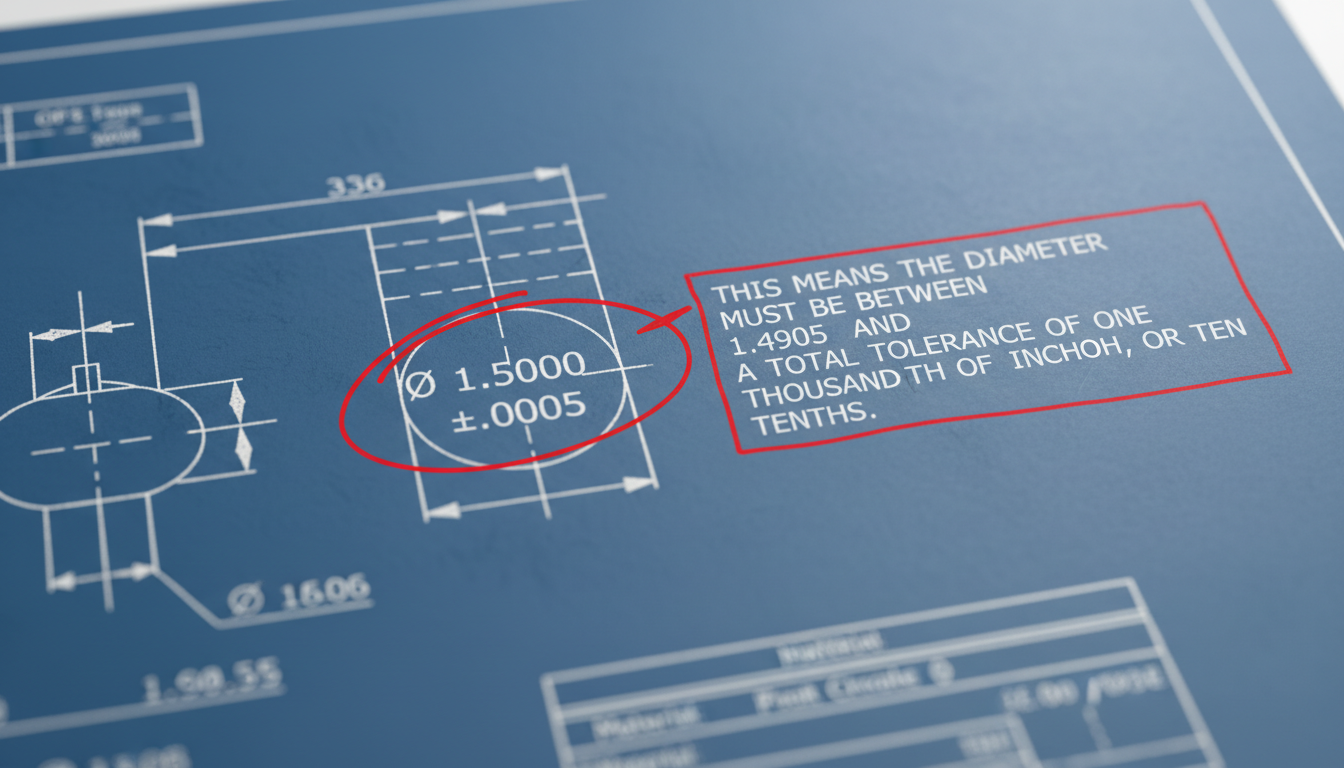
When you see a tolerance on a blueprint written as “±.0005,” say it out loud as “plus or minus five tenths.” This habit, common among veteran machinists, reinforces the correct scale in your mind and prevents you from misinterpreting it as “five thousandths.”
How to Convert Tenths to Inches: The Fast & The Manual Way
While a digital calculator is your best friend for speed and accuracy, understanding the math is non-negotiable. It allows you to perform quick sanity checks and builds confidence. Luckily, the formula is dead simple.
The core relationship is:
1 Tenth = 0.0001 Inches
So, the conversion formula is:
Inches = (Number of Tenths) × 0.0001
That’s it. You’re just moving the decimal point four places to the left. Let’s see it in action.
| If you have… | Calculation | The result is… |
|---|---|---|
| 3 Tenths | 3 × 0.0001 | 0.0003″ |
| 15 Tenths | 15 × 0.0001 | 0.0015″ (one and a half thou) |
| 120 Tenths | 120 × 0.0001 | 0.0120″ (twelve thou) |
| 2500 Tenths | 2500 × 0.0001 | 0.2500″ (a quarter of an inch) |
Using a Digital Tenths to Inches Calculator: A 3-Step Process
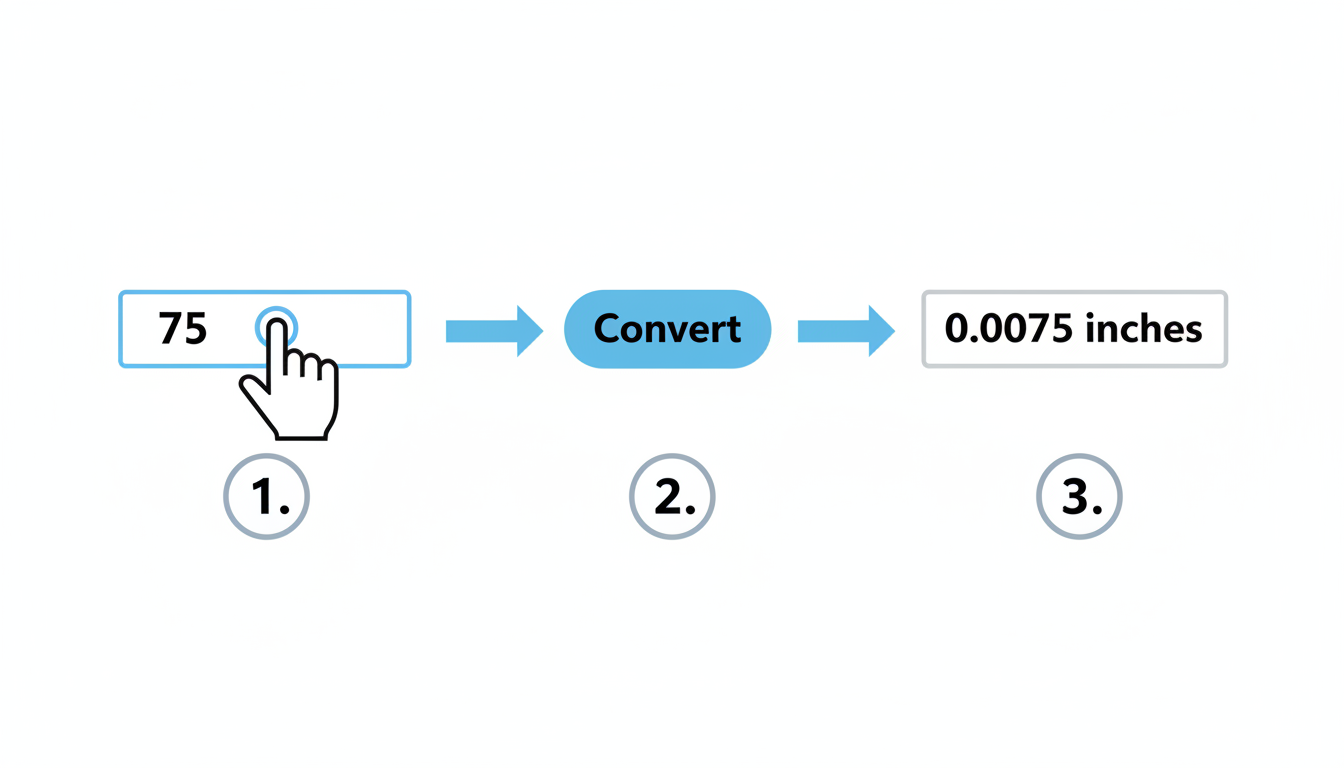
For day-to-day work, a dedicated tool eliminates any chance of a slip-up. Here’s the foolproof process:
- Input Your Value: Locate the input field, clearly labeled “Enter Tenths.” Type in the number you need to convert, like
75. - Click Convert: Hit the “Calculate” or “Convert” button. The tool instantly applies the formula.
- Get Your Result: The output field will display the equivalent in inches, which would be
0.0075. No guesswork, no risk.
⚠️ Watch Out
The most common mistake we see isn’t bad math—it’s a “fat finger” error. When you’re in a hurry, it’s easy to type 120 instead of 12. Always, always, always give your input a quick double-check before you hit convert or enter the value into a CNC controller. It takes one second and can save you thousands of dollars.
🎯 Key Takeaway
A “tenth” is machinist shorthand for 0.0001 inches, not 0.1 inches. This fundamental distinction is the most critical concept in high-precision work. Mastering this prevents costly errors and ensures everyone, from the design engineer to the machine operator, is speaking the same language.
Beyond the Basics: Thinking in Tenths Like a Pro
Converting one way is great, but true fluency means you can move between these units effortlessly. This is especially important when you need to verify engineering drawings or convert a measurement from an indicator back into tenths.
The Reverse Conversion: Inches to Tenths
Need to go the other way? The formula is just as simple. You’ll divide by 0.0001, which is the same as multiplying by 10,000.
Tenths = (Value in Inches) × 10,000
For example, if a quality control report shows a part is 0.0032″ over specification, how many tenths is that?
- Calculation: 0.0032 × 10,000
- Result: 32 Tenths
Now you know the machine’s offset needs to be adjusted by 32 tenths to bring the part into spec. See how practical that is?
💡 Pro Tip
Use the reverse conversion to sanity-check blueprints. If a drawing from a European client specifies a tolerance in millimeters, say 0.02mm, first convert it to inches (0.02mm ≈ 0.00078″). Then, convert that to tenths (0.00078″ x 10,000 ≈ 7.8 tenths). This tells you immediately that you’re working with a very tight, sub-thou tolerance.
⚠️ Watch Out
Be extremely careful when working with international teams. The term “tenth” is specific to the imperial system. In the metric system, a “tenth of a millimeter” is 0.1mm, which equals roughly 0.004″ (or 4 thou). Confusing a “tenth” (0.0001″) with a “tenth of a mm” (0.004″) is an error of 40 times and will absolutely lead to scrapped parts. Always clarify which unit system is being used.
❓ Frequently Asked Questions
How many tenths are in one inch?
There are exactly 10,000 tenths in one inch. This is because a “tenth” in a precision context means one ten-thousandth of an inch (0.0001″). So, 10,000 multiplied by 0.0001 equals 1.0.
What’s the difference between a “thou” and a “tenth”?
A “thou” is shorthand for one thousandth of an inch (0.001″). A “tenth” is shorthand for one ten-thousandth of an inch (0.0001″). Therefore, a “thou” is ten times larger than a “tenth.” It takes 10 tenths to make 1 thou.
Why is this conversion so critical for CNC machining?
In our experience with CNC programming, machine tool offsets and wear compensation are often adjusted in increments of tenths. Accurately converting a blueprint’s tolerance (e.g., 0.0005″) into tenths (5 tenths) is a daily task that ensures parts are made perfectly to spec. An error here directly translates to a scrapped part.
Can I just use a digital caliper to measure tenths?
Not reliably. Most standard digital calipers are accurate to about one thousandth of an inch (0.001″), or 10 tenths. To accurately measure individual tenths, you need a more precise instrument like a micrometer or a high-quality test indicator. Relying on a standard caliper for single-tenth accuracy can be misleading.
Is there an official standard for the term “tenth”?
While it’s universally understood shop-floor slang, official engineering standards like those from the American National Standards Institute (ANSI) will always write out the full decimal value (e.g., 0.0001″) on formal documents to avoid ambiguity. The term “tenth” is the professional’s conversational shortcut.
What is metrology?
Metrology is the scientific study of measurement. It establishes a common understanding of units, which is crucial in science, technology, and industry. You can learn more about its principles on its dedicated Wikipedia page.
Conclusion: Precision is a Language
Mastering the tenths to inches conversion isn’t just about math; it’s about learning the language of precision. It’s the vocabulary that separates hobby-grade work from professional, mission-critical results. That tiny, almost imperceptible unit of 0.0001″ is the foundation upon which modern marvels of engineering are built.
By now, you understand the critical difference between a “tenth” and a “tenth of an inch.” You know the formula by heart and, more importantly, you understand the immense cost of getting it wrong.
Your next step is simple: make precision a habit. Bookmark a reliable tenths to inches calculator. Double-check your inputs. And the next time you see a tolerance on a blueprint, speak the language. Say “five tenths,” not “point zero zero zero five.” It’s a small shift that signals a professional mindset and protects you from that one misplaced decimal that could ruin your day.