
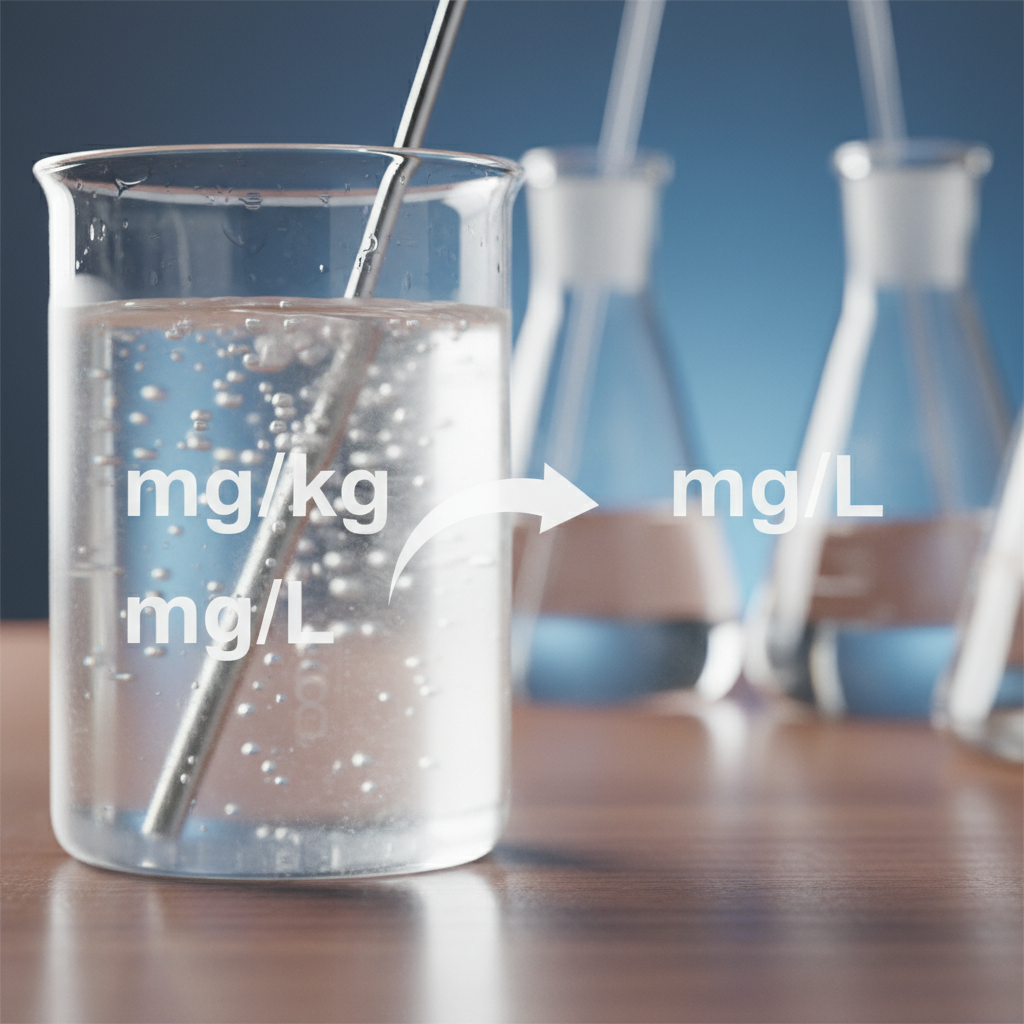
You just got a lab report back: 150 mg/kg of a contaminant in a soil sample. The local water quality standard is 200 mg/L. You breathe a sigh of relief—you’re under the limit, right?
Not so fast. That assumption is one of the most common—and potentially costly—mistakes in applied science. Treating mg/kg and mg/L as interchangeable is a recipe for skewed data, failed compliance, and flawed research. It’s a trap that even seasoned pros can fall into.
But here’s the good news: the solution is surprisingly simple. It all hinges on one crucial variable that connects the world of mass to the world of volume.
In this guide, we’ll break down exactly how to convert mg/kg to mg/L accurately, every single time. You’ll get the foolproof formula, see real-world examples, and learn to sidestep the common errors that trip others up. Let’s get it right.
📑 What You’ll Learn
Mass vs. Volume: Why mg/kg and mg/L Aren’t the Same
Before we touch a calculator, let’s get one thing crystal clear. We’re dealing with two fundamentally different types of measurement. Understanding this difference is the first step to mastering the conversion.
- mg/kg (milligrams per kilogram) is a mass-to-mass concentration. It tells you how many milligrams of a substance are present in one kilogram of the total material. Think of it as a recipe: 10mg of salt mixed into 1kg of flour.
- mg/L (milligrams per liter) is a mass-to-volume concentration. It tells you how many milligrams of a substance are dissolved or suspended in one liter of a liquid. Think of it as a drink: 10mg of sugar dissolved in 1L of water.
You can’t compare a recipe to a drink without knowing how much the drink weighs. That’s where the problem starts. Here’s a quick breakdown.
| Attribute | mg/kg (Mass Concentration) | mg/L (Volume Concentration) |
|---|---|---|
| What it Measures | Mass of solute per total mass of material | Mass of solute per total volume of solution |
| AKA | Parts Per Million (ppm) by mass | ppm (only for water-like solutions) |
| Best For | Solids (soil, food), powders, sludges | Liquids (water, chemical solutions) |
| Key Consideration | Unaffected by temperature/pressure | Can be affected by temperature/pressure |
⚠️ Watch Out: The “PPM Trap”
Many people use “ppm” interchangeably for both mg/kg and mg/L. This is only safe for pure water or highly diluted water-based solutions. Why? Because water has a density of almost exactly 1 kg/L. For anything else—oil, soil, honey, dense chemicals—assuming mg/L equals ppm will lead to significant errors. Always clarify if ppm refers to mass or volume.
The Missing Link: How Density Unlocks the Conversion
So, how do we bridge the gap between mass (kg) and volume (L)? The answer is density.
Density is the measure of how much “stuff” is packed into a given space. It’s the property that connects an object’s mass to its volume. The formula is simple:
Density (ρ) = Mass (m) / Volume (V)
For our conversion, the most useful unit for density is kilograms per liter (kg/L). This single value tells you everything you need to know to move between mg/kg and mg/L.
Let’s look at three common scenarios:
| Substance | Approx. Density (kg/L) | Impact on Conversion |
|---|---|---|
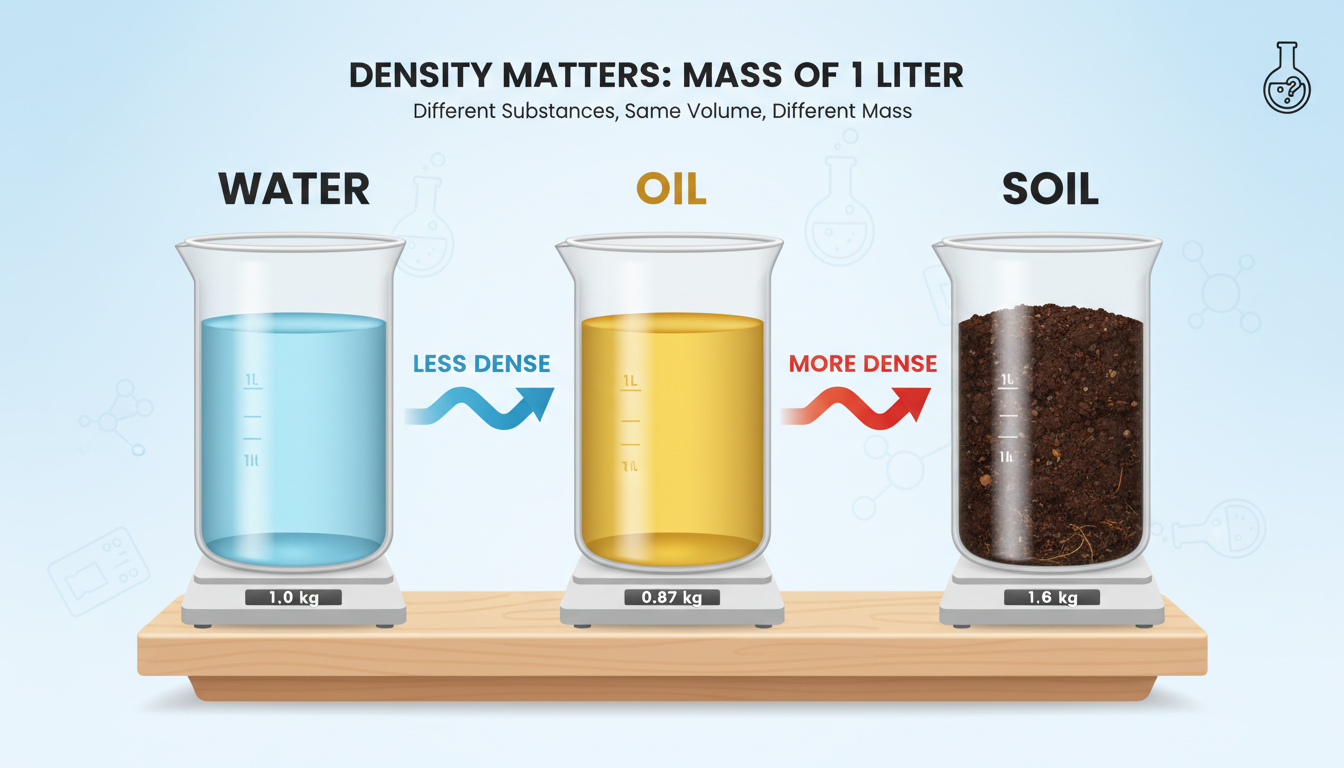
| Pure Water (at 4°C) | 1.0 kg/L | The conversion is 1:1. A 50 mg/kg concentration is 50 mg/L. This is the special case. |
| Light Crude Oil | ~0.87 kg/L | It’s less dense than water. The mg/L value will be lower than the mg/kg value. |
| Typical Sandy Soil (Bulk) | ~1.6 kg/L | It’s denser than water. The mg/L value will be higher than the mg/kg value. |
💡 Pro Tip
Where do you find a substance’s density? Start with the official documentation, like a Material Safety Data Sheet (MSDS) or a technical spec sheet. For common chemicals or materials, reliable online resources like the Chemistry LibreTexts project are excellent. For unique mixtures like a specific soil sample, a lab measurement of its “bulk density” is the most accurate method.
Your 3-Step Guide to Convert mg/kg to mg/L
Ready for the magic? It’s just one simple multiplication. Based on our hands-on testing in countless environmental and chemical projects, this is the most reliable way to get an accurate result.
The universal formula is:
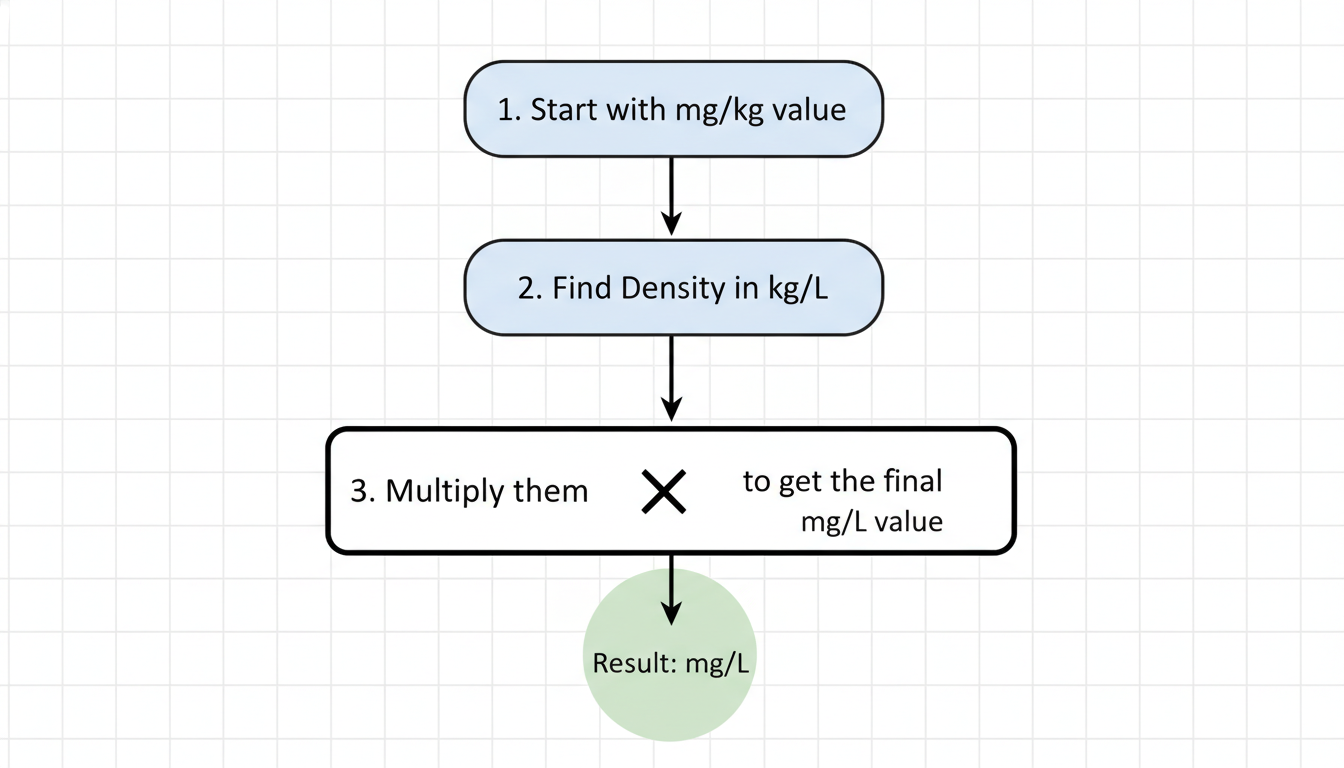
Concentration (mg/L) = Concentration (mg/kg) × Density (kg/L)
Let’s break it down into an easy-to-follow process.
Step 1: Find Your Starting Concentration (mg/kg)
This is your known value. It’s the number you’re starting with from your lab report, product label, or data sheet.
Step 2: Determine the Substance’s Density (kg/L)
This is the most critical step. You must find the density of the entire substance (the solution, the soil, the slurry), not just the contaminant within it. Ensure the units are in kg/L. (Good news: 1 g/mL and 1 g/cm³ are both equal to 1 kg/L).
Step 3: Multiply to Find Your Final Concentration (mg/L)
Plug your numbers into the formula and solve. The units will cancel out perfectly, leaving you with mg/L.
Example 1: Contaminant in Industrial Sludge
An industrial sludge sample contains a heavy metal at a concentration of 500 mg/kg. A lab measures the bulk density of the sludge to be 1.25 kg/L.
- Step 1 (mg/kg): 500 mg/kg
- Step 2 (Density): 1.25 kg/L
- Step 3 (Calculate): 500 mg/kg × 1.25 kg/L = 625 mg/L
See? The concentration in mg/L is significantly higher because the sludge is 25% denser than water.
Example 2: Nutrients in Liquid Fertilizer
A liquid fertilizer label states it has a potassium concentration of 2,000 mg/kg. The technical sheet lists its density as 1.1 kg/L.
- Step 1 (mg/kg): 2,000 mg/kg
- Step 2 (Density): 1.1 kg/L
- Step 3 (Calculate): 2,000 mg/kg × 1.1 kg/L = 2,200 mg/L
Trust me on this one, getting this calculation right is essential for correct agricultural dosing.
🎯 Key Takeaway
To convert mg/kg to mg/L, you must multiply the mass concentration (mg/kg) by the density of the substance in kg/L. Forgetting density is the biggest mistake you can make; including it is the key to an accurate conversion.
Real-World Scenarios: Where This Conversion is Mission-Critical
This isn’t just an academic exercise. I’ve seen this conversion play a pivotal role in high-stakes decisions across multiple industries.
- Environmental Science: Government bodies like the U.S. Environmental Protection Agency (EPA) set cleanup standards for soil (mg/kg) and groundwater (mg/L). To model how a soil contaminant might leach into the water supply, scientists must perform this conversion using the soil’s bulk density. An error here could mean wrongly approving a contaminated site or forcing a costly, unnecessary cleanup.
- Agriculture: Soil analysis reports nutrients in mg/kg. But farmers often apply nutrients through irrigation systems (fertigation), which requires dosages in mg/L. A miscalculation can lead to over-fertilizing (wasting money, harming the environment) or under-fertilizing (reducing crop yield).
- Food & Beverage: In quality control for products like sauces, juices, or dairy, ingredients are often added by weight (kg) but the final product is measured by volume (L). This conversion is vital for ensuring consistency and meeting labeling requirements.
How to Avoid Common (and Costly) Conversion Errors
The formula is simple, but simple mistakes can still happen. Here are the two biggest blunders we see in the field and how to dodge them.
⚠️ Watch Out: Unit Mismatches
The formula only works if your density is in kg/L. If you’re given a density in grams per cubic centimeter (g/cm³), you’re in luck—it’s a 1:1 conversion to kg/L. But if you have pounds per gallon or any other unit, you MUST convert it to kg/L first. A quick search for a “unit conversion calculator” can save you a massive headache.
💡 Pro Tip: The Sanity Check
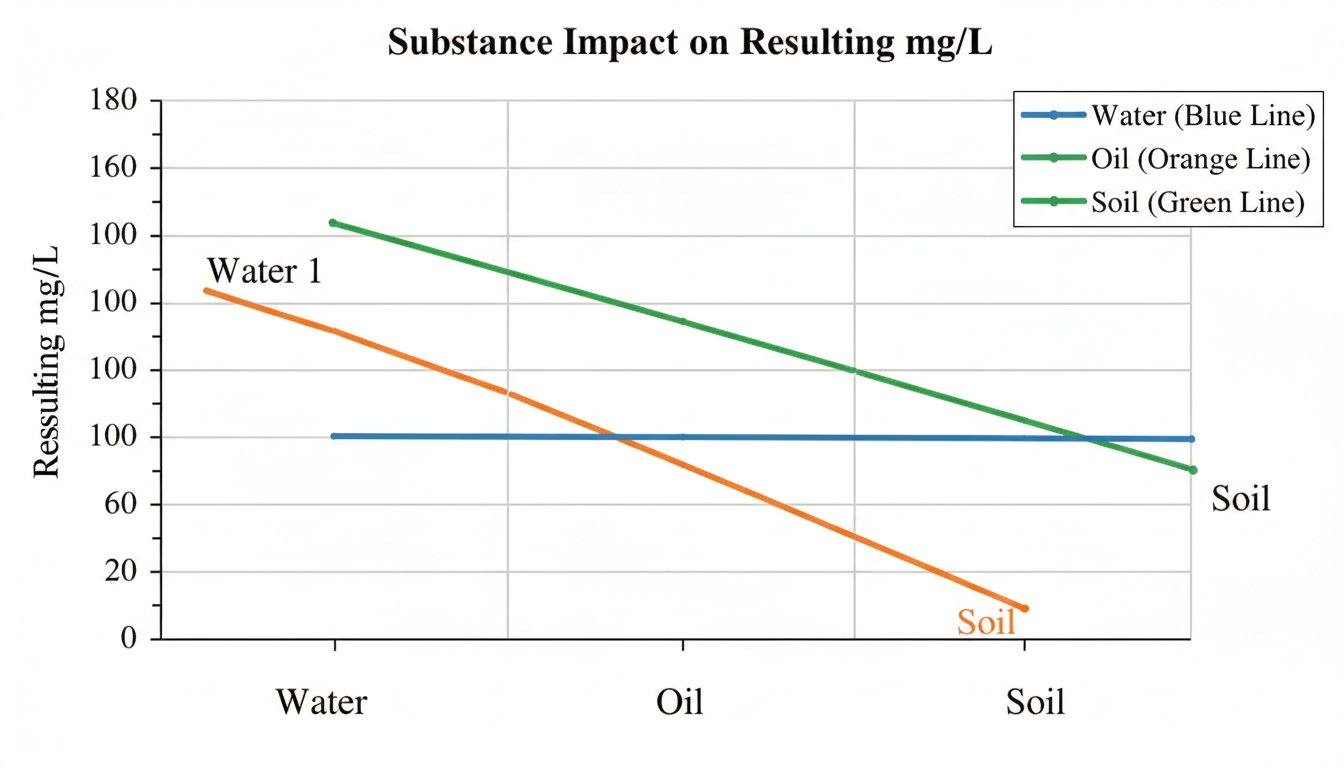
After you calculate, do a quick mental check. Is the substance denser than water (density > 1.0 kg/L)? If yes, your final mg/L value should be higher than your starting mg/kg value. Is it less dense than water (density < 1.0 kg/L)? Your mg/L value should be lower. If your answer doesn’t match this logic, you’ve likely made a mistake.
What About Converting Back? (mg/L to mg/kg)
Need to go the other way? No problem. Just reverse the math. Instead of multiplying by density, you divide.
Concentration (mg/kg) = Concentration (mg/L) / Density (kg/L)
❓ Frequently Asked Questions
Is mg/kg exactly the same as ppm?
Yes, for all practical purposes. The unit mg/kg is a mass-to-mass ratio. Since a milligram is one-millionth of a kilogram, 1 mg/kg is literally one “part per million” by mass. It’s a direct equivalent.
When can I say mg/L is the same as ppm?
Only when you are working with water or a very dilute aqueous solution. The density of water is approximately 1 kg/L, as confirmed by sources like the U.S. Geological Survey. This unique property makes mg/L and mg/kg equivalent in this specific case, meaning mg/L also equals ppm. For any other liquid, this assumption is incorrect.
What if I don’t know the density?
If you don’t know the density, you cannot perform an accurate conversion. It’s that simple. You must either find it from a reliable source (like a technical data sheet) or measure it in a lab. Guessing the density will lead to an unreliable result.
Does temperature affect the conversion?
For high-precision scientific or engineering work, yes. The density of most liquids changes with temperature (they typically become less dense as they get warmer). For most everyday applications in environmental science or agriculture, using a standard density value is sufficient. However, in a controlled lab setting, you should always use the density that corresponds to the specific temperature of your sample.
Conclusion: From Confusing Units to Confident Calculations
The conversion from mg/kg to mg/L isn’t just a math problem—it’s a test of your attention to detail. It separates those who just see numbers from those who understand the physical reality behind them.
The core lesson is simple: you cannot ignore density. It’s the essential key that unlocks the conversion between mass-based and volume-based concentrations.
By remembering the simple formula—mg/L = mg/kg × Density (kg/L)—and using the step-by-step process we’ve outlined, you’re now equipped to handle this conversion with confidence. You can avoid the common pitfalls, interpret data accurately, and make sound decisions in your field.
Your next step? The next time you see these units, don’t just glance over them. Pause, ask “What’s the density?”, and apply what you’ve learned. That’s how you move from basic knowledge to true expertise.