
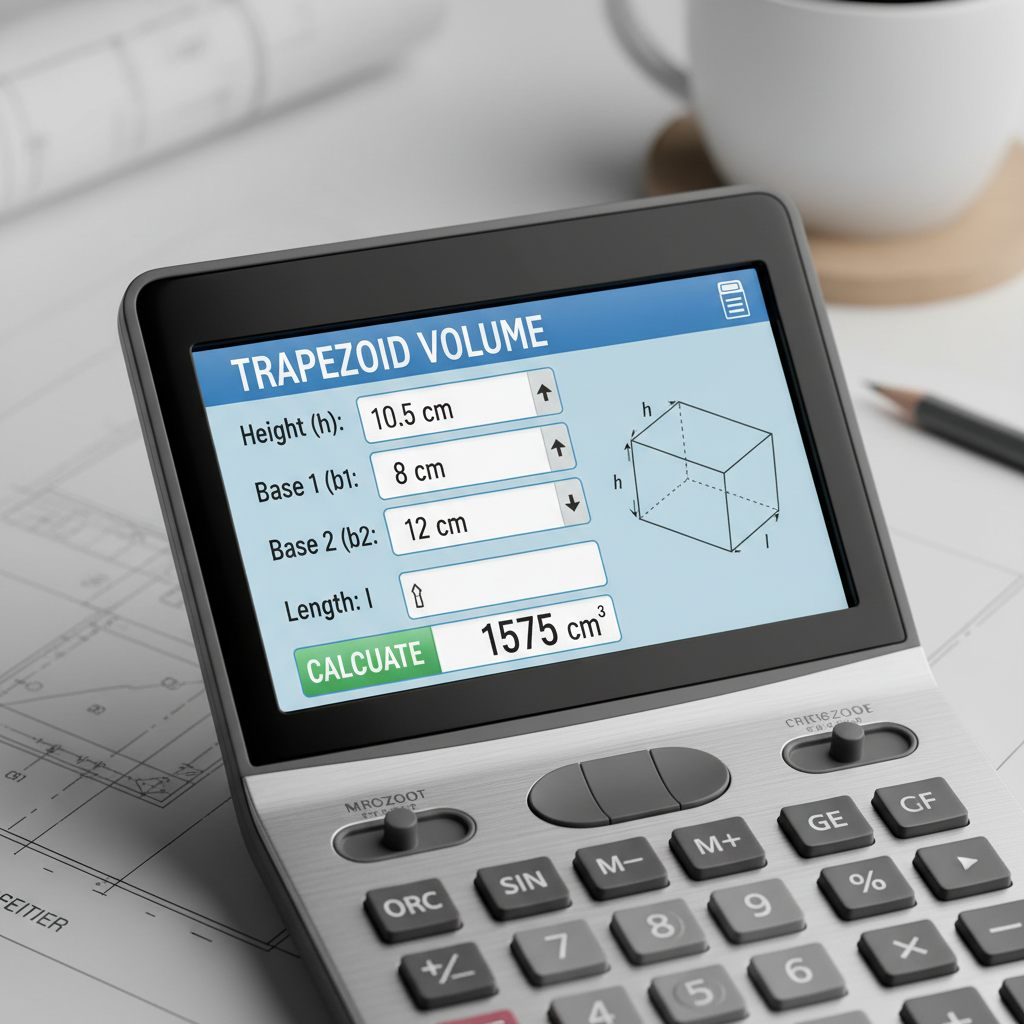
Ever stood in front of a half-finished project, staring at a mountain of gravel you over-ordered? Or worse, had to halt a concrete pour because you came up short? It’s a frustrating, expensive, and all-too-common scenario. The culprit is often a simple miscalculation involving a shape we see everywhere but rarely think about: the trapezoidal prism.
Look, you don’t need to be a math genius to get this right. You just need the right approach and the right tool.
This isn’t just another dry geometry lesson. This is a field guide for builders, landscapers, and ambitious DIYers. I’m going to show you how to master the trapezoid volume calculator to save serious time, eliminate material waste, and execute your projects with the confidence of a seasoned pro. We’ll break down the “why,” the “how,” and the critical mistakes to avoid that I’ve seen cost people thousands on job sites.
📑 What You’ll Learn
- What Exactly Is a Trapezoidal Prism (And Why Should You Care)?
- The Formula Demystified: How a Trapezoid Volume Calculator Works
- Your 5-Step Guide to Flawless Measurement
- Real-World Scenarios: Where You’ll Use This Every Day
- The Two Most Expensive Mistakes (And How to Avoid Them)
- Frequently Asked Questions
What Exactly Is a Trapezoidal Prism (And Why Should You Care)?
First, let’s clear up a common point of confusion. A trapezoid is a flat, 2D shape. Think of a slice of a ramp. It has an area, but no volume.
A trapezoidal prism is the 3D version. It’s the whole ramp. It’s the ditch, the garden bed, the water trough. It has two identical trapezoid faces (a front and a back) connected by a length. This is the shape that holds “stuff”—soil, water, concrete, gravel. And that “stuff” is what costs you money.
Understanding this distinction is everything. When you say you need the “volume of a trapezoid,” what you really mean is the volume of a trapezoidal prism. Getting the terminology right helps you think about the problem correctly. It’s not just about the shape of the end; it’s about how long that shape runs.
The Formula Demystified: How a Trapezoid Volume Calculator Works
While a good online calculator makes this a one-click job, a true professional understands what’s happening behind the scenes. It builds trust in your own work. The formula isn’t scary, I promise.
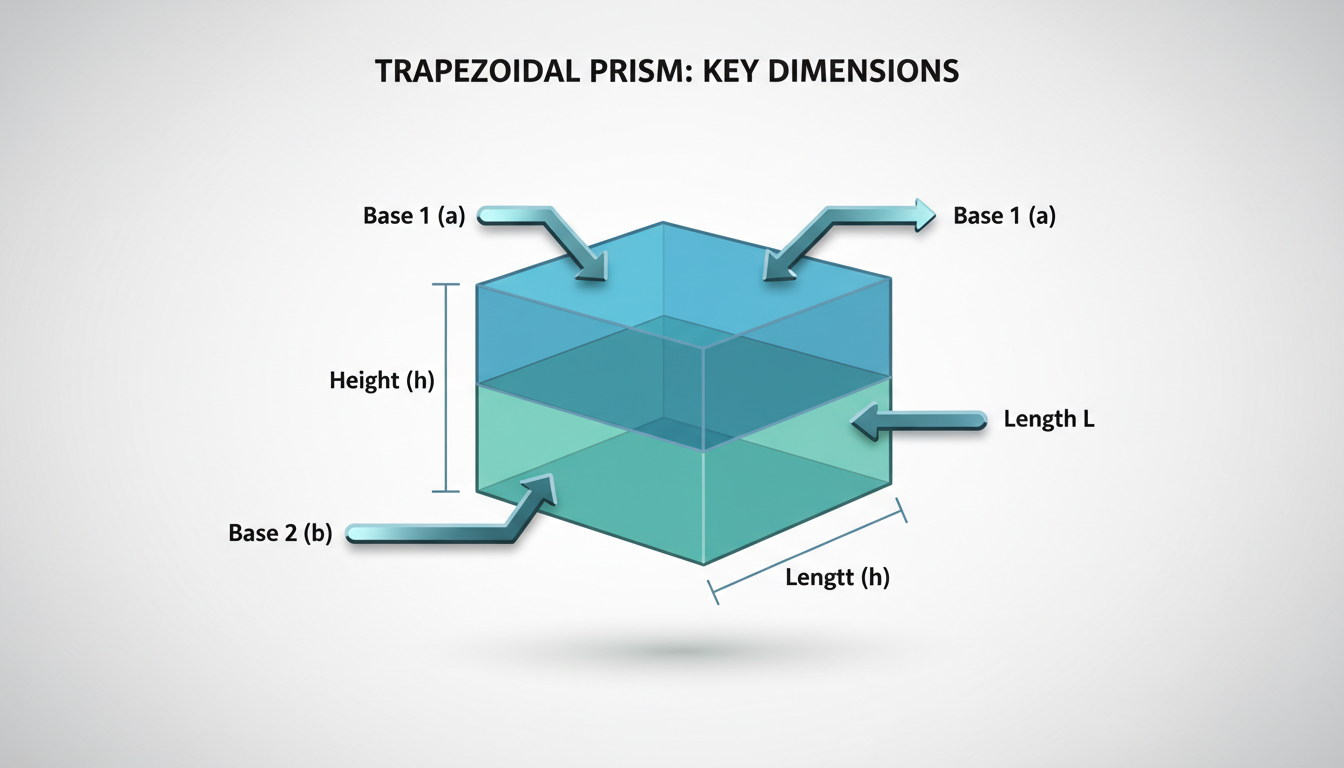
The official formula is: Volume = [ (a + b) / 2 ] * h * L
Let’s translate that into plain English:
- (a + b) / 2: This part finds the average width of your trapezoid’s top and bottom bases.
- … * h: Now, you multiply that average width by the height. Boom. You’ve just found the area of the 2D trapezoid face.
- … * L: Finally, you multiply that area by the total length of the prism. This “stretches” the 2D area into a 3D volume.
That’s it. You’re just finding the area of the end piece and multiplying it by how long the whole thing is. Simple, right?
⚠️ Watch Out
The single most common measurement error is confusing the height (h) with the length of the sloped side. The height must be the perpendicular distance from the top base to the bottom base. A straight line, top to bottom. Measuring the slope will inflate your area calculation and lead to ordering too much material.
A Quick Example: Digging a French Drain
Let’s say you’re digging a 50-foot long trench for a French drain.
- The top width (a) is 2 feet.
- The bottom width (b) is 1 foot.
- The depth, or height (h), is 3 feet.
- The length (L) is 50 feet.
Let’s plug it in:
Volume = [ (2 + 1) / 2 ] * 3 * 50
Volume = [ 3 / 2 ] * 3 * 50
Volume = 1.5 * 3 * 50
Volume = 4.5 * 50
Volume = 225 cubic feet
You need to excavate 225 cubic feet of soil and will need a similar amount of gravel to fill it back in.
💡 Pro Tip
Most bulk materials like soil, mulch, and gravel are sold by the cubic yard, not the cubic foot. To convert, just divide your cubic feet result by 27 (since there are 27 cubic feet in one cubic yard). In our example, 225 / 27 = ~8.33 cubic yards. Ordering 8.5 cubic yards would be a smart move.
Your 5-Step Guide to Flawless Measurement
A calculator is only as good as the numbers you feed it. From years of hands-on projects, I can tell you that careful measurement is 90% of the battle. Follow these steps and you won’t go wrong.
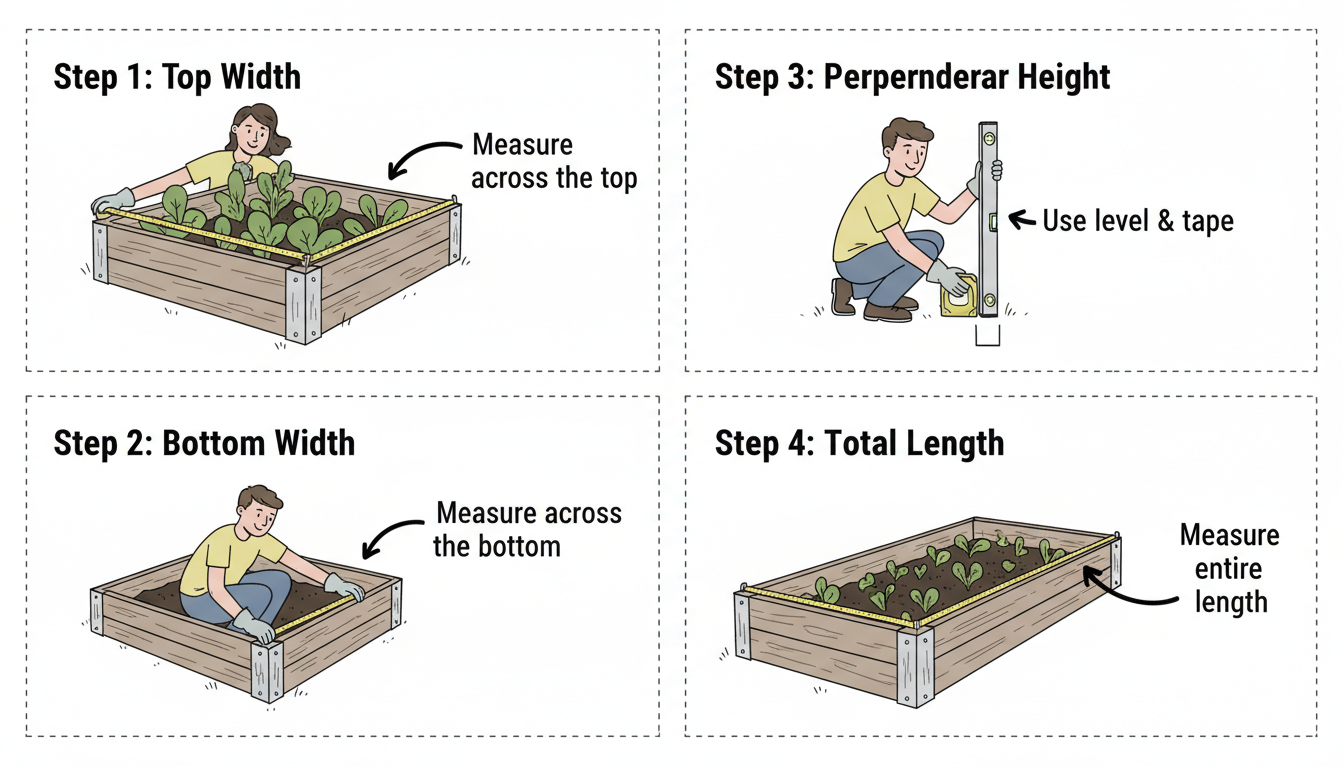
- Identify & Isolate the Four Variables: Before you even grab a tape measure, clearly identify the four parts you need: Top Base (a), Bottom Base (b), Perpendicular Height (h), and Overall Length (L). Sketch it out if you have to.
- Measure with Precision: Use a quality tape measure. For the height (h), use a level or a plumb bob to ensure you’re measuring straight down, especially if the surrounding ground is uneven. Don’t eyeball it.
- Check for Consistency: Are the trapezoid ends truly the same size? If you’re digging a long trench, measure the cross-section at both ends and in the middle. If they differ significantly, you may need to calculate the volume in sections and add them together for the most accurate result.
- Unify Your Units: This is non-negotiable. If you measure length in feet, all other measurements must be in feet. If one measurement is in inches, convert it to feet (e.g., 18 inches = 1.5 feet) before you enter it into the calculator. Mixing units is a guaranteed path to disaster.
- Double-Check Your Inputs: It sounds obvious, but it’s easy to type ‘3.5’ when you meant ‘2.5’. Take five extra seconds to verify the numbers you’ve entered into the calculator match what you wrote down.
🎯 Key Takeaway
The accuracy of your trapezoid volume calculation depends entirely on the quality of your measurements. Master the distinction between sloped sides and true height, and always convert all your measurements to a single, consistent unit before using any calculator.
Real-World Scenarios: Where You’ll Use This Every Day
This isn’t just abstract math; it’s a practical skill. You’ll find trapezoidal prisms in dozens of professional and home projects. Based on our experience, these are the most common applications where a trapezoid volume calculator is indispensable.
| Project Type | What You’re Calculating | Why Accuracy Matters |
|---|---|---|
| Excavation & Trenching | Volume of soil to be removed and hauled away. | Underestimating means extra machine time; overestimating means paying to haul “air.” |
| Concrete Footings/Ramps | Volume of concrete needed for a pour. | Coming up short is a disaster. Over-ordering by even half a yard can cost hundreds. |
| Landscaping Beds & Ponds | Volume of topsoil, mulch, gravel, or water. | Ensures you buy the right number of bags or cubic yards, preventing waste and extra trips. |
| Drainage Ditches & Swales | Water-holding capacity and volume of fill material. | Critical for proper water management and erosion control, as outlined by agencies like the Federal Highway Administration. |
| Agricultural Troughs | Volume of water or feed the trough can hold. | Essential for livestock management and ensuring proper nutrition and hydration. |
The Two Most Expensive Mistakes (And How to Avoid Them)
We’ve already touched on these, but they are so critical they deserve their own section. I’ve seen these two simple mistakes turn profitable jobs into losses.
Mistake #1: The “Sloped Height” Trap
As mentioned before, measuring the angled side of a ditch instead of its true vertical depth is a classic blunder. The sloped side will always be longer than the perpendicular height, sometimes significantly so. This single error will cause you to calculate a larger cross-sectional area, leading you to over-order materials every time.
Mistake #2: The “Unit Soup” Fiasco
This happens when you mix units—measuring the bases in inches but the length in feet, for example. A calculator is a dumb machine; it will crunch whatever numbers you give it. The result will be a volume number that is wildly incorrect and meaningless.
💡 Pro Tip
To avoid unit errors, choose one unit and stick with it from the start. I recommend using decimal feet for everything (e.g., 6 inches = 0.5 feet, 3 inches = 0.25 feet). It makes the math cleaner and is the standard on most professional job sites.
Here’s a quick comparison to show why using a calculator, once you have good measurements, is the superior method for professionals.
| Factor | Manual Calculation | Trapezoid Volume Calculator |
|---|---|---|
| Speed | Slow; requires multiple steps. | Instantaneous. |
| Accuracy | Prone to human error (typos, math slips). | 100% accurate if inputs are correct. |
| Complexity | Can be confusing with fractions or decimals. | Handles any numbers effortlessly. |
| Best For | Quick mental estimates, understanding the concept. | Final material orders, professional quotes, any time money is on the line. |
Trust me on this one: understand the formula, but use the calculator for the final numbers. It’s the smart way to work.
❓ Frequently Asked Questions
What’s the difference between a trapezoid and a trapezoidal prism?
A trapezoid is the 2D, flat shape with one pair of parallel sides (like the end of a trough). A trapezoidal prism is the 3D object that has length and can hold a volume (the entire trough). You find the area of a trapezoid and the volume of a trapezoidal prism.
Can I use different units in the calculator?
No. You must convert all your measurements to a single, consistent unit (e.g., all feet, or all meters) before you input them. Mixing units is the fastest way to get a wrong answer.
Is a ditch or a trough a trapezoidal prism?
Yes, absolutely. These are perfect real-world examples. The cross-section of the ditch is the trapezoid face, and its length is the prism’s length. The same volume formula applies. For a deeper dive into the geometry, the properties of a trapezoid are well-documented on Wikipedia.
What if the sides aren’t straight, but sloped like a pyramid?
If the sides slope inwards over the length (meaning the trapezoid at one end is smaller than the other), you’re dealing with a “frustum.” This is a different shape and requires a more complex formula. A standard trapezoid volume calculator is only for prisms where the trapezoid shape is consistent from end to end.
Why is understanding the math important if I just use a calculator?
Because understanding the components (a, b, h, L) forces you to measure correctly. It helps you spot when a number looks wrong and prevents the “garbage in, garbage out” problem. Great resources like Khan Academy’s lessons on solid geometry can provide a strong foundation.
Conclusion: From Guesswork to Guaranteed Accuracy
Calculating the volume of a trapezoidal prism isn’t an obscure mathematical exercise—it’s a fundamental skill for anyone who works with physical materials. It’s the difference between a smooth, profitable project and one plagued by delays and budget overruns.
By now, you should see that the process is simple: understand the shape, take meticulous measurements, and use a reliable trapezoid volume calculator to do the heavy lifting. You’ve learned how to avoid the critical errors of measuring slopes and mixing units, and you’re equipped to tackle your next project with precision.
So, the next time you’re planning a trench, a foundation, or a garden bed, don’t guess. Measure with confidence, calculate with certainty, and build with the assurance that your numbers are rock solid.