
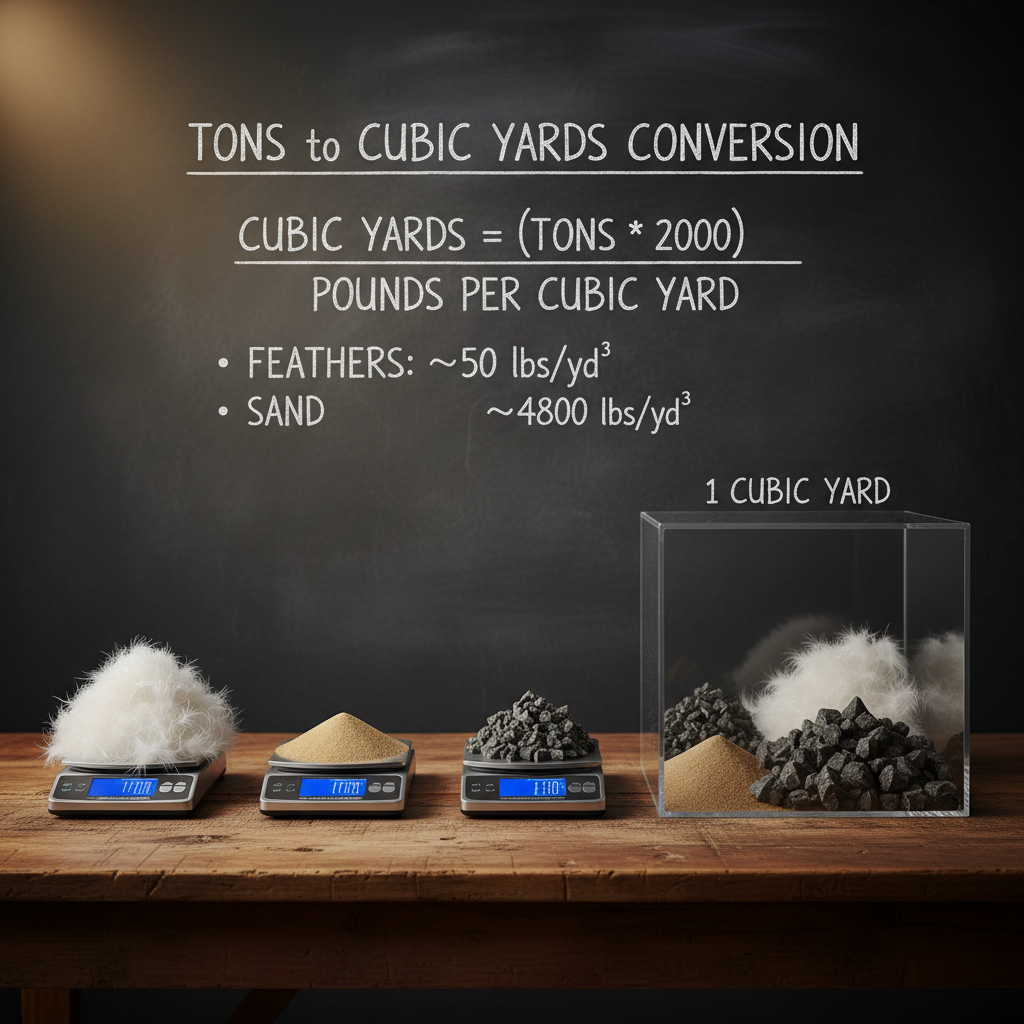
You’ve got a 10-ton truck of gravel on the way. But will it actually fill your 400-square-foot driveway? That’s a volume question, not a weight question. And it’s a mistake that costs DIYers and even new contractors a fortune in wasted material or last-minute, panic-driven orders.
Here’s the hard truth: there is no magic number to convert tons to cubic yards. It’s physically impossible. But don’t worry. There is a dead-simple formula that works every single time, for any material.
In this guide, we’re not just giving you the math. We’re showing you the exact, field-tested process the pros use to nail their material orders. You’ll learn the one piece of information that makes it all click, how to avoid the common traps that derail projects, and how to calculate your needs with total confidence. Let’s get this right.
📑 What You’ll Learn
The Real Reason You Can’t Directly Convert Tons to Cubic Yards
Before we touch a calculator, let’s get one thing straight. Asking “how many cubic yards are in a ton?” is like asking “how many feet are in a gallon?” They measure two completely different properties of the universe.
- A ton is a unit of weight (or mass). It tells you how heavy something is.
- A cubic yard is a unit of volume. It tells you how much space something takes up.
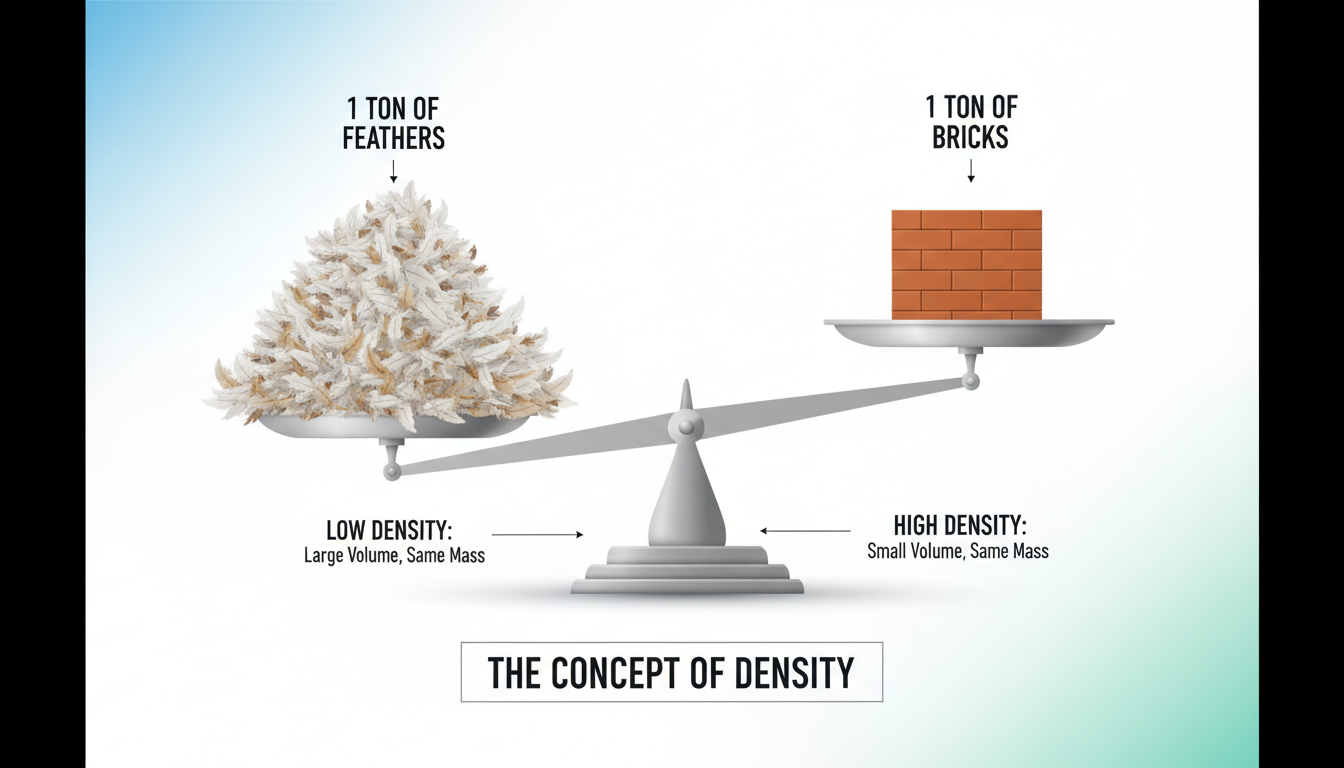
Think about it this way. A ton of fluffy wood mulch and a ton of solid granite boulders both weigh exactly 2,000 pounds. But which one will fill a bigger hole? The mulch, obviously. It’s far less dense.
And that’s the secret ingredient. The missing link. The one word that connects weight and volume is density.
Density is simply the measure of how much “stuff” is packed into a given space. For the materials we’re talking about—gravel, sand, topsoil—it’s usually measured in tons per cubic yard. Once you know a material’s density, you can switch between weight and volume effortlessly.
The Simple Formula to Convert Tons to Cubic Yards (A Step-by-Step Guide)
Okay, enough theory. Let’s get to the practical part. Once you have the density, the math is incredibly straightforward. It’s just one division problem.
The formula is:
Cubic Yards = Total Tons / Material Density
Here’s how to apply it in three simple steps.
- Step 1: Identify Your Exact Material. Don’t just say “gravel.” Is it 3/4″ crushed stone? Pea gravel? River rock? Be specific. Different sizes and types have different densities. The same goes for topsoil—is it screened, sandy, or clay-based?
- Step 2: Find the Material’s Density. This is the most critical step. The absolute best place to get this number is from your material supplier. Call them and ask, “What is the density of your screened topsoil in tons per cubic yard?” They know their product. If they can’t provide it, you can use an online chart for an estimate, but know it won’t be perfect.
- Step 3: Do the Math. Plug your numbers into the formula.
A Real-World Example: The Driveway Project
Let’s go back to our initial problem. You need to buy 10 tons of 3/4″ crushed stone for your driveway. You call the quarry, and they tell you their stone has a density of 1.4 tons per cubic yard.
- Formula: Cubic Yards = Total Tons / Density
- Calculation: Cubic Yards = 10 tons / 1.4 tons per cubic yard
- Result: 7.14 cubic yards
So, that 10-ton delivery will give you just over 7 cubic yards of material to spread on your driveway. Now you can accurately calculate if that’s enough to cover your area to the desired depth.
💡 Pro Tip
Always, always, always ask your supplier for the density first. Based on our experience managing hundreds of projects, relying on generic online charts can lead to being 10-15% off on your order. That’s a costly mistake. The supplier’s number is the ground truth for their specific product.
Material Density Cheat Sheet (With a Crucial Warning)
While we stand by getting the number from your supplier, it’s helpful to have a ballpark idea for initial planning. The table below shows common density ranges for popular landscaping and construction materials. Use these for estimates only!
| Material Type | Typical Density (Tons per Cubic Yard) | Notes & Considerations |
|---|---|---|
| Gravel / Crushed Stone | 1.3 – 1.5 | Smaller, more angular stones are often denser. |
| Sand (Dry) | 1.2 – 1.4 | Moisture content dramatically increases density. |
| Topsoil / Dirt (Loose) | 0.8 – 1.1 | Highly variable. Screened topsoil is lighter than dense, wet clay. |
| Compost / Mulch | 0.4 – 0.7 | Very light and contains a lot of air. Density changes as it decomposes. |
| Recycled Asphalt (RAP) | 1.8 – 2.0 | Extremely dense and heavy material. |
⚠️ Watch Out: The Moisture Trap
These numbers are for relatively dry materials. If it has rained recently, that pile of sand or topsoil at the yard is holding a lot of water. Water is heavy. A cubic yard of wet sand can weigh significantly more than a cubic yard of dry sand, throwing off any calculation based on dry density. Ask your supplier if their density figure accounts for typical moisture levels.
The 3 Biggest Mistakes We See (And How to Avoid Them)
I’ve seen this play out dozens of times. A simple project gets delayed or goes over budget because of a small calculation error. Trust me on this one, avoid these common pitfalls.
Mistake #1: Using a “Generic” Density
This is the big one. Grabbing the first number you see on Google for “gravel density” and running with it is a recipe for disaster. As you saw in the chart, there’s a range. Using 1.3 when the actual density is 1.5 will leave you short on material. Be specific.
Mistake #2: Forgetting About Compaction
Materials like gravel and topsoil are delivered “loose” in a pile. When you spread, rake, and tamp them down, they compact and lose volume. This is the “fluff factor.” The final, compacted volume can be 5-15% less than the loose volume you paid for. It’s a law of physics you can’t ignore.
Mistake #3: Ordering the Exact Amount
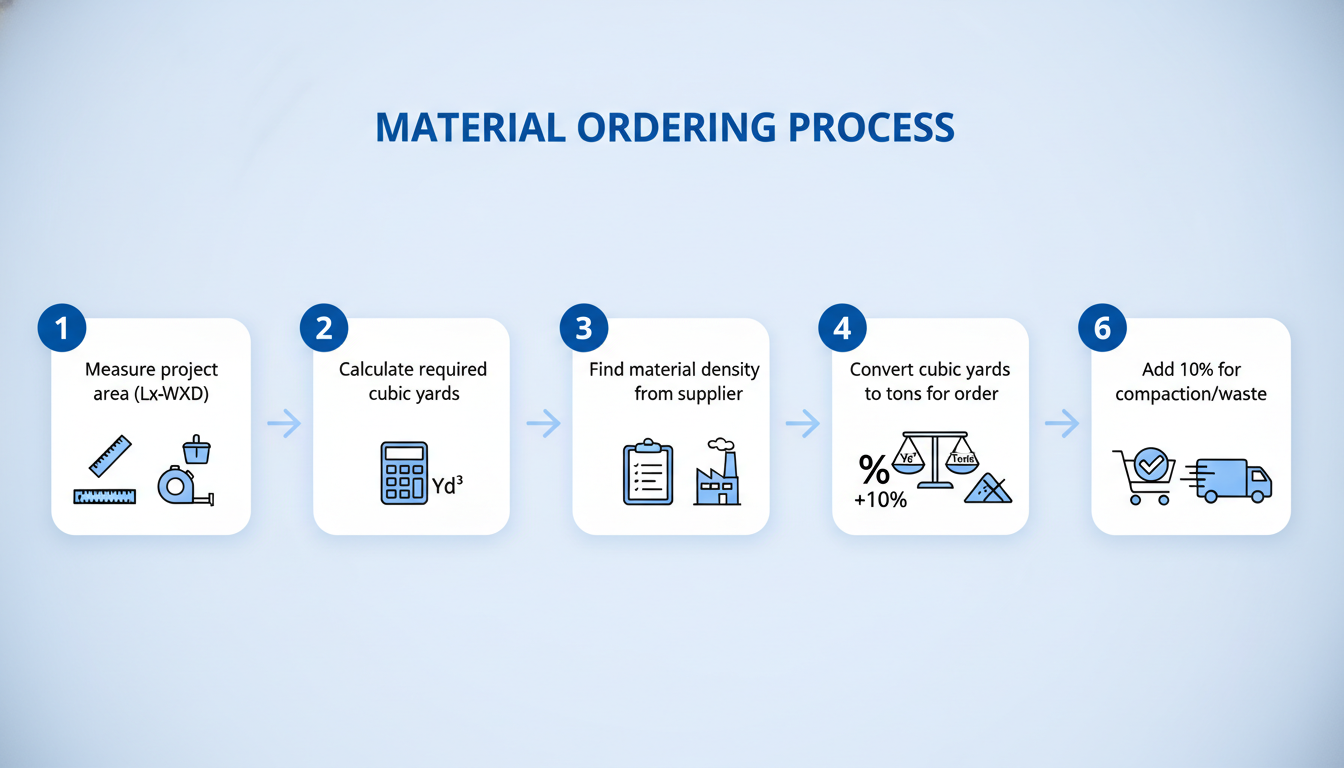
Never order the precise, mathematically perfect amount. Ever. Between compaction, slight variations in ground level, and minor spillage, you will always need a little extra. Not having enough is a much bigger problem than having a small pile left over.
💡 Pro Tip
To account for compaction and waste, industry best practice is to add a 5-10% buffer to your final calculated amount. If you calculate you need 7.14 cubic yards, order 7.5 or even 8. It’s cheap insurance against a second delivery fee and project delays.
🎯 Key Takeaway
The bridge between weight (tons) and volume (cubic yards) is density. The core formula is Cubic Yards = Tons / Density. For the most accurate project planning, always get the density figure directly from your material supplier and add 5-10% to your final order to account for compaction and waste.
Flipping the Script: How to Convert Cubic Yards to Tons
Sometimes you have the opposite problem. You’ve measured your garden beds and know you need exactly 10 cubic yards of mulch, but the supplier sells it by the ton. No problem. The math is just as easy—you just multiply.
The reverse formula is:
Total Tons = Cubic Yards Needed x Material Density
Example: Buying Mulch for Garden Beds
You need 10 cubic yards of hardwood mulch. Your supplier tells you their mulch has a density of 0.5 tons per cubic yard.
- Formula: Total Tons = Cubic Yards x Density
- Calculation: Total Tons = 10 cubic yards x 0.5 tons per cubic yard
- Result: 5 tons
You’ll need to order 5 tons of mulch to get the 10 cubic yards you need to cover your garden beds. Simple as that.
❓ Frequently Asked Questions
How many cubic yards are in a ton of gravel?
There’s no single answer because it depends on the gravel’s specific density. However, a common range is 0.65 to 0.75 cubic yards per ton. To get a precise number, you must use the formula: 1 / Density. For gravel with a density of 1.4 tons/yd³, one ton would be 1 / 1.4 = 0.71 cubic yards.
Why do some suppliers sell by the ton and others by the yard?
Selling by the ton (weight) is extremely accurate for the supplier, as they use certified scales at the quarry. It’s how they manage their inventory. Selling by the cubic yard (volume) is often more intuitive for customers planning projects. Many offer both options, with prices adjusted based on the material’s density.
What’s the difference between a ton and a metric ton?
In the U.S., a “ton” almost always refers to a “short ton,” which is 2,000 pounds. A “metric ton” (also spelled tonne) is 1,000 kilograms. A metric ton is heavier, equaling about 2,204.6 pounds. For a deep dive into measurement standards, the National Institute of Standards and Technology (NIST) is the ultimate authority. Unless you’re dealing with international shipping, you’re almost certainly working with short tons.
Does wet vs. dry topsoil change the calculation?
Absolutely. Water is heavy and adds weight without adding volume of soil. A cubic yard of saturated topsoil can weigh 20-30% more than when it’s bone dry. This is one of the biggest variables. If you’re buying right after a storm, be aware that you’re paying for a lot of water weight.
How do I calculate how many cubic yards I need in the first place?
To find the volume you need to fill, use this formula: (Length in feet x Width in feet x Depth in inches) / 324. The ‘324’ is the conversion factor to get a final answer in cubic yards. For example, a 10 ft by 20 ft driveway with a 4-inch depth needs (10 x 20 x 4) / 324 = 2.47 cubic yards of material.
Your Next Step: Order with Confidence
So, the next time you need to figure out how to convert tons to cubic yards, you know the answer isn’t a number—it’s a process. It’s about understanding the crucial role of density.
You’re no longer guessing. You have the formula, you know the pitfalls to avoid, and you understand the importance of that 10% buffer. Grab your project measurements, call your supplier to get that all-important density figure, and place your order with the confidence of a seasoned pro. You’ve got this.

