
Let’s cut to the chase. You’re here because you searched for a “watts to hz” converter, and you’re about to discover a fundamental truth of electronics: you can’t convert them.
It’s like asking to convert the color blue into the temperature outside. The question itself is based on a misunderstanding.
But don’t leave. The fact you’re asking this question means you’re on the brink of a major “aha!” moment. Understanding why this conversion is impossible is the key to truly grasping how everything from your home’s power grid to your computer’s processor actually works. This isn’t just a boring physics lesson; it’s the secret decoder ring for reading any tech spec sheet like a pro.
In this deep dive, you’ll learn exactly what watts and hertz measure, why they’re fundamentally different, and—most importantly—how they work together in the real world. Forget the non-existent calculator; you’re about to gain real knowledge.
📑 What You’ll Learn
Watts vs. Hertz: Defining the Dynamic Duo
To bust this myth for good, we need to get crystal clear on what these two units represent. They’re partners in crime in almost every electronic device, but they have very different jobs.
What is a Watt (W)? The Measure of Power
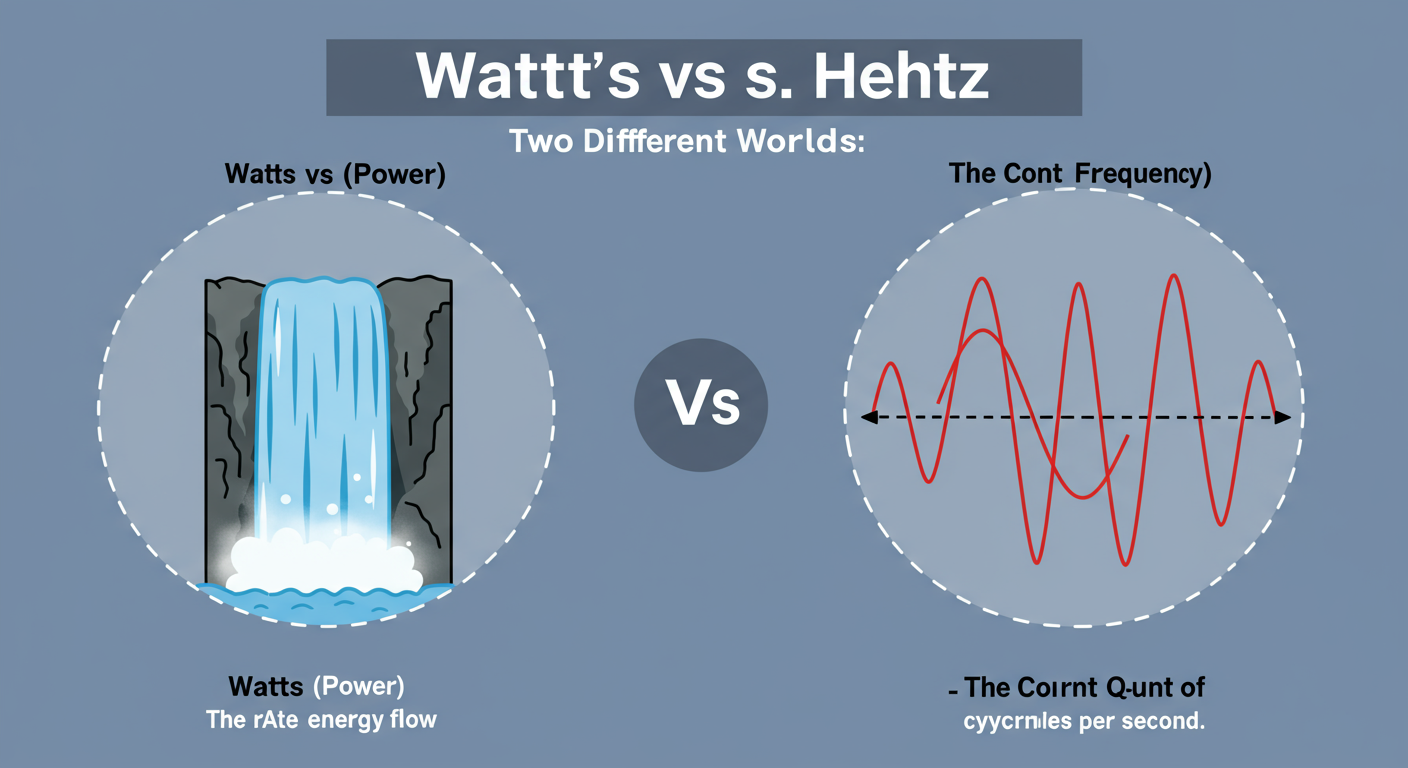
A watt is the unit of power. Simple as that. In physics, power is the rate at which energy is used or transferred. It’s not about how much energy exists, but how quickly it’s being put to work.
Think of it like water flowing from a dam. The total water in the reservoir is the energy (measured in Joules). The amount of water gushing through the gates every second? That’s the power (Watts).
- A massive fire hose has high wattage. It moves a huge amount of water (energy) very quickly.
- A tiny garden sprinkler has low wattage. It moves the same water, but much more slowly.
In your daily life, a 1500-watt microwave is a fire hose—it dumps a ton of energy into your food fast. Your 5-watt phone charger is a garden sprinkler, slowly and steadily topping up your battery. Both use energy, but at vastly different rates.
What is a Hertz (Hz)? The Measure of Frequency
A hertz is the unit of frequency. It measures how many times something happens—a cycle, an oscillation, a repetition—in one second. It’s all about timing and rhythm.
Imagine you’re skipping rope. If the rope goes around once every second, you’re skipping at a frequency of 1 Hz. If you’re a speed-jumper and it goes around 5 times per second, your frequency is 5 Hz.
- AC Power: The electricity in North American homes is Alternating Current (AC). The current changes direction and comes back to the start 60 times every second. Its frequency is 60 Hz.
- Computer Processors: A CPU with a clock speed of 4.2 Gigahertz (GHz) has an internal clock that “ticks” 4.2 billion times per second. That’s a frequency of 4,200,000,000 Hz.
- Monitor Refresh Rate: A 144 Hz gaming monitor redraws the entire screen 144 times every second, providing smoother motion.
💡 Pro Tip
When you see prefixes like ‘kilo’ (k), ‘mega’ (M), or ‘giga’ (G), they just denote scale. A kilowatt (kW) is 1,000 watts (power). A gigahertz (GHz) is 1 billion hertz (frequency). Don’t let the prefixes confuse you; the base units of Watt and Hertz remain measures of power and frequency, respectively.
Here’s a simple breakdown to help you remember the difference:
| Attribute | Watt (W) | Hertz (Hz) |
|---|---|---|
| What it Measures | Power (Rate of energy transfer) | Frequency (Cycles per second) |
| Think of it as… | Intensity or Flow Rate | Speed or Repetition Rate |
| Real-World Analogy | How fast water flows from a hose. | How many times a wave passes you per second. |
| Common Example | A 100W light bulb. | A 60 Hz power supply. |
The Real Reason You Can’t Convert Watts to Hz
Okay, so they’re different. But why can’t some clever formula connect them? The answer lies in their fundamental physical dimensions. It’s a concept called dimensional analysis, but don’t worry, it’s simpler than it sounds.
Every unit in physics can be broken down into a combination of Mass (M), Length (L), and Time (T).
- Power (Watts) breaks down to ML²/T³
- Frequency (Hertz) breaks down to 1/T
Look at those formulas. They don’t even share the same ingredients. Asking to convert watts to hertz is like trying to follow a recipe for a cake (ML²/T³) when all you have is a single ingredient, salt (1/T). It’s physically and mathematically impossible.
You can’t convert a measure of intensity into a measure of repetition. Period.
🎯 Key Takeaway
Stop trying to convert watts to hertz. Instead, ask: “How do the watts and hertz in this system relate to each other?” This is the question that unlocks true understanding and helps you make smarter decisions, whether you’re buying a generator or building a PC.
Where Power and Frequency Collide: 4 Critical Examples
If they aren’t convertible, why does the question come up so often? Because in the real world, watts and hertz are constantly interacting. Their relationship is contextual, defined by the physics of a specific system. Here’s where it gets interesting.
1. The Power Grid (Your Home’s Electricity)
Your wall outlet provides power at a remarkably stable frequency—60 Hz in North America, 50 Hz in most other parts of the world. This frequency is a property of the entire grid. The power (watts) you draw, however, changes constantly. When you turn on a 1200W hair dryer, you’re demanding 1200 watts of power from the 60 Hz supply. The frequency is the road; the wattage is the amount of traffic on it at any given moment. The U.S. Department of Energy has a great explanation of how this alternating current works.
2. Computer Processors (CPUs) & Graphics Cards (GPUs)
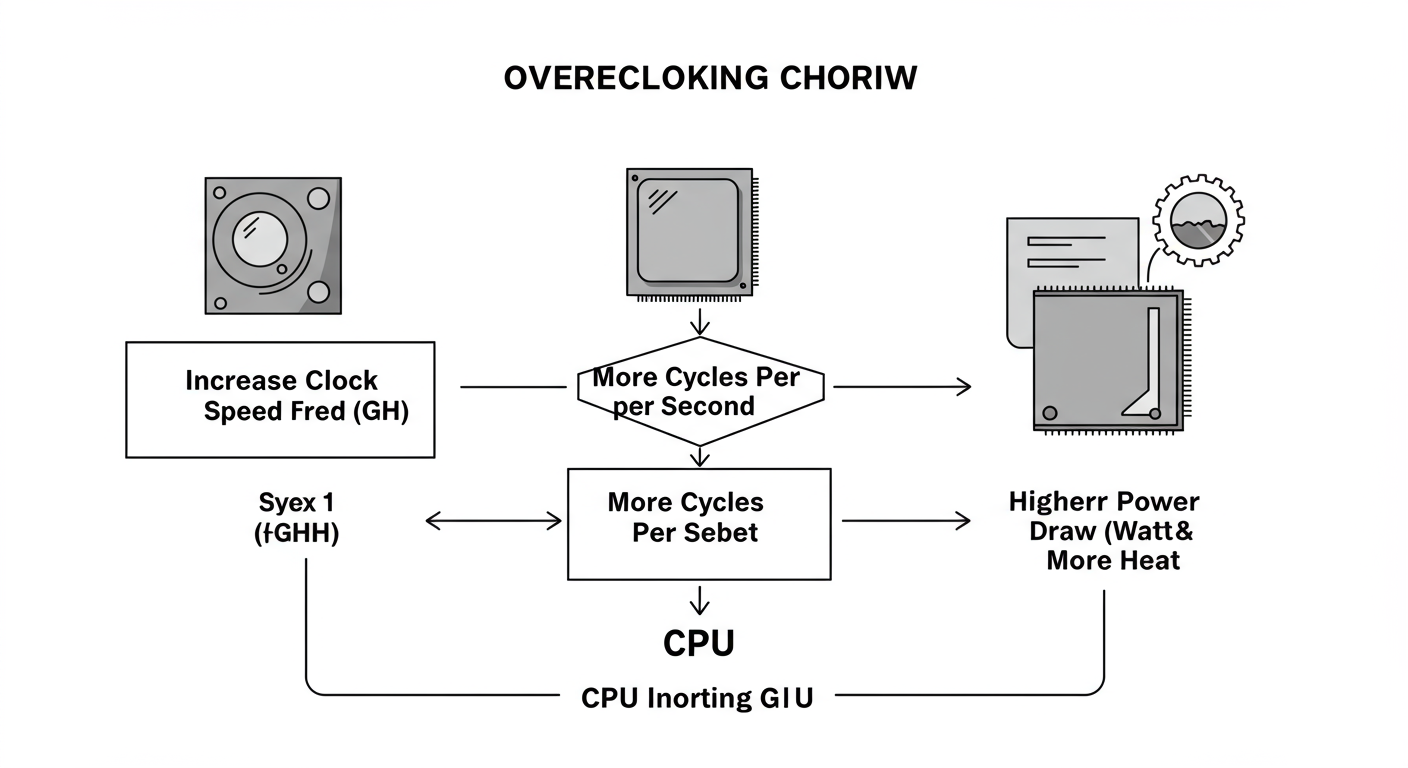
This is where the relationship is most direct. A CPU’s speed is its frequency (e.g., 4.2 GHz). Each cycle consumes a tiny bit of energy. To make the CPU faster, manufacturers increase the frequency (a process called overclocking). More cycles per second mean more calculations per second. But it also means more energy is consumed per second.
This is a critical point: In a CPU, increasing the frequency (Hz) directly causes an increase in power consumption (W) and heat generation. It’s not a conversion, but a cause-and-effect relationship within that specific component.
⚠️ Watch Out
Don’t assume higher frequency (GHz) is always better. A more efficient, modern CPU at 4.0 GHz can often outperform an older, less efficient CPU at 4.5 GHz while consuming far less power (watts). Efficiency—performance per watt—is the metric that truly matters.
3. Inverters and Generators
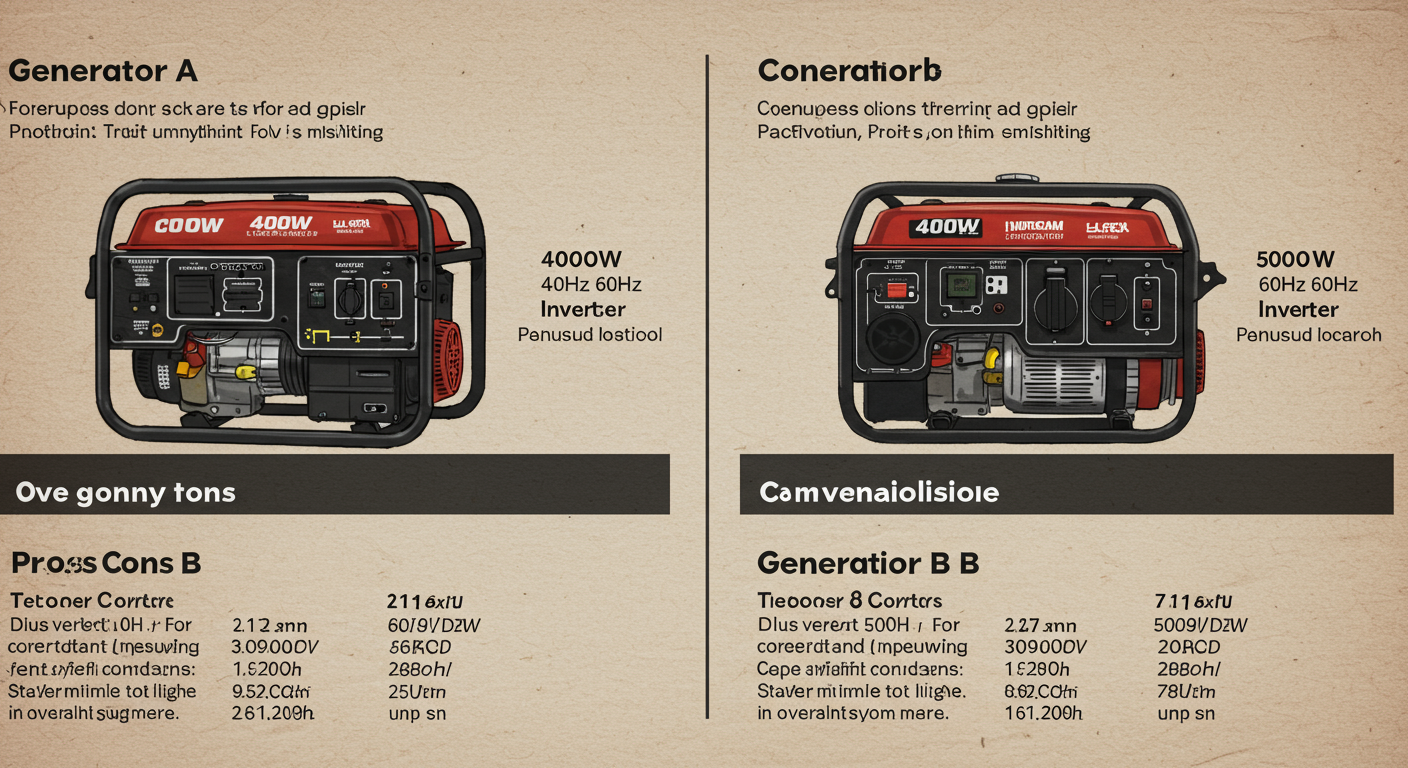
This is a huge source of confusion. A generator might be rated at “5000W, 60 Hz.” This means it can supply up to 5000 watts of power while producing an electrical current that alternates at 60 Hz. The two numbers describe what the machine can do, but they aren’t linked by a formula. You need the 60 Hz output to run standard appliances, and you need enough watts to power them all at once.
4. Audio Systems
In audio, frequency (Hz) is pitch. Low frequencies are deep bass (20-200 Hz), while high frequencies are sharp treble (2,000-20,000 Hz). Power (watts) from your amplifier is what drives the speakers to produce those sounds. You need enough watts to accurately reproduce the full range of frequencies at a loud volume without distortion. An underpowered amp will struggle to push the low-frequency bass notes, resulting in weak, muddy sound.
This table summarizes these real-world relationships:
| System | Hertz (Frequency) Role | Watts (Power) Role | The Relationship |
|---|---|---|---|
| Power Grid | A stable property of the supply (e.g., 60 Hz) | The variable demand from appliances | Independent: Wattage changes, Hz stays fixed. |
| CPU / GPU | Clock speed (determines calculations/sec) | Energy consumed and heat produced | Directly Correlated: Higher Hz leads to higher W. |
| Generator | The frequency of the AC power it creates | The maximum power it can supply | Definitional: Two separate specs of the machine. |
| Audio Amp | The range of sound pitches to be reproduced | The “muscle” to drive speakers loudly | Supportive: Watts must be sufficient to handle the Hz range. |
How to Actually Compare Devices Using Watts and Hz
So, what should you do when you see these two numbers on a spec sheet? Instead of looking for a conversion, follow this simple 4-step process to analyze them like an expert.
- Identify the System’s Role: Is this device producing power (like a generator) or consuming power (like a microwave)? This is the most important first step.
- Analyze the Frequency (Hz): Is the frequency a fixed requirement or a performance metric?
- For a US appliance, it needs a 60 Hz supply. That’s a requirement.
- For a gaming monitor, 144 Hz is a performance feature for smoother motion.
- Analyze the Power (W): Is the power a measure of consumption or output?
- For a power supply, 750W is its maximum output capacity.
- For a light bulb, 10W is its consumption.
- Synthesize the Relationship: Now, put it together. “This 750W power supply can provide enough power for my GPU, which will consume about 300W while driving my 144 Hz monitor.” See? No conversion needed. You’re evaluating how the parts of a system work together.
💡 Pro Tip
When looking at power consumption, always distinguish between idle, average, and peak watts. A powerful graphics card might idle at 20W but spike to 400W under heavy load. Base your power supply choice on the peak wattage, not the average.
⚠️ Watch Out
Never plug a device designed for a 50 Hz grid into a 60 Hz grid (or vice-versa) unless it’s explicitly rated for dual-frequency use (e.g., “50/60 Hz”). For simple electronics like chargers, it’s often fine. But for devices with motors, it can cause overheating, incorrect speed, and permanent damage. This is a common mistake for international travelers.
❓ Frequently Asked Questions
So just to be 100% clear, there’s no watts to hz formula?
Correct. 100% no formula. It’s a physical impossibility because they measure fundamentally different things: power (rate of energy) vs. frequency (rate of repetition). Anyone offering a “converter” is misleading you.
Why does my PC’s wattage go up when I overclock the CPU to a higher GHz?
Think of it as making your car’s engine run at a higher RPM. In a CPU, each “cycle” (measured in Hz) makes millions of transistors flip on and off, which uses energy. By increasing the cycles per second (higher GHz), you’re forcing those transistors to flip more often, which increases the total energy used per second. That increased rate of energy use is, by definition, higher power (watts).
What’s the difference between a kilowatt (kW) and a gigahertz (GHz)?
This is a great question about scale. A kilowatt (kW) is simply 1,000 watts—it’s still a unit of power. A gigahertz (GHz) is 1 billion hertz—it’s still a unit of frequency. They are not related; they just use prefixes to describe very large numbers in their respective domains.
Does the frequency of an AC signal affect its power?
Not directly in a simple resistive circuit. Power is calculated as Voltage × Current. However, in more complex circuits with motors (inductors) or certain electronics (capacitors), the frequency can change how the circuit resists the flow of current (a property called impedance). This is an advanced topic, but as electrical impedance changes with frequency, it can indirectly affect the power a device draws. For most consumer purposes, you don’t need to worry about this.
I have a power meter that shows W, V, A, and Hz. What am I looking at?
Your power meter is showing you four distinct properties of the electricity flowing through it. For a US outlet, it will likely show: around 120V (Volts, electrical pressure), a variable A (Amps, current flow), a variable W (Watts, the power being used, which is V x A), and a very stable 60 Hz (Hertz, the frequency of the AC supply). They are all related parts of the same electrical picture.
Conclusion: From Confusion to Confidence
The search for a watts to hz conversion is a dead end. But the journey is what matters. You started with a simple question and have now uncovered the fundamental principles that govern every electronic device you own.
Remember the core lesson: Watts measure “how much” power, while Hertz measure “how fast” it cycles. They are a team, not two versions of the same thing.
From this moment on, you’re equipped to look at a spec sheet not with confusion, but with confidence. You won’t see two random numbers; you’ll see a story about how a device performs its job. The next time you’re comparing a generator, a CPU, or even a kitchen blender, you won’t be looking for a mythical converter. You’ll be asking the right question: “How do the power and frequency work together to get the job done?”
And that, right there, is the difference between a casual user and someone who truly understands the technology that powers our world. For a deeper dive into the standardized units that make all this possible, the NIST Guide to the SI is the ultimate authoritative resource.

