
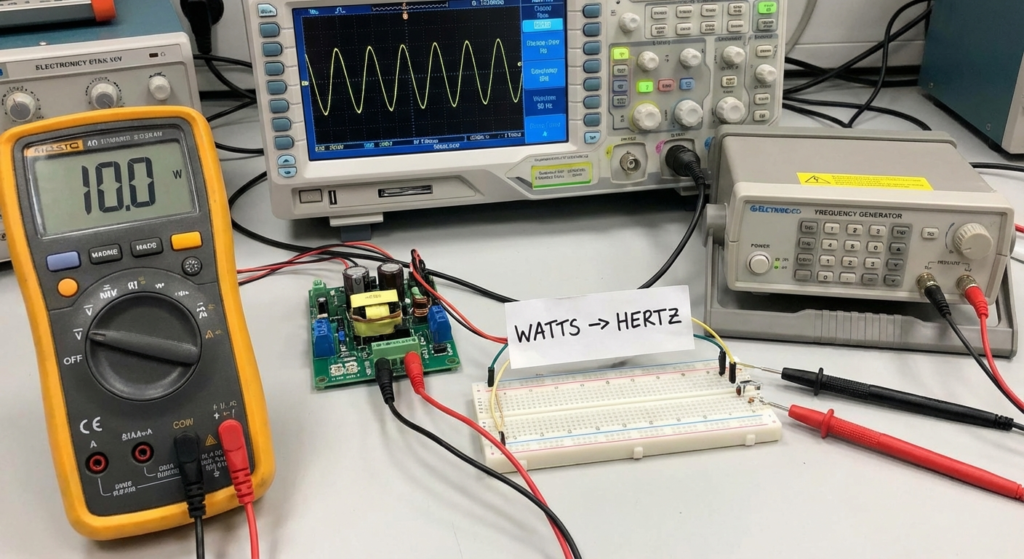
Picture this: You’ve just bought a high-end vintage amplifier from Japan, or maybe a specialized generator for your workshop. You look at the spec sheet, and the confusion hits. One number says 1000W, the other says 50Hz. You start Googling for a watts to hertz conversion calculator, assuming there’s a magic formula to swap one for the other.
Here is the hard truth that might save you from an electrical fire: There is no conversion.
Asking how to convert watts to hertz is exactly like asking how to convert “gallons of gas” into “miles per hour.” One measures how much energy you have (volume/power), and the other measures how fast the engine is cycling (speed/frequency). They are related, sure. They work together in the same system. But they are fundamentally different beasts.
In this guide, updated for electrical standards in 2026, we aren’t just going to throw textbook definitions at you. We’re going to break down exactly how these two units interact in your home, your audio gear, and your wallet—and why getting them mixed up is an expensive mistake.
📑 What You’ll Learn
The Core Difference: Power vs. Speed
To understand why a watts to hertz calculator doesn’t exist, we have to look at what is actually happening inside the wire. In our years of testing electrical components, we’ve seen that confusion usually stems from not visualizing the current.
What is a Watt? (The Muscle)
A Watt (W) is a unit of power. It measures the rate at which energy is consumed or produced. Think of it as the “muscle” of electricity. A 100-watt light bulb is burning more energy per second than a 60-watt bulb. It’s doing more work.
When you look at your utility bill in 2026, you are paying for Watt-hours (the amount of muscle used over time), not the frequency of the electricity.
What is a Hertz? (The Heartbeat)
A Hertz (Hz) is a unit of frequency. It measures how many times the electrical current changes direction in one second. In Alternating Current (AC)—which is what comes out of your wall outlet—the electrons don’t flow in a straight line. They wiggle back and forth.
- 60Hz: The current switches direction 60 times a second (Standard in North America).
- 50Hz: The current switches direction 50 times a second (Standard in Europe/Asia).
🎯 Key Takeaway
Watts measure how much work is being done (Power). Hertz measures how often the current cycles (Frequency). You cannot convert one to the other because they measure completely different physical properties.
The Water Hose Analogy (That Actually Makes Sense)
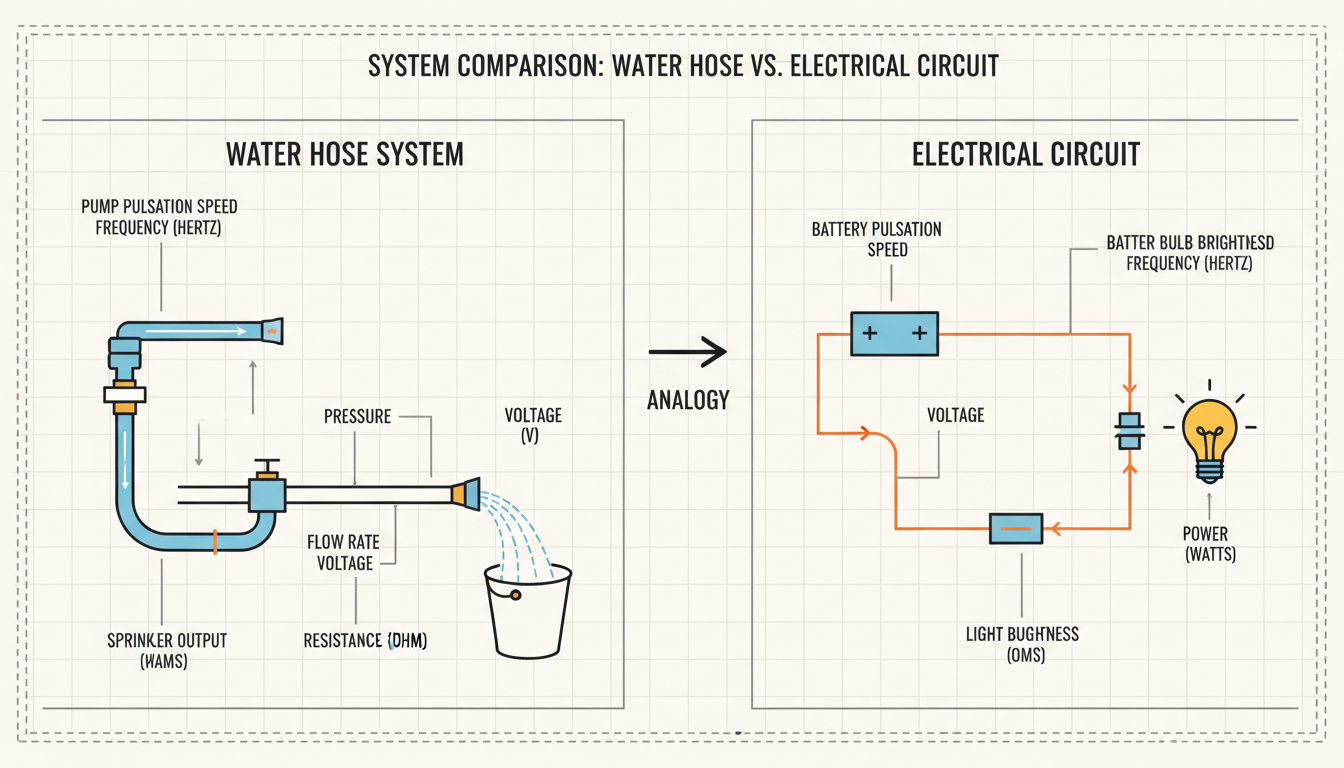
Physics definitions can get dry. Let’s look at this through a lens that everyone understands: plumbing. Imagine a firefighter holding a hose.
| Electrical Unit | Water Analogy | What It Determines |
|---|---|---|
| Volts (V) | Water Pressure | How hard the water pushes out of the pipe. |
| Amps (A) | Hose Diameter | How wide the stream of water is. |
| Watts (W) | Total Water Volume | The total amount of water hitting the fire (Pressure x Diameter). |
| Hertz (Hz) | The Pump’s Rhythm | How fast the pump pulses the water (Pulse… Pulse… Pulse). |
If you increase the speed of the pump (Hertz), the water pulses faster. That doesn’t necessarily mean more water (Watts) is coming out—it just means the delivery rhythm has changed. This is why you can have a massive 5,000-watt generator running at 60Hz, and a tiny 5-watt nightlight also running at 60Hz.
Real-World Scenarios: Generators & Audio
So, if you can’t convert them, why do people keep searching for watts to hertz? Usually, it’s because they are dealing with a specific piece of hardware where both numbers matter. Let’s break down the two most common scenarios we see.
1. The Generator Dilemma
If you are buying a generator for backup power, you need to match the Hertz to your appliances. In the US, your fridge motor is built to spin in time with a 60Hz rhythm. If you hook it up to a European 50Hz generator, that motor will spin 17% slower.
The Result? The motor runs hot, the cooling fan spins too slowly, and your expensive refrigerator burns out. The wattage of the generator (how much power it can provide) doesn’t matter if the frequency (Hertz) is wrong.
⚠️ Watch Out
Never plug a frequency-sensitive device (like a clock, turntable, or AC motor) into a power source with the wrong Hertz. Even if the voltage is correct, the wrong frequency can cause the device to overheat or run at the wrong speed.
2. Audio Engineering: Loudness vs. Pitch
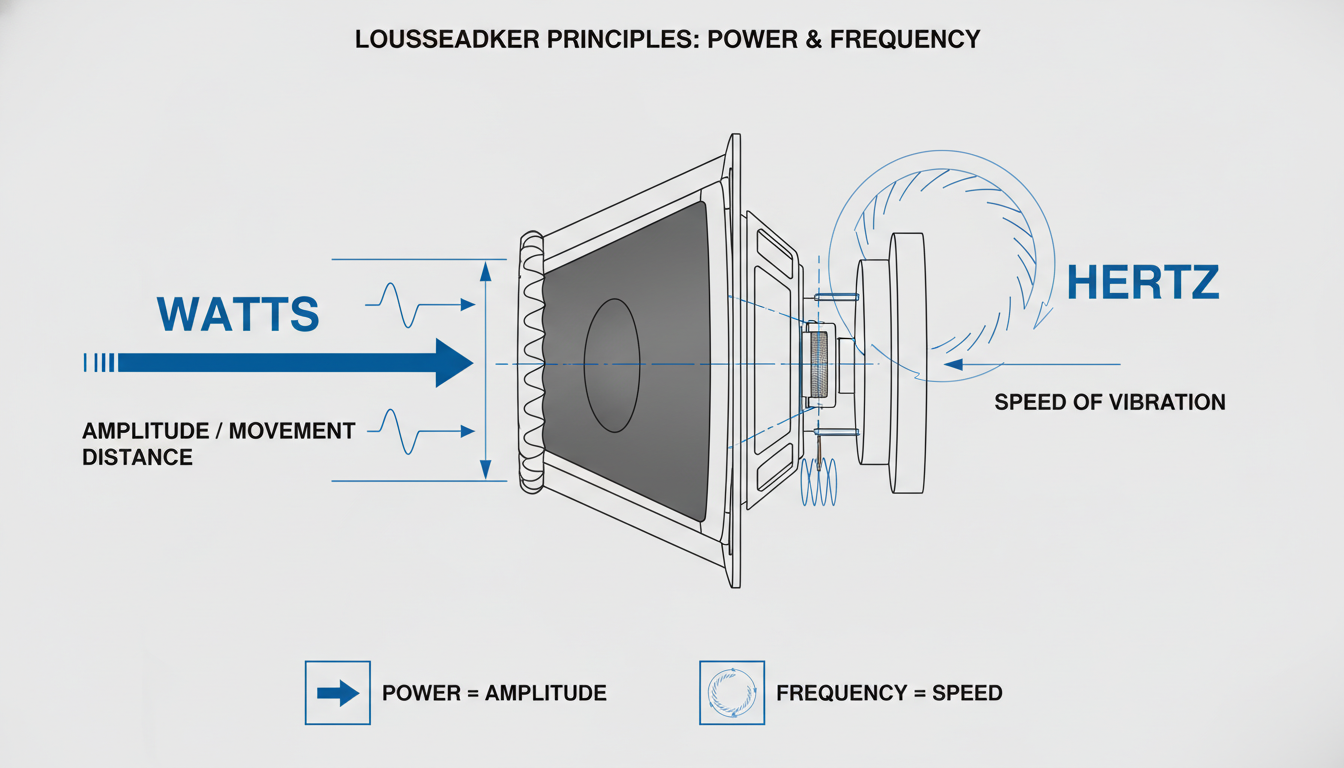
In the audio world, Watts and Hertz are constantly discussed, but they control different aspects of sound.
- Watts = Volume (mostly): More watts generally mean the speaker can be driven louder without distorting.
- Hertz = Pitch: This is the frequency of the sound wave. 20Hz is a low rumble (bass); 20,000Hz is a high-pitched whine.
You might see a subwoofer rated at “500 Watts” with a frequency response of “20Hz – 200Hz.” This means it can handle 500 watts of power to produce sounds within that low-frequency range.
Global Power Standards: 50Hz vs 60Hz
If you travel or import electronics, this is where the rubber meets the road. The world is split into two main camps regarding frequency. Knowing which camp you are in is vital for protecting your gear.
| Region | Standard Voltage | Standard Frequency (Hz) |
|---|---|---|
| North America (USA, Canada) | 120V | 60Hz |
| Europe (UK, Germany, France) | 230V | 50Hz |
| Japan (East) | 100V | 50Hz |
| Japan (West) | 100V | 60Hz |
| Australia | 230V | 50Hz |
Japan is the odd one out—they actually have a split grid where half the country uses 50Hz and the other half uses 60Hz. It’s a historical quirk that still causes engineering headaches today.
💡 Pro Tip
Check the power brick on your laptop or phone charger. Most modern electronics have “Switching Power Supplies” labeled “Input: 100-240V ~ 50/60Hz”. If you see this, you are safe to use it anywhere in the world with just a simple plug adapter. No voltage converter needed.
The Math You CAN Do (Step-by-Step)
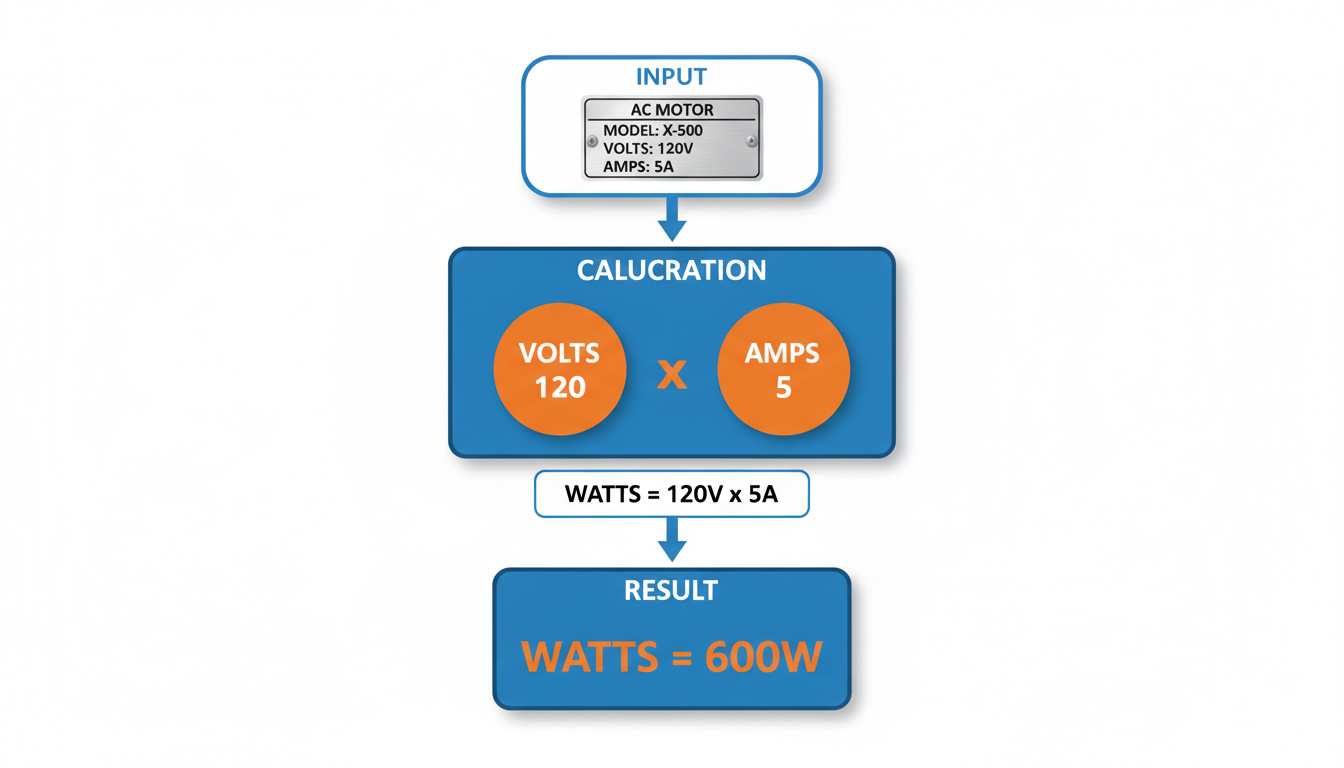
Okay, so you can’t convert Watts to Hertz. But you can calculate Watts if you know your Volts and Amps. This is the calculation you actually need if you’re trying to figure out if you’ll trip a circuit breaker.
The formula is known as Watt’s Law:
Watts (P) = Volts (V) × Amps (I)
Step-by-Step Guide: Calculating Your Load
- Find the Amps: Look at the sticker on the back of your device (e.g., a space heater might say 12.5A).
- Find the Volts: In the US, this is typically 120V for standard outlets.
- Multiply them: 12.5 Amps × 120 Volts = 1,500 Watts.
- Check your Breaker: A standard 15-Amp circuit breaker can handle roughly 1,800 Watts (15A × 120V). If you run two of those heaters, you’ll trip the breaker immediately.
Notice that Hertz didn’t enter this equation? That’s because for resistive loads (like heaters and lightbulbs), frequency doesn’t change the power calculation.
Conclusion
The search for a watts to hertz conversion usually ends in a realization: you were asking the wrong question. Watts tell you how much power you are using, while Hertz tells you the rhythm at which that power is delivered. They are partners in the electrical dance, but they are not interchangeable.
As we move through 2026, our devices are getting smarter and more efficient, but the fundamental physics of electricity hasn’t changed. Whether you are setting up a home theater or wiring a generator, keep your units straight. Check the label, match the Hertz, and calculate the Watts. It’s the only way to keep your gear running and your lights on.
For deeper reading on electrical standards, reliable sources like the NIST Guide to SI Units or the Department of Energy’s Appliance Guide are excellent places to start. If you are interested in the physics of frequency, Wikipedia’s entry on Hertz offers a comprehensive history.
❓ Frequently Asked Questions
Can I convert 60Hz to Watts?
No. 60Hz refers to the frequency of the AC cycle (60 times per second). Watts refers to the power consumption. A device running at 60Hz could use 1 Watt or 1,000,000 Watts. There is no direct mathematical conversion between them.
Does higher Hertz mean more power?
Not in standard electricity. A 50Hz and 60Hz supply can deliver the exact same amount of power (Watts). However, in computer processors (CPUs), a higher clock speed (measured in GHz) often correlates with higher power consumption, but that is a different application entirely.
What happens if I plug a 50Hz device into a 60Hz outlet?
If the device has an AC motor (like a clock, turntable, or older fan), it will run about 20% faster. This can cause overheating or mechanical failure. If the device uses a switching power supply (like a laptop charger), it will likely work fine as they are designed to handle both frequencies.
Is there any formula linking Energy and Frequency?
Yes, but only in quantum physics, not home wiring. The Planck-Einstein relation (E = hf) links the energy of a photon to its frequency. Unless you are a physicist studying light particles, this formula won’t help you fix your electrical appliances.
Why do some motors use Variable Frequency Drives (VFDs)?
VFDs are used in industrial settings to control motor speed. By lowering the Hertz (frequency) supplied to the motor, the motor spins slower. Interestingly, slowing the motor down usually reduces the Watts (power) required, saving energy. This is one of the few areas where Hertz and Watts are functionally linked in operation.