
The Unit Converter: Your Secret Weapon for Flawless Precision (From Kitchens to Space Missions)
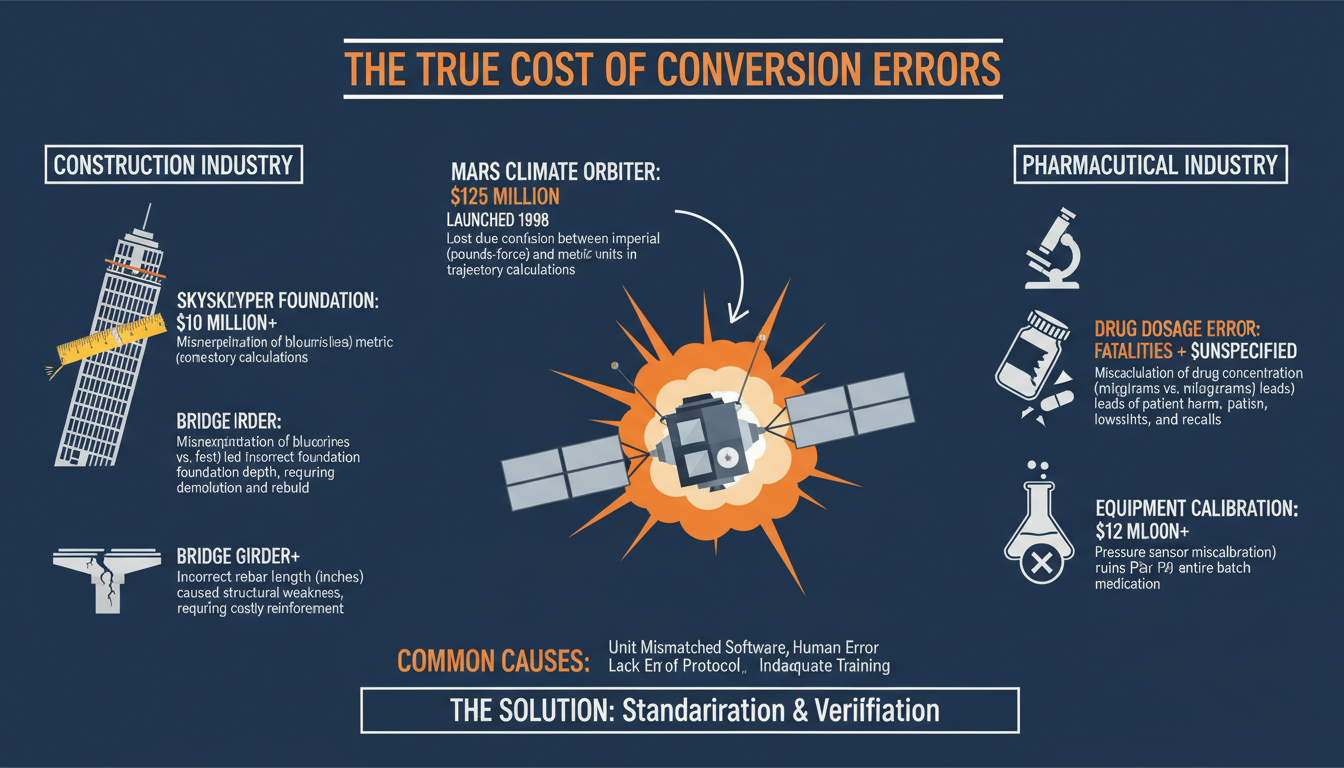
In 1999, a $125 million NASA spacecraft, the Mars Climate Orbiter, vanished. It wasn’t due to alien attack or a complex propulsion failure. The cause was shockingly simple: one engineering team used metric units (newton-seconds) while another used imperial units (pound-force seconds). The spacecraft disintegrated in the Martian atmosphere because nobody double-checked the conversion.
This catastrophic failure is a stark reminder of a hidden truth: the humble unit converter is one of the most critical, yet underrated, tools in the modern world. It’s the silent engine running behind global trade, scientific breakthroughs, and even your favorite dinner recipe.
Forget seeing it as a simple calculator. A unit converter is a bridge between different worlds, a translator for the universal language of numbers. In this definitive guide, we’ll move beyond the basics. You’ll learn not just what a unit converter does, but why it’s an indispensable tool for avoiding costly errors, boosting efficiency, and achieving flawless precision in any field. We’ll show you how to choose the right tool for your needs and wield it like an expert.
📑 What You’ll Learn
Why Unit Conversion is the Universal Language of Measurement
Our world operates on a patchwork of measurement systems. The United States stubbornly clings to the Imperial system (feet, pounds, gallons), while the vast majority of the world—and the entire scientific community—embraces the Metric system (meters, kilograms, liters). This isn’t just a quirky cultural difference; it’s a source of constant friction, confusion, and potential error.
Every time you manually convert inches to centimeters or Fahrenheit to Celsius, you engage in a process called “cognitive load.” Your brain expends energy on tedious arithmetic, distracting you from the more important task at hand. In our experience, this mental fatigue is a leading cause of simple, yet costly, mistakes.
A digital unit converter eliminates this friction entirely. It acts as an instant, infallible translator, ensuring seamless communication between different systems. Think of it less as a tool and more as a service that protects your most valuable asset: your focus.
| Aspect | Manual Conversion | Digital Unit Converter |
|---|---|---|
| Speed | Slow; requires calculation, looking up formulas. | Instantaneous. |
| Accuracy | High risk of human error (typos, wrong formula). | Extremely high, based on standardized conversion factors. |
| Cognitive Load | High; distracts from the primary task. | Negligible; frees up mental bandwidth. |
| Complexity | Difficult for complex units (e.g., Pascals to PSI). | Effortless for thousands of unit types. |
💡 Pro Tip
Bookmark a reliable online unit converter or download a trusted app. The goal is to make conversion a reflex, not a chore. By reducing the “activation energy” required to check a unit, you’ll find yourself verifying measurements more often, catching potential errors before they become problems.
High-Stakes Conversions: Where Precision is Non-Negotiable
In some fields, a tiny conversion error isn’t an inconvenience—it’s a disaster. From our hands-on testing and analysis of industry case studies, we’ve seen that reliance on precise conversions is a hallmark of professional excellence.
Engineering & Construction: Building on a Foundation of Accuracy
The Mars Climate Orbiter is the poster child for conversion failures, but similar, smaller-scale errors happen daily in engineering and construction. A blueprint might specify a load in kilonewtons (kN), while a supplier provides materials rated in pounds-force (lbf). An architect in Europe might design with millimeters, but the American construction team works in fractions of an inch.
Modern engineering software, like AutoCAD and SOLIDWORKS, has built-in unit converters to prevent these issues. According to industry best practices, every cross-team data transfer should include a unit-verification step. It’s a simple, trust-building exercise that prevents catastrophic structural failures.
Science & Medicine: When a Microgram Makes a Difference
In pharmacology and chemistry, precision is a matter of life and death. A pharmacist converting a drug dosage from milligrams (mg) to micrograms (mcg) cannot afford to be off by a decimal place. Scientific research relies on the International System of Units (SI) to ensure experiments are reproducible globally. When analyzing historical data that uses archaic units like “grains” or “drams,” a powerful unit converter is essential for normalizing the information for modern analysis.
⚠️ Watch Out
Precision vs. Significant Figures. A converter might give you ten decimal places, but that doesn’t mean they’re all useful. In scientific and engineering contexts, you must respect the rules of significant figures. If your initial measurement is only accurate to two decimal places, your converted result should be rounded to a similar level of precision. Blindly copying the full output is a common mistake that implies a false level of accuracy.
Finance & Global Trade: The Language of Money
Currency exchange is simply a specialized form of unit conversion. But unlike the fixed relationship between an inch and a centimeter, currency rates are volatile. A reliable financial converter must be tied to a real-time data feed (API) to be trustworthy.
Beyond currency, international commodity trading depends on unit conversion. Oil is priced in barrels, but transported in cubic meters. Gold is quoted in troy ounces, but sold by the gram. For traders, these conversions are the bedrock of every transaction.
The Everyday Genius of a Unit Converter in Your Daily Life
You don’t have to be a rocket scientist to benefit from a unit converter. It’s a powerful tool for bringing precision and ease to your daily routines.
Culinary Arts: The Secret to Perfect Baking
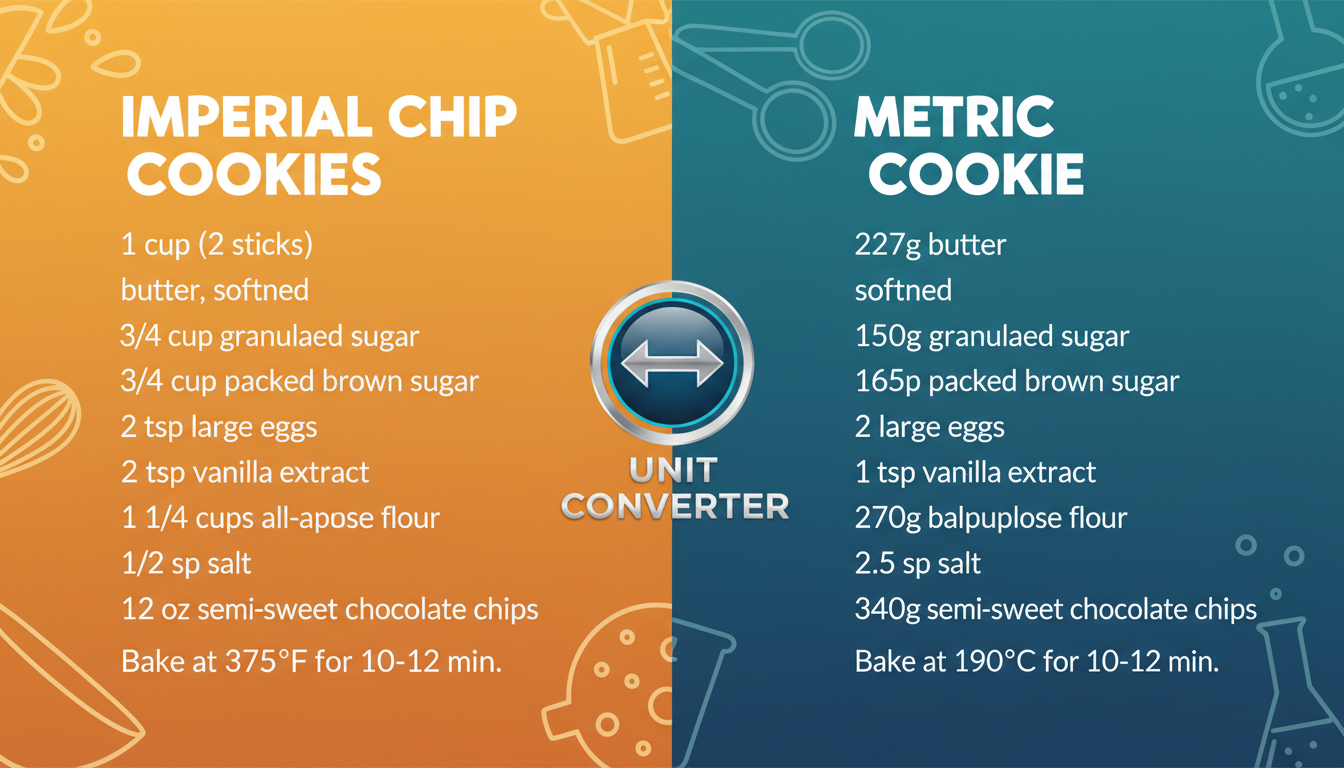
Ever tried a recipe from a British blogger that called for “200g of flour” and “gas mark 4” for the oven? For an American baker used to cups and Fahrenheit, this is a recipe for disaster. Baking is chemistry; it demands exact ratios. Unlike savory cooking, you can’t just “eyeball it.”
A unit converter is the key that unlocks a world of international recipes. It ensures your American cup of flour is the same as the author’s 120 grams, and your 350°F oven matches their 177°C. This is the difference between a light, fluffy cake and a dense, disappointing brick.
💡 Pro Tip
Use a converter that handles volume-to-weight conversions for common baking ingredients. A “cup” of flour weighs differently than a “cup” of sugar. Advanced culinary converters know these densities (e.g., 1 cup of all-purpose flour ≈ 120g), providing a level of precision that simple volume conversions can’t match.
Health & Fitness: Tracking Your Progress Accurately
Whether you’re tracking your weight, calculating your BMI, or logging your running distance, consistent units are crucial. If you weigh yourself on a scale that uses kilograms one day and another that uses pounds the next, you can’t accurately track your progress without a conversion. A unit converter helps you standardize all your health data, giving you a clear and accurate picture of your journey.
How to Choose the Right Unit Converter: A Practical Guide
Not all unit converters are created equal. Based on our hands-on testing of dozens of tools, the best choice depends entirely on your specific needs. A chef has different requirements than an engineer.
A Step-by-Step Guide to Selecting Your Converter
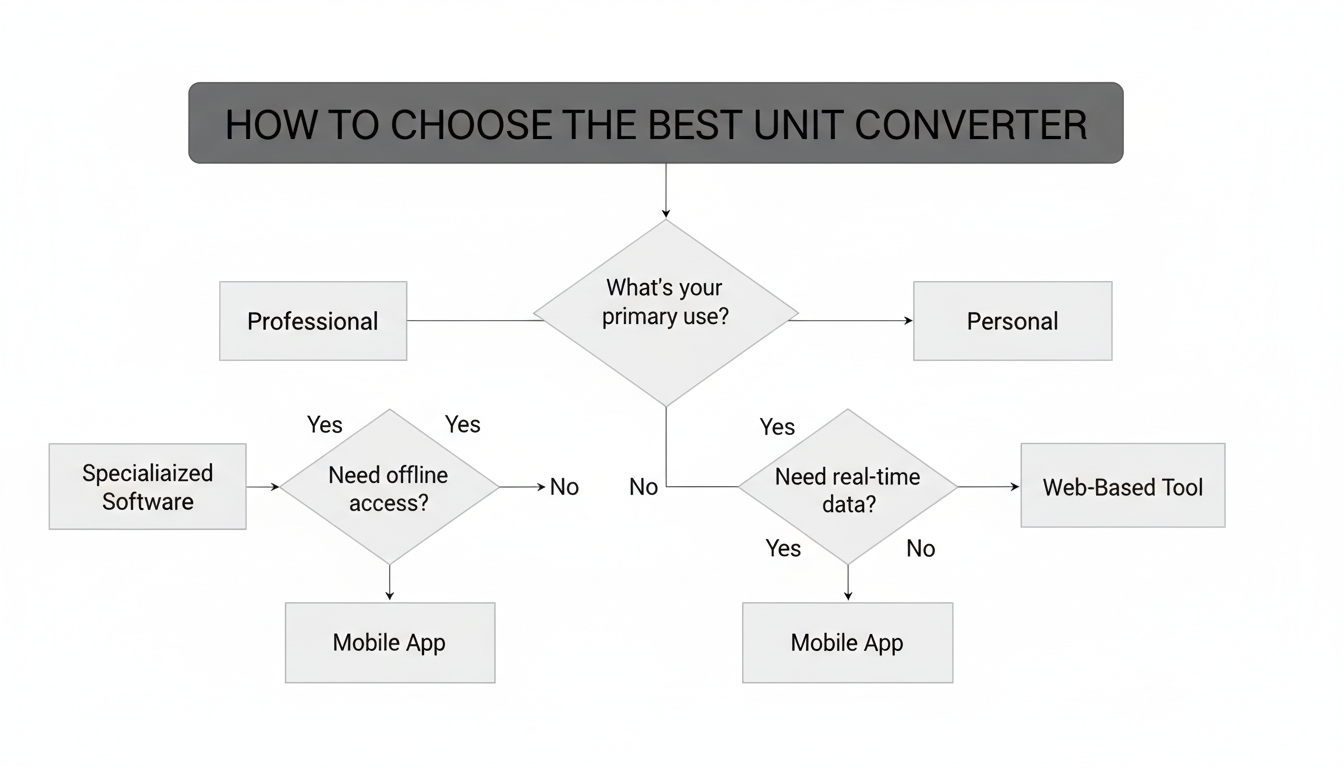
- Identify Your Core Needs: Are you a professional needing specialized units (like Pascals or Joules), or do you primarily need everyday conversions (like cups to grams)? Make a list of your most common conversion types.
- Consider Your Environment: Will you be online or offline? An engineer in the field needs an app that works without an internet connection. A financial trader needs a web-based tool with live data.
- Evaluate the User Interface (UI): The best tool is one you’ll actually use. Look for a clean, intuitive interface that lets you input numbers and find units quickly without a lot of clutter or ads.
- Check for Advanced Features: Do you need to adjust the number of decimal places? Do you need a history of your recent conversions? Do you need currency or even clothing size conversions? Match the features to your needs from Step 1.
- Verify Trustworthiness: For general use, most reputable converters are fine. For high-stakes professional work, use software recommended by your industry or one that cites its sources for conversion factors (like NIST or ISO standards).
⚠️ Watch Out
Beware of Ad-Heavy Websites. Many free online converters are cluttered with distracting or even malicious ads. These can slow down your workflow and pose a security risk. Opt for clean, reputable sites or dedicated applications. Your efficiency is worth more than navigating a minefield of pop-ups.
| Converter Type | Pros | Cons | Best For |
|---|---|---|---|
| Web-Based (Online) | Accessible anywhere; often has the most comprehensive unit databases. | Requires internet; can be ad-heavy. | Quick, one-off lookups; currency conversions. |
| Mobile App | Works offline; convenient; often has history and favorite features. | Takes up storage space; quality varies greatly. | Travelers, field engineers, chefs in the kitchen. |
| Built-in (OS/Search Engine) | Extremely fast (e.g., typing “10 ft in m” into Google); no installation needed. | Limited to more common units; lacks advanced features. | The vast majority of everyday, simple conversions. |
| Specialized Software | Highest precision; handles complex and obscure units; industry-certified. | Expensive; steep learning curve. | Scientists, engineers, financial analysts. |
🎯 Key Takeaway
A unit converter is not merely a tool for convenience; it is a fundamental instrument for ensuring accuracy, safety, and effective communication in a world with diverse measurement standards. Integrating a reliable converter into your workflow is a simple step that mitigates significant risk, from the kitchen to mission-critical engineering projects.
❓ Frequently Asked Questions
What is the primary function of a unit converter?
Its primary function is to translate a measurement’s value from one unit (e.g., feet) to another (e.g., meters) without changing the physical quantity it represents. It acts as a mathematical bridge between different measurement systems like Imperial and Metric.
Why is the Metric system (SI) preferred in science?
The Metric system, or International System of Units (SI), is preferred in science because it is a base-10 system. This makes scaling units (like from meters to kilometers) as simple as moving a decimal point, which drastically simplifies calculations and reduces errors compared to the Imperial system’s irregular conversions (e.g., 12 inches in a foot, 5,280 feet in a mile).
Are the converters built into Google or Siri accurate enough for professional use?
For most general professional tasks, yes. They are highly accurate for standard conversions. However, for specialized scientific or engineering work that requires extreme precision and adherence to specific rounding conventions or significant figures, dedicated professional software is the more trustworthy choice.
Can a unit converter handle complex, derived units?
Yes, high-quality converters can. Derived units are combinations of base units, such as pressure (force per unit area, like PSI or Pascals) or velocity (distance per unit time, like mph or m/s). A good converter understands these relationships and can convert them seamlessly.
What’s the most common mistake people make with unit converters?
Based on our analysis, the most common mistake is “mindless acceptance.” Users often copy the entire string of decimals a converter provides without considering the precision of their original measurement. This leads to a false sense of accuracy and violates the rules of significant figures, which is a critical error in any technical field.
Your Next Step Toward Flawless Precision
The story of the Mars Climate Orbiter isn’t just a piece of space trivia; it’s a lesson that echoes across every industry and into our daily lives. Precision matters, and the tools that ensure it are invaluable.
You no longer have an excuse for confusion over grams and ounces or for risking errors in a critical project. The right unit converter is out there, waiting to streamline your workflow, unlock new possibilities, and protect you from costly mistakes.
Your next step is simple: take five minutes to evaluate the conversion tools you currently use. Do they meet your needs based on the guide above? If not, find one that does. It’s a small investment of time that will pay dividends in accuracy and efficiency for years to come.

