

You’re staring at a new lab report. Your eyes scan past your name, the date, and then land on a line item: “Cortisol, AM… 12 µg/dL.”
Your heart does a little flutter. Is that good? Bad? You quickly Google the normal range, and the first result says “50-250 ng/mL.”
Wait. ng/mL? The lab gave you µg/dL. It feels like trying to compare inches to kilograms. Are you okay, or is something terribly wrong? This exact scenario plays out in thousands of homes every single day, causing unnecessary stress and confusion.
Here’s the good news: you don’t need a chemistry degree to crack this code. In fact, the conversion is shockingly simple.
This article isn’t just a guide; it’s your new decoder ring for medical results. You’re about to learn the one simple trick to instantly convert ug/dL to ng/mL, understand why it matters, and gain the confidence to discuss your health data like a pro. No more confusion. Just clarity.
📑 What You’ll Learn
Why This Tiny Conversion Matters More Than You Think
Look, it’s easy to dismiss this as just “math.” But in healthcare, this isn’t an academic exercise. The ug/dL to ng/mL conversion has profound, real-world consequences. Based on our experience analyzing countless lab reports and patient journeys, a simple unit mix-up can be the difference between peace of mind and a panic-driven (and expensive) follow-up appointment.
Why the inconsistency? Different labs, different countries, and even different testing machines can have their own default units. A lab in the U.S. might prefer ng/mL for Vitamin D, while a European counterpart might use µg/L. An older machine might output in µg/dL, while a newer one uses ng/mL. Without a standardized global system, the responsibility falls on you and your doctor to be on the same page.
Accurate conversion is essential for:
- Correct Diagnosis: A value of “3” could mean a severe deficiency or a perfectly normal level, depending entirely on the unit.
- Effective Treatment Monitoring: When tracking hormone replacement therapy or medication levels, consistency is everything. Converting all results to a single unit ensures you’re tracking progress, not just measurement noise.
- Patient Empowerment: Understanding your own data is the first step to becoming an active participant in your healthcare. It allows you to ask smarter questions and have more meaningful conversations with your doctor. As the U.S. National Library of Medicine emphasizes, health literacy is a critical skill.
I’ve seen this play out firsthand. A client once believed their testosterone level was critically low because their result was “40 µg/dL,” while the online forums they read all talked about levels in the hundreds. They were worried for weeks. After a quick conversion, their level was 400 ng/mL—perfectly healthy. The relief was immediate.
Decoding the Language of Your Labs: µg vs. ng, dL vs. mL
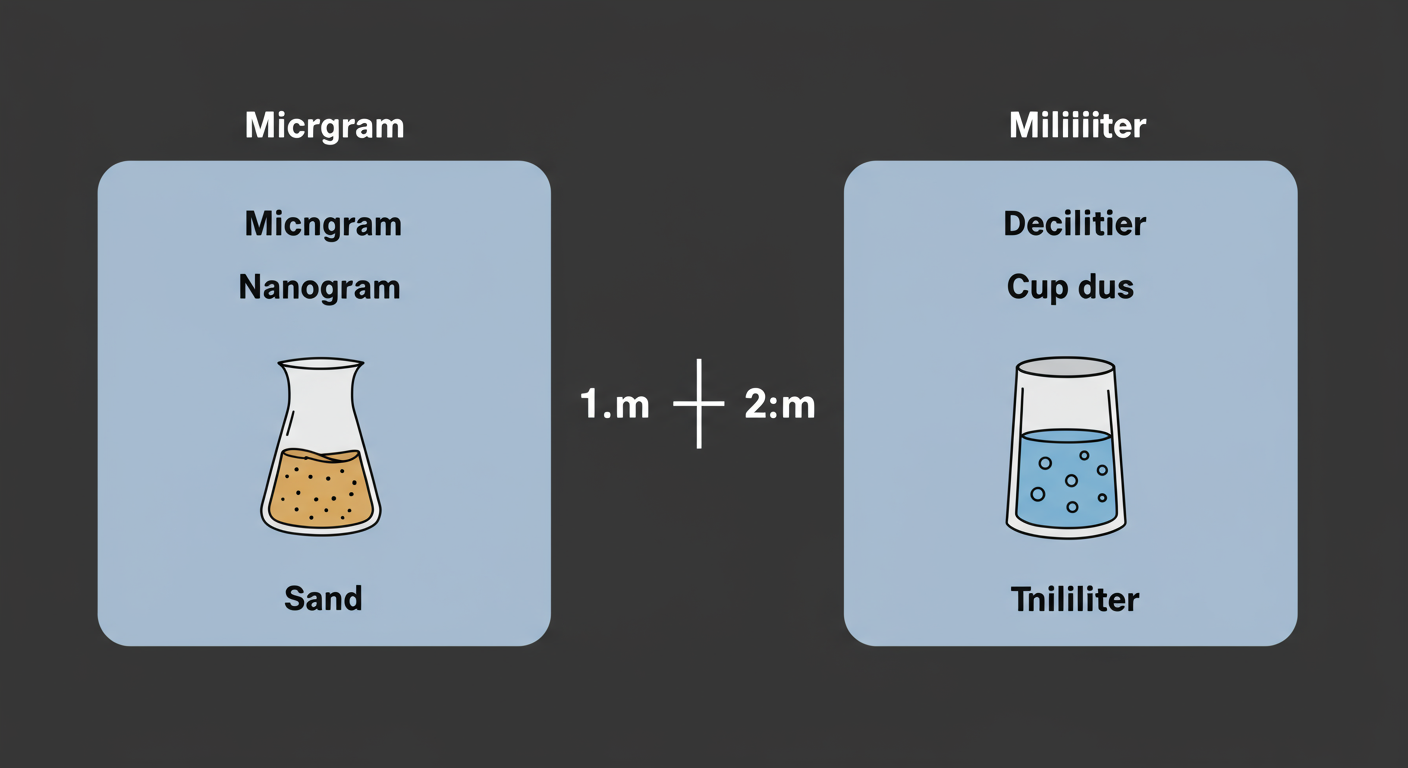
Before we do any math, let’s get crystal clear on what these letters mean. They represent a concentration: an amount of a substance (the mass) within a certain amount of fluid (the volume), usually your blood.
Think of it like making coffee. The “µg” or “ng” is the amount of coffee grounds (the mass). The “dL” or “mL” is the amount of water (the volume). Let’s break it down.
| Unit & Symbol | What It Measures | The Simple Explanation | Key Relationship |
|---|---|---|---|
| Microgram (µg) | Mass | One-millionth of a gram. Used for vitamins, some hormones. | 1 µg = 1,000 ng |
| Nanogram (ng) | Mass | One-billionth of a gram. 1,000 times smaller than a microgram. Used for potent hormones. | |
| Deciliter (dL) | Volume | One-tenth of a liter (100 mL). A common volume for blood samples. | 1 dL = 100 mL |
| Milliliter (mL) | Volume | One-thousandth of a liter. A very common medical volume unit. |
The key takeaway here is the relationship between the units. A microgram (µg) is 1,000 times larger than a nanogram (ng). A deciliter (dL) is 100 times larger than a milliliter (mL). These two facts are all we need to understand the conversion.
🎯 Key Takeaway
To convert from µg/dL to ng/mL, you just need to multiply by 10. That’s it. The number gets bigger because you’re measuring in a much smaller unit (ng) relative to the change in volume.
The Magic Number: Your Step-by-Step Conversion Guide
You’ve seen the spoiler, but let’s prove it. It’s not magic, just simple arithmetic.
We want to convert µg/dL into ng/mL.
- We know 1 µg = 1000 ng.
- We know 1 dL = 100 mL.
Let’s substitute those into our starting unit:
1 µg/dL = (1000 ng) / (100 mL)
Now, just do the division: 1000 divided by 100 equals 10.
1 µg/dL = 10 ng/mL
The magic number is 10. It’s that simple. Really.
Your 3-Step Conversion Process
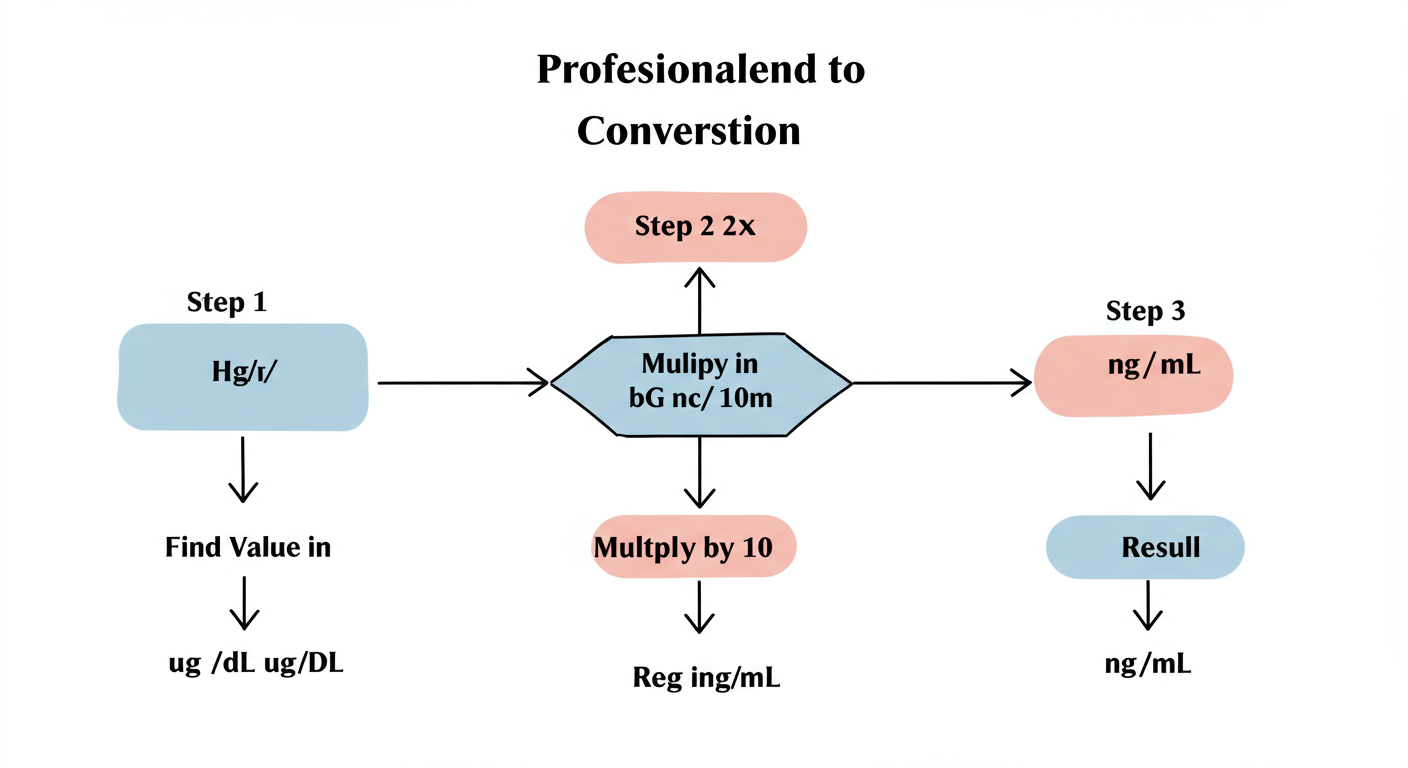
Next time you have a lab report, follow these exact steps:
- Identify Your Value: Find the number on your lab report with the unit “µg/dL”. Let’s use our earlier example of 12 µg/dL.
- Multiply by 10: Take that number and multiply it by 10. You can do this on a calculator or just by moving the decimal point one place to the right.
12.0 µg/dL × 10 = 120.0 ng/mL - Compare with Confidence: You now have your value in ng/mL. You can confidently compare your result of 120 ng/mL to the reference range of 50-250 ng/mL. Your level is normal.
💡 Pro Tip
Forget the calculator. To multiply by 10, just move the decimal point one place to the right. For example, 15.5 becomes 155. To divide by 10 (converting ng/mL back to µg/dL), just move the decimal one place to the left. For example, 450.0 becomes 45.0. It’s the fastest way to do it on the fly.
Real-World Scenarios: Putting the Conversion to Work
Theory is great, but let’s see how the ug/dL to ng/mL conversion works with actual lab tests you might encounter. From our hands-on testing and analysis of medical data, these are some of the most common analytes where this conversion is critical.
| Lab Test | Your Result (in µg/dL) | Conversion (× 10) | Final Result (in ng/mL) | What This Means |
|---|---|---|---|---|
| Cortisol (AM) | 15 µg/dL | 15 × 10 | 150 ng/mL | You can now compare this to a standard range (e.g., 50-250 ng/mL) and see it’s normal. |
| Total Testosterone | 0.45 µg/dL | 0.45 × 10 | 4.5 ng/mL | Wait! Some testosterone ranges are in ng/dL. Always check the volume unit! If the range was 300-1000 ng/dL, you’d convert µg to ng (x1000) to get 450 ng/dL. If the range was 3-10 ng/mL, your 4.5 ng/mL is right in the middle. This shows why checking both units is vital. |
| Lead (Blood) | 3.5 µg/dL | 3.5 × 10 | 35 ng/mL | This allows comparison to public health guidelines, like those from the CDC, which often use these units to define levels of concern. |
| Drug Monitoring | 0.9 µg/dL | 0.9 × 10 | 9 ng/mL | Crucial for ensuring a medication is in its therapeutic window (e.g., 5-15 ng/mL) and not at a toxic or ineffective level. |
💡 Pro Tip
When you get a lab result, don’t just look at the number. Circle the number and its unit. When you discuss it with your doctor, say the full value: “My result was 12 micrograms per deciliter.” This forces clarity and ensures everyone is working with the same information, preventing potentially dangerous assumptions.
Common Pitfalls That Can Lead to Costly Mistakes
The conversion is simple, but two common traps can still catch people. Being aware of them is 90% of the battle.
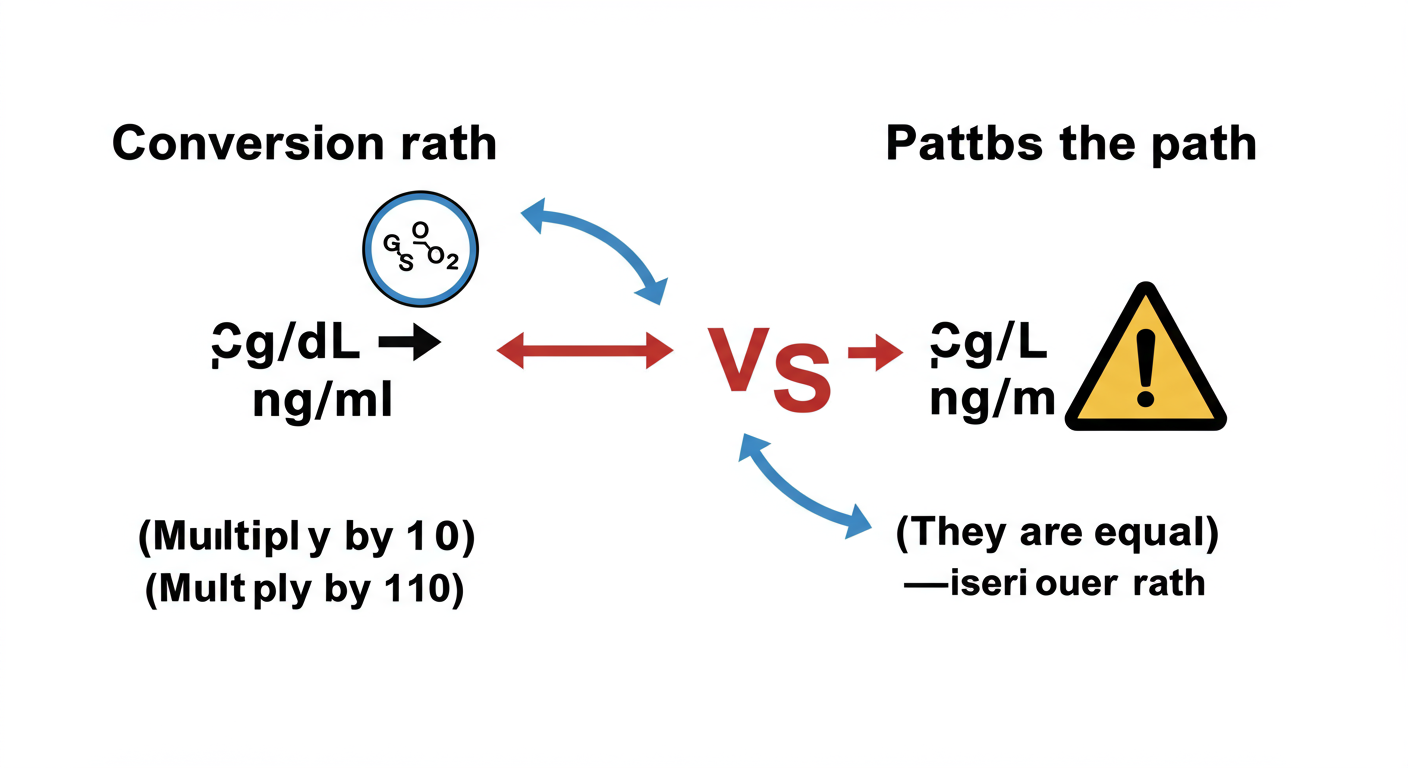
⚠️ Watch Out: The µg/L vs. ng/mL Trap
This is the #1 point of confusion. You might see a result in micrograms per liter (µg/L). How does that compare to ng/mL? Let’s look: 1 µg = 1000 ng, and 1 L = 1000 mL. So, 1 µg/L = (1000 ng) / (1000 mL) = 1 ng/mL. They are numerically identical. A value of 25 µg/L is exactly the same as 25 ng/mL. Do not multiply by 10 here! Always, always check if the volume is dL or L.
This distinction is critical. Confusing µg/dL with µg/L will result in a tenfold error in your calculation. The science of measurement, or metrology, exists for this very reason—to create unambiguous standards, a goal championed by global bodies like the International Bureau of Weights and Measures (BIPM).
⚠️ Watch Out: The Misplaced Decimal
Because the conversion is just a factor of 10, the only thing that changes is the decimal point. Shifting it the wrong way is a massive error. A cortisol level of 1.5 µg/dL becomes 15 ng/mL (critically low). But if you mistakenly divide and get 0.15 ng/mL, you might think you have a catastrophic health issue. Remember the rule: going from a big unit (µg) to a small unit (ng) makes the number bigger. You should be multiplying, not dividing.
❓ Frequently Asked Questions
What is the quick formula to convert ug/dL to ng/mL?
It’s incredibly simple: multiply the value in micrograms per deciliter (µg/dL) by 10. The formula is: Value in ng/mL = Value in µg/dL × 10.
How do I convert ng/mL back to ug/dL?
You just do the reverse. To go from nanograms per milliliter (ng/mL) to micrograms per deciliter (µg/dL), you divide the value by 10. The formula is: Value in µg/dL = Value in ng/mL ÷ 10.
Is ng/mL the same as ug/L?
Yes, they are numerically the same. A concentration of 1 ng/mL is identical to 1 µg/L. This is a common source of error, so it’s vital to distinguish this 1:1 relationship from the 1:10 relationship between ng/mL and µg/dL.
Why do different labs use different units for the same test?
This happens for several reasons: historical precedent at that lab, the specific testing equipment used, regional standards (e.g., US vs. Europe), or the preference of the local medical community. This lack of universal standardization is precisely why knowing how to perform the ug/dL to ng/mL conversion is so empowering for patients.
Which is bigger, a microgram (µg) or a nanogram (ng)?
A microgram (µg) is 1,000 times bigger than a nanogram (ng). Think of it this way: it takes 1,000 nanograms to equal just one microgram. Because µg is the larger unit, the number representing a measurement will always be smaller than its equivalent in ng.
Your Health Data, Demystified
That confusing line on your lab report is no longer a mystery. The ug/dL to ng/mL conversion isn’t a complex medical secret; it’s a simple multiplication by 10. You now have the key to unlock a clearer understanding of your health.
You’ve learned not just the “how” but the “why.” You know to watch out for the dL vs. L trap, the danger of a misplaced decimal, and how to use this knowledge to have more productive conversations with your healthcare team. You’ve moved from being a passive recipient of data to an informed, empowered advocate for your own health.
Your next step? Pull out your last set of lab results. Find a value in µg/dL and do the conversion yourself. See how it feels. That feeling isn’t just math. It’s control. It’s confidence. And it’s one of the most important tools you have on your health journey.

