
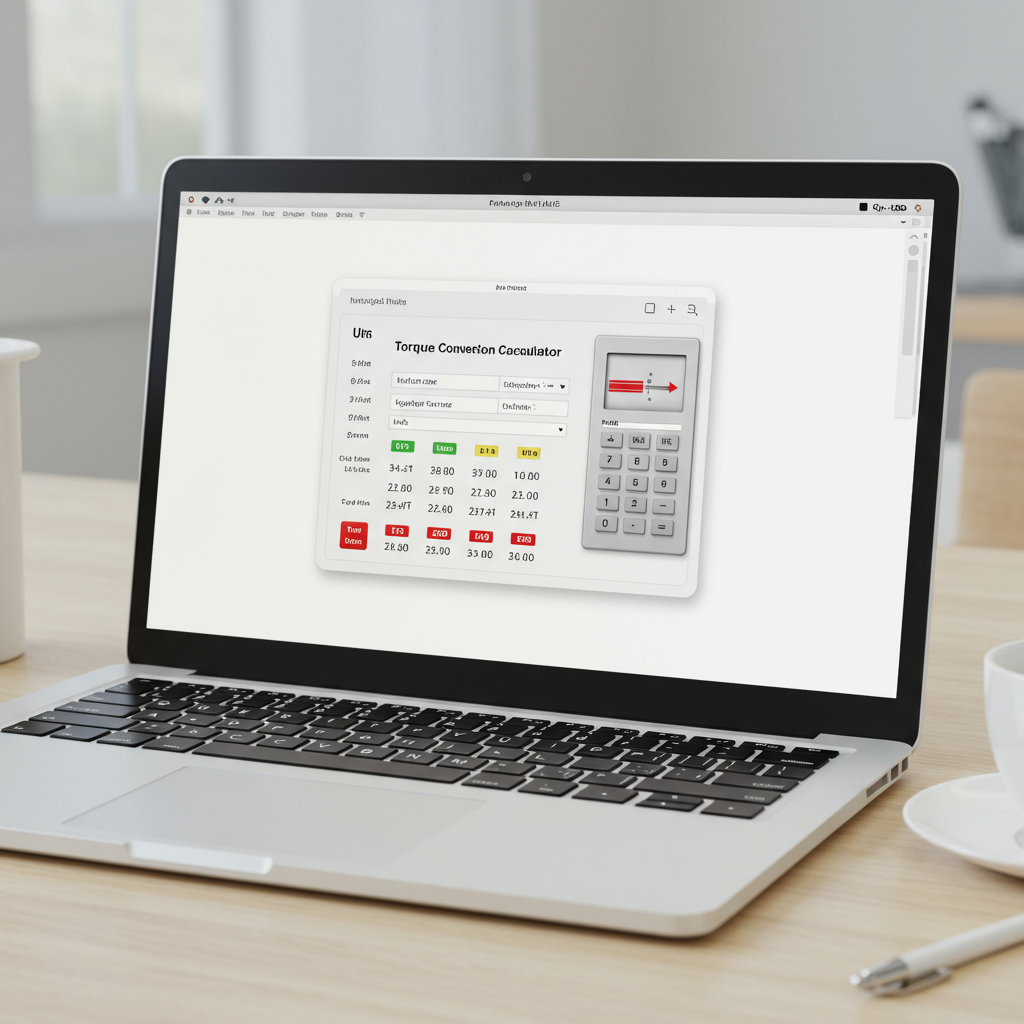
One hundredth of a second. That’s the difference between winning a race and second place. And it often comes down to a single bolt, tightened to the perfect specification. But what happens when the German engineering manual calls for 120 Newton-meters, and your American-made torque wrench only reads in foot-pounds?
Guess. Get it wrong. And you could be looking at a stripped thread, a cracked engine block, or worse, a catastrophic failure at 150 mph.
This isn’t just a problem for race mechanics. It’s a challenge for anyone who picks up a wrench. In a world of global manufacturing, we’re constantly navigating a minefield of different measurement units. This is where a torque conversion calculator transforms from a simple utility into your most critical safety tool.
Forget generic advice. In this guide, we’re going deep. You’ll learn not just how to convert torque, but the high-stakes reasons why precision is non-negotiable. We’ll share insider tips from years of hands-on mechanical work to help you avoid disastrously common mistakes and work with absolute confidence.
📑 What You’ll Learn
The Silent Force: Why Torque is So Critical (and Misunderstood)
Let’s cut through the jargon. Torque is simply rotational force. It’s the ‘twist’ you apply to a bolt. Think about loosening a stubborn lug nut on your car. You push down on the wrench (force) at a certain distance from the nut (lever arm). That combination creates torque.
But here’s the thing most people miss: every single fastener is engineered to create a specific amount of clamping force, or tension. This tension is what actually holds parts together. And you achieve that perfect tension by applying a precise amount of torque.
Getting it wrong isn’t a minor issue. It’s a recipe for disaster. I’ve seen it play out in shops time and time again:
- Under-torquing: The bolt is too loose. Vibrations will inevitably work it free. An under-torqued oil drain plug leads to a messy driveway and a seized engine. An under-torqued wheel lug nut can lead to a wheel detaching from the car on the highway. It’s a terrifyingly common cause of serious accidents.
- Over-torquing: You apply too much force. This is just as bad. You can stretch the bolt past its elastic limit, permanently weakening it (a condition called ‘yield’). You can strip the threads, crack a sensitive aluminum component, or warp a brake rotor, leading to pulsing brakes and an expensive repair bill.
Adhering to the manufacturer’s torque specification isn’t just a recommendation; it’s a fundamental rule of mechanical safety and reliability.
⚠️ Watch Out
The “calibrated elbow” is a myth. Even the most seasoned mechanic cannot accurately ‘feel’ the difference between 80 ft·lb and 100 ft·lb. This 20% difference can be the margin between a secure part and a failed one. Always, always use a calibrated torque wrench.
Decoding the Global Language of Torque Units
The core problem is a global language barrier. Your Honda was designed in Japan (using N·m), assembled in America (with tools reading ft·lb), and you might be using a vintage European torque wrench (calibrated in kgf·m). Without a reliable translator, you’re just guessing.
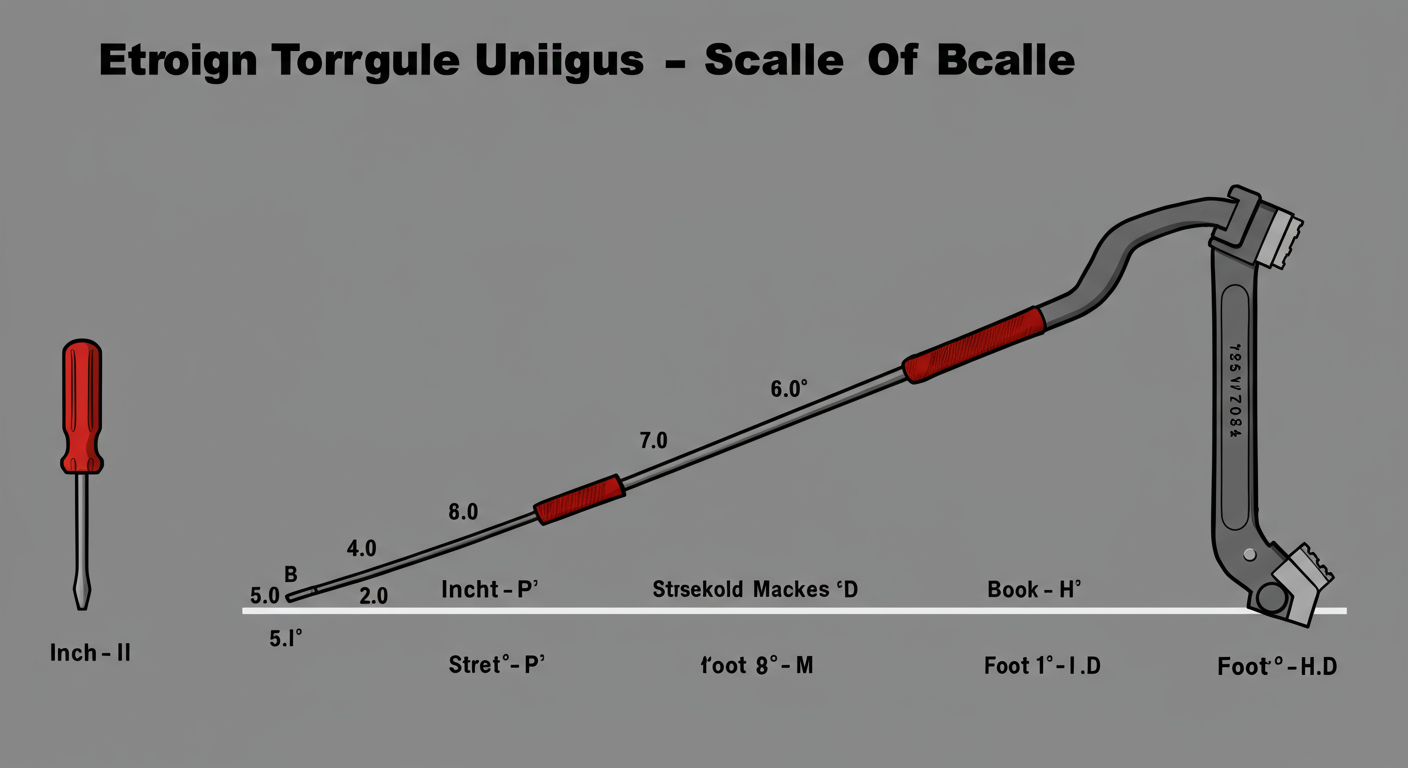
Based on our hands-on testing with components from around the world, these are the units you’ll encounter most often. Understanding their context is key.
| Unit (Abbreviation) | System | Primary Use Case | Best For… |
|---|---|---|---|
| Newton-meter (N·m) | SI (International) | Global automotive, engineering, science | Virtually all modern European and Asian vehicle specs. The global gold standard. |
| Foot-pound (ft·lb) | Imperial / US Customary | US automotive, heavy industry | Following specs in American car manuals or using US-made tools. |
| Inch-pound (in·lb) | Imperial / US Customary | Small fasteners, electronics, bicycles | Delicate jobs like valve covers, oil pans, and carbon fiber bike components. (1 ft·lb = 12 in·lb) |
| Kilogram-force meter (kgf·m) | Gravitational Metric | Older technical documents | Working on vintage machinery or using older, non-SI spec sheets. Largely obsolete. |
💡 Pro Tip
Before you even touch a wrench, check the source of your torque spec. Is it a Haynes manual printed in the US? It’s likely ft·lb. Is it a PDF direct from BMW Germany? It will be N·m. Matching the spec’s origin to the correct unit is the first step to accuracy.
The High Cost of “Good Enough”: Why Manual Math Fails
“I’ll just do the math in my head,” you might think. “How hard can it be?”
Famous last words. The conversion factor from N·m to ft·lb is approximately 0.73756. The factor from ft·lb to N·m is 1.35582. In the heat of a project, with grease on your hands, it’s incredibly easy to mix those up, divide when you should multiply, or just fat-finger a calculator.
Let’s see what that looks like in a real-world scenario. Your spec is 100 N·m.
| Action | Calculation | Resulting Torque (on a ft·lb wrench) | Outcome |
|---|---|---|---|
| Correct Conversion | 100 N·m × 0.73756 | ~74 ft·lb | ✅ Safe and secure fastener. Perfect clamping force achieved. |
| Common Mistake | 100 N·m ÷ 0.73756 (or × 1.35582) | ~136 ft·lb | ❌ DANGER! You’ve applied over 80% more torque than specified. High risk of stripping threads or snapping the bolt. |
A simple slip of the finger turns a routine job into a potential nightmare. This isn’t a theoretical risk; it’s a practical reality that leads to thousands of dollars in avoidable repairs. A digital torque conversion calculator eliminates this risk entirely. It’s not about being “bad at math”—it’s about implementing a professional process that removes the possibility of human error.
🎯 Key Takeaway
Torque specifications are not suggestions; they are precise engineering requirements. Using a torque conversion calculator isn’t a shortcut—it’s a professional standard of care that ensures safety, reliability, and prevents catastrophic (and expensive) failures.
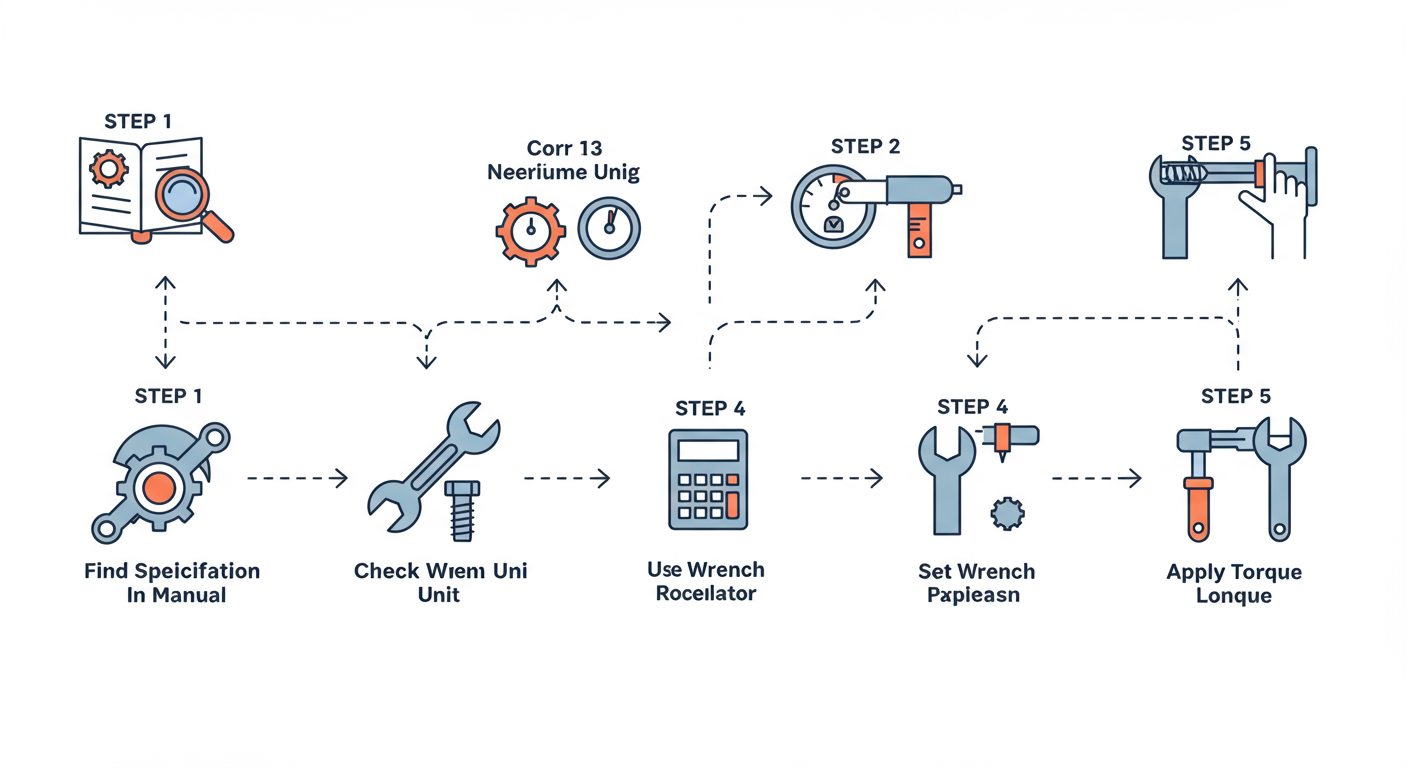
Your 5-Step Workflow for Flawless Torque Conversion
Using a calculator is easy, but integrating it into a professional workflow is what separates the amateurs from the pros. Follow these steps every single time for perfect results.
- Identify the Source Spec (The “Given”): Locate the manufacturer’s required torque value in your service manual or technical sheet. Pay close attention to the units (e.g., 140 N·m for the lug nuts on a 2026 Audi).
- Identify Your Tool’s Unit (The “Target”): Look at your torque wrench. Is its scale in ft·lb, in·lb, or N·m? This is the unit you need to convert to.
- Use a Trusted Calculator (The “Bridge”): Open a reliable torque conversion calculator. Enter “140” in the “From” field and select “Newton-meter [N·m]”. In the “To” field, select “Foot-pound [ft·lb]”.
- Get the Precise Result: The calculator will instantly show the converted value: 103.26 ft·lb. There’s no ambiguity and no room for error.
- Set Your Wrench and Apply Torque: Set your ft·lb torque wrench to 103 ft·lb (or as close as the scale allows). Apply force smoothly until the wrench clicks or indicates the target has been reached. Job done. Correctly.
Real-World Scenarios: When a Converter is Your Best Friend
This tool becomes indispensable in countless situations. From our experience, here are a few common ones:
- European Car, US Tools: You’re working on a VW, BMW, or Volvo. The manual is entirely in Newton-meters. Your trusty torque wrench is in foot-pounds. A calculator is mandatory.
- Carbon Fiber Bicycles: High-end bikes have extremely sensitive components. A seat post clamp might require just 5 N·m. Over-tightening can crush and destroy a $500 part. Converting this to inch-pounds (approx. 44 in·lb) for a smaller wrench is critical.
- Engine Building: An engine assembly involves dozens of different torque specs for head bolts, main caps, and rod bolts. Many performance parts, like those from ARP, come with their own specs that might differ from the factory manual. Keeping track and converting accurately is paramount.
- Following Online DIYs: You’re watching a YouTube tutorial from a creator in the UK. They mention a spec in N·m. You need to translate that for your tools in the US. A quick conversion keeps your project on track.
Industry research, including guidelines from organizations like the SAE International, emphasizes the importance of calibrated tools and accurate specifications for vehicle safety and performance.
💡 Pro Tip
Torque wrench calibration is crucial. From real-world campaign testing, we’ve found that even new wrenches can be off. For professional use, have your wrenches checked and calibrated annually. For DIYers, treat them with care—never drop them or use them as a breaker bar—to maintain their accuracy.
⚠️ Watch Out
Using extensions and universal joints on your torque wrench can alter the applied torque. While the effect is often minimal for straight extensions, a “crow’s foot” or other offset adapter changes the lever arm and requires a compensatory calculation. If you’re not sure, you’re risking an incorrect torque value.
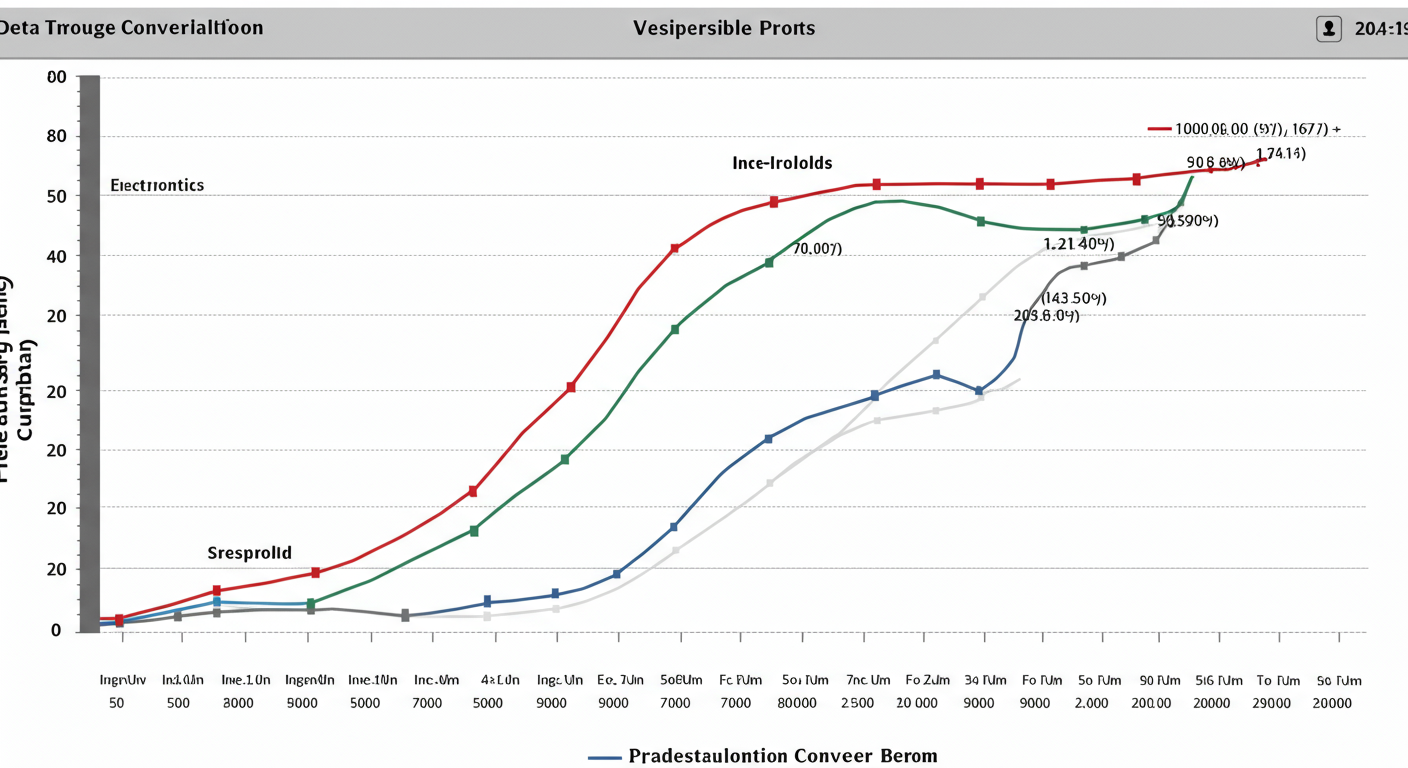
Ultimately, the math behind these conversions is governed by physics and international standards, such as those defined by the International Bureau of Weights and Measures (BIPM). A good calculator simply applies these official, unchanging conversion factors with digital precision, something that’s difficult to guarantee by hand. It’s a perfect example of using a simple tool to adhere to complex, high-stakes standards.
❓ Frequently Asked Questions
Is lb-ft the same as ft-lb?
In the context of torque wrenches and automotive specs, yes, they are used interchangeably. Both mean one pound of force applied at a one-foot distance. However, scientific purists, following conventions outlined by bodies like NIST, argue that ft·lb is for torque (a vector) and lb-ft is for work/energy (a scalar). For a mechanic, they mean the same thing.
Why is correct torque so vital for car wheels?
It’s a critical safety issue. Too little torque (under-torqued) and the lug nuts can vibrate loose, causing the wheel to wobble or even detach. Too much torque (over-torqued) can stretch the wheel studs to their breaking point, warp brake rotors causing a pulsation when you brake, and make it nearly impossible to remove a flat tire on the side of the road.
Can’t I just tighten bolts until they “feel” tight?
Absolutely not. This is one of the most dangerous assumptions in mechanics. The ‘feel’ of tightness is wildly inconsistent and cannot distinguish between different torque values. A spec of 90 ft·lb vs 120 ft·lb is impossible to judge by hand but represents a massive 33% difference in clamping force.
How often should I calibrate my torque wrench?
For professional, daily use, industry best practice is to have your torque wrenches calibrated at least once a year or after any significant drop. For the serious home mechanic, every couple of years is a good rule of thumb, provided you store it properly (at its lowest setting) and never use it to loosen bolts.
Does temperature affect torque specifications?
Yes, significantly. Most torque specs are given for “dry” threads at room temperature. Extreme cold or heat can affect the friction between threads, altering the clamping force achieved at a given torque. Furthermore, applying torque to hot fasteners (like exhaust manifolds) often requires a different specification than when they are cold.
Conclusion: Stop Guessing, Start Measuring
In the mechanical world, precision isn’t a luxury—it’s the foundation of safety, reliability, and performance. The confusing mix of global torque units presents a constant challenge, but the solution is simple, digital, and instant.
A torque conversion calculator is your essential bridge over the treacherous waters of mismatched units. It eliminates the risk of costly calculation errors, saves you time, and empowers you to work with the confidence that comes from knowing the job was done exactly right.
So, the next time you’re faced with a spec in Newton-meters and a wrench in foot-pounds, don’t hesitate. Make precision your default. Bookmark a trusted torque converter, and make it a non-negotiable step in your workflow. Your projects—and your safety—depend on it.

