
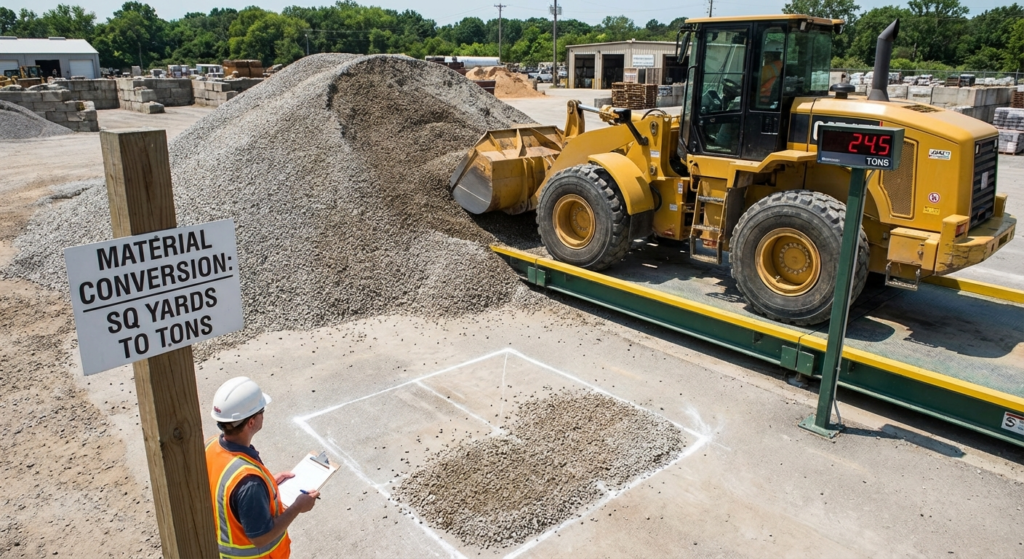
Picture this: The dump truck tilts its bed, the last pile of gravel slides out, and the driver hands you the bill. He drives off, and you grab your shovel. But halfway through spreading the stone, your heart sinks. You’re five feet short of the garage door.
Now you’re stuck paying a “short load” fee for a second truck, waiting another two days for delivery, and explaining the delay to your client or spouse. It’s a nightmare scenario. And it happens constantly.
Why? Because of a simple disconnect in how we measure the world. We measure our driveways, patios, and garden beds in square yards (area). But quarries and supply yards sell materials by tons (weight). If you don’t know how to bridge that gap, you’re guessing with your wallet.
In 2026, material costs are higher than ever. You can’t afford to guess. Whether you’re a seasoned contractor or a DIY warrior, mastering the conversion from square yards to tons is the single most valuable math skill you can have in your back pocket.
In this guide, I’m going to walk you through the exact formula I’ve used on job sites for over a decade. We’ll cover the physics, the “fudge factors” that save your hide, and the specific density charts you need to get it right the first time.
📑 What You’ll Learn
The Physics: Why You Can’t Just “Convert” It
Here is the thing most online calculators don’t tell you: You cannot directly convert square yards to tons. It’s physically impossible.
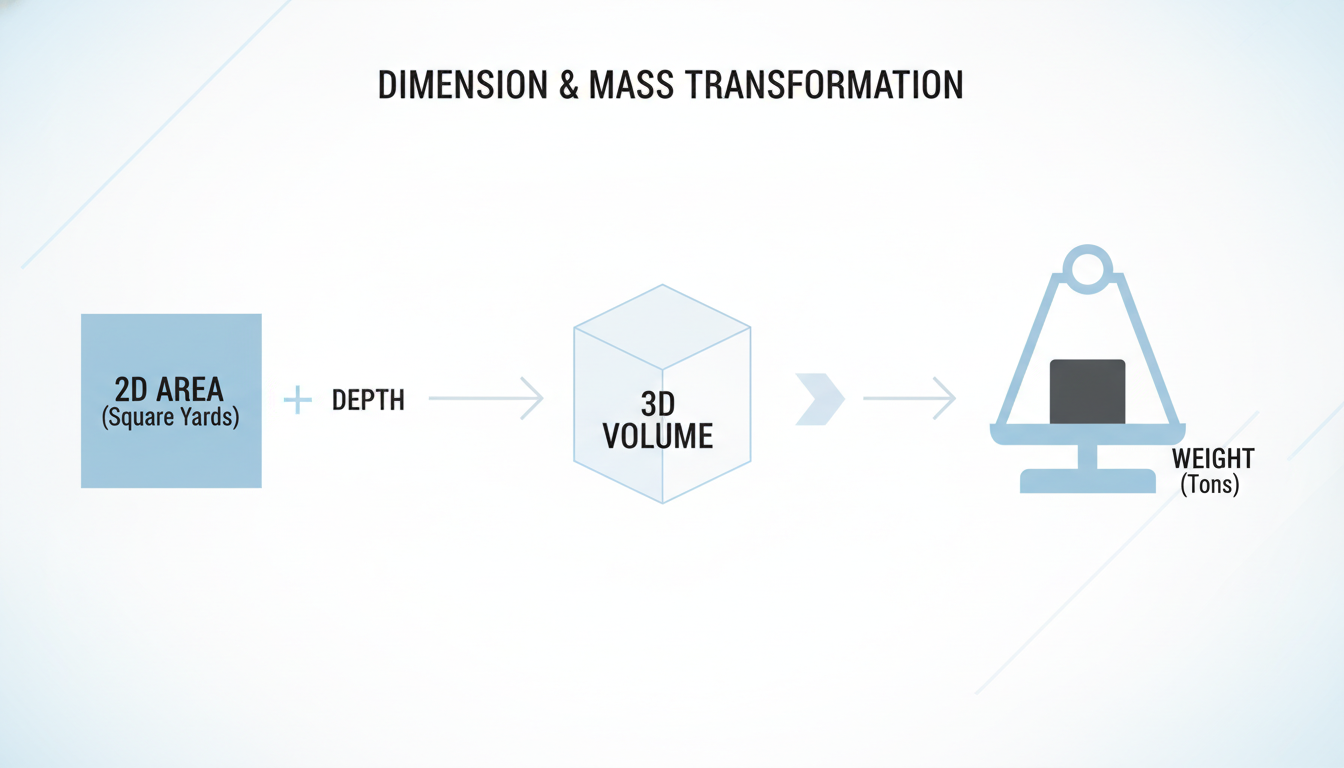
Why? Because a square yard is a measure of area (2D). A ton is a measure of weight. To get from one to the other, you need a third dimension: Depth.
Think of it like this. A square yard of feathers spread one inch thick weighs almost nothing. A square yard of lead spread one inch thick weighs a massive amount. To solve the square yards to tons equation, we have to calculate the Volume first, and then apply the material’s Density.
🎯 Key Takeaway
There is no “magic number” to convert area to weight. You must follow the sequence: Area + Depth = Volume, and then Volume × Density = Weight. Skipping the volume step is the #1 cause of ordering errors.
The 3-Step Conversion Formula
Let’s strip away the complex engineering jargon. You only need three steps to get an accurate number. Grab your calculator.
Step 1: Determine Your Volume (Cubic Yards)
You likely measured your project in feet or yards. If you have the area in square yards, you need to multiply it by the depth. But here is the catch: your depth is usually in inches.
First, convert your depth to yards: Depth in Inches ÷ 36 = Depth in Yards.
Then, multiply: Area (Sq. Yards) × Depth (Yards) = Volume (Cubic Yards).
Step 2: Identify the Material Density
This is where experience counts. A cubic yard of topsoil is fluffy and light. A cubic yard of wet crusher run (gravel with dust) is incredibly dense. You need the specific “Unit Weight” of your material. (We have a chart for this below).
Step 3: Calculate the Tonnage
Multiply your Volume (Cubic Yards) by the Material Density (Tons per Cubic Yard).
💡 Pro Tip
Always round UP your depth measurement. If the ground is uneven and ranges between 3 and 4 inches deep, calculate for 4 inches. It is much cheaper to have a small pile of leftover gravel than to pay a $150 delivery fee for half a ton of missing stone.
2026 Material Density Charts
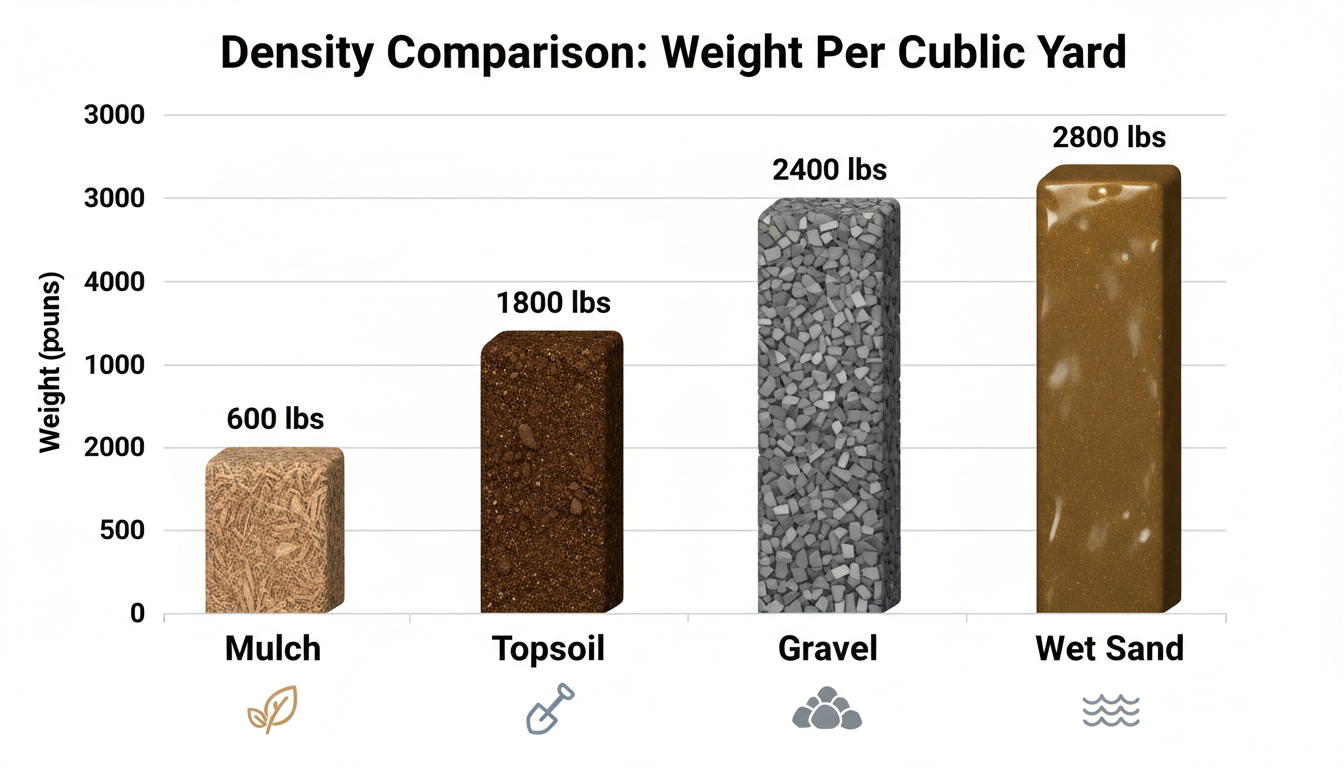
Using a generic “1.5 tons per yard” rule works for some gravel, but it will fail you on other materials. In my experience, using precise density figures is the difference between a perfect order and a disaster.
Below is a comparison of common construction materials and their typical conversion factors. Note that these are averages; rain and moisture content can skew these numbers higher.
| Material Type | Condition | Tons per Cubic Yard (Approx) | Lbs per Cubic Foot |
|---|---|---|---|
| Crushed Stone / Gravel | Loose / Dry | 1.35 – 1.45 | 100 – 107 |
| Crushed Stone with Fines | Compacted (Driveway Mix) | 1.55 – 1.70 | 115 – 125 |
| Sand | Dry / Loose | 1.10 – 1.25 | 80 – 95 |
| Sand | Wet / Packed | 1.40 – 1.60 | 105 – 120 |
| Topsoil | Loose / Screened | 1.00 – 1.20 | 75 – 90 |
| Clay / Fill Dirt | Packed | 1.30 – 1.50 | 100 – 110 |
| Mulch | Shredded Hardwood | 0.25 – 0.40 | 18 – 30 |
For highly specific geological data on rock densities, the U.S. Geological Survey (USGS) provides extensive mineral databases, though the chart above covers 95% of residential and commercial needs.
The “Hidden” Variable: Compaction
This is the part that trips up even the pros. When you buy material, it is “fluffed up” in the loader bucket. When you spread it on your driveway and run a plate compactor over it, it shrinks. A lot.
If you need 4 inches of finished depth, and you order exactly enough for 4 inches of loose gravel, you will end up with a 3-inch driveway after compaction. You must factor in the Compaction Loss.
⚠️ Watch Out
The “Shrinkage” Trap: Most aggregates (gravel/sand) will compress by 15% to 20% once installed. If your project requires a specific code-compliant depth (like a foundation base), failing to add this margin will cause you to fail inspection.
Here is how much extra material you should order based on the material type:
| Material | Compaction Loss % | Multiplier Factor |
|---|---|---|
| Clean Stone (No dust) | 5% – 10% | x 1.10 |
| Gravel with Fines (Driveway) | 15% – 20% | x 1.20 |
| Topsoil | 20% – 25% | x 1.25 |
| Sand | 10% – 15% | x 1.15 |
Special Case: Calculating Asphalt
Asphalt is the heavyweight champion of the square yards to tons world. Because it is hot, sticky, and expensive, you need high precision. According to the National Asphalt Pavement Association, standard mixes have a very specific density.
Contractors use a simplified rule of thumb for Hot Mix Asphalt (HMA):
1 Ton of Asphalt covers 80 Square Yards at 1 inch thick.
However, for the math nerds (and to be safe), use this formula:
(Square Yards × Thickness in Inches × 113) ÷ 2000 = Tons Needed
Note: The “113” represents the standard weight in pounds per square yard per inch of depth.
Real-World Example: The Driveway Project
Let’s put this into practice. Imagine you are re-graveling a driveway. Here are your specs:
- Area: 100 Square Yards
- Desired Depth: 4 Inches
- Material: Crusher Run (Gravel with fines)
Step 1: Convert Depth to Yards
4 inches ÷ 36 = 0.111 yards.
Step 2: Get the Volume
100 Sq Yards × 0.111 Yards = 11.1 Cubic Yards.
Step 3: Apply Density
Looking at our chart, Crusher Run is about 1.5 tons per cubic yard.
11.1 Cubic Yards × 1.5 = 16.65 Tons.
Step 4: The Compaction Safety Margin
Since this is a driveway, we want it packed tight. We add 15% for compaction.
16.65 Tons × 1.15 = 19.14 Tons.
The Verdict: You should order a standard “tri-axle” dump truck load, which typically holds about 20-22 tons. You will have a tiny bit left over—perfect for filling potholes next spring.
Frequently Asked Questions
❓ Frequently Asked Questions
How many square yards does 1 ton of gravel cover?
It depends on the depth. At a standard 2-inch depth, 1 ton of gravel covers approximately 10 to 12 square yards. At 4 inches deep, that coverage drops to about 5 to 6 square yards.
Does wet gravel weigh more than dry gravel?
Yes, significantly. Water fills the porous gaps in the stone. If you are buying by weight after a heavy rainstorm, you might receive 10-15% less actual stone volume per ton because you are paying for water weight.
What is the difference between a “short ton” and a “long ton”?
In the US, construction materials are almost always sold by the “short ton” (2,000 lbs). The “long ton” (2,240 lbs) is used mostly in the UK and for shipping. Always verify with your supplier, but in the US, assume 2,000 lbs.
Can I just use a cubic yard calculator?
You can use a cubic yard calculator to get volume, but you still need to convert that volume to weight manually using the density of your specific material. Volume calculators do not account for density differences between mulch and rock.
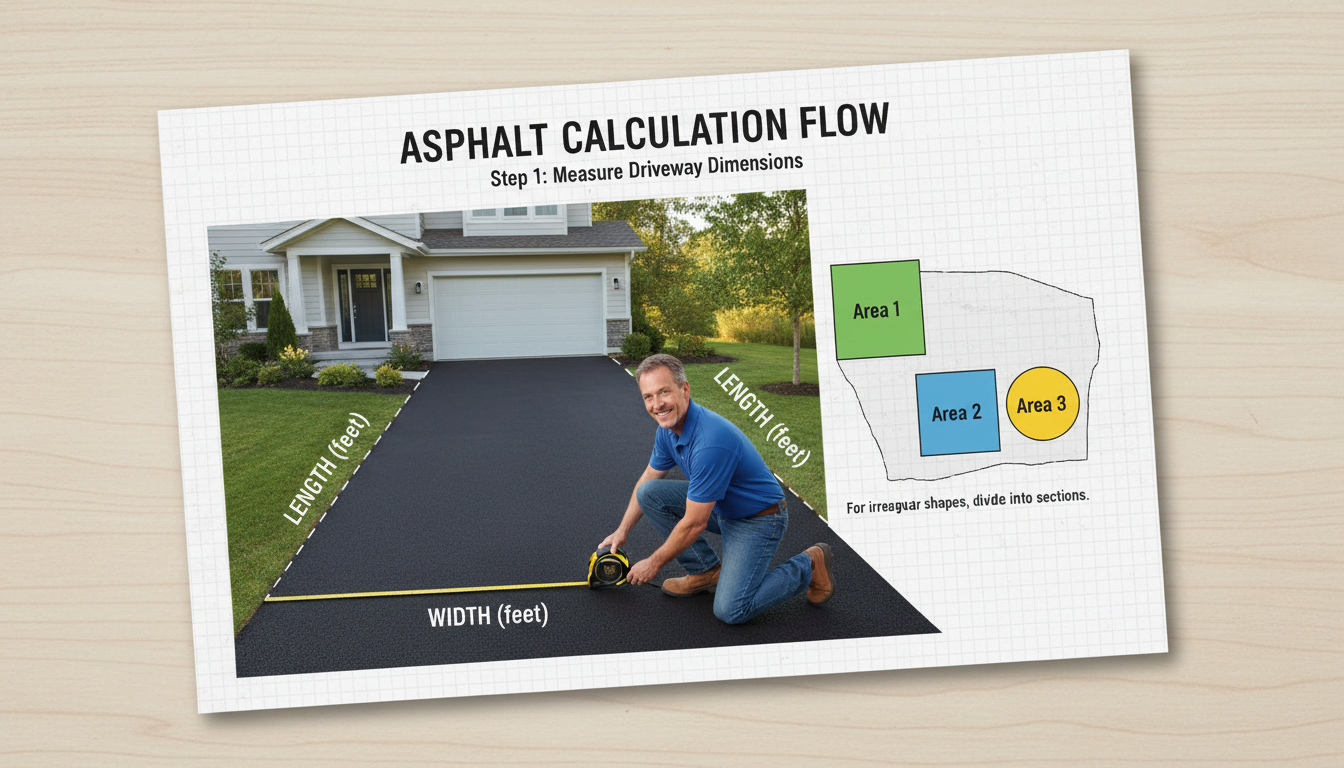
How do I measure an irregularly shaped area?
Break the shape down into smaller rectangles and squares. Calculate the area of each section individually and add them together. For complex curves, resources like Purdue University’s Engineering extension suggest using the “offset method” for higher accuracy.
Conclusion: Measure Twice, Order Once
Converting square yards to tons isn’t just about passing a math test; it’s about project management. An accurate calculation prevents project delays, saves you money on delivery fees, and ensures your construction has the structural depth it needs to last.
Remember the golden rule of material ordering in 2026: Volume × Density + Compaction Factor.
Don’t rely on guesses. Use the charts above, add your safety margin, and order with confidence. Now that you have the numbers right, it’s time to get to work.