
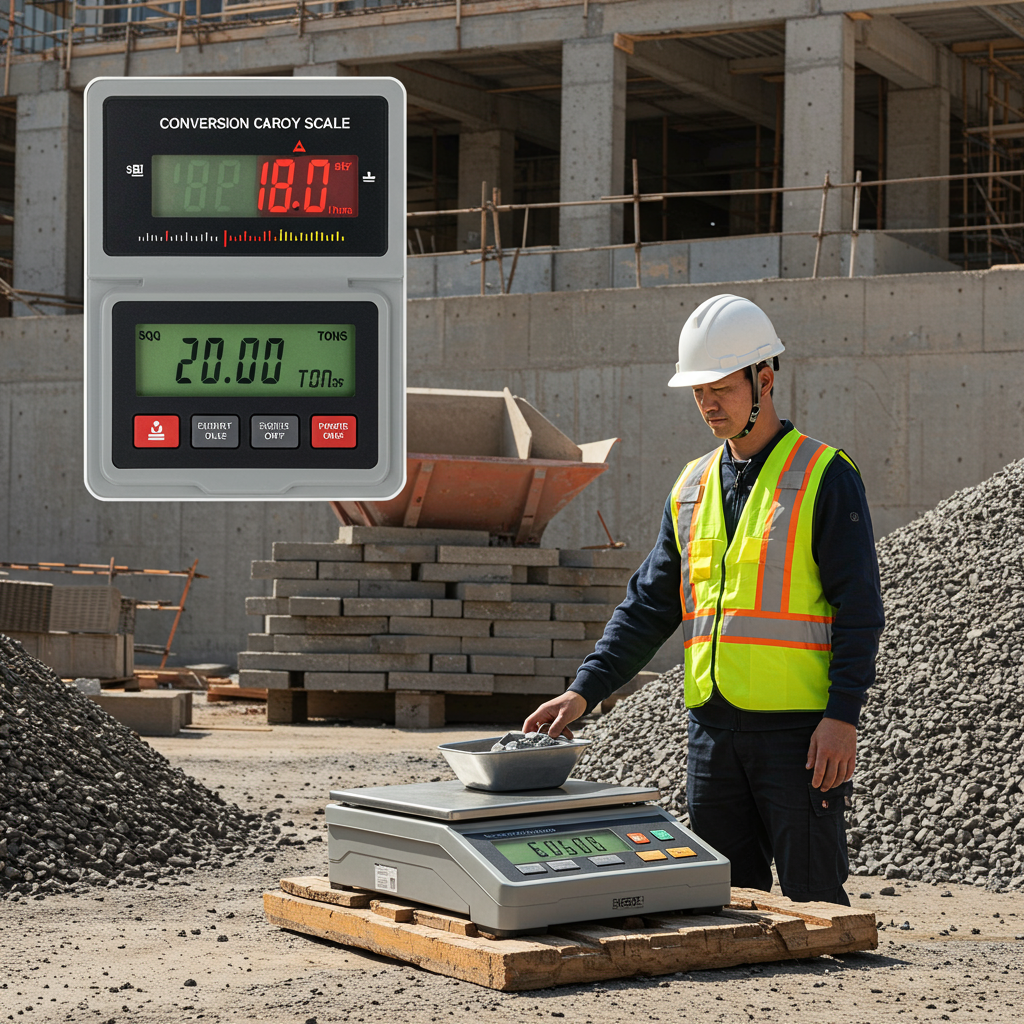
You’ve measured it three times. Your new gravel driveway is exactly 150 square yards. You’re ready. You call the local supplier, feeling confident, and proudly state your number. Then comes the question that stops countless projects in their tracks:
“Okay, great. So… how many *tons* do you need?”
Silence. The confidence evaporates. Suddenly, you’re faced with a conversion that feels like trying to turn minutes into miles. It’s a classic, frustrating roadblock.
Here’s the truth: you can’t directly convert square yards to tons. It’s impossible. But don’t worry—you’re not stuck. You’re just missing two simple but crucial pieces of information.
This guide will give you the exact framework professionals use. You’ll learn the simple math that bridges the gap between the *area* you measured and the *weight* you need to order. Forget guesswork. By the end of this article, you’ll be able to calculate your material needs with pinpoint accuracy, saving you hundreds of dollars and the massive headache of ordering too much or—even worse—not enough.
📑 What You’ll Learn
The #1 Mistake: Why You Can’t Just Convert Sq Yards to Tons
Let’s get this straight right away. Asking how many tons are in a square yard is like asking how much a floor plan weighs. It doesn’t make sense because the units measure completely different things.
* **Square Yards (sq yd):** This is a two-dimensional measurement of **area**. Think of it as a flat square on the ground. It has length and width, but no height.
* **Tons:** This is a measurement of **weight** or **mass**. It tells you how heavy something is.
To connect these two, you need to turn your flat area into a three-dimensional volume. You need to add **depth**.
Once you have a volume (length x width x depth), you get **cubic yards**. Now you have a tangible amount of “stuff.” From there, all you need is to know how much that specific “stuff” weighs. That’s its **density**.
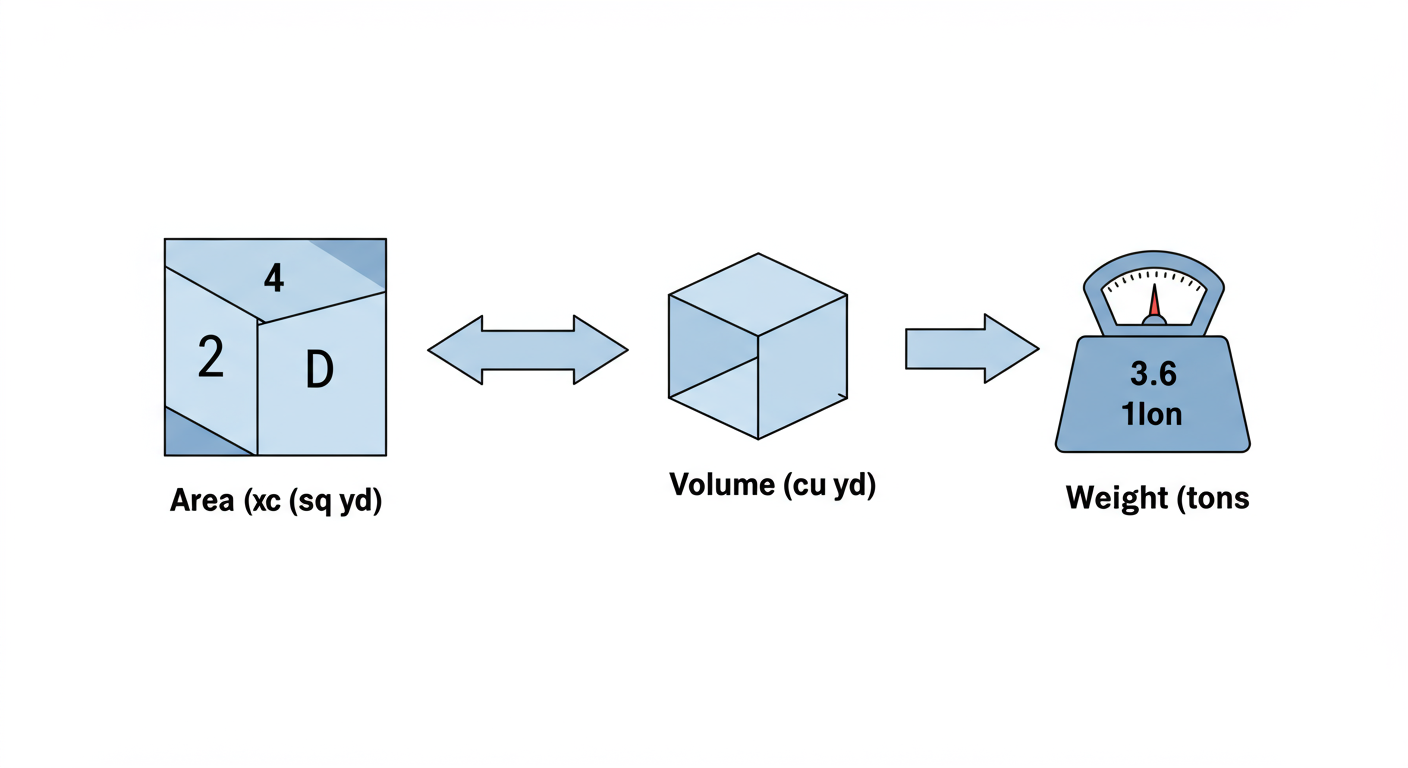
So, the path isn’t from A to B. It’s from A to C to D.
**Area (sq yd) → Volume (cu yd) → Weight (tons)**
Mastering this simple path is the key to every successful landscaping or construction material order.
The 3-Step Framework for a Perfect Order
To get from your flat square yard measurement to a precise tonnage, you need three key numbers. Get these right, and the rest is simple multiplication. Based on our experience managing hundreds of material orders, focusing on these three inputs prevents 99% of all ordering errors.
Step 1: Nail Your Area (Square Yards)
This is your starting point. For simple rectangular or square areas, the formula is easy:
Area (sq yd) = (Length in feet × Width in feet) / 9
Why divide by 9? Because there are 9 square feet in 1 square yard (3 ft x 3 ft).
Let’s say your patio area is 20 feet long and 18 feet wide.
* 20 ft × 18 ft = 360 square feet
* 360 sq ft / 9 = **40 square yards**
Easy enough. But what about L-shaped patios or curved garden beds?
💡 Pro Tip
For irregular shapes, break them down into smaller, manageable rectangles and circles. Calculate the area of each section and add them together. For a curve, you can often approximate it as a half-circle or a series of small rectangles. It doesn’t have to be perfect, but getting close is better than a wild guess.
Step 2: Define Your Depth (The Missing Link)
How deep will your material be? This isn’t just a random number; it’s critical for the project’s success. A gravel driveway needs a thick base for support, while a layer of mulch might only be a few inches.
Suppliers measure volume in cubic *yards*, so you must convert your depth (usually measured in inches) into yards.
Depth (yards) = Depth in inches / 36
Why 36? Because there are 36 inches in 1 yard.
So, a 4-inch layer of gravel is **0.111 yards** deep (4 / 36). A 3-inch layer of mulch is **0.083 yards** deep (3 / 36).
Here are some common project depths we use as a baseline:
| Project Type | Recommended Depth (Inches) | Depth in Yards (for calculation) |
|---|---|---|
| Gravel Driveway Base | 4″ – 6″ | 0.111 – 0.167 |
| Paver Patio Base (Gravel) | 4″ – 6″ | 0.111 – 0.167 |
| Paver Patio Sand Layer | 1″ | 0.028 |
| Garden Bed Topsoil | 6″ – 12″ | 0.167 – 0.333 |
| Mulch Layer | 2″ – 3″ | 0.056 – 0.083 |
Step 3: Uncover Material Density (The Secret Ingredient)
This is the most critical variable and the one people most often get wrong. **Not all materials weigh the same.** A cubic yard of airy mulch is a featherweight compared to a cubic yard of dense, wet sand. This property is called bulk density.
**Never, ever use a generic “average” density from a random website.**
Why? Because density changes based on the specific rock type, moisture content, and how it was processed. A crushed limestone from one quarry can have a different density than granite from another.
⚠️ Watch Out
The biggest variable in material density is water. Wet sand or topsoil can be 15-20% heavier than its dry counterpart. If you’re ordering after a week of rain, your tonnage will be higher for the same volume. Always ask your supplier for the density of the specific product you are buying today.
Your supplier is your source of truth. Ask them for the “tons per cubic yard” for your material. They will have this number ready. For planning purposes, here are some typical ranges we see in the field:
| Material | Typical Density (Tons per Cubic Yard) | Notes |
|---|---|---|
| Crushed Stone / Gravel | 1.2 – 1.5 | Varies by rock type (granite is denser than limestone). |
| Sand (Dry) | 1.2 – 1.4 | Coarse sand is slightly heavier than fine sand. |
| Sand (Wet) | 1.5 – 1.7 | Water adds significant weight. |
| Screened Topsoil | 0.8 – 1.1 | Lighter due to organic matter and air. |
| Asphalt (Compacted) | 1.9 – 2.1 | Very dense. As noted by the U.S. Federal Highway Administration, material properties are key. |
| Hardwood Mulch | 0.3 – 0.5 | Very light and sold by the cubic yard, but this shows the contrast. |
The Master Calculation: Putting It All Together
You have your three numbers: Area (sq yd), Depth (yd), and Density (tons/cu yd). Now, it’s just two simple steps.
Step-by-Step Guide to Your Final Tonnage
1. **Calculate Total Volume (in Cubic Yards):**
This turns your flat area into a 3D volume.
Volume (cu yd) = Area (sq yd) × Depth (yd)
2. **Calculate Total Weight (in Tons):**
This converts your volume into the final weight for your order.
Total Weight (tons) = Volume (cu yd) × Density (tons/cu yd)
Real-World Example: A New Gravel Patio Base
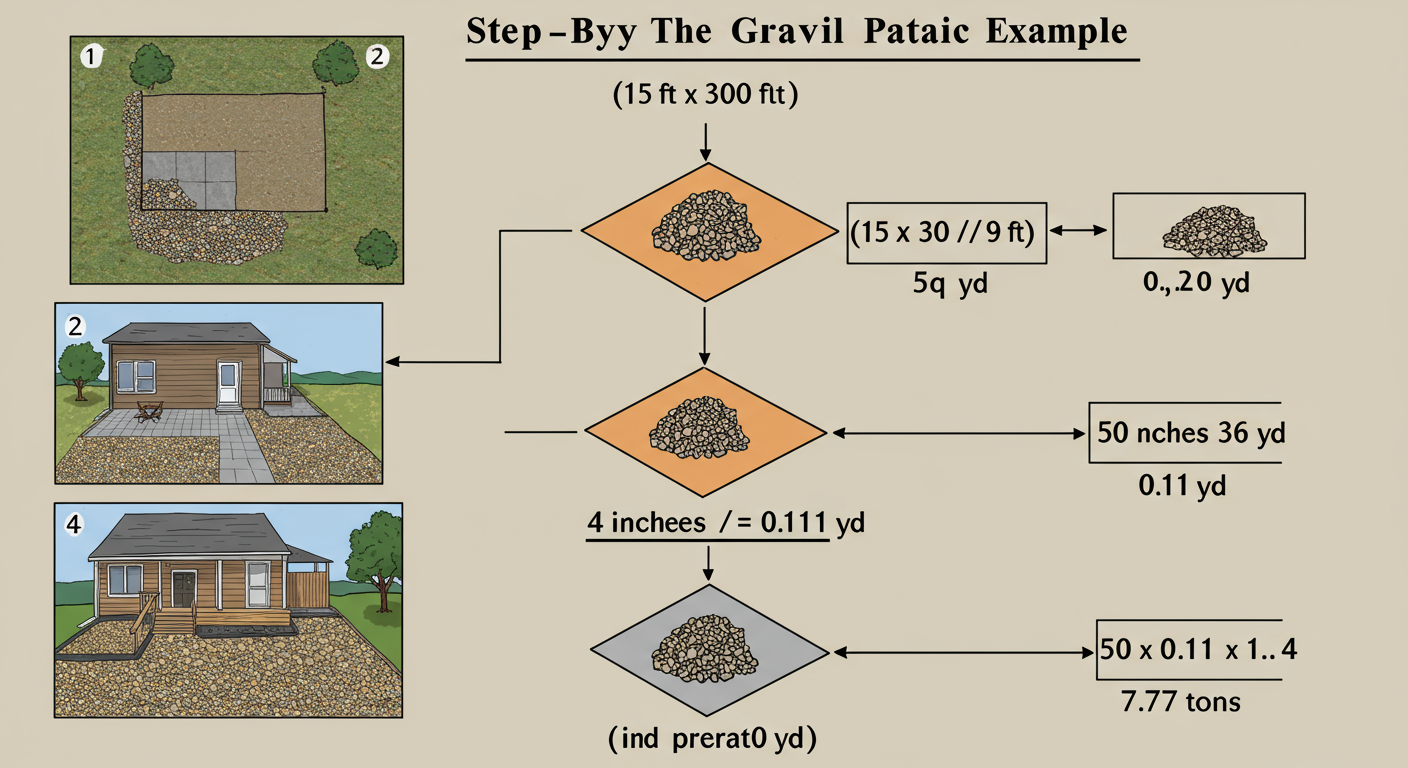
Let’s calculate the gravel needed for a patio that is 15 feet wide by 30 feet long. You need a sturdy 4-inch base. Your supplier confirms their 3/4″ crushed stone is **1.4 tons per cubic yard**.
* **Area:** (15 ft × 30 ft) / 9 = 450 / 9 = **50 sq yards**
* **Depth:** 4 inches / 36 = **0.111 yards**
* **Density:** **1.4 tons / cubic yard**
**Step 1: Calculate Volume**
50 sq yd × 0.111 yd = 5.55 cubic yards
**Step 2: Calculate Weight**
5.55 cu yd × 1.4 tons/cu yd = 7.77 tons
Boom. You need to order 7.77 tons. But wait…
💡 Pro Tip
Always order 5-10% extra material. Trust me on this one. You’ll lose some to compaction, uneven ground, and minor spills. For our 7.77-ton calculation, ordering 8.25 or even 8.5 tons is a smart move. The cost of a small surplus is nothing compared to the cost and delay of having to order a tiny second delivery.
🎯 Key Takeaway
Converting sq yards to tons is a three-part process, not a direct conversion. You must first calculate your project’s volume in cubic yards (Area × Depth) and then multiply that by the material’s specific density (tons per cubic yard) to find the total weight.
The Real-World Cost of Guessing
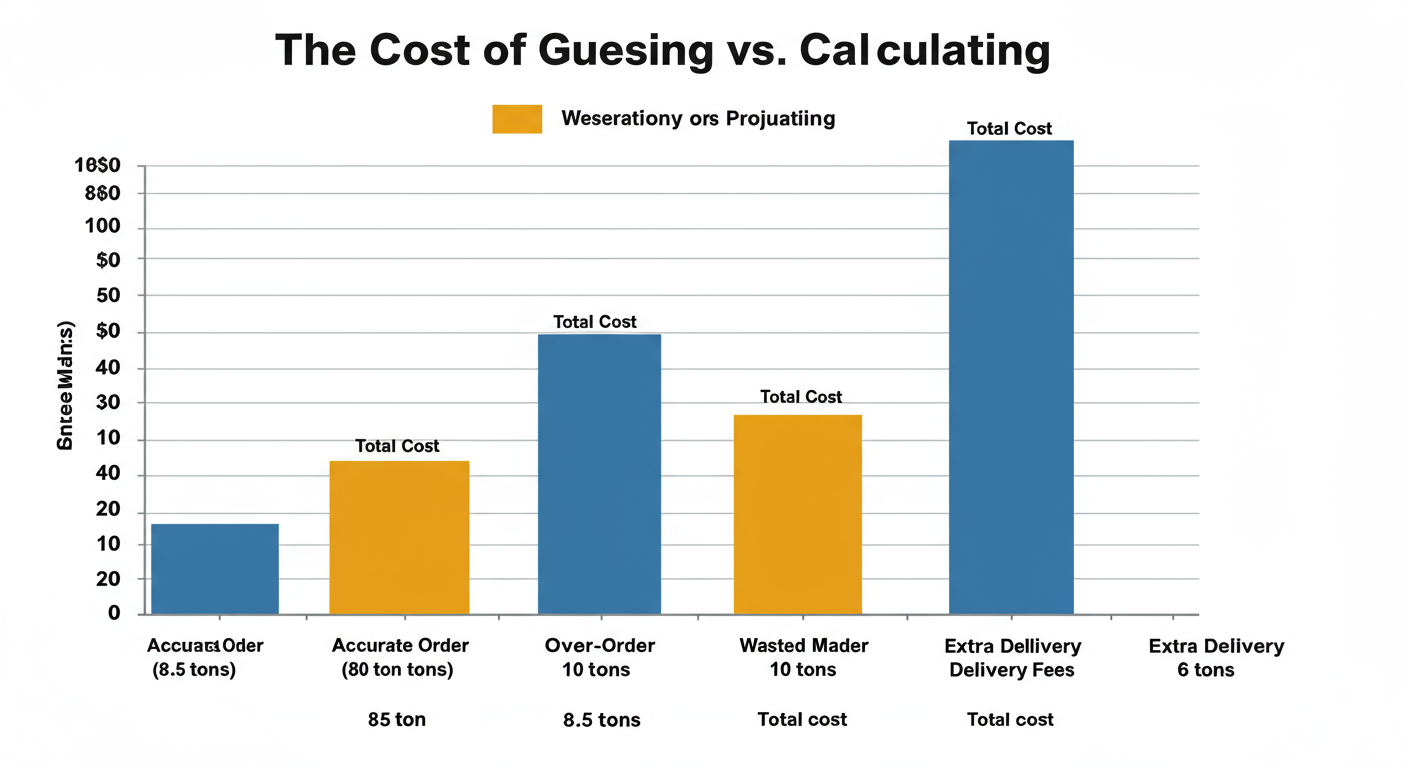
“So what if I’m off by a ton?” I hear you ask. It’s a bigger deal than you think. Let’s run the numbers on that 50 sq yard patio project, assuming gravel costs $50/ton and the delivery fee is $100.
⚠️ Watch Out
Under-ordering is often more expensive than over-ordering. A second delivery fee for a small amount of material can kill your budget. And the project delay while you wait for that second truck? That’s a cost you can’t even measure. Do the math upfront.
Here’s how a simple guess can cost you. Let’s say you guessed you needed 10 tons instead of calculating the 7.77 tons (which we’d round up to 8.5 tons with our buffer).
* **You Over-Ordered:** You bought 10 tons but only needed 8.5. That’s 1.5 extra tons.
* Cost of extra material: 1.5 tons × $50/ton = **$75 wasted.**
* Plus, you now have a giant pile of gravel to deal with. Disposal isn’t free.
* **You Under-Ordered:** You guessed 6 tons. You’re 2.5 tons short.
* Your project grinds to a halt.
* Cost of a second delivery: **$100 extra.**
* Your weekend is shot, and your project timeline is ruined.
The 10 minutes it takes to do the calculation properly literally saves you time and money. It’s the highest ROI activity you can do in project planning.
❓ Frequently Asked Questions
How many tons of gravel do I need for 100 sq yards in 2026?
It always depends on depth and density. But for a common scenario—a 4-inch deep driveway using gravel at 1.4 tons/cu yd—the math is: [100 sq yd × (4/36 yd)] × 1.4 tons/cu yd = 15.55 tons. We’d recommend ordering 16.5 to 17 tons to be safe.
Can I just use an online sq yards to tons calculator?
You can, but be careful. A calculator is only as good as the numbers you put in. Many use generic density values that could be wrong for your specific material. Use them as a starting point, but always get the density from your supplier and run the calculation yourself to be 100% sure. Think of it as “trust, but verify.”
What’s the average density of topsoil?
Topsoil density varies wildly. Screened, dry topsoil might be 0.8 tons/cu yd. Wet, clay-heavy soil can be 1.2 tons/cu yd or more. The data from sources like the U.S. Geological Survey shows huge variations in soil composition. Always, always ask your supplier for their specific number.
Why do I have to convert my depth from inches to yards?
Because your units must match to get a correct answer. The entire industry prices and measures material density in “tons per *cubic yard*.” To calculate cubic yards, you must multiply square *yards* (area) by *yards* (depth). Mixing inches and yards in the formula will give you a completely wrong result.
Is it better to have too much or too little material?
From years of on-site experience, it is almost always better to have a little too much than a little too little. A small surplus can be used for another project or spread thinly in another area. Being short means project delays and often a costly second delivery fee. Our 5-10% buffer rule has never failed us.
From Guesswork to Guaranteed Success
The **sq yards to tons** conversion isn’t a dark art; it’s simple, logical math. It’s a process that separates amateur guesswork from professional execution. By abandoning the idea of a direct conversion and embracing the three-step framework, you take control of your project.
1. **Measure Area** (sq yd)
2. **Define Depth** (and convert to yards)
3. **Confirm Density** (with your supplier)
That’s it. That’s the whole game.
The next time you call a supplier, you won’t be met with confusion. You’ll have your exact tonnage calculated, including a smart buffer for compaction. You’ll order with confidence, build with precision, and finish your project on time and on budget. Now, go get those numbers.