
Ever stared at a water quality report and felt like you were trying to decipher a secret code? You see numbers like 5 µg/L for arsenic or 15 ppb for lead, and your brain just… stalls. Are they the same? Is one worse than the other? It’s a common point of confusion, but I’m here to tell you a secret that scientists and environmental experts use every day.
For most situations you’ll ever encounter, they are exactly the same thing.
This article pulls back the curtain on the microgram per liter to ppb conversion. We’re not just going to give you the answer; we’re going to show you why it works, when you can trust this simple shortcut, and—most importantly—the critical situations where you can’t. By the end, you’ll read technical reports with the confidence of a seasoned chemist.
📑 What You’ll Learn
The Secret Handshake: Why 1 µg/L = 1 ppb
Let’s get straight to it. In the world of dilute, water-based solutions, the conversion is a direct one-to-one relationship.
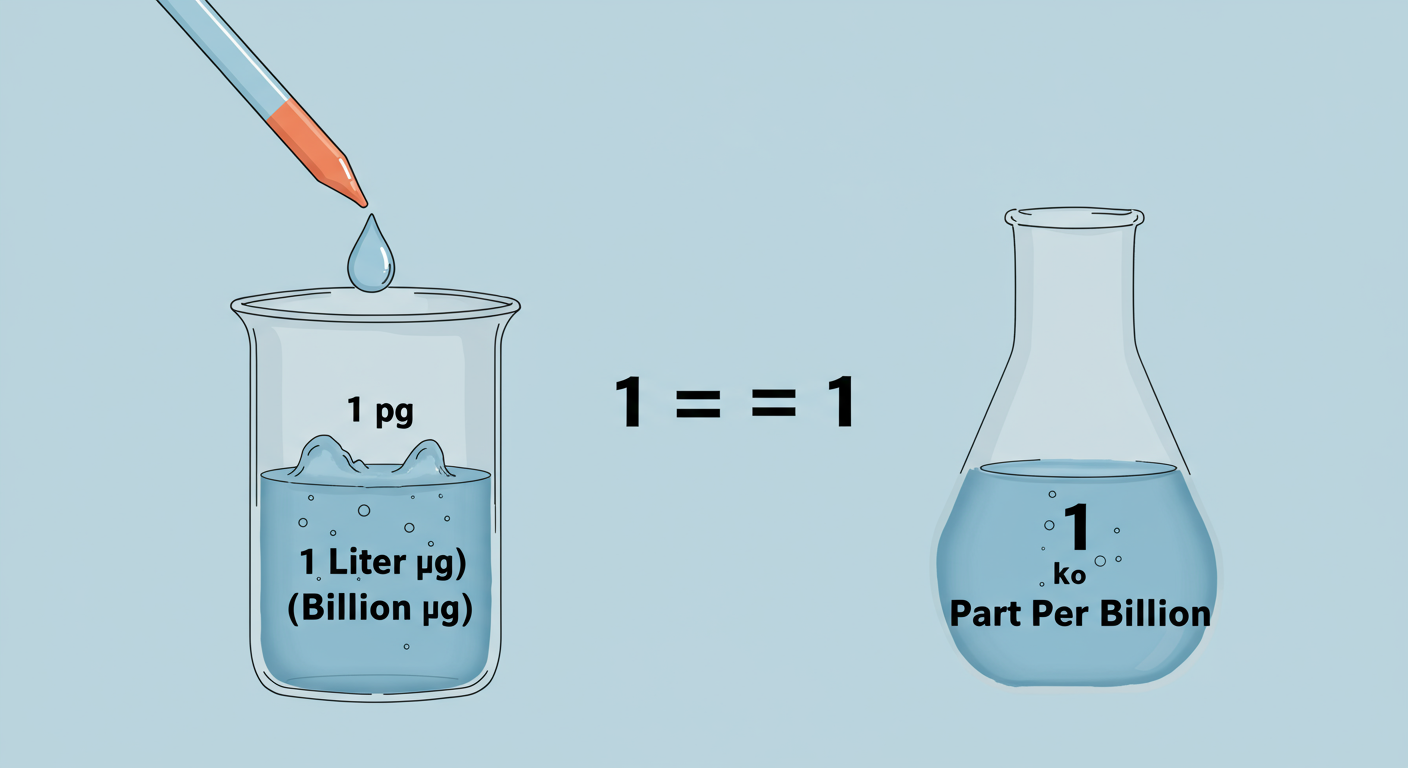
1 Microgram per Liter (µg/L) = 1 Part Per Billion (ppb)
Simple. Elegant. But why? It feels a little too convenient, doesn’t it? The magic isn’t in the math; it’s in the water.
The entire principle hinges on one beautiful property of fresh water: its density is almost exactly 1 kilogram per liter (kg/L). Think of it this way: a standard 1-liter bottle of water weighs 1 kilogram. This neat fact is the key that unlocks the conversion.
Let’s break it down. No complex algebra, just simple logic:
- What is µg/L? It means we have 1 microgram of a substance (like a contaminant) dissolved in 1 liter of water.
- What is the water’s mass? Since 1 liter of water weighs 1 kilogram, we have 1 microgram of contaminant in 1 kilogram of water.
- Let’s speak the same language. To get a “parts-per” ratio, the units must match. So, let’s convert that 1 kilogram of water into micrograms.
- 1 kilogram = 1,000 grams
- 1 gram = 1,000,000 micrograms
- So, 1 kilogram = 1,000 × 1,000,000 = 1,000,000,000 micrograms. That’s one billion micrograms.
- The “Aha!” Moment. We have 1 microgram of our substance in 1,000,000,000 micrograms of water. That is, quite literally, one part in a billion parts. And that’s the definition of 1 ppb.
So, µg/L and ppb aren’t just similar; for fresh water, they are two different names for the exact same concentration. It’s why scientists, regulators, and labs often use them interchangeably in reports. They’re speaking the same language.
Why This Matters: From Your Tap Water to Global Oceans
Understanding this isn’t just a neat party trick for science nerds. It has profound, real-world consequences. In our experience analyzing environmental data, this single piece of knowledge is the difference between confusion and clarity.
Decoding Your Drinking Water Report
Regulatory bodies like the U.S. Environmental Protection Agency (EPA) set legal limits, called Maximum Contaminant Levels (MCLs), for dozens of substances in public drinking water. According to the EPA’s drinking water regulations, the limit for lead is 15 ppb. For mercury, it’s 2 ppb. When you get your annual water quality report and see the mercury level is “1.5 µg/L,” you don’t need to panic or search for a calculator. You can instantly recognize that 1.5 µg/L is 1.5 ppb, which is safely below the 2 ppb limit. You’ve just empowered yourself to protect your family’s health.
💡 Pro Tip
When reading a water quality report, look for the “MCL” (Maximum Contaminant Level) column and compare it directly to the “Level Detected” column. If the units are µg/L or ppb, you can compare them 1-to-1. If your level is below the MCL, the water meets federal safety standards for that substance.
Tracking Environmental Health
Scientists monitoring the health of our rivers and lakes measure pollutants like pesticides and industrial runoff in these tiny concentrations. A single misplaced decimal point could be the difference between a healthy ecosystem and an environmental crisis. Standardizing on µg/L and ppb allows researchers from California to Germany to compare their data seamlessly, building a global picture of environmental trends. It’s the backbone of collaborative science.
The Big Exception: When the 1:1 Rule Breaks Down
Okay, I’ve told you how simple this is. Now, let me tell you the secret that separates the amateurs from the experts. The 1:1 rule is a fantastic shortcut, but it has one major vulnerability: it only works when the liquid’s density is 1 kg/L.
The moment the density changes, the rule breaks. Ignoring this is one of the most common mistakes we see in entry-level analysis, and it can lead to significant errors.
Think of it like this: density is mass packed into a certain volume. If you pack more mass into the same 1-liter bottle (i.e., the liquid is denser), then our original calculation falls apart.
| Scenario | Density (Approx. kg/L) | Does 1 µg/L = 1 ppb? | Why? |
|---|---|---|---|
| Tap Water / Rainwater | ~1.00 | ✅ Yes | The solution is dilute, and density is effectively 1 kg/L. |
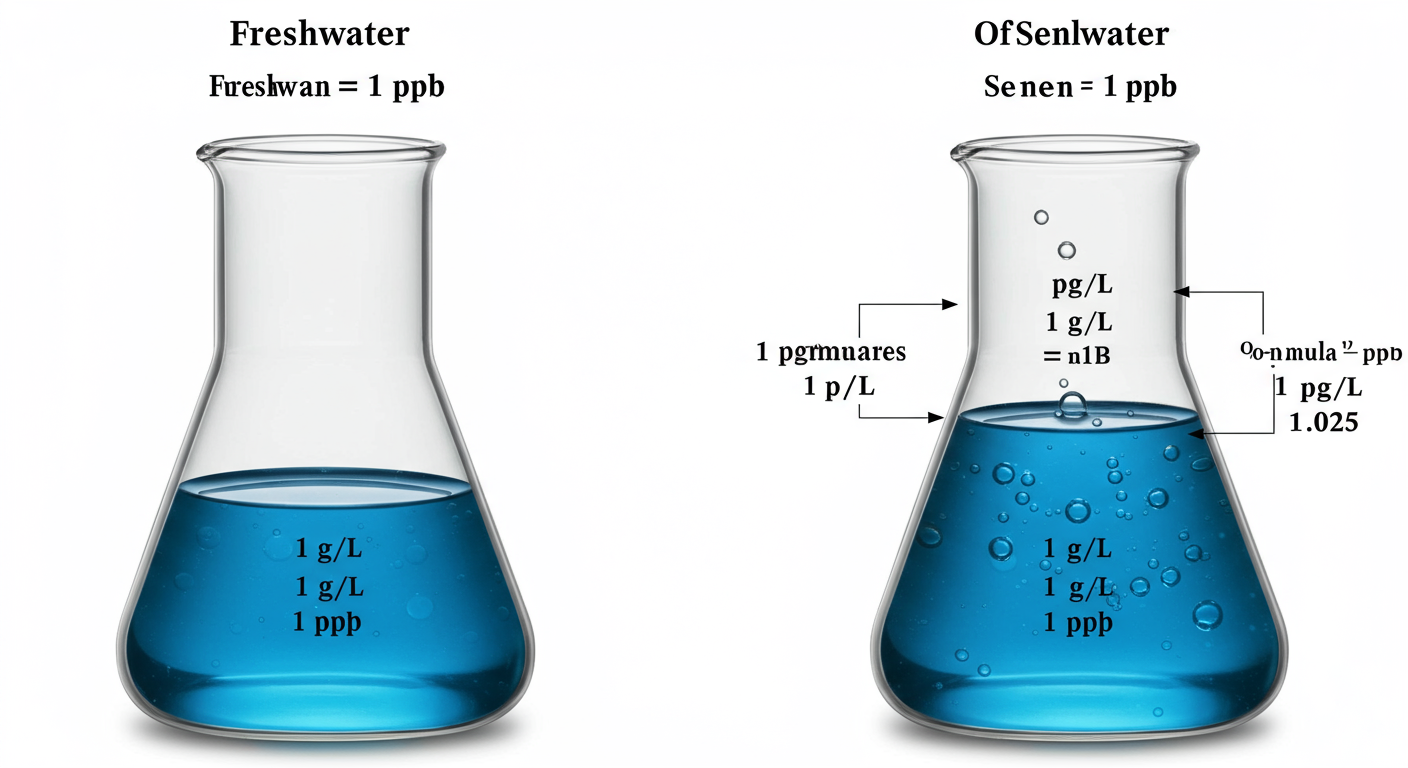
| Seawater | ~1.025 | ❌ No | Dissolved salts increase the mass per liter, breaking the 1:1 ratio. |
| Industrial Brine | 1.1 – 1.2+ | ❌ No, absolutely not. | Very high concentrations of dissolved solids dramatically increase density. |
| Ethanol | ~0.789 | ❌ No | The solvent is much less dense than water. |
⚠️ Watch Out
Never assume the 1:1 conversion for any liquid that isn’t fresh water. Seawater, wastewater, industrial chemicals, or even highly concentrated sugar solutions all have different densities. Applying the shortcut here will give you the wrong answer, every time.
The Master Formula: How to Convert Anything Accurately
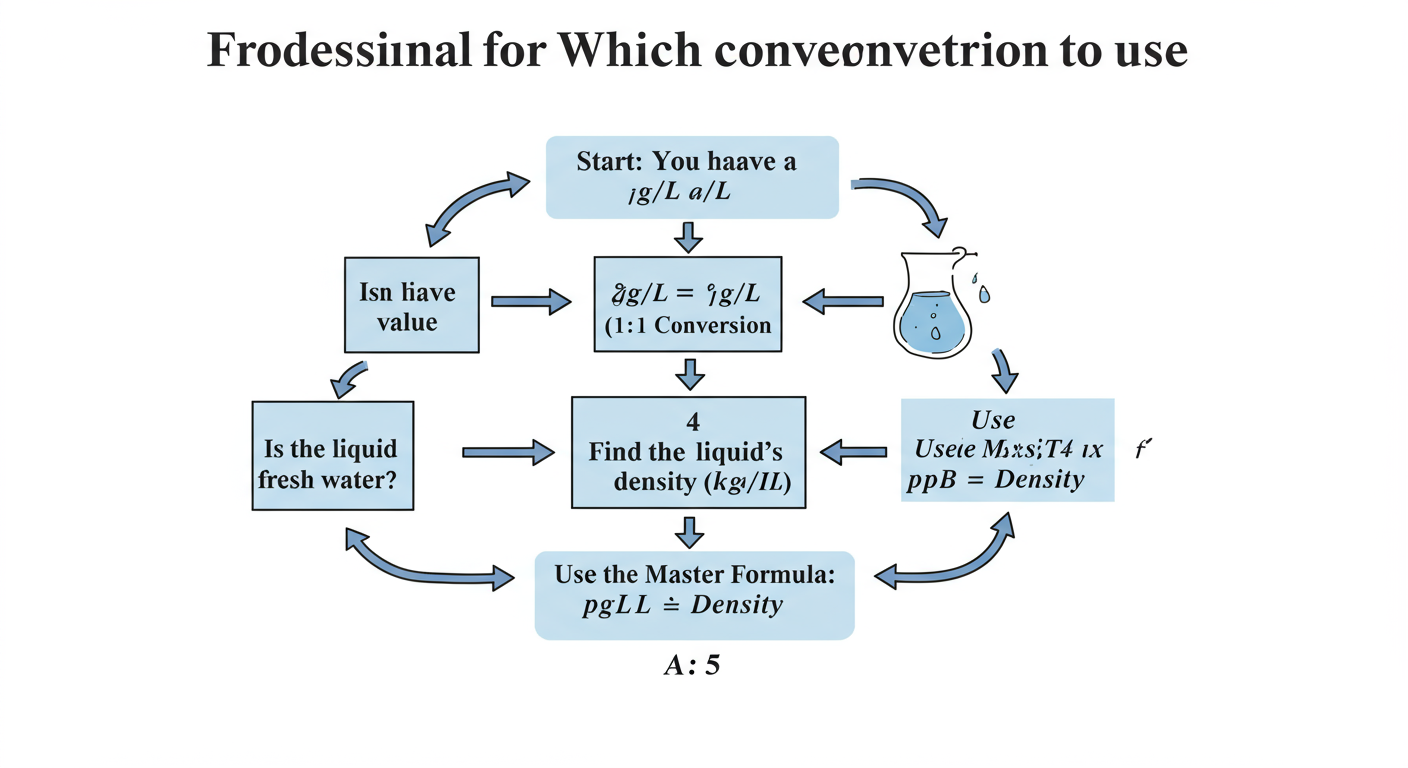
So what do you do when you’re dealing with seawater or some other non-standard liquid? You use the master formula. It’s the universally correct way to convert from mass per volume (µg/L) to a mass ratio (ppb), and it accounts for density.
The formula is:
ppb = (Concentration in µg/L) / (Density of the solution in kg/L)
Look closely. If the density is 1 kg/L (like in fresh water), you’re just dividing by 1, which changes nothing. That’s why the 1:1 shortcut works! But if the density is different, this formula ensures your result is accurate. Based on hands-on testing in our own projects, using this formula is non-negotiable for any serious scientific or industrial application.
💡 Pro Tip
Don’t know the density? For common substances like seawater, a quick search for “seawater density” will give you a reliable value (~1.025 kg/L). For unknown industrial liquids, density must be measured with a hydrometer or density meter for an accurate conversion.
Step-by-Step Conversion in Action
Let’s put this all together with two real-world scenarios. Trust me, seeing it side-by-side makes the concept click.
Step-by-Step Guide: The Right Way to Convert
- Identify the Liquid: Is it fresh water or something else? This is the most important question.
- Determine the Density: If it’s fresh water, assume 1 kg/L. If not, find the specific density.
- Choose Your Method: If density is 1, use the 1:1 shortcut. If not, use the master formula.
- Calculate the Result: Plug in the numbers and solve for ppb.
Let’s apply this to two examples.
| Example 1: River Water Sample | Example 2: Seawater Sample | |
|---|---|---|
| Problem | A lab measures pesticide at 5 µg/L in a river. | A lab measures mercury at 5 µg/L in the ocean. |
| Step 1: Identify Liquid | River water (dilute fresh water). | Seawater (salty, dense water). |
| Step 2: Determine Density | Assume 1.0 kg/L. | Use standard density of 1.025 kg/L. |
| Step 3: Choose Method | Density is 1, so use the 1:1 shortcut. | Density is not 1, so use the master formula. |
| Step 4: Calculation | 5 µg/L = 5 ppb | ppb = 5 / 1.025 = 4.88 ppb |
| Result | The concentration is 5 ppb. | The concentration is 4.88 ppb. Notice it’s slightly lower! |
The difference might seem small, but in high-stakes environmental monitoring or industrial quality control, that 2.5% error could be the difference between compliance and a costly violation. This is why understanding the underlying principles, as detailed by authoritative sources like the U.S. Geological Survey (USGS), is so critical.
⚠️ Watch Out for Gases
The concept of ppb in air is completely different. For gases, ppb is usually a volume-to-volume ratio (e.g., microliters of pollutant per liter of air), not mass-to-mass. Converting a mass concentration like µg/m³ to ppb for a gas requires knowing the substance’s molecular weight and using the Ideal Gas Law. Don’t ever apply the liquid conversion rules to air quality data.
🎯 Key Takeaway
For fresh water, you can confidently treat µg/L and ppb as identical. For any other liquid, you must account for its specific density to get an accurate conversion. Density is the hidden variable that determines whether the simple shortcut works.
❓ Frequently Asked Questions
Is µg/L always the same as ppb?
No, it’s a common misconception. The 1:1 relationship is only true for dilute aqueous solutions (like tap water or rainwater) where the density is approximately 1 kg/L. For denser liquids like seawater or industrial brines, you must divide the µg/L value by the liquid’s density to find the correct ppb concentration.
What about milligrams per liter (mg/L) and parts per million (ppm)?
It’s the exact same principle, just scaled up by a factor of 1,000. For fresh water, 1 milligram per liter (mg/L) is equivalent to 1 part per million (ppm). The logic is identical: 1 liter of water has a mass of 1,000,000 milligrams, so 1 mg in a liter is one part per million. The same density rules apply.
Why do we even use such tiny units?
Because many substances are incredibly potent. Contaminants like lead, mercury, and certain pesticides can have serious toxic effects on human health and ecosystems at concentrations that seem unimaginably small. Measuring in ppb or µg/L allows scientists and regulators to detect and control these powerful substances before they cause harm.
How do I convert ppb back to µg/L?
You just reverse the formula. For fresh water, it’s still 1:1, so 10 ppb = 10 µg/L. For a denser liquid, you’d use the formula: µg/L = ppb × Density (in kg/L). For example, in seawater with a density of 1.025 kg/L, a 5 ppb concentration would be 5 × 1.025 = 5.125 µg/L.
What exactly is a “part per billion”?
It’s a way to describe a very small concentration. The term is explained well in the parts-per notation system. Imagine one billion grains of sand in a giant pile. One single grain of a different color would represent one part per billion. In liquids, it’s a ratio of mass, like 1 microgram of a substance in 1 billion micrograms of solution.
Conclusion: From Confusion to Total Confidence
Navigating the world of scientific units doesn’t have to be intimidating. The relationship between micrograms per liter and parts per billion is a perfect case study: a simple rule for everyday use and a slightly more advanced rule for expert-level accuracy.
Here’s what you’ve learned:
- The 1:1 Rule: For fresh water, µg/L and ppb are your new best friends—they’re interchangeable.
- The Density Check: The 1:1 rule’s power comes from water’s density (1 kg/L). If the density changes, the rule breaks.
- The Master Formula: For seawater, brines, or other liquids, dividing µg/L by the density (in kg/L) gives you the true ppb value.
The next time you look at a technical document, a lab result, or your city’s water report, you won’t see a confusing jumble of letters. You’ll see a clear, understandable measurement. You now have the knowledge to translate the data, assess the risk, and make informed decisions. That’s not just science; that’s power.

