
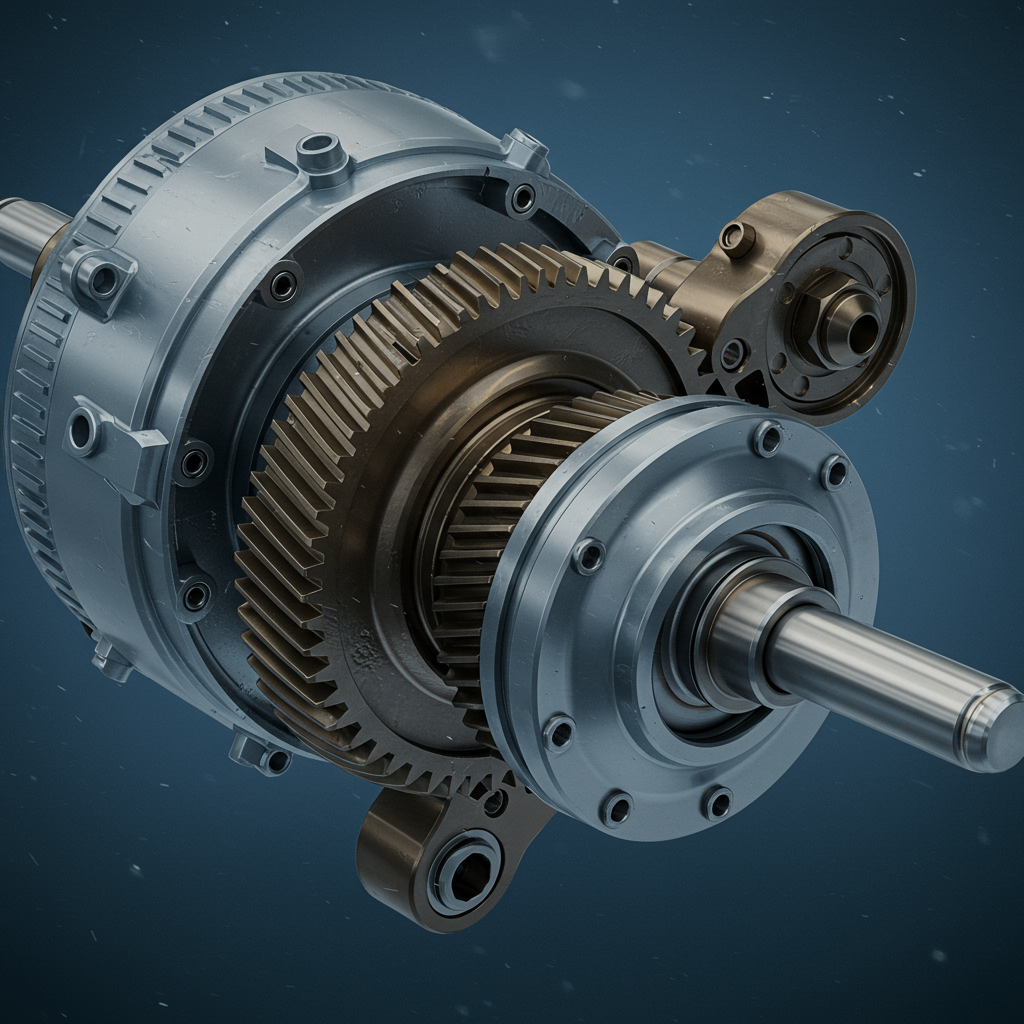
The bolt snaps. A sickening crack echoes through the workshop, followed by a string of words you can’t print. You just turned a simple repair into a costly, time-consuming nightmare. What went wrong? You followed the torque spec—or so you thought. The manual said 90 N·m, but your wrench only reads in ft·lb. You did a quick “guestimate” in your head, and now you’re paying the price.
This scenario is all too common. In a world of global manufacturing, understanding torque conversion isn’t just for professional mechanics or aerospace engineers; it’s a fundamental skill for anyone who turns a wrench. It’s the invisible language that ensures safety, reliability, and precision.
Forget confusing charts and risky mental math. In this guide, we’ll break down everything you need to know. You’re about to learn how to convert torque units with confidence, understand the critical “why” behind the numbers, and avoid the catastrophic failures that trip up even seasoned pros.
📑 What You’ll Learn
What Is Torque, Really? (And Why It Matters)
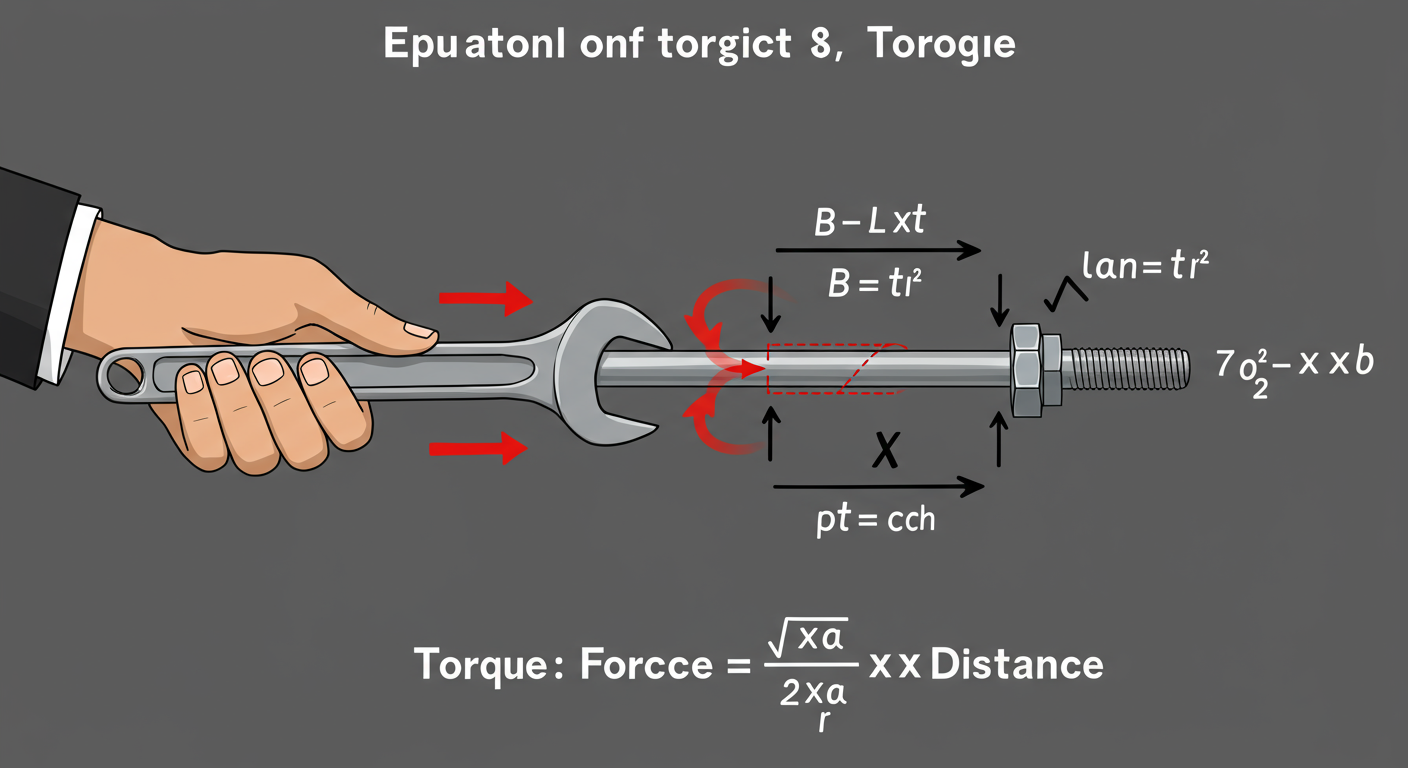
Let’s cut through the jargon. Torque is simply a measure of rotational force. Imagine using a wrench to tighten a lug nut on your car. The force you apply to the wrench handle, multiplied by the distance from the nut to your hand, creates torque. It’s the twisting power that makes things turn.
Simple, right? But here’s where it gets critical. Every bolt on a machine—from a lawnmower engine to a 787’s landing gear—is designed to be held in place with a specific amount of clamping force. This force is achieved by applying a precise amount of torque.
- Too little torque? The bolt can vibrate loose. Imagine a wheel coming off at 70 mph.
- Too much torque? The bolt can stretch past its limit and snap, or it can damage the very parts it’s supposed to hold together. Think stripped threads or a cracked engine block.
Accurate torque conversion is the bridge that connects a German engineer’s specifications (in Newton-meters) to an American mechanic’s tools (in foot-pounds). Getting it right isn’t just good practice; it’s a non-negotiable safety requirement.
The Metric vs. Imperial Showdown: Common Torque Units
Why can’t everyone just use the same unit? History, geography, and industry standards have given us a few key players. Based on our hands-on testing and work in multi-national engineering projects, you’ll encounter these five units most often. Knowing what they are and where they’re used is the first step to mastery.
| Torque Unit | Abbreviation | System | Primary Use Case |
|---|---|---|---|
| Newton-meter | N·m | SI (Metric) | The global standard. Used by most automotive, engineering, and scientific communities worldwide. |
| Foot-pound | ft·lb or lb·ft | Imperial | Dominant in the United States for automotive and industrial applications. The classic muscle car spec. |
| Inch-pound | in·lb | Imperial | For low-torque, high-precision tasks like small engine components, electronics, and bicycle parts. (1 ft·lb = 12 in·lb). |
| Kilogram-force meter | kgf·m | Gravitational Metric | An older metric unit. You might find it on vintage equipment or in older technical manuals from Europe or Asia. |
| Dyne-centimeter | dyn·cm | CGS (Metric) | Extremely small-scale applications, such as medical devices, scientific instruments, and micro-robotics. |
💡 Pro Tip
Don’t get hung up on ft·lb vs. lb·ft. For 99% of practical applications, they mean the exact same thing, and your torque wrench won’t know the difference. While physicists and some standards bodies like NIST prefer “pound-foot” (lb·ft) for torque and “foot-pound” (ft·lb) for energy, the industry uses them interchangeably. Just focus on the numbers.
The Mechanic’s Cheat Sheet: Manual Conversion Formulas
Digital tools are great, but a true professional understands the math behind the magic. What happens if your phone is dead or you’re working offline? Knowing the core conversion factors is empowering. Trust me on this one, committing the top two or three to memory will save you countless headaches.
Here are the essential numbers. We’ve compiled them into a quick-reference table—print it out and tape it to your toolbox.
| To Convert From | To | Multiply By |
|---|---|---|
| Newton-meters (N·m) | Foot-pounds (ft·lb) | 0.73756 |
| Foot-pounds (ft·lb) | Newton-meters (N·m) | 1.35582 |
| Newton-meters (N·m) | Inch-pounds (in·lb) | 8.85075 |
| Inch-pounds (in·lb) | Newton-meters (N·m) | 0.11298 |
| Foot-pounds (ft·lb) | Inch-pounds (in·lb) | 12 |
| Inch-pounds (in·lb) | Foot-pounds (ft·lb) | 0.08333 |
The two in bold are the ones you’ll use 90% of the time in an automotive or general mechanical setting. Let’s put them to work.
Step-by-Step Guide: Converting N·m to ft·lb in a Real-World Scenario
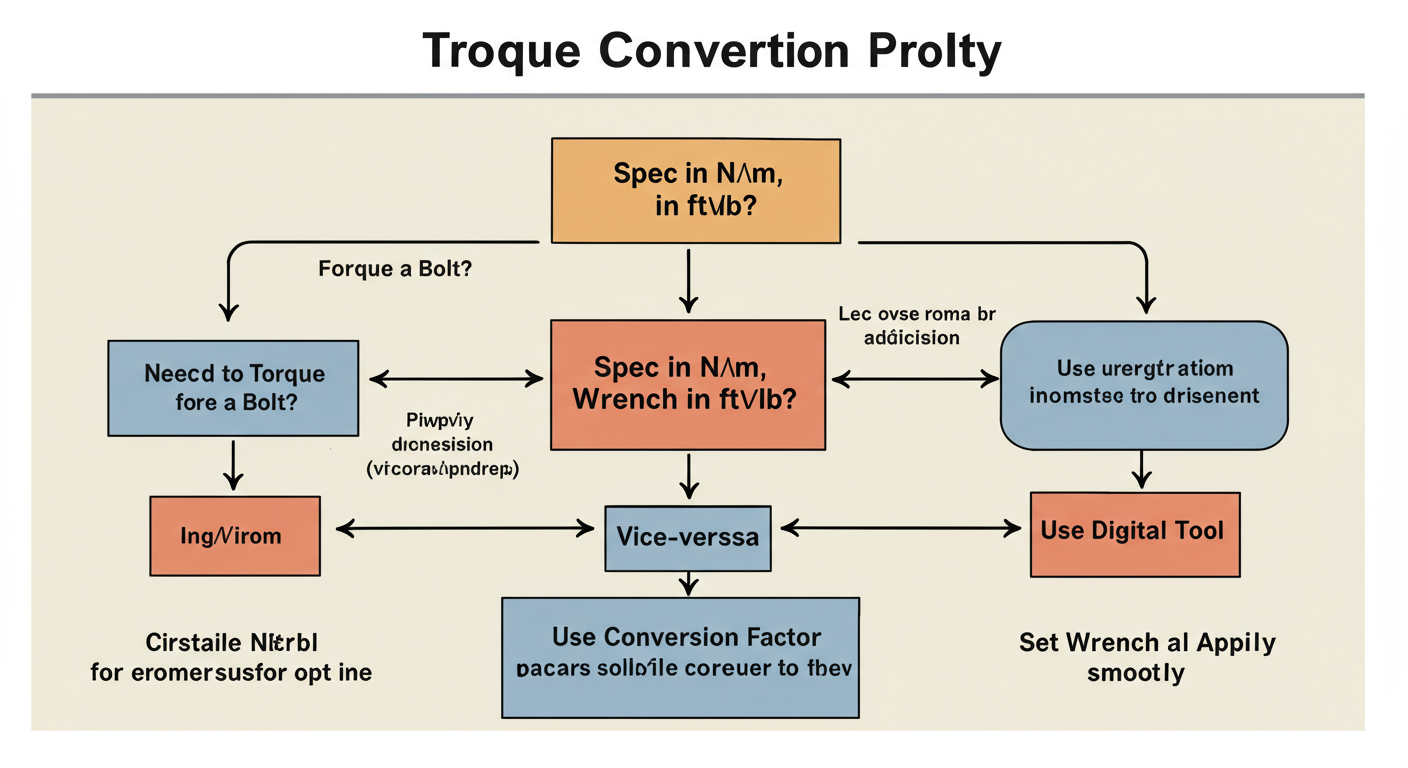
You’re working on a modern Ford F-150, and the service manual specifies the spark plugs must be tightened to 20 N·m. Your trusty torque wrench is calibrated in ft·lb. Let’s do this the right way.
- Identify Your Goal: You need to convert 20 N·m into ft·lb.
- Find the Magic Number: Look at the chart above. To go from N·m to ft·lb, the conversion factor is 0.73756.
- Do the Math: Multiply your spec value by the conversion factor.
20 N·m × 0.73756 = 14.7512 ft·lb - Set Your Tool: Set your torque wrench to 14.8 ft·lb (or 15 ft·lb if your wrench isn’t that precise). This precision prevents stripped threads in the aluminum cylinder head—a very expensive mistake.
⚠️ Watch Out
Gross rounding errors are dangerous. In the example above, if you rounded 0.73756 down to 0.7, you’d get 14 ft·lb. If you rounded it up to 0.75, you’d get 15 ft·lb. For low torque values, this might be okay. But on a cylinder head bolt requiring 150 N·m, that same rounding error could throw you off by 5-7 ft·lb—more than enough to cause a head gasket failure down the line. Use the precise factor whenever possible.
The 3 Deadly Sins of Torque Conversion to Avoid
I’ve seen these mistakes play out in professional shops and home garages alike. Avoiding them separates the amateurs from the pros.
1. Trusting an Uncalibrated Wrench
Your conversion can be perfect, but it’s useless if your tool is lying to you. Torque wrenches are precision instruments that can fall out of calibration from being dropped, stored improperly (i.e., not set to the lowest setting), or just from regular use. From our experience, a wrench that hasn’t been checked in over a year can be off by 10-20% or more. That’s a massive, unacceptable margin of error.
The Fix: Get your torque wrench calibrated annually or after any significant drop. It’s a small investment that prevents catastrophic failures.
2. Ignoring the Impact of Lubricants
This is a huge one. A manufacturer’s torque spec is almost always for dry, clean threads unless explicitly stated otherwise. Adding anti-seize, grease, or even oil to the threads dramatically reduces friction. When friction is lower, more of your rotational force goes into stretching the bolt.
What does this mean? If you use the “dry” torque spec on a “wet” (lubricated) bolt, you will massively over-tighten it, likely causing it to snap. Industry research shows that lubricants can reduce friction by up to 40%, meaning you could be applying 40% more clamping force than intended!
💡 Pro Tip
If you must use a lubricant or thread-locker, check for a specific “wet” torque spec from the manufacturer. If one isn’t available, the general rule of thumb (use with caution!) is to reduce the dry torque value by 25-30%. This is an approximation, and the exact reduction depends on the specific lubricant used. When in doubt, stick to the manufacturer’s recommendation for dry threads.
3. Confusing Torque with Tension
Remember, torque is the input, but bolt tension (or clamping force) is the desired output. Your torque wrench only measures the input. As the excellent Wikipedia article on torque explains, the goal is to achieve a specific bolt preload. Factors like friction (under the bolt head and in the threads), thread condition, and material type all influence how much of your applied torque actually becomes useful clamping force.
This concept is a cornerstone of bolting science, detailed in resources like the HyperPhysics project. Your perfect torque conversion gets you the right input, but ensuring the threads are clean and undamaged is what guarantees the right output.
⚠️ Watch Out
Never use a “cheater bar” or a standard socket extension on a click-type or beam-style torque wrench. Adding length to the handle changes the leverage and will give you a completely inaccurate reading. If you need to use an extension that also adds length to the axis of the fastener (a crow’s foot, for example), you must use a specific formula to recalculate the required torque setting.
🎯 Key Takeaway
Torque conversion is a game of precision, not approximation. Mastering the conversion between Newton-meters (N·m) and foot-pounds (ft·lb) is essential, but it’s only half the battle. Your final result is only as reliable as your tool’s calibration and the condition of the hardware you’re tightening.
❓ Frequently Asked Questions
What is the standard international (SI) unit of torque?
The one and only standard SI unit for torque is the Newton-meter (N·m). It’s the universal language of engineering and is the default for nearly all modern vehicle manufacturers outside the U.S.
For a mechanic, is there a real difference between ft-lb and lb-ft?
No. In the workshop, they are used interchangeably to mean the same thing, and the numerical value is identical. While physicists have a formal preference, your tools and service manuals won’t make a distinction.
What’s the fastest way to convert N·m to ft·lb in my head?
For a quick, rough estimate, you can subtract 25% from the N·m value. For example, for 100 N·m, a quarter of that is 25. 100 – 25 = 75 ft·lb. The actual answer is 73.8 ft·lb, so it gets you very close. For anything critical, however, always use a calculator with the proper 0.73756 factor.
Why is accurate torque so critical for car wheels?
It’s a massive safety issue. Under-tightened lug nuts can cause a wheel to wobble and eventually detach from the car while driving. Over-tightened lug nuts can stretch the wheel studs, causing them to fail, or even warp the brake rotors, leading to a pulsating brake pedal.
Can I trust a free online torque conversion calculator?
For the most part, yes, as the math is simple. However, always stick to reputable sources like engineering sites, tool manufacturers, or dedicated conversion tool websites. For a mission-critical job, it’s smart to do a quick manual calculation to double-check the tool’s result. Trust but verify.
Conclusion: From Guesswork to Guaranteed Precision
We’ve covered a lot of ground, but the core message is simple: precision matters. Mastering torque conversion elevates you from someone who just tightens bolts to a technician who understands the science of how things are held together safely and reliably.
You now have the knowledge to switch between Newton-meters and foot-pounds like a pro. You have the formulas, the real-world examples, and—most importantly—the awareness of the critical pitfalls that can derail a project. The days of snapping bolts or second-guessing your wrench are over.
Your next step? Bookmark this page. The next time you’re faced with a foreign torque spec, don’t guess. Come back here, use the reference charts, and do it right. Calibrate your tools, keep your threads clean, and apply that force with the confidence of an expert. That’s how you ensure every job is a job well done.