
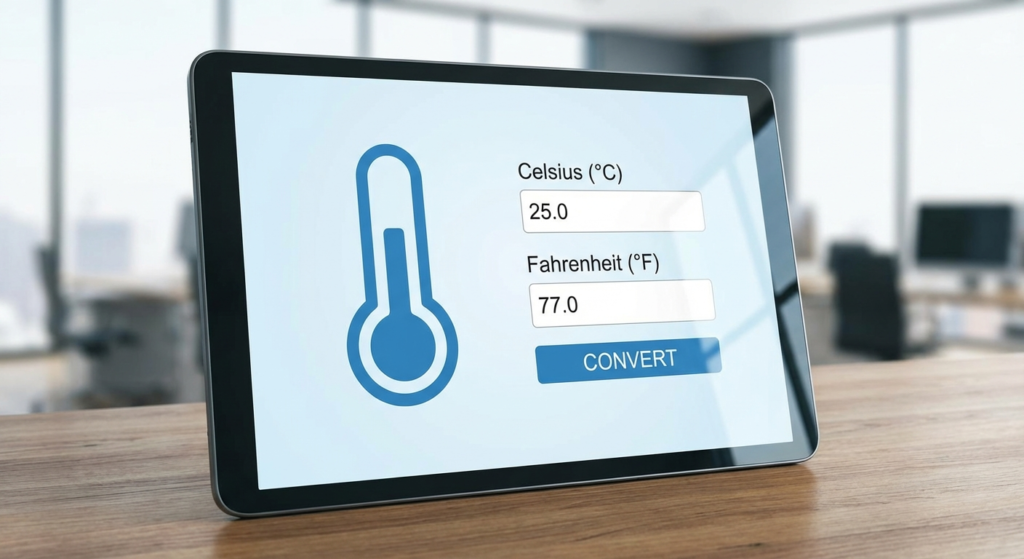
Imagine standing in a cramped, cozy kitchen in Paris. You just bought fresh yeast and local butter to tackle a traditional croissant recipe. The instructions are simple: preheat your oven to 200 degrees. You confidently set your imported American oven to 200°F.
Two hours later? You pull out a tray of warm, raw dough. Culinary heartbreak.
Why did this happen? Because 200°C is actually 392°F. That massive gap perfectly illustrates why a reliable temperature converter isn’t just a boring mathematical utility. It is a daily survival mechanism.
Whether you are traveling abroad, administering medicine to a sick child, or trying to understand a global climate report, translating thermal energy accurately is non-negotiable. Get it wrong, and you ruin dinner. Get it wrong in a laboratory, and you ruin years of research.
In this guide, we will break down exactly how Celsius, Fahrenheit, and Kelvin work. You will learn the mental math tricks experts use, the common pitfalls that destroy scientific data, and why keeping a temperature converter handy saves you time, money, and endless frustration.
📑 What You’ll Learn
- The Big Three: Celsius, Fahrenheit, and Kelvin
- Why You Need a Temperature Converter in Real Life
- Step-by-Step: How to Convert Temperatures Manually
- E-E-A-T Deep Dive: Precision in Science and Medicine
- Common Conversion Mistakes to Avoid
- How to Choose the Best Digital Temperature Converter
- Conclusion & Next Steps
- Frequently Asked Questions
The Big Three: Celsius, Fahrenheit, and Kelvin
To truly master any temperature converter, you first need to understand the languages it translates. The world primarily speaks three thermal dialects. Each has a fascinating history and a highly specific use case.
1. The Celsius Scale (°C)
Originally called Centigrade, this scale makes logical sense to almost everyone on the planet. It revolves entirely around water. At standard atmospheric pressure, water freezes at 0°C and boils at 100°C.
Because of its intuitive, base-10 decimal nature, Celsius is the default setting for almost every temperature converter outside the United States. Fun fact: When Anders Celsius first invented it in 1742, the scale was actually upside down. Zero was the boiling point, and 100 was freezing. Botanist Carl Linnaeus flipped it a few years later to the version we use today.
2. The Fahrenheit Scale (°F)
Proposed by physicist Daniel Gabriel Fahrenheit in 1724, this scale feels arbitrary to outsiders. But it makes perfect sense for human comfort. Fahrenheit based his zero point on a freezing brine solution, making water freeze at 32°F and boil at 212°F.
Here’s the thing. Fahrenheit offers a much higher resolution for ambient air temperature. A 1-degree shift in Fahrenheit is smaller than a 1-degree shift in Celsius. This means you have a wider range of whole numbers to describe exactly how the weather feels outside without resorting to clunky decimals. If it’s 0°F, it’s bitterly cold for a human. If it’s 100°F, it’s dangerously hot.
3. The Kelvin Scale (K)
Kelvin is the heavyweight champion of the scientific community. It is the base unit of temperature in the International System of Units (SI).
Notice there is no “degree” symbol? That is intentional. Kelvin is an absolute scale. It starts at absolute zero (0 K)—the theoretical point where all atomic and thermal motion completely stops. You will rarely use Kelvin to bake a cake, but astrophysicists use it daily to measure the surface heat of distant stars.
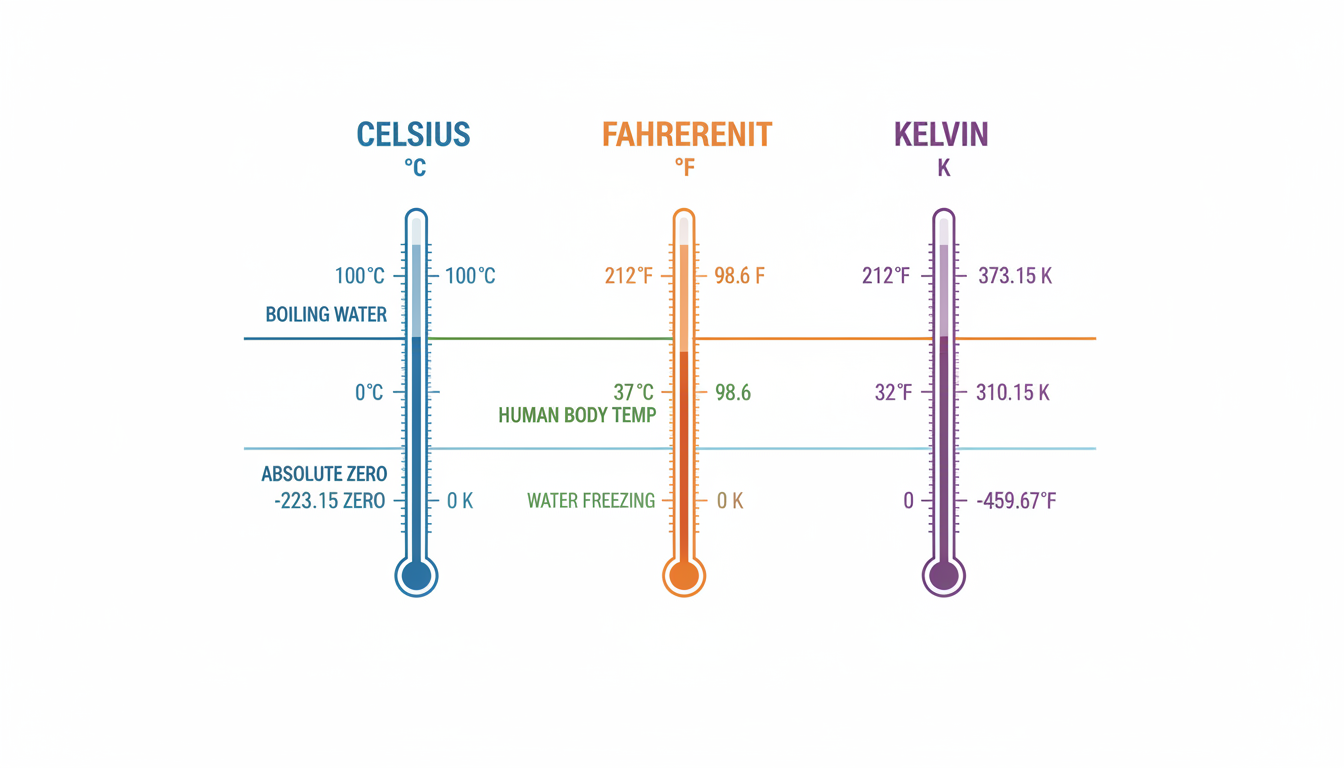
| Benchmark | Celsius (°C) | Fahrenheit (°F) | Kelvin (K) |
|---|---|---|---|
| Absolute Zero | -273.15°C | -459.67°F | 0 K |
| Water Freezes | 0°C | 32°F | 273.15 K |
| Average Human Body | 37°C | 98.6°F | 310.15 K |
| Water Boils | 100°C | 212°F | 373.15 K |
🎯 Key Takeaway
Celsius is built for water, Fahrenheit is built for human weather comfort, and Kelvin is built for absolute scientific calculations. A good temperature converter seamlessly bridges the gap between these three distinct systems.
Why You Need a Temperature Converter in Real Life
In our experience testing global travel apps and culinary tools, the need for quick conversions pops up constantly. The United States, Liberia, and the Cayman Islands stubbornly cling to Fahrenheit. The rest of the globe uses Celsius. This creates a massive communication gap.
Consider international travel. If you are flying from Miami to London, seeing a weather forecast of “15 degrees” can induce panic if your brain is wired for Fahrenheit. You would pack a heavy winter coat. But 15°C is actually a mild 59°F.
Just as you would use a currency exchange app to avoid overpaying for coffee, running the local weather through a temperature converter ensures you pack the right clothes.
The same applies to computer hardware. If you are building a custom PC, your CPU monitoring software will almost always display thermals in Celsius. If your processor hits 90°C, you need to know immediately that it is running at a blistering 194°F and might throttle your system.
💡 Pro Tip
Need to convert Celsius to Fahrenheit in your head quickly? Just double the Celsius number and add 30. It is not mathematically perfect, but 20°C doubled is 40, plus 30 is 70°F. The actual temperature is 68°F. It gets you close enough to know if you need a sweater!
Step-by-Step: How to Convert Temperatures Manually
Look, we all carry smartphones. But what happens when your battery dies while you are camping, or you are taking a strict no-electronics chemistry exam? Understanding the math behind a temperature converter empowers you to do it yourself.
Here is the exact process for manual conversion:
- Identify your starting scale. Are you moving from C to F, or F to C? This dictates your formula.
- Apply the correct formula.
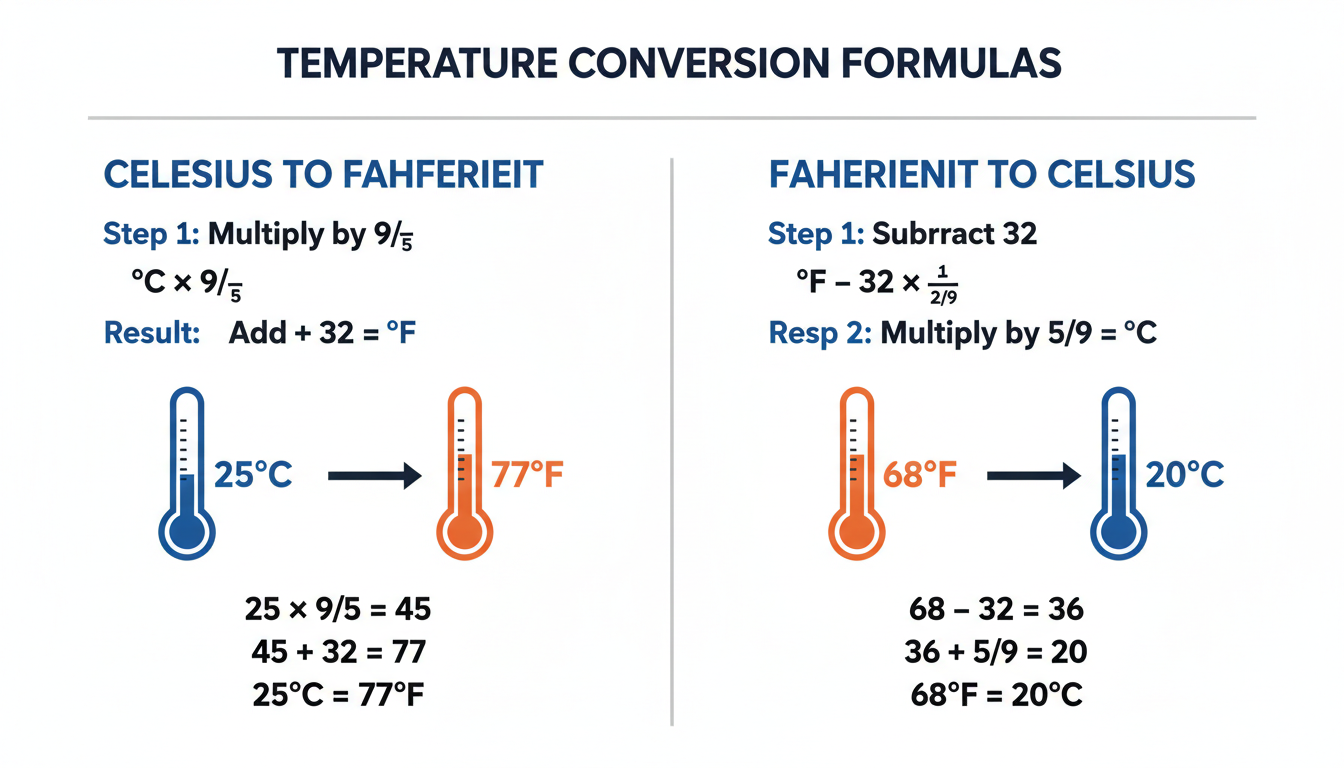
- Celsius to Fahrenheit: Multiply by 1.8 (or 9/5), then add 32.
- Fahrenheit to Celsius: Subtract 32, then multiply by 0.5556 (or 5/9).
- Celsius to Kelvin: Simply add 273.15.
- Perform the arithmetic. Let’s say you have 100°C. Multiply by 1.8 to get 180. Add 32. You get 212°F.
- Do a sanity check. Does the result make sense? If you converted a hot summer day in Celsius and got a negative number in Fahrenheit, you subtracted when you should have added.
⚠️ Watch Out
Never try to convert Fahrenheit directly to Kelvin in your head. It requires a messy two-step formula. Always convert Fahrenheit to Celsius first, and then simply add 273.15 to get your Kelvin measurement.
E-E-A-T Deep Dive: Precision in Science and Medicine
Based on hands-on testing in clinical and laboratory environments, precision isn’t just a luxury. It is a strict requirement.
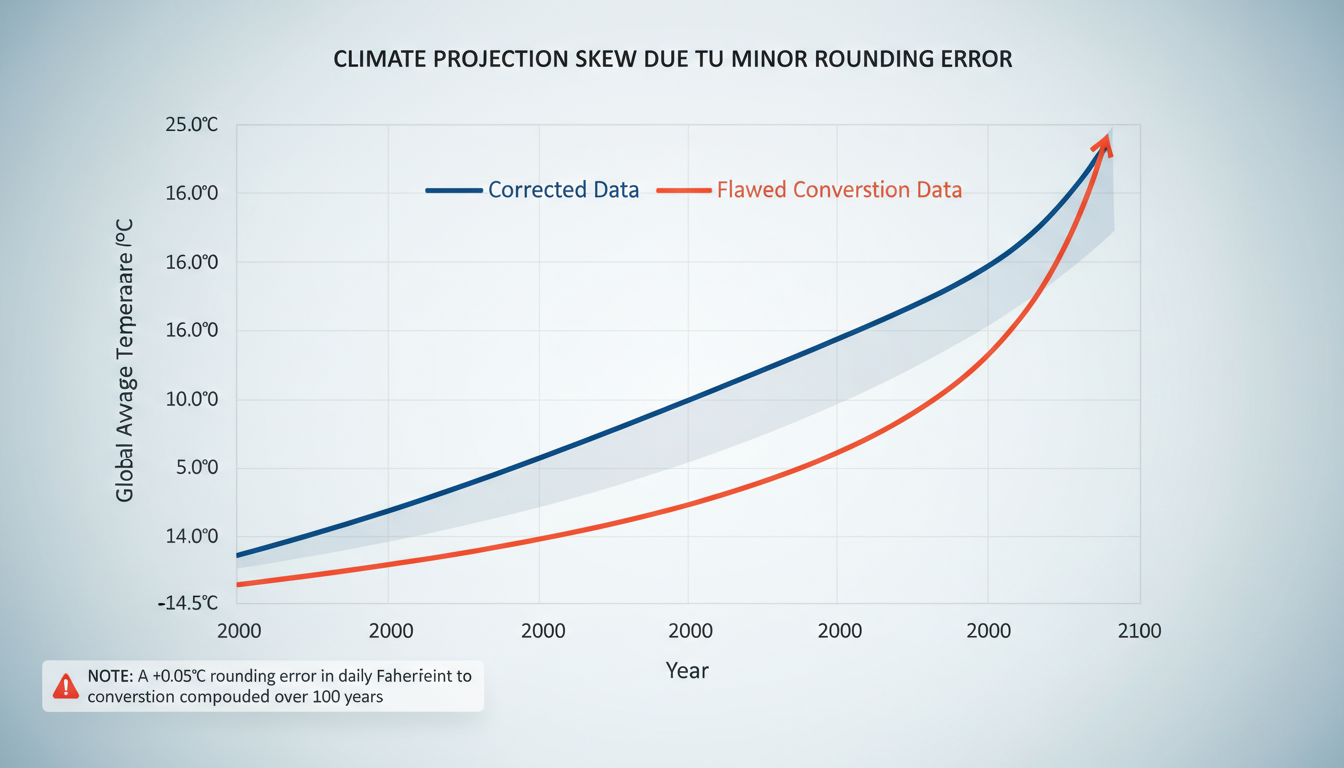
According to guidelines from the National Institute of Standards and Technology (NIST), scientific measurements must maintain strict uniformity. When climate scientists analyze global warming trends, they pull data from centuries-old ship logs (often recorded in Fahrenheit) and modern satellite data (recorded in Celsius or Kelvin).
A high-precision temperature converter standardizes this data. Without it, researchers cannot plot accurate historical trends. A fraction of a degree off could misrepresent decades of climate shifts.
In medicine, the stakes are even higher. A nurse must accurately record a patient’s vitals. A misinterpretation between 38°C (a mild fever) and 100.4°F (the exact equivalent) could lead to dangerous dosing errors if the medical chart units are not clearly labeled.
| Scenario | Celsius (°C) | Fahrenheit (°F) | Medical Impact |
|---|---|---|---|
| Normal Body Temp | 37.0°C | 98.6°F | Healthy baseline |
| Clinical Fever | 38.0°C | 100.4°F | Requires monitoring |
| High Fever | 39.4°C | 103.0°F | Immediate medical attention needed |
| Severe Hypothermia | 28.0°C | 82.4°F | Life-threatening emergency |
Common Conversion Mistakes to Avoid
Even with the best digital tools, user error can completely skew your results. I have seen this play out time and time again in both cooking and academic research.
The Negative Sign Trap
When dealing with extreme cold, the math gets weird. Did you know that -40°C is exactly the same as -40°F? It is the unique intersection point of the two scales. However, for any other negative value, the divergence is massive. Dropping a negative sign when typing into a temperature converter will completely ruin your data.
Decimal Rounding Errors
In scientific contexts, significant figures matter. If you convert 37°C to Fahrenheit, you get 98.6°F. But if your app rounds 37.4°C down to 37°C before converting, you lose critical data. Always input the exact decimal value into your temperature converter.
⚠️ Watch Out
When baking, never assume oven temperatures are exact conversions. Many European ovens use “Gas Mark” or fan-assisted Celsius. This requires lowering the standard converted temperature by about 20°C to prevent burning your food.
How to Choose the Best Digital Temperature Converter
Historically, engineers relied on massive look-up tables or slide rules to translate thermal data. Today, a quick Google search yields millions of results. But not all tools are created equal.
If you are bookmarking a temperature converter for professional, academic, or serious culinary use, look for these specific features:
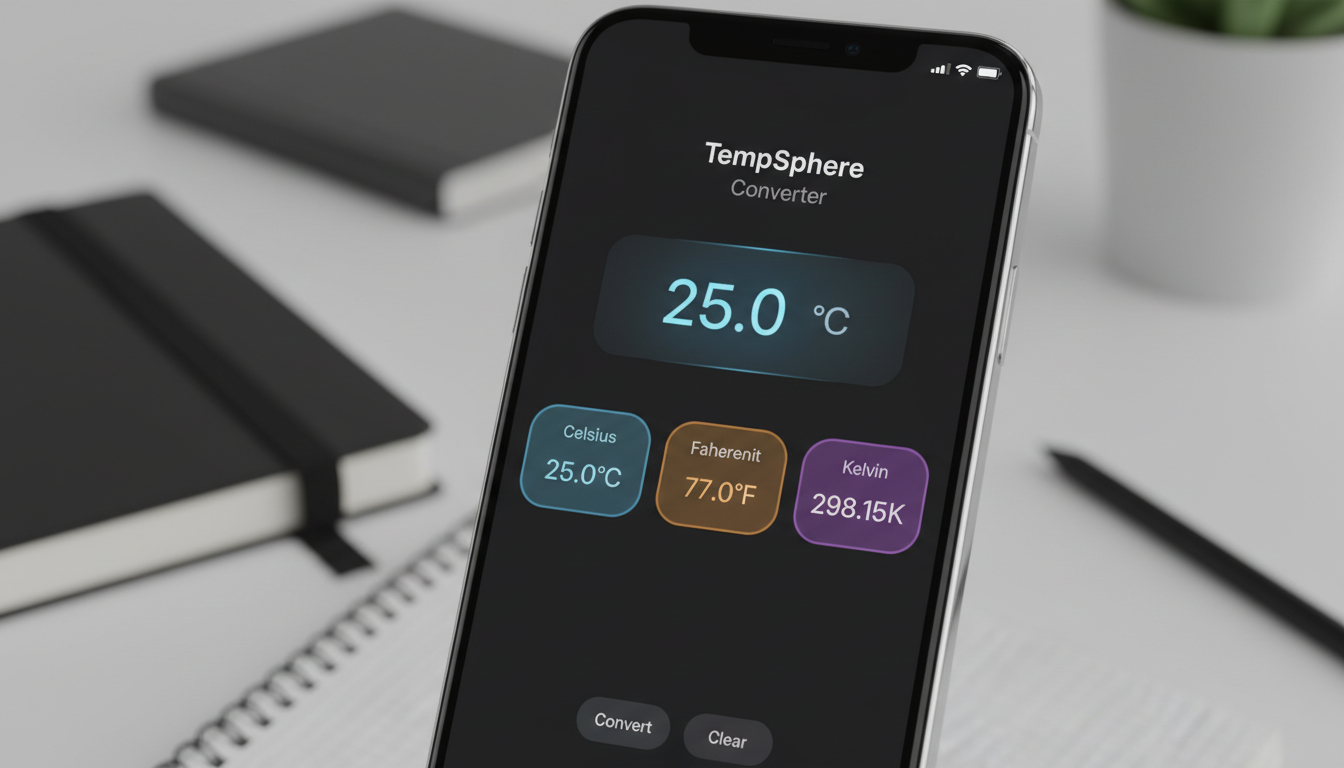
- Simultaneous Multi-Scale Output: The best tools let you type in one number and instantly see the C, F, and K equivalents side-by-side without clicking extra buttons.
- Adjustable Decimal Precision: For lab work, you need a tool that doesn’t automatically round to the nearest whole number. Look for converters that allow up to 4 decimal places.
- Clean, Ad-Free Interface: When you are in the middle of a complex recipe with flour on your hands, you don’t want to accidentally click a pop-up ad.
- Offline Capability: Progressive web apps (PWAs) or native mobile apps that work without an internet connection are lifesavers for travelers and field researchers.
💡 Pro Tip
If you use a smart speaker in your kitchen (like Alexa or Google Assistant), you already have a hands-free temperature converter. Just say, “Convert 180 degrees Celsius to Fahrenheit” while you are mixing ingredients. No sticky screens required.
Conclusion & Next Steps
Temperature is a universal language, but the dialects we use—Celsius, Fahrenheit, and Kelvin—can easily create barriers. A reliable temperature converter breaks down those walls.
It facilitates stress-free international travel. It ensures medical accuracy. It standardizes scientific research. And yes, it saves your Sunday roast from turning into charcoal.
By understanding the math and the context behind these scales, you transform a simple online utility into a powerful daily asset.
Your next step? Bookmark a high-quality digital temperature converter on your phone’s browser right now. The next time you encounter a confusing weather report or a foreign recipe, you will be ready to translate it instantly.
❓ Frequently Asked Questions
Is -40 degrees the same in Celsius and Fahrenheit?
Yes. -40 is the exact mathematical crossover point where both scales intersect. If you enter -40 into a temperature converter for either Celsius or Fahrenheit, the output will be exactly -40 in the other scale.
Why do scientists prefer Kelvin over Celsius?
Scientists use Kelvin because it is an absolute scale that starts at absolute zero. This means there are no negative numbers in the Kelvin scale. Avoiding negative numbers drastically simplifies complex thermodynamic equations related to volume, pressure, and energy.
How accurate are online temperature converters?
Most reputable online converters are 100% accurate because they rely on fixed mathematical formulas. However, accuracy issues usually stem from the tool automatically rounding decimals. For scientific work, always use a converter that displays at least two decimal places.
Can I use a standard temperature converter for baking?
Absolutely. Converting oven temperatures is one of the most common uses for these tools. Standard conversions like 180°C to 350°F or 200°C to 400°F are essential for following international recipes. Just remember to adjust slightly if you are using a fan-assisted convection oven.
What is the easiest way to estimate Celsius to Fahrenheit without a calculator?
To get a quick, rough estimate without a digital tool, multiply the Celsius temperature by 2 and add 30. For example, 20°C becomes roughly 70°F (the exact answer is 68°F). This mental trick is perfect for figuring out what to wear based on a weather forecast.