
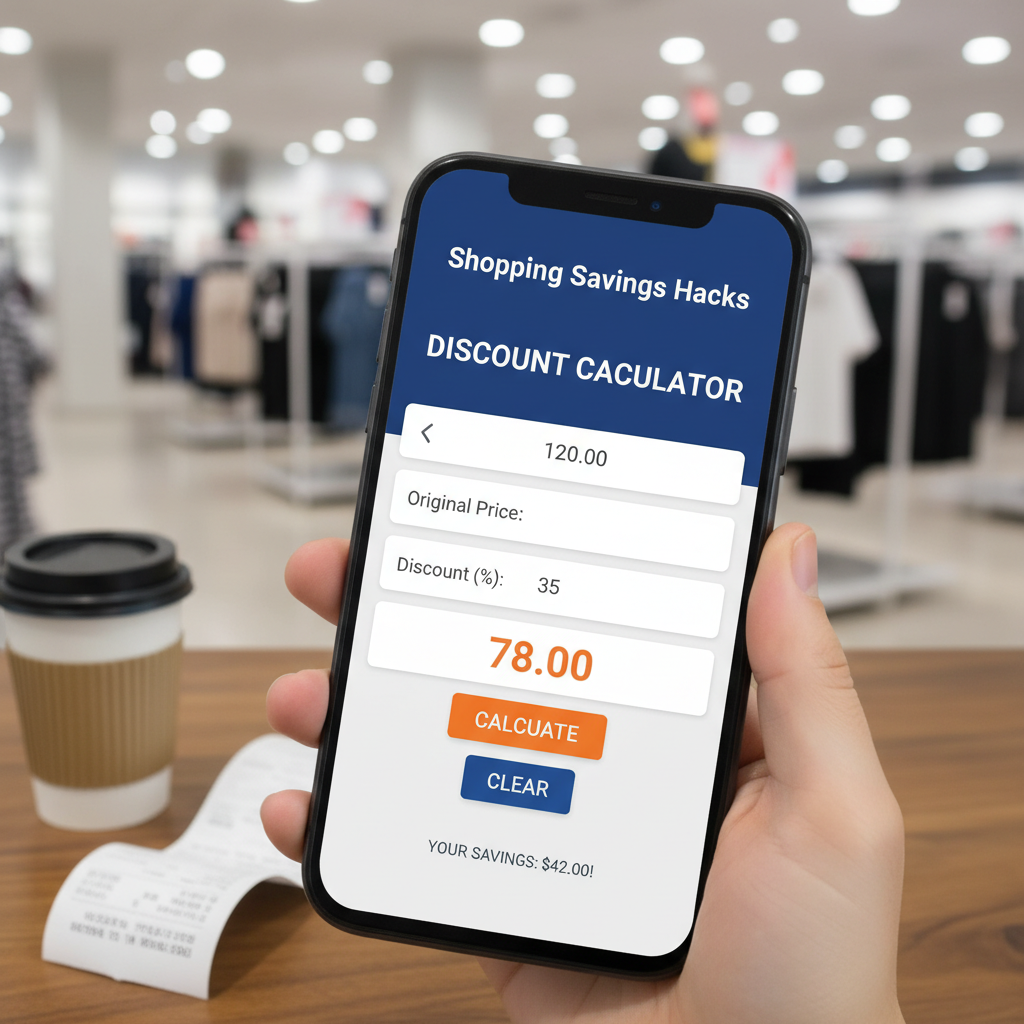
Introduction: Unlocking the Power of Retail Math
Walking into a store or browsing online during a massive sale can feel overwhelming. Tags scream “50% OFF!” or “Save $75!” But how do you truly know if you are getting the best deal, especially when comparing multiple promotions? The secret weapon of the savvy consumer isn’t just spotting the sale tag; it’s mastering the discount percentage calculator shopping savings hacks that put you in control of your budget.
In the competitive world of retail, understanding percentages is paramount. This guide will transform you from a passive shopper into a strategic buyer, equipping you with the knowledge needed to accurately calculate savings, compare complex deals, and ensure you never overpay again. By the time you finish, you will fully grasp how to leverage a discount percentage calculator shopping savings hacks philosophy for maximum financial benefit.
Why Mastering the Discount Percentage Calculator is Essential for Smart Shopping
Retailers often use confusing pricing strategies to encourage impulse buys. Sometimes a flat dollar amount discount seems bigger, but a percentage off the original price might yield greater savings. Relying solely on the store’s advertised final price can lead to mistakes, especially when dealing with exclusions, tax, or stacked coupons.
The Core Formula: How Discounts Work
Before using any tool, it’s vital to understand the underlying calculation. There are two primary calculations you need to master:
- Calculating the Discount Amount: This tells you how much money you save.
- Calculating the Final Price: This tells you the actual cost after the discount.
Formula: Original Price × (Discount Percentage / 100) = Savings Amount
Formula: Original Price – Savings Amount = Final Price
For example, if a jacket costs $150 and is 20% off:
- Discount Amount: $150 × (20 / 100) = $30.00
- Final Price: $150 – $30.00 = $120.00
The Psychology of Percentages
Retailers know that seeing a high percentage (like 70% off) triggers a stronger purchasing impulse than a low percentage, even if the absolute dollar savings are similar on high-cost items. Always convert percentages to dollars to assess true value.
Hidden Costs Awareness
A discount applies only to the item’s price, not usually to shipping, handling, or sales tax. Smart shoppers factor in all these variables to determine the true cost of the purchase.
Time-Saving Automation
While manual calculation is good for understanding, using a Discount Calculator tool, especially during fast-paced online shopping, ensures accuracy and speed, preventing costly errors.
Practical Discount Percentage Calculator Shopping Savings Hacks for Retail Therapy
The real magic of savings happens when you can compare seemingly disparate deals. Is 20% off better than $50 off? It depends entirely on the original price. Using the principles of the discount percentage calculator shopping savings hacks allows you to standardize comparisons.
Comparing Apples to Apples: Fixed vs. Percentage Discounts
When faced with a choice between a fixed dollar amount discount and a percentage discount, you must calculate the break-even point or convert the fixed amount into a percentage, or vice versa.
Scenario 1: Which Coupon is Better?
You are buying a new gadget that costs $400. You have two coupons:
- Coupon A: 15% off the total price.
- Coupon B: $65 off the total price.
Calculation:
- Coupon A (15%): $400 × 0.15 = $60 savings. Final Price: $340.
- Coupon B ($65): $65 savings. Final Price: $335.
In this case, the fixed $65 discount (Coupon B) is superior, yielding an extra $5 in savings. If the item were $500, Coupon A (15% = $75 savings) would win.
Understanding these scenarios helps consumers make financially sound decisions rather than being swayed by marketing language. As Investopedia notes, “Budgeting and saving are less about deprivation and more about informed decision-making.”
Hack 1: The ‘Percentage Equivalent’ Rule
When offered a fixed dollar amount discount, quickly divide that amount by the original price to see the effective percentage. If $25 off a $100 item is 25%, compare that percentage against any available percentage coupons.
Hack 2: Always Calculate the ‘Remainder’
Instead of calculating the discount amount, sometimes it’s faster to calculate the amount you will pay. If the discount is 30%, you will pay 70%. Multiply the original price by (1 – 0.30) or 0.70.
Hack 3: The ‘BOGO’ Trap Conversion
“Buy One, Get One 50% Off” (BOGO) is not 50% off your total purchase. It’s 25% off if you buy two items of equal price. Always convert BOGO deals into a single percentage discount to compare against other sales.
Advanced Techniques: Beyond the Basic Discount Percentage Calculator
The most lucrative savings often come from stacking discounts—combining sales, coupons, loyalty rewards, and credit card offers. This is where the manual calculation can become tricky, necessitating a precise understanding of the order of operations.
Dealing with Stacked Discounts and Tax
When discounts are stacked, they are almost always applied sequentially. The second discount is calculated on the reduced price, not the original price. This is a critical element of advanced discount percentage calculator shopping savings hacks.
Order of Operations for Maximum Savings
Imagine a shirt is $80. There is a store-wide sale of 20% off, and you have a coupon for an additional 10% off.
- Apply the first discount (20%): $80 × 0.20 = $16 savings. New Price: $80 – $16 = $64.
- Apply the second discount (10%): This 10% is taken off the new price ($64). $64 × 0.10 = $6.40 savings. Final Discounted Price: $64 – $6.40 = $57.60.
- Total Discount: $16.00 + $6.40 = $22.40.
Crucial Note: If you simply added the percentages (30% total), you would calculate $80 × 0.30 = $24 savings, resulting in a final price of $56. The retailer’s method ($57.60) means you save less than if the discounts were additive. Always calculate discounts sequentially.
Once you have the final discounted price, the tax is applied to that final total. This is an important consideration, especially when analyzing the true cost of ownership. For further guidance on optimizing your finances, you might find our article on powerful tax saving tips insightful.
For complex calculations involving multiple items and varying discounts, using an automated tool is highly recommended. You can easily find a reliable Discount Calculator online to handle these sequential steps quickly and accurately.
Implementing Discount Percentage Calculator Shopping Savings Hacks in Real Life
The ability to calculate discounts quickly is especially valuable during high-pressure shopping events like Black Friday or flash sales, where time is money.
Deal Comparison Checklist: Maximizing Value
- Normalize the Price: Always convert the deal (BOGO, fixed amount, percentage) into the final price per unit.
- Factor in Shipping Thresholds: Does spending $5 more to qualify for free shipping save you $10 in shipping fees? Calculate the net savings.
- Check Price History: Use browser extensions to see if the current “sale price” is actually the lowest the item has ever been.
- Consider Loyalty Points: Factor in the cash value of any points or rewards earned on the purchase against the initial cost.
Scenario 2: The Bulk Buy Decision
You need to buy toothpaste. Store A sells a single tube for $4.99, currently 20% off. Store B sells a three-pack for $12.00, with an additional $1 coupon off the pack.
Store A (Single): $4.99 × 0.80 = $3.99 per tube.
Store B (Three-Pack): $12.00 – $1.00 coupon = $11.00 total. $11.00 / 3 tubes = $3.67 per tube.
Conclusion: Store B offers the better per-unit price, illustrating how critical the calculation is when comparing bulk versus single-item deals.
The Role of Technology in Discount Percentage Calculator Shopping Savings Hacks
While mental math is a powerful skill, today’s retail environment demands speed. Many consumers utilize smartphone apps or dedicated online tools to perform complex calculations instantly. These tools are especially useful for quickly converting foreign currency sales or dealing with complex tiered discounts (e.g., spend $100 save 10%, spend $200 save 20%).
By using a reliable calculator, you remove human error and emotional bias from the purchasing decision, ensuring that every purchase aligns with your financial goals. This structured approach to spending is vital for long-term fiscal health, a principle often emphasized by financial experts focusing on consumer spending habits.
The mastery of retail math, combined with strategic planning, ensures that you maximize your purchasing power. Remember the fundamental economic principle: the real value of money is determined by what it can buy. By rigorously applying these discount percentage calculator shopping savings hacks, you ensure your money buys more every time.
Conclusion: Making Every Dollar Count
The ability to swiftly and accurately calculate discounts is no longer a niche skill for accountants; it is an essential life skill for modern consumers. By understanding the core formulas, recognizing the difference between sequential and additive discounts, and proactively comparing deals using a consistent percentage metric, you gain a significant advantage.
Embrace the discount percentage calculator shopping savings hacks methodology. Use the tools available to you, question every advertised price, and always verify the final cost before you commit to a purchase. This disciplined approach guarantees that you are maximizing savings and truly capitalizing on every sale opportunity presented to you.
FAQs
The quickest method is to calculate the remainder. If an item is 40% off, you will pay 60% of the original price. Simply multiply the original price by 0.60. For example, $50 × 0.60 = $30 final price.
Sales tax is almost always applied after the discount is calculated. Discounts reduce the taxable base amount. You calculate the final discounted price first, and then apply the local sales tax rate to that reduced total.
It depends entirely on the original price of the item. You must calculate the exact dollar savings for both options. Fixed dollar discounts are usually better for lower-priced items, while high percentage discounts typically yield greater savings on high-value items.
If all three items are the same price, you are effectively getting one-third off the total purchase. One-third is approximately 33.33%. If the items have different prices, calculate the total cost of all three items, subtract the price of the lowest-cost item (the free one), and then divide the savings amount by the original total cost to find the true percentage saved.
When discounts are stacked sequentially (e.g., 20% off, then an additional 10% off the remainder), the second discount is applied to a smaller base amount. If you simply add them (30% total), you are calculating the discount based on the original, larger price, which yields a greater theoretical savings. Retailers use sequential stacking to minimize their loss while still offering the appearance of a deep discount.
Read Also:
- SGPA Calculator
- Credit Card Validator
- Bank IFSC Code Finder
- Protein Intake Calculator
- 7 Essential Tips Using a PDF Unlocker to Access Documents Online (2025 Guide)
- Stop Guessing: Weight vs Volume in 2026
- µg/L to PPB: Your 2026 Water Safety Guide
- Schema Secrets to Dominate Google in 2026
- Your 2026 Secret SEO Weapon: Meta Tags
- AI Summaries: Your 2026 Productivity Hack
- SY to Tons Conversion: The Pro’s Formula for 2026
- Hertz to Watts in 2026: The Expert Guide to How They Relate
- Your Text, Real Handwriting: The 2026 Trick
- Your 2026 Guide to Website Safety
- Master Ohm Conversions in 2026
- Unlock SEO Success in 2026
- Dominate Your 8-to-5 in 2026