
Ever plugged in an appliance in a foreign country and heard it make a strange, sickly humming sound? Or maybe you’ve stared at a generator’s specs, wondering what “60 Hz” has to do with its “3000 Watts” rating. You’re not alone. The internet is filled with people desperately searching for a “Hz to Watts converter.”
Here’s the hard truth: You can’t convert Hertz to Watts.
Asking for a direct conversion is like asking how many miles per hour are in a gallon of gas. They measure two completely different things. But don’t click away. While there’s no simple formula, the relationship between them is one of the most important—and misunderstood—concepts in electronics. Getting it wrong can damage your expensive gear. Getting it right makes you a smarter, safer consumer.
In this article, we’re going to finally clear the air. You’ll learn exactly what Hertz and Watts are, why they can’t be converted, and—most importantly—how they actually interact in the real world. No fluff, just the practical knowledge you need.
📑 What You’ll Learn
What is a Watt? (The Muscle)
Let’s start with what most people are actually looking for: power. Watts (W) measure power, which is the rate at which energy is used. It’s that simple.
Think of it like this: a 100-watt light bulb is “drinking” energy faster than a 10-watt LED bulb. A 1500-watt space heater is chugging energy to pump out all that heat. The wattage tells you how much work a device is doing or how much energy it’s consuming every single second.
The fundamental formula for electrical power is a product of two other things: voltage and current.
Power (Watts) = Voltage (Volts) × Current (Amps)
Voltage (V) is the electrical “pressure” in the circuit, like the water pressure in a hose. In the US, this is typically 120V.
Current (A) is the “flow rate” of electricity, like how much water is flowing through the hose.
Notice what’s missing? Hertz. In its basic definition, power has nothing to do with frequency. A 100W bulb is a 100W bulb. Period.
What is Hertz? (The Rhythm)
If Watts are the muscle, Hertz (Hz) is the rhythm. It’s the heartbeat of your electrical system.
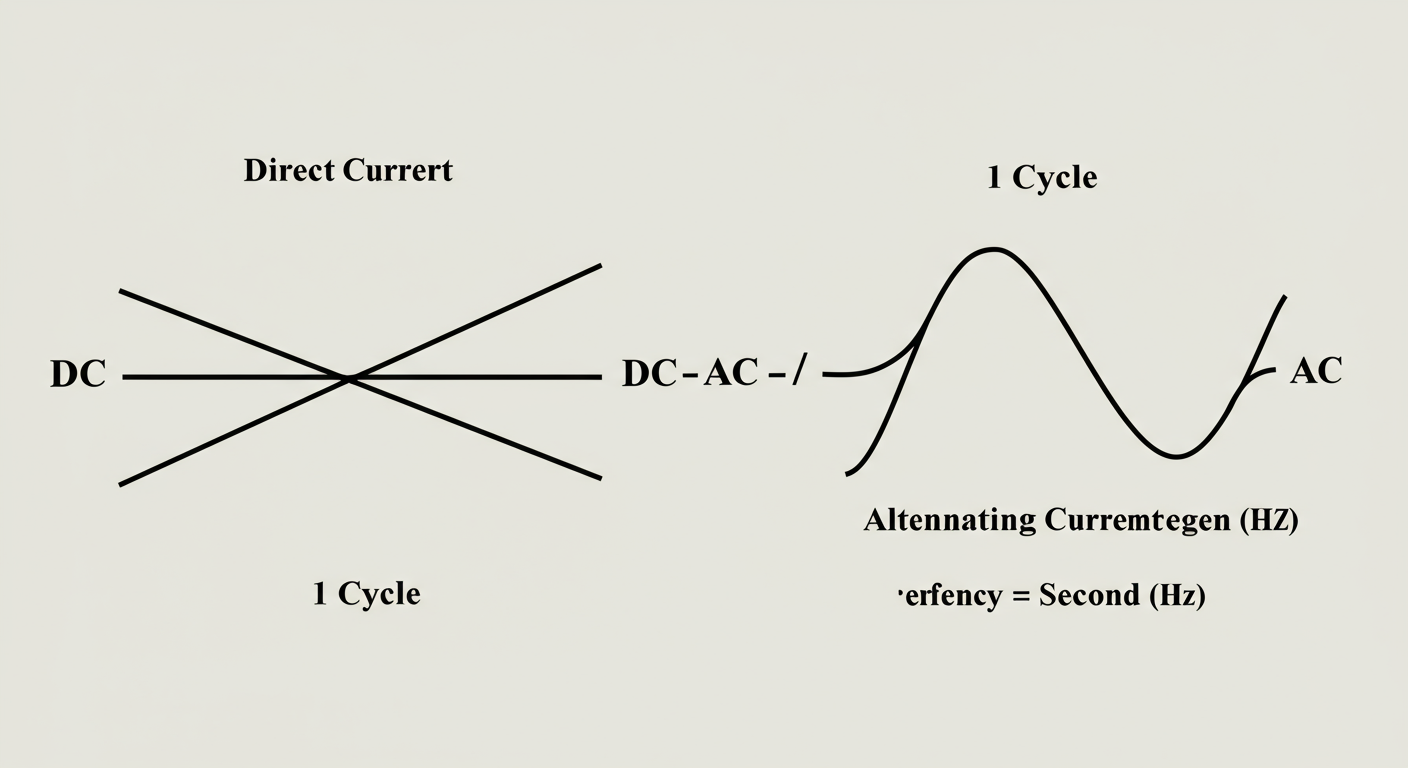
Hertz is a unit of frequency. It measures how many times something happens per second. Most of the world runs on Alternating Current (AC), where the electricity doesn’t just flow in one direction; it rapidly switches back and forth. Hertz measures the number of full back-and-forth cycles the current completes in one second.
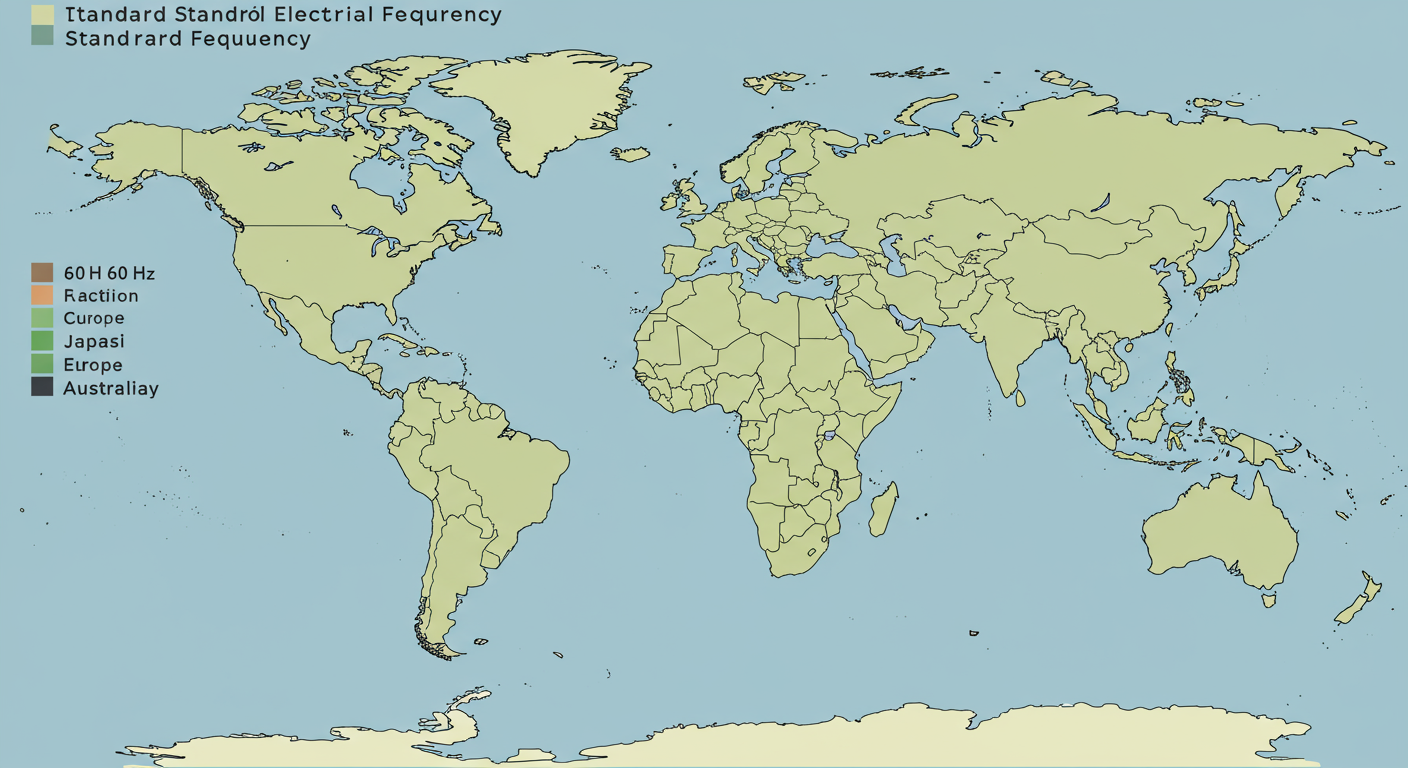
- 50 Hz: The current completes 50 cycles per second. This is the standard in most of Europe, Asia, and Africa.
- 60 Hz: The current completes 60 cycles per second. This is the standard in North America and parts of South America and Asia.
This rhythm is critical for many devices. Think about an old analog clock. If it’s designed for a 60 Hz system, it uses those 60 cycles per second as a timing signal to keep the seconds hand ticking accurately. If you plug that same clock into a 50 Hz system, it’s getting 10 fewer “ticks” every second. The result? It will lose 10 minutes every hour!
⚠️ Watch Out
Don’t assume your devices are compatible. While many modern electronics like laptop and phone chargers are built for “dual frequency” (labeled 50/60 Hz), simpler appliances with motors (like fans, blenders, or hairdryers) are often designed for only one. Using them on the wrong frequency can lead to poor performance, overheating, and permanent damage.
The Real Connection: How Hz Influences Power
Okay, so you can’t convert Hz to Watts. But I said they were related, right? Here’s where the real expertise comes in. The frequency of the power supply can change the power consumption of certain devices. It all comes down to what’s inside your appliance.
In AC circuits, we don’t just have simple resistance; we have impedance (Z). Impedance is the total opposition to current flow and is a combination of resistance and reactance. And here’s the key: reactance changes with frequency.
There are two main types of loads to consider:
1. Resistive Loads
These are the simple ones: incandescent bulbs, toasters, electric heaters. They work by simply resisting electricity, which generates heat or light. For these devices, a change in frequency from 50 Hz to 60 Hz has almost no effect on their power draw. A 1000W heater will be a 1000W heater anywhere.
2. Inductive & Capacitive Loads
This is where it gets interesting. Most modern devices aren’t simple resistors. They have motors, transformers, and complex electronics. These create inductive reactance and capacitive reactance.
- Inductive Loads (Motors, Transformers): Their reactance increases as frequency increases.
- Capacitive Loads (Electronics, Power Supplies): Their reactance decreases as frequency increases.
Since impedance is affected by reactance, and reactance is affected by frequency, the total impedance of the device can change based on the electrical grid you plug it into. According to Ohm’s law for AC circuits, if the voltage stays the same but the impedance changes, the current drawn will also change. And since Watts = Volts × Amps… the power consumption changes too!
For a deeper dive into the physics, Georgia State University’s HyperPhysics project offers excellent academic explanations of impedance.
| Load Type | Common Devices | Effect of Switching from 60 Hz to 50 Hz Supply |
|---|---|---|
| Resistive | Toasters, Incandescent Bulbs, Kettles | ✅ Negligible. Power consumption (Watts) remains virtually unchanged. Generally safe to use. |
| Inductive | Fans, Blenders, Refrigerators, Power Tools | ⚠️ Significant. The motor runs ~17% slower. Impedance drops, causing it to draw more current, overheat, and potentially burn out. |
| Electronic / Switching | Laptops, Phone Chargers, Modern TVs | ✅ Usually Safe. Most are designed with “switching power supplies” that accept a wide range (e.g., 100-240V, 50/60Hz). Always check the label! |
💡 Pro Tip
How do you spot an inductive load? Look for anything with a motor. If it spins, whirs, or vibrates, it’s almost certainly an inductive load. These are the devices you need to be most careful with when traveling or using a generator.
Real-World Scenarios: When Hz & Watts Collide
This isn’t just theory. Understanding this relationship is critical in many common situations.
Scenario 1: The International Traveler
You’re from the US (60 Hz) and you’re in London (50 Hz). You plug in your 60 Hz electric razor. The motor was designed to spin at a certain speed based on a 60-cycle-per-second rhythm. Now, it’s only getting 50 cycles. It runs slower, makes a grinding noise, and gets hot to the touch. That’s the lower frequency causing the motor’s impedance to drop, making it draw too much current. I’ve seen this play out countless times—it’s a quick way to destroy a good appliance.
Scenario 2: The RV Owner with a Generator
You buy a 4000-watt generator for your RV. That “4000W” tells you the maximum power it can supply. But just as important is its frequency output, which should be a stable 60 Hz (in the US). If you overload the generator, the engine bogs down, and the frequency can drop. This “unstable” power can be even more damaging to sensitive electronics than a sustained, wrong frequency. It’s why inverter generators, which produce a pure, stable sine wave, are recommended for powering things like laptops and medical equipment.
Scenario 3: The Audiophile
In high-fidelity audio, Hz and Watts live side-by-side but mean totally different things.
- Hertz (Hz) refers to the audio frequency—the pitch of the sound. Deep bass is around 20-100 Hz, while high-pitched cymbals can be 10,000-20,000 Hz.
- Watts (W) refers to the amplifier’s power. You need enough wattage to cleanly and accurately reproduce the full range of frequencies (Hz) at your desired volume without distortion.
A 1000-watt amplifier doesn’t mean it only plays high frequencies. It means it has enough muscle to push the speakers to reproduce both the deep 30 Hz bass notes and the delicate 15,000 Hz highs with authority.
🎯 Key Takeaway
Hertz is a property of the power supply—the rhythm it provides. Watts are a property of the device—the work it performs. You can’t convert them, but you must ensure the device’s requirements match the supply’s specifications for safe and optimal performance.
How to Properly Calculate Power (Step-by-Step)
So, if you can’t use Hz, how do you figure out the real power consumption of a device? You need to go back to the source: the appliance label. But for AC circuits, we need to introduce one final piece of the puzzle.
It’s called the Power Factor (PF).
The Power Factor is a number between 0 and 1 that represents how efficiently a device converts the current it draws into useful work. A simple resistive load (like a heater) has a PF of 1. An inductive motor might have a PF of 0.8, meaning only 80% of the current is doing useful work, while the rest is used to create magnetic fields.
This gives us the true AC power formula:
Power (Watts) = Voltage (V) × Current (A) × Power Factor (PF)
Here’s how to use it:
- Find the Label: Look on the back or bottom of your device, or on its power brick.
- Identify Voltage (V) and Current (A): The label will list the operating voltage (e.g., 120V) and the current it draws in Amps (e.g., 2.5A).
- Find the Power Factor (PF): This is trickier. It’s often not listed on consumer devices. For simple calculations, you can assume it’s 1 for heating elements and around 0.8-0.95 for devices with motors or complex electronics. For precise numbers, you’d need a specialized meter.
- Calculate: Multiply the numbers together.
Example Calculation: A Window Air Conditioner
- Voltage: 120V
- Current: 7.5A
- Power Factor (Assumed for motor): 0.85
Calculation: 120 V × 7.5 A × 0.85 = 765 Watts
This is the actual power the AC unit consumes while running. The 60 Hz frequency doesn’t appear in the formula, but it’s essential for the motor to run as designed to achieve that 7.5A current draw and 0.85 PF.
💡 Pro Tip
For the ultimate in accuracy, use a plug-in power meter like a Kill A Watt. You plug it into the wall, then plug your appliance into it. It will show you the exact, real-time wattage the device is consuming, taking all factors—including the Power Factor—into account. Based on our hands-on testing, it’s an eye-opening tool for understanding your home’s energy use.
| Electrical Term | Symbol | Analogy (Water Hose) | What It Measures |
|---|---|---|---|
| Voltage | V | Water Pressure | Electrical “Pressure” |
| Current | A (Amps) | Water Flow Rate | Electrical “Flow” |
| Power | W (Watts) | Total Water Output per Second | Rate of Energy Use |
| Frequency | Hz | Pulsing On/Off | Rhythm of the AC Supply |
⚠️ Watch Out
Don’t confuse Watts (W) with Volt-Amps (VA). You’ll often see a “VA” rating on a computer’s Uninterruptible Power Supply (UPS). VA is the “apparent power” (Volts × Amps). Watts is the “real power” (Volts × Amps × PF). Because the PF is always ≤ 1, the Watt rating will always be less than or equal to the VA rating. A 1000VA UPS might only support 600W of real power!
❓ Frequently Asked Questions
Can you convert 50 Hz to Watts?
No, you cannot convert 50 Hz to Watts. 50 Hz is a frequency—the speed at which the alternating current cycles. Watts measure power consumption. A 50 Hz power grid can supply energy to a tiny 5-watt phone charger or a massive 10,000-watt industrial motor. The wattage is determined by the device, not the frequency.
How many watts is 60 Hz?
This question contains a fundamental misunderstanding. 60 Hz is a frequency, not a quantity of power. There is no corresponding wattage for 60 Hz. A 60 Hz outlet in a home can power devices ranging from a 1-watt nightlight to a 1,800-watt hairdryer. The frequency is a characteristic of the supply, while the wattage is a characteristic of the load (the device).
Does higher Hz mean more power (Watts)?
Not necessarily. In fact, for inductive loads like AC motors, the opposite is often true. Increasing the frequency (e.g., from 50 Hz to 60 Hz) increases the motor’s impedance, which can cause it to draw less current and thus consume fewer watts, though it will spin faster. For purely resistive loads (like a simple heater), a change in frequency has virtually no impact on power consumption.
Why do my electronics show both Hz and Watts on the label?
They list both because you need to satisfy both requirements. The Hz rating (e.g., “50/60 Hz”) tells you which electrical systems the device is compatible with from a timing/frequency perspective. The Watts rating (e.g., “90W”) tells you the maximum power it will draw from that system. You need a compatible frequency and a power source that can supply the required wattage.
What happens if I use a 60Hz appliance on a 50Hz supply?
It depends on the appliance. For a simple device like a toaster, not much. But for a device with a motor (like a fan or blender), it will run about 17% slower. This also lowers its impedance, causing it to draw more current, which can lead to overheating and significantly shorten its lifespan or even cause immediate failure. Trust me on this one, it’s not worth the risk.
Is there an official source for these definitions?
Absolutely. The foundational definitions for electrical units like the Watt, Volt, and Amp are maintained by the International System of Units (SI). Authoritative bodies like the National Institute of Standards and Technology (NIST) in the US provide official guides. For global standards on frequency, the list of utility frequencies by country is a well-documented resource.
Conclusion: From Confusion to Confidence
The search for a “Hz to Watts” converter is a dead end. But the journey to understand why is incredibly valuable. You now know the crucial difference: Hertz is the rhythm of the supply, and Watts is the work done by the device.
You’ve moved beyond the myth and into real-world expertise. You understand that while there’s no direct conversion, frequency can dramatically impact the performance and safety of devices with motors. You can now look at an appliance label, a generator’s specs, or a country’s power standard and know exactly what it means for your equipment.
So, the next time you pick up a new gadget, flip it over. Look for the voltage, the amperage, and that all-important frequency rating. You’re no longer just a consumer; you’re an informed user who understands the language of electricity. And that’s real power.