In the relentless battle for online attention, crafting compelling content is only half the victory. The real war is won by *keeping* your audience engaged, and that’s where many content creators stumble. You might possess groundbreaking ideas, back them up with rock-solid data, but if your readers struggle to decipher your sentences, they’ll bounce faster than you can say, “Return to Search Results.” Trust me; I’ve seen it happen countless times over my 20+ years in this business. That’s where a strategic readability tool becomes an indispensable weapon in the arsenal of modern content creators, marketers, and SEO specialists.
Writing for the web isn’t the same as composing academic treatises or crafting literary novels. Online readers are scanners, skimmers, and hunters of immediate answers. They want information, and they want it *now*. A high-quality readability tool acts as your ever-vigilant editorial assistant, ensuring your message punches through the digital noise with laser-like clarity. By meticulously analyzing sentence structure, word choice, and paragraph length, these tools bridge the chasm between complex industry knowledge and user-friendly comprehension.
In this comprehensive guide, I’m going to pull back the curtain and reveal why readability is a crucial ranking factor (hint: it’s more than you think), how to wield these analyzers effectively, and how to seamlessly integrate them into your writing workflow to transform your content from good to *unforgettable*.
Why Mastering Readability is Mission-Critical for SEO Success
Let’s be honest: many writers are under the mistaken impression that SEO is solely about keyword density and backlinks. While those elements are undeniably important, user experience (UX) has ascended to become a dominant force in Google’s ranking algorithms. Search engines now prioritize content that satisfies user intent with lightning speed and maximum efficiency. If your content is dense, mired in jargon, or simply difficult to parse, users will abandon your site in droves, sending a clear signal to search engines that your content is, well, *not valuable*.
Using a readability tool empowers you to align your content with the reading level of the general population. As a rule of thumb, aim for an 8th-grade reading level for the vast majority of web content. This isn’t about “dumbing down” your ideas; it’s about simplifying the *delivery* so that the cognitive load on the reader is minimized. Think of it as making your content as easily digestible as possible. According to a study by the Nielsen Norman Group in 2008, users spend an average of 5.59 seconds looking at a website’s written content.
Reduced Bounce Rate
Clear, concise text acts like a magnet, encouraging visitors to stick around longer. A readability tool acts as your early warning system, highlighting complex sentences that might otherwise send a user running for the hills (or, more accurately, clicking the ‘back’ button).
Voice Search Optimization
Voice assistants are all about simplicity and conversational answers. High readability scores often correlate directly with winning featured snippets and coveted voice search results. After all, nobody wants their smart speaker to recite a doctoral thesis.
Mobile Accessibility
Let’s face it: reading on small screens can be a real strain on the eyes. Short sentences and paragraphs, as suggested by readability analyzers, dramatically improve the mobile user experience. Remember, mobile-friendliness is no longer optional – it’s essential.
The Undeniable Link Between Dwell Time and Readability
Dwell time—the amount of time a visitor spends luxuriating on your page—is a powerful indicator of content quality in the eyes of search engines. When you meticulously run your draft through a readability tool, you’re essentially fine-tuning the user journey. By strategically breaking up those intimidating walls of text and simplifying complex vocabulary, you’re practically *inviting* the reader to scroll further and engage more deeply. If you’re curious about how site authority plays into this intricate equation, you can explore how to check domain age and authority. But remember this: even the most authoritative sites need readable, engaging content to truly shine in search results.
Decoding the Algorithm: How a Readability Tool Analyzes Your Content
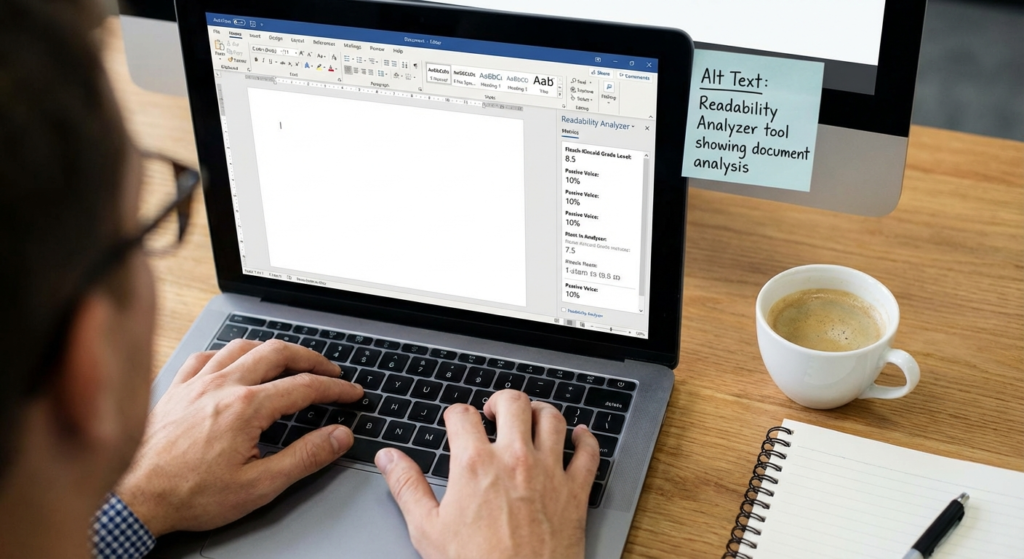
To truly harness the power of these tools, it’s crucial to understand what’s happening under the hood. Most readability analyzers rely on established algorithms such as the Flesch-Kincaid Grade Level, the Gunning Fog Index, or the Coleman-Liau Index. While the precise math may differ, the core metrics remain remarkably consistent. Here’s a breakdown:
- Sentence Length: Long, rambling sentences are mentally exhausting. The tool will flag sentences that stretch on for too long, gently suggesting you break them down into two (or even three!) more manageable chunks.
- Syllable Count: Words with three or more syllables are generally considered complex. The tool will often suggest simpler, more accessible synonyms (e.g., swapping out “utilize” for the more straightforward “use”).
- Passive Voice: Passive voice can inject a sense of distance and weakness into your writing. A readability tool diligently identifies these instances and encourages you to embrace active voice for more engaging and impactful copy.
- Transition Words: These are the essential glue that binds your text together, ensuring a smooth and logical flow. Analyzers meticulously check for words like “however,” “therefore,” and “because” to guarantee coherence.
According to the Nielsen Norman Group, users typically read only about 20% of the text on an average web page. This stark statistic underscores the absolute necessity of leveraging a tool to ensure that the 20% they *do* read is as impactful and easily digestible as humanly possible.
Best Practices: Mastering the Art of Using a Readability Tool
Having a readability tool at your fingertips is one thing; knowing how to wield it effectively without sacrificing your unique writing personality is quite another. It’s easy to fall into the trap of blindly accepting every suggestion the tool throws your way, transforming your writing into a robotic, soulless imitation of its former self. So, how do you strike that delicate balance between optimization and authentic human connection? Here’s my advice, based on years of experience:
1. Write First, Edit Later: Unleash Your Creativity
Resist the urge to appease the readability tool while you’re in the throes of drafting. This will only stifle your creativity and disrupt your precious flow state. Instead, write your article from start to finish, allowing your unique voice to shine through. Once the draft is complete, then—and only then—paste it into the analyzer to polish the rough edges.
2. Don’t Obsess Over a Perfect Score: Context is King
A perfect score of 100/100 isn’t always the holy grail. If you’re crafting content for a highly specialized audience, such as a medical journal or a legal firm, your readers will expect a certain level of technical terminology. Simplifying “constitutional amendment” to “law change” might boost your score, but it would utterly decimate the accuracy and credibility of your writing. Use the tool as a trusted guide, not an iron-fisted dictator.
Target Audience: Know Your Reader
Tailor your score goals to the specific audience you’re trying to reach. Writing for the general public? Aim for a Grade 8 level. Targeting B2B professionals? A Grade 10-12 level might be perfectly acceptable.
Context Matters: The Nuances of Language
Sometimes, a passive sentence is strategically necessary for emphasis or stylistic effect. If the tool flags it, carefully evaluate whether changing it would actually detract from the intended meaning.
Visual Readability: Beyond the Words
Readability tools primarily analyze text, but don’t overlook the importance of visual formatting. Strategically use bullet points, numbered lists, headings, and subheadings to break up the visual monotony and guide the reader’s eye.
Busting the Myths: Common Misconceptions About Using a Readability Tool
Unfortunately, there’s a lot of misinformation floating around about how these tools actually impact SEO. Let’s debunk a few of the most pervasive myths to ensure you’re using your readability tool with the right mindset and expectations.
Myth 1: Simple Content is “Dumb” Content.
Absolutely false! As Albert Einstein famously said, “If you can’t explain it simply, you don’t understand it well enough.” Simplicity is a sign of true mastery. The goal is to make complex topics accessible to a wider audience, not to strip away the substance and intellectual rigor.
Myth 2: Google Ranks Pages Based on Readability Score Directly.
While Google hasn’t explicitly confirmed that readability scores are a *direct* ranking factor, user behavior signals (like dwell time, bounce rate, and pages per session) most certainly are. Therefore, a readability tool indirectly boosts your ranking by improving those crucial user engagement metrics.
Integrating a Readability Tool into Your Workflow: A Step-by-Step Guide
To truly reap the rewards of readability analysis, it must become a standard, non-negotiable part of your editorial process. Whether you’re a solo blogger or managing a sprawling team of writers, consistency is absolutely key. Here’s a proven framework I’ve used with countless clients:
- Drafting: Focus solely on getting your ideas down on paper (or, more accurately, on the screen). Don’t worry about grammar, style, or readability at this stage.
- First Pass Review: Manually check for overall flow, logical structure, and factual accuracy. This is where you identify any major gaps or inconsistencies in your content.
- Tool Analysis: Run the content through your chosen readability tool. Pay close attention to any red flags, such as paragraph lengths exceeding 150 words or sentence lengths pushing past the 20-word mark.
- Human Polish: Carefully review each suggested change, reading the sentences aloud to ensure they sound natural and engaging. If a suggested change makes the sentence sound robotic or stilted, discard it without hesitation.
- Final Formatting: Ensure that headings, subheadings, bullet points, and images are used strategically to enhance visual appeal and guide the reader through the content.
For those seeking to build a brand that truly resonates with a wide audience, a deep understanding of your tools is vital. You can learn more about our approach to digital tools on our About Us page, where we delve into the importance of precision and strategic thinking in the digital landscape.
The Future of Readability: AI-Powered Clarity
As Artificial Intelligence continues its relentless march forward, the capabilities of the average readability tool are expanding at an astonishing rate. We’re rapidly moving beyond simple syllable counting and sentence length analysis. Modern tools can now analyze sentiment, detect tone inconsistencies, and even identify potentially non-inclusive language. They can predict how a reader will *feel* after consuming your content, not just whether they understood it on a superficial level.
However, let me be clear: the human element remains irreplaceable. A tool can never fully grasp cultural nuances, subtle humor, or the power of genuine empathy in the same way a human writer can. The most successful content strategies seamlessly blend the efficiency of AI-powered analysis with the irreplaceable emotional intelligence of human creativity. According to The Center for Plain Language, clear communication is the bedrock of trust. And in an era of fake news and overwhelming content overload, trust is your most valuable currency.
Conclusion: Readability – Your Secret Weapon for Online Success
Incorporating a readability tool into your content strategy is no longer a nice-to-have option; it’s an absolute necessity for anyone serious about achieving lasting online visibility and building a loyal audience. These tools do far more than simply count syllables – they force you to become a more disciplined, empathetic, and reader-centric writer. They serve as a constant reminder that your reader’s time is precious and that your message deserves to be understood effortlessly.
By meticulously optimizing your sentence structures, minimizing passive voice, and relentlessly focusing on clarity, you’ll pave the way for higher SEO rankings, dramatically improved engagement rates, and a fiercely loyal audience that eagerly awaits your next piece of content. So, start using a readability analyzer today, and prepare to watch your content transform from merely “good” to utterly unputdownable.
Frequently Asked Questions
For the vast majority of web content, a Flesch Reading Ease score between 60 and 70 is generally considered ideal. This roughly translates to an 8th or 9th-grade reading level, which is easily understood by a large portion of internet users. However, always consider your target audience.
Yes, many modern readability tools also incorporate grammar and spell-checking features. However, it’s important to remember that their primary focus is on the overall structure and flow of the text, rather than simply correcting grammatical errors. Think of them as a comprehensive writing assistant.
Absolutely! Voice search devices read answers aloud, so they naturally favor content that sounds natural, conversational, and easy to understand. A readability tool can help you ensure that your content is optimized for this increasingly important conversational tone and style.
Not necessarily. If you’re writing a highly technical dissertation or a specialized B2B whitepaper targeted at industry experts, a higher reading level is perfectly acceptable – and even expected. The key is to align the complexity of your writing with the expectations and knowledge base of your specific audience.
Yes, the vast majority of free readability tools utilize standard, well-established algorithms like Flesch-Kincaid, making them highly reliable for basic readability analysis. Premium tools often offer more advanced features and insights, such as tone analysis, style suggestions, and plagiarism detection.