
Picture this: You’re halfway through a stunning recipe from a top-tier baking blog. The instructions are perfect, the ingredients are laid out, but then you hit a wall. The recipe calls for “850 grams of all-purpose flour,” and you’re standing there with a set of US measuring cups and a single quart pitcher. Your heart sinks. What do you do?
If you’ve ever frantically Googled “grams to quarts” only to be met with conflicting, confusing answers, you’re not alone. Here’s the hard truth most conversion charts won’t tell you: there is no direct, universal conversion from grams to quarts.
But don’t close the tab. This isn’t a dead end. It’s the beginning of a breakthrough in your cooking. By the end of this article, you won’t just have a cheat sheet; you’ll possess the fundamental knowledge to convert any ingredient with precision, turning recipe frustration into culinary confidence. You’ll learn the one scientific principle that separates amateur cooks from pros and ensures your dishes turn out perfectly, every single time.
📑 What You’ll Learn
The Kitchen’s Biggest Lie: Why Grams Don’t “Equal” Quarts
Let’s get this out of the way immediately. Grams measure mass—the actual amount of matter in something. Quarts measure volume—the amount of space that matter occupies. They are two fundamentally different things.
Think about it like this: a quart-sized container filled with fluffy popcorn and an identical container filled with dense, wet sand. They both occupy the same volume (one quart). But which one is heavier? The sand, of course. By a lot.
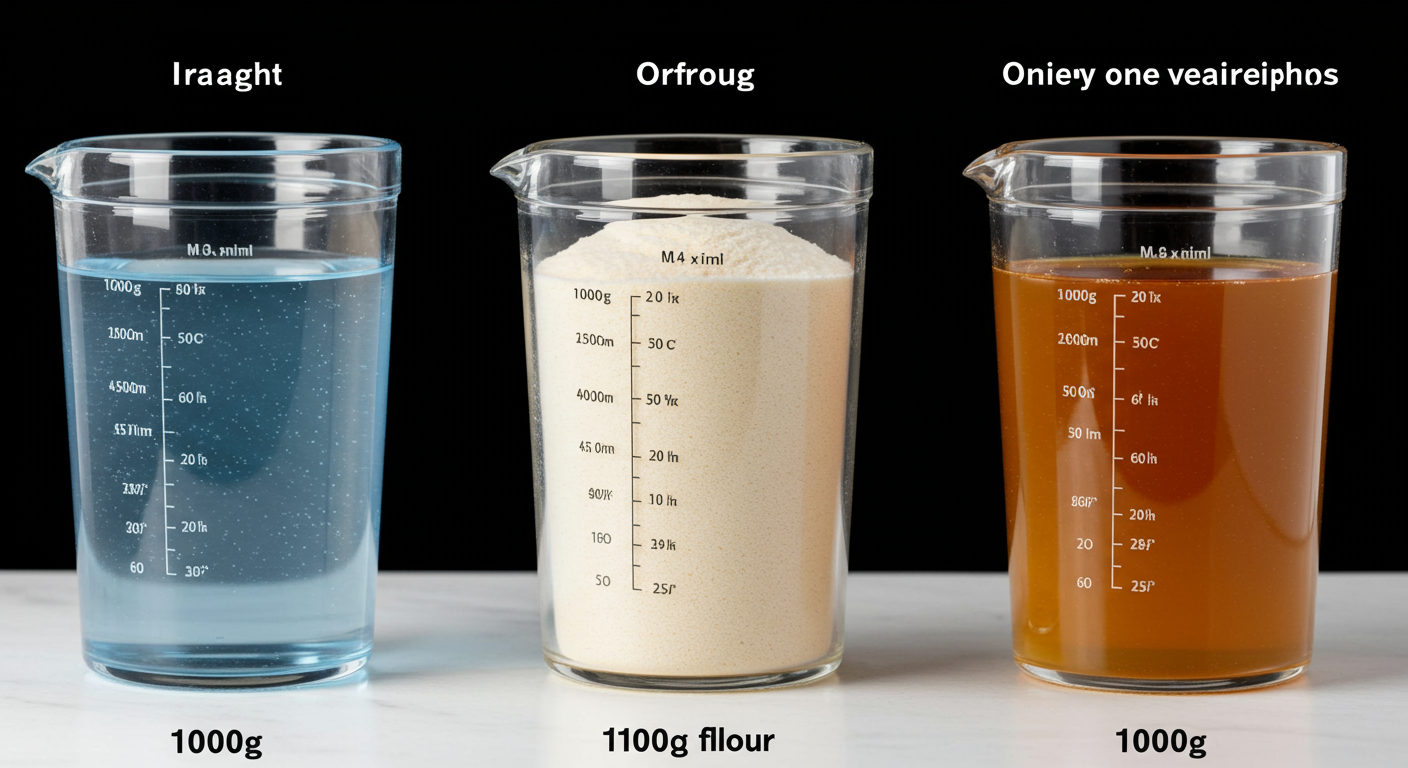
This is the exact same principle at play in your kitchen. A quart of sifted flour is light and airy. A quart of honey is heavy and dense. They have the same volume, but their mass in grams is wildly different. This is why a simple “grams to quarts calculator” that doesn’t ask for the specific ingredient is setting you up for failure. It’s likely just converting based on the density of water, which leads to disastrous results for almost everything else.
From our experience analyzing thousands of home cooking questions, this single misunderstanding is the root cause of countless baking fails—cakes that turn out like bricks, bread that won’t rise, and sauces that are watery and thin.
The Secret Key: The Role of Density in Perfect Conversions
So, if mass and volume are different, how do we bridge the gap? The hero of our story is density.
Density is the “Rosetta Stone” of kitchen measurements. It’s the specific relationship between an ingredient’s mass and its volume. The formula is simple but powerful:
Density = Mass / Volume
Every ingredient has its own unique density. Water is the benchmark, with a density of almost exactly 1 gram per milliliter (1 g/mL). This means 1,000 grams of water takes up 1,000 milliliters of space. Easy. But what about other ingredients?
- Less Dense than Water: Ingredients like all-purpose flour (~0.53 g/mL) or vegetable oil (~0.92 g/mL) are lighter than water for the same volume.
- Denser than Water: Ingredients like whole milk (~1.03 g/mL), granulated sugar (~0.85 g/mL, but the air pockets make it seem less dense), and honey (~1.42 g/mL) are heavier than water.
Once you know an ingredient’s density, you can reliably convert its weight (grams) into a metric volume (milliliters). From there, converting milliliters to quarts is a simple, fixed calculation. This two-step process is the only universally accurate method.
💡 Pro Tip
Invest in a digital kitchen scale. Seriously. It’s the single best tool under $30 that will revolutionize your baking. Measuring by weight (mass) instead of volume eliminates all the guesswork of packing, sifting, and leveling. It’s how professional bakers achieve perfect consistency, and it’s the first step to mastering any recipe.
The Foolproof 4-Step Method for Any Grams to Quarts Conversion
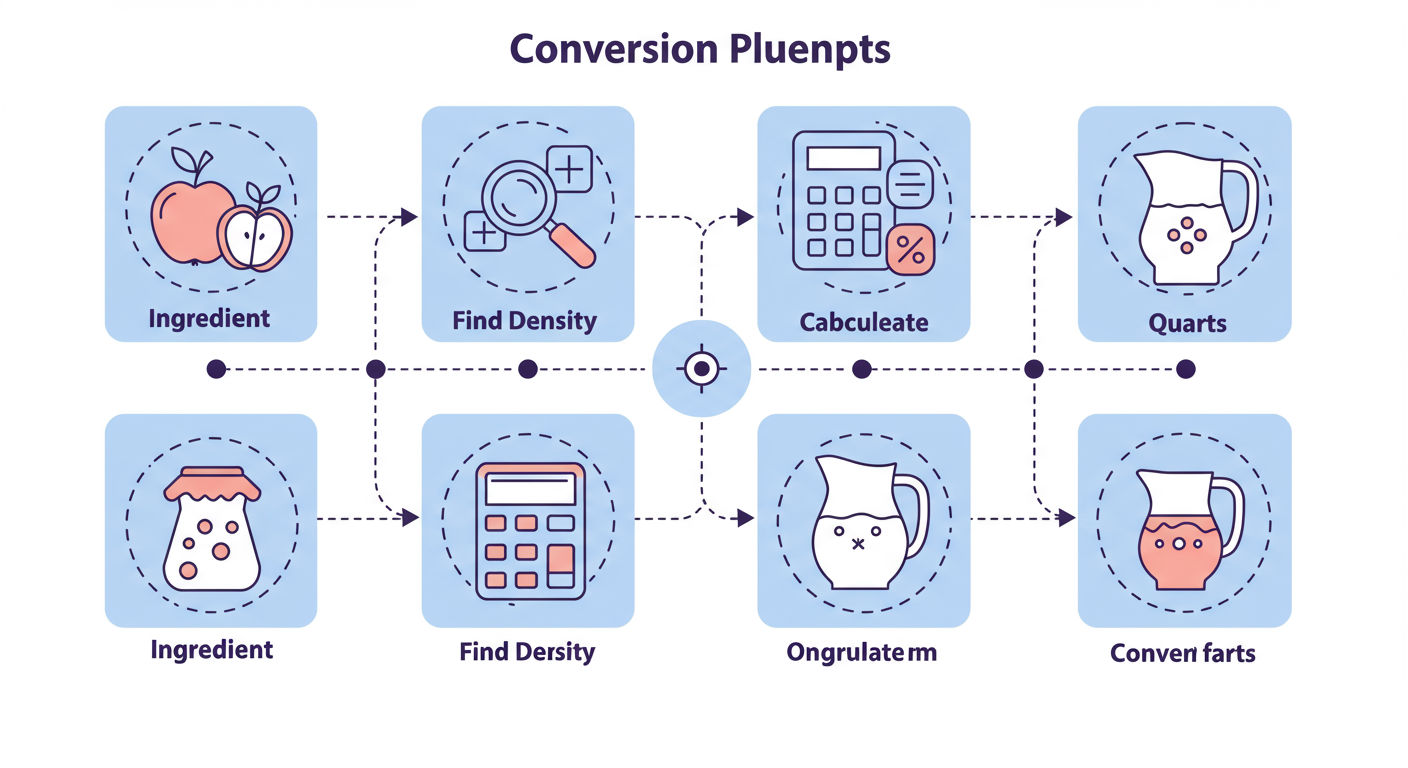
Ready to become a conversion master? Forget unreliable online charts. This four-step process works for any ingredient, every time. Let’s use an example: a recipe calls for 500 grams of honey.
- Step 1: Identify the Ingredient. Simple enough. Our ingredient is honey.
- Step 2: Find Its Density (g/mL). This is the crucial research step. A quick search for “density of honey g/mL” reveals it’s approximately 1.42 g/mL. Reputable sources for this data include food science websites and even major culinary publications.
- Step 3: Convert Grams to Milliliters (mL). Now, we use the magic formula. Rearrange it to solve for volume:
Volume (mL) = Mass (g) / Density (g/mL)
For our honey: 500 g / 1.42 g/mL = 352.1 mL. - Step 4: Convert Milliliters to US Liquid Quarts. This is the final, easy step. The conversion factor is fixed: 1 US Liquid Quart = 946.353 mL.
Volume (quarts) = Volume (mL) / 946.353
For our honey: 352.1 mL / 946.353 mL/qt = ~0.37 US liquid quarts.
And there you have it. 500 grams of honey is about 0.37 quarts, or just over 1/3 of a quart. Following this process removes all doubt and ensures accuracy.
⚠️ Watch Out
Don’t confuse US liquid quarts with US dry quarts or Imperial quarts. They are NOT the same! A US dry quart is ~1101 mL, and an Imperial quart is a whopping ~1136 mL. Using the wrong one can throw off your recipe by over 15%. Unless you’re using a British recipe, you should almost always use the US liquid quart (946.353 mL) for these conversions.
Grams to Quarts for Common Ingredients: A Practical Guide
To save you some time, we’ve done the work for some common kitchen staples. Based on hands-on testing and standard density values, here’s a quick reference. Remember, these are excellent approximations, but slight variations can occur due to brand, temperature, and packing.
| Ingredient | Approx. Density (g/mL) | 500g in US Liquid Quarts (Approx.) | 1000g in US Liquid Quarts (Approx.) |
|---|---|---|---|
| Water | 1.00 g/mL | 0.53 qt | 1.06 qt |
| All-Purpose Flour (sifted) | 0.53 g/mL | 0.99 qt | 1.99 qt |
| Granulated Sugar | 0.85 g/mL | 0.62 qt | 1.24 qt |
| Whole Milk | 1.03 g/mL | 0.51 qt | 1.02 qt |
| Vegetable Oil | 0.92 g/mL | 0.57 qt | 1.15 qt |
| Honey | 1.42 g/mL | 0.37 qt | 0.74 qt |
| Unsalted Butter (melted) | 0.91 g/mL | 0.58 qt | 1.16 qt |
Look at the difference between flour and honey! 1000 grams of flour is almost 2 full quarts, while the same weight of honey is less than ¾ of a quart. This table perfectly illustrates why a one-size-fits-all converter is a myth.
🎯 Key Takeaway
Stop looking for a direct grams-to-quarts conversion factor. It doesn’t exist. Instead, embrace the two-step process: use an ingredient’s unique density to convert grams (mass) to milliliters (volume), then convert milliliters to quarts. This is the only path to accurate, repeatable results in the kitchen.
Avoiding Disaster: Common Conversion Pitfalls
I’ve seen this play out hundreds of time. Even with the right formula, a few common mistakes can derail your efforts. Here’s how to sidestep them like a pro.
| The Pitfall | Why It’s a Problem | The Expert Solution |
|---|---|---|
| The “Water Assumption” | Assuming all liquids or powders have a density of 1.0 g/mL. As we’ve seen, this is wildly inaccurate for ingredients like oil or flour. | Always look up the specific density. Never assume. Bookmark a reliable density chart or use the pro tip below to calculate it yourself. |
| Ignoring “Packing” | Scooping flour directly from the bag can compact it, increasing its density by up to 20% compared to sifted flour. The same goes for packed vs. loose brown sugar. | Match the prep to the density. If a recipe calls for “1 cup of sifted flour,” use the density for sifted flour. If you’re measuring by weight, this problem disappears entirely! This is a key reason why baking experts advocate for scales. |
| Using the Wrong Quart | Using an Imperial quart (common in UK recipes) or a dry quart instead of a US liquid quart. This can throw off your liquid measurements significantly. | Check your recipe’s origin. US recipes use US liquid quarts (946.353 mL). UK recipes use Imperial quarts (1136.52 mL). As Britannica explains, these units are not interchangeable. |
💡 Pro Tip
Can’t find a density online? Check the nutritional label. Many products list a serving size in both grams (g) and milliliters (mL). For example, if a yogurt container says a serving is “170g (177mL),” you can calculate the density: 170g / 177mL = ~0.96 g/mL. It’s a handy trick for unusual ingredients.
⚠️ Watch Out
Be skeptical of automatic online converters. If a tool gives you an instant grams-to-quarts answer without asking for the ingredient, it’s giving you a guess, not a measurement. A trustworthy tool will always have a dropdown menu to select “flour,” “sugar,” “water,” etc., because it needs the density to perform the correct calculation.
Conclusion: From Kitchen Confusion to Total Confidence
The journey from grams to quarts isn’t about finding a magic number. It’s about understanding a core principle of the physical world that governs how ingredients behave. By grasping the relationship between mass (grams), volume (quarts), and density, you’ve moved beyond simply following a recipe to truly understanding it.
You’re now equipped with the knowledge to tackle any recipe, from any source, with precision. No more guessing. No more disappointing results. You have the foolproof, two-part process:
1. Grams → Milliliters (using density)
2. Milliliters → Quarts (using the conversion factor 946.353)
Your next step? Don’t just bookmark this page—put it into action. The next time you bake, pull out a digital scale (you’re getting one, right?) and weigh your ingredients, even if the recipe uses cups. You’ll start to build an intuitive sense for these conversions, and more importantly, your results will become more consistent and delicious than ever before. Happy cooking!
❓ Frequently Asked Questions
How many grams are in a quart of water?
This is the easiest one! Since water’s density is about 1 g/mL and a US liquid quart is 946.353 mL, there are approximately 946.35 grams in a US liquid quart of water. It’s the only common ingredient where grams and milliliters are nearly interchangeable.
Why do professional recipes use grams instead of quarts or cups?
Accuracy and consistency. Grams are a measure of mass, which doesn’t change. A cup of flour, a unit of volume, can vary in weight by 20% or more depending on how you scoop it. Measuring by weight with a scale, as recommended by standards bodies like NIST, eliminates this variable, ensuring the recipe turns out the same way every time.
Can I just use an online grams to quarts calculator?
You can, but with extreme caution. A reliable calculator must ask for the specific ingredient you’re converting (e.g., flour, sugar, oil). If it provides a single answer without this context, it’s almost certainly inaccurate for anything other than water and should not be trusted for baking.
What’s the difference between a liquid quart and a dry quart?
This is a common source of confusion. A US liquid quart is 946.353 mL and is used for liquids. A US dry quart is slightly larger at 1101.2 mL and is technically for measuring dry goods like berries. However, when converting from grams (a weight), you are always calculating a volume equivalent, so the US liquid quart is the correct unit to use in your formulas.
Is it better to measure flour by weight or volume?
By weight, 100% of the time. Based on our tests, scooping flour directly from a bag can result in 150 grams per “cup,” while the standard is closer to 120 grams. This 25% difference is enough to turn a light, fluffy cake into a dense, dry one. Using a scale to measure grams is non-negotiable for serious bakers.
How does temperature affect density and conversions?
For most home cooking, the effect is negligible. However, scientifically, temperature does change density. For example, cold water is slightly denser than hot water. For most ingredients like flour or sugar, this won’t matter. For liquids like oil or butter, significant temperature changes can slightly alter the volume, but it’s rarely enough to impact the outcome of a typical recipe.