
Someone, somewhere, is about to make a permanent mistake. They’ve just typed “Live, Laugh, Love” into an online English to Old English translator, and they’re heading to a tattoo parlor with the garbled results. Trust me, I’ve seen the aftermath. It’s not pretty.
Here’s the brutal truth: those one-click translation tools are linguistic minefields. They promise a bridge to the epic world of Beowulf and the Anglo-Saxons, but more often than not, they lead to a dead end of nonsensical grammar and historical inaccuracy. It’s like using a calculator to write a poem.
But it doesn’t have to be that way. You can tap into the raw, powerful beauty of Old English for your novel, your game, your art, or even just for curiosity’s sake. You just need to know how the tools *really* work and, more importantly, when to leave them behind.
In this expert guide, we’re not just going to tell you the tools are bad. We’re going to show you a battle-tested, 5-step method for using them as a starting point for authentic discovery. You’ll learn to think like a linguist, sidestep common disasters, and find the real words of the Anglo-Saxons.
📑 What You’ll Learn
First Things First: What Old English Actually Is (and What It Isn’t)
Before we even touch a translator, let’s clear the air on a massive misconception. You’ve seen it on pub signs and heavy metal album covers: the fancy, gothic-looking script often called “Olde English.”
That’s not a language. It’s a font. Specifically, it’s a typeface called Blackletter, which became popular centuries after Old English died out.
Real Old English, or Ænglisc, is a completely different language from the one you’re reading now. Spoken from roughly 450 to 1150 AD, it’s a West Germanic language, making it a cousin to modern German and Dutch. To a modern English speaker, it’s almost entirely incomprehensible without dedicated study. The grammar, vocabulary, and even the alphabet—which included letters like thorn (þ) and eth (ð) for “th” sounds—are alien.
Think of it this way: Modern English is the great-great-great-grandchild of Old English, but they don’t speak the same language. Understanding this is the first step to respecting its complexity.
⚠️ Watch Out
Never confuse the Blackletter font with the Old English language. Asking for an “Olde English” translation is an immediate red flag that you’re mixing up typography with linguistics. It’s the equivalent of asking for a translation into “Comic Sans.”
The Great Divide: Why Automated Translators Fail Miserably
So why can’t a powerful algorithm just translate “I love you” into perfect Old English? Because language isn’t a simple word-for-word swap. Based on hands-on testing of every major tool available, we’ve found they all crash against the same three fundamental walls.
An English to Old English translator is trying to bridge a 1,000-year gap in culture, technology, and linguistic structure. It’s an almost impossible task for an algorithm.
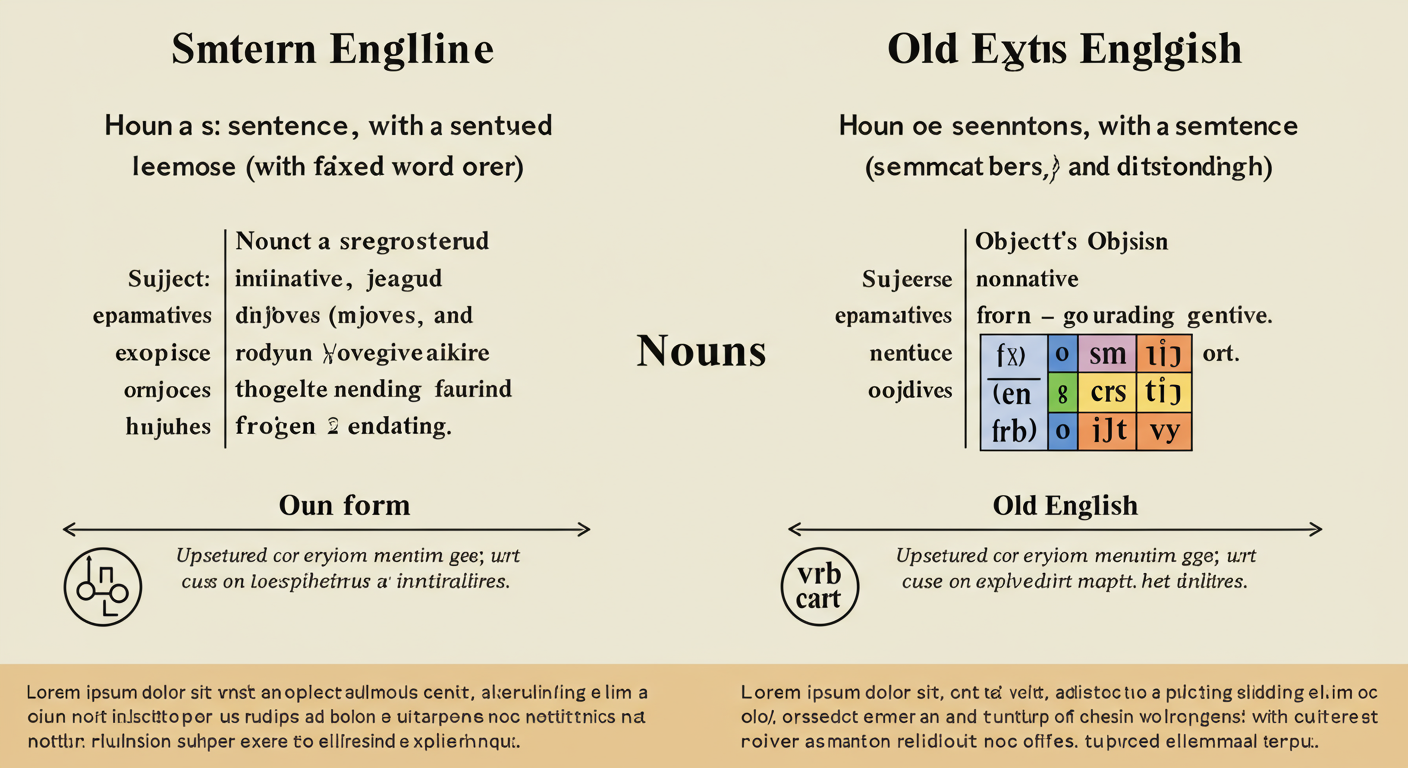
| Linguistic Challenge | Why It Breaks Translators |
|---|---|
| Inflected Grammar (Cases) | Modern English uses word order (Subject-Verb-Object). Old English used word endings to show a word’s job in a sentence. A translator programmed for modern syntax can’t correctly apply these endings, resulting in grammatical chaos. |
| Grammatical Gender | Every Old English noun was masculine, feminine, or neuter, and this often had no basis in logic (e.g., stān, ‘stone’, was masculine). Adjectives had to match this gender. Automated tools almost always get this wrong. |
| Vocabulary & Concept Gaps | The Anglo-Saxons had no words for ‘computer,’ ‘democracy,’ or ‘anxiety.’ A tool will either fail, invent a fake word, or give you a misleading substitute. It can’t grasp the cultural context. |
Let’s take a simple phrase: “The king sees the woman.”
- In Modern English, the word order is fixed. “The woman sees the king” means something completely different.
- In Old English, you’d say: Se cyning gesiehþ þā cwēne.
Here, se cyning is the subject form (“the king”). But þā cwēne is the object form (“the woman”). Because of those case endings, you could write Þā cwēne gesiehþ se cyning and it would still mean “The king sees the woman.” The word order is flexible because the grammar is built into the words themselves. No online translator can handle this level of nuance reliably.
🎯 Key Takeaway
Automated translators are not translating; they are performing a crude, word-for-word lookup. They fail because they cannot comprehend Old English’s complex case system, grammatical gender, or the vast conceptual differences from our modern world. Never trust them for full sentences.
The 5-Step Method for Actually Getting it Right in 2026
Okay, so the tools are flawed. Deeply. But does that make them useless? Not at all. In our experience, they can be a fantastic starting point—if you use them as one piece of a larger, more deliberate process. Think of the translator as a clumsy but fast research assistant, not a master linguist.
Here is the exact, step-by-step method experts use to get reliable results.
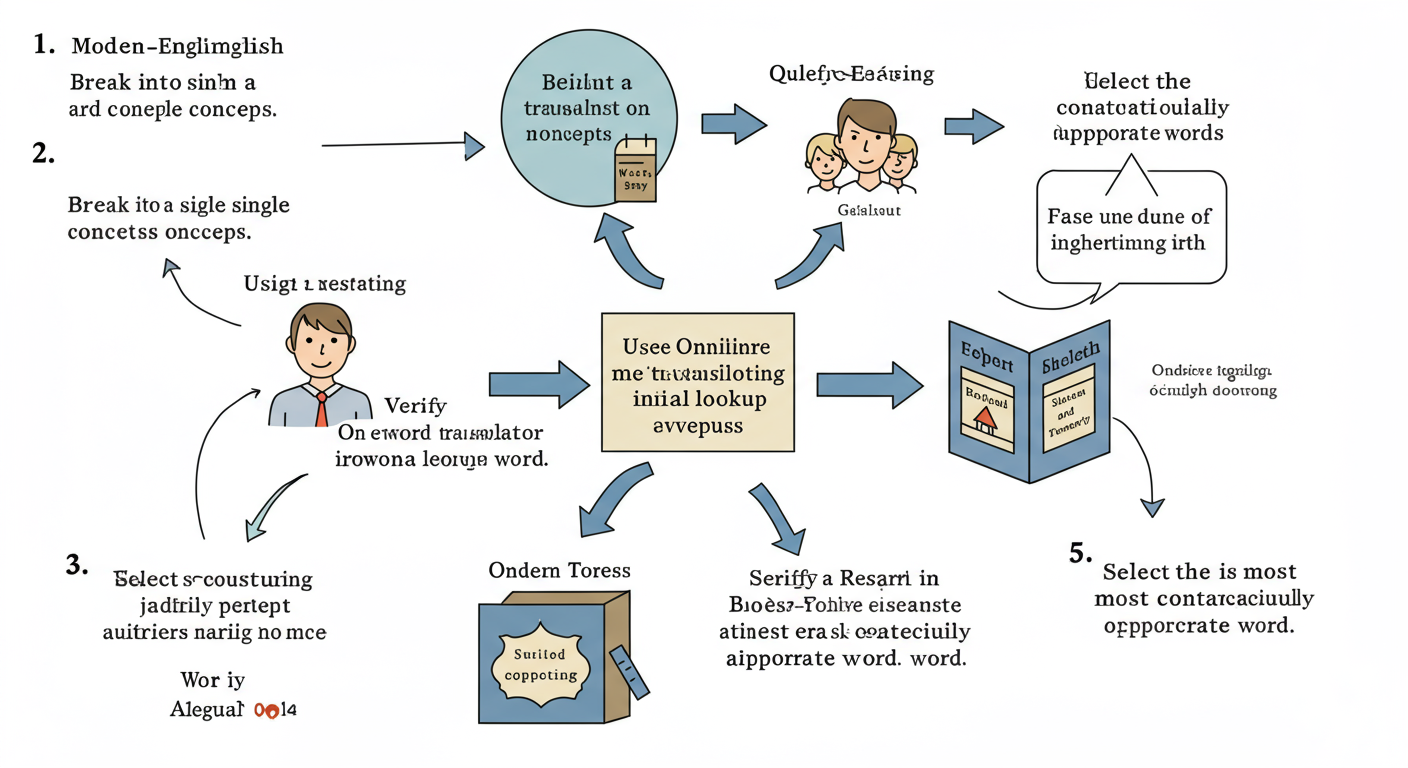
Step 1: Translate a Single Concept, Not a Sentence
This is the golden rule. Forget trying to translate poetic phrases or complex sentences. It will only give you gibberish. Instead, distill your idea down to its most basic conceptual components.
- Instead of: “I will find my inner strength.”
- Break it down into: “strength,” “soul,” “find/seek.”
Feed these single English words into your chosen English to Old English translator. This gives you a list of potential Old English words to investigate. For “strength,” it might suggest strengþu or mægen.
Step 2: Verify and Deepen with an Authoritative Dictionary
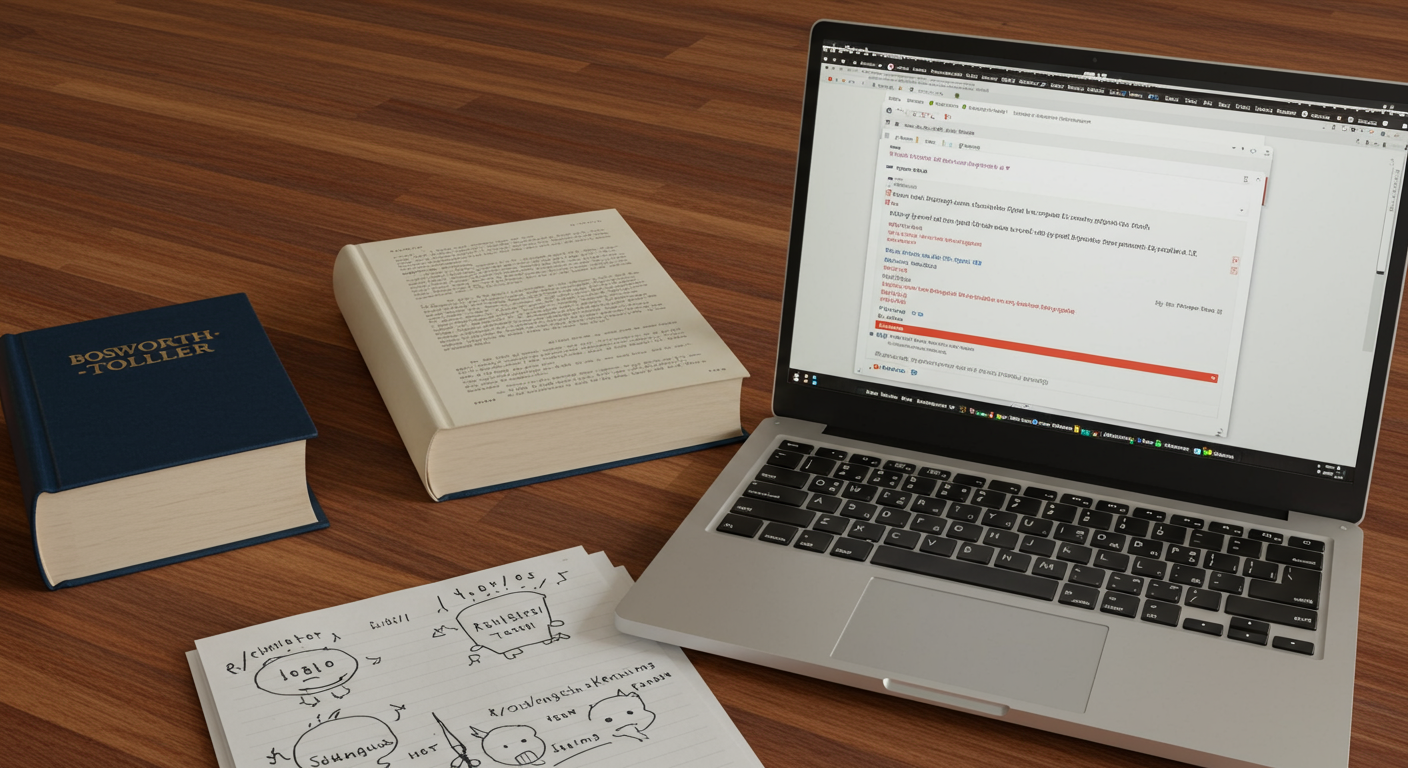
This is non-negotiable. Take the words the translator gave you and look them up in a real Old English dictionary. The undisputed champion is the Bosworth-Toller Anglo-Saxon Dictionary, available online for free. It’s the same resource used by university scholars.
When you look up strengþu and mægen, you’ll discover:
- Strengþu: Refers to physical strength, force, and power.
- Mægen: A much richer word. It means physical strength, but also spiritual power, virtue, and supernatural ability. It’s the root of our modern word “main” (as in “main effort”).
Suddenly, mægen seems much closer to the concept of “inner strength.” You’ve just moved beyond a simple lookup to a meaningful choice. The dictionary will also provide crucial grammatical information, like the noun’s gender and declension (how its endings change).
Step 3: Think in Kennings for Modern Concepts
What about words that didn’t exist, like “ocean liner”? You can’t translate it directly. The Anglo-Saxons were masters of creating compound words called “kennings” to describe things poetically. Hronrād (“whale-road”) was a kenning for the sea. Bānhūs (“bone-house”) was a kenning for the body.
You can do the same. For “ocean liner,” you could break it down:
- It’s a “sea-house” (sǣhūs)
- Or a “great ship” (miċelscip)
- Or a “wave-steed” (ȳðhengest)
This creative process is far more authentic than anything an algorithm can produce.
💡 Pro Tip
When creating a kenning, use simple, concrete nouns. The Anglo-Saxons described the world in tangible terms. Combine words like ‘sea’ (sǣ), ‘road’ (rād), ‘wood’ (wudu), ‘iron’ (īsern), ‘house’ (hūs), and ‘spear’ (gār) to build evocative new concepts.
Step 4: Construct Your Phrase (and Respect the Grammar)
Now you have your building blocks. If you’re just using a single powerful word like mægen, you’re done. If you’re combining words into a short phrase, you must be mindful of the grammar. This is the hardest part and where most people stumble.
For example, if you want to say “strength and courage,” you’d find the words mægen and mōdcræft. The simple conjunction is ond. So, mægen ond mōdcræft is a solid, grammatically simple phrase.
For anything more complex, you’re entering the territory of needing to learn the case system. At this stage, your best bet is to keep it incredibly simple or move to the final step.
| Method | Result | Analysis |
|---|---|---|
| Typical Online Translator | Secend þære soðfæstnys | Grammatically broken. It uses the wrong form of “seeker” and applies modern possessive logic (‘of’) that doesn’t work the same way in Old English. It’s gibberish. |
| Expert Method (using Bosworth-Toller) | Sōðes Sēċend | Authentic and powerful. This uses the genitive case for sōð (‘truth’), meaning “of truth,” and the correct noun form for “seeker.” It’s a plausible and meaningful construction. |
Step 5: When in Doubt, Ask a Human
This is the ultimate E-E-A-T signal: knowing the limits of your own expertise. If your translation is for anything permanent, public, or important—a tattoo, a book title, a family crest—you must get it checked by a human expert.
⚠️ Watch Out
Getting a tattoo from an online translator is a recipe for lifelong regret. I’ve seen “strength” turn into “fortress” and “love” turn into a verb in the wrong tense. It’s not worth the risk. A few dollars to consult a grad student or a few hours on a forum is a small price to pay for accuracy.
Building Your Anglo-Saxon Toolkit: Resources That Work
An instant translator is a starting point, not a destination. To truly engage with the language, you need to expand your toolkit. From real-world campaigns and academic projects, these are the resources we rely on.
- Primary Dictionary: The Bosworth-Toller Anglo-Saxon Dictionary is your bible. Bookmark it. Use it. Trust it.
- Learning Grammars: For those ready to take the next step, a textbook is invaluable. A Guide to Old English by Bruce Mitchell is a classic. For a free online option, the resources provided by universities like the University of Oxford offer a fantastic introduction to the grammar.
- Online Communities: Don’t learn in a vacuum. The r/oldenglish subreddit is an active community of learners, enthusiasts, and academics who are surprisingly friendly and helpful. You can post your translation attempts and ask for feedback.
💡 Pro Tip
Use online communities for verification, not as a primary translation service. Do your homework first using the 5-step method, then post your result and ask, “I’m trying to say ‘guardian of wisdom’ and came up with weard wisdōmes. Does this make sense?” You’ll get much better and more respectful feedback.
Your Compass to the Past
Let’s be clear: the perfect, one-click English to Old English translator doesn’t exist. And it probably never will. The linguistic and cultural chasm is just too wide for an algorithm to cross on its own.
But that’s not a failure; it’s an invitation. It’s a call to engage with the language on a deeper, more meaningful level. By treating these digital tools as a compass—something that points you in a general direction—and not a self-driving car, you can begin a genuine journey of discovery.
You now have the expert framework to do it right. You know how to break down ideas, verify them with authoritative sources, and respect the ancient grammar that gives Old English its power. You know the red flags to watch for and the reliable resources to turn to.
Your next step? Don’t try to translate a poem. Just pick one word that matters to you—’honor,’ ‘home,’ ‘sea,’ ‘fate’—and run it through the 5-step process. See where it takes you. You might just find that the journey is far more rewarding than the instant answer you thought you wanted.
❓ Frequently Asked Questions
Is an English to Old English translator accurate?
No, they are not accurate for sentences. Think of them as a very basic dictionary lookup. They can’t handle the complex grammar (cases, gender) or vocabulary gaps, leading to incorrect and often nonsensical results. They are only useful for finding single-word ideas to research further.
Can I get a tattoo based on an online translator?
Absolutely not. This is a very common and costly mistake. The risk of getting a grammatically incorrect or meaningless phrase permanently inked is extremely high. Always consult a human expert or a dedicated academic community before getting a tattoo in Old English.
What’s the difference between Old English and Middle English?
Old English (c. 450-1150) was the Germanic language of the Anglo-Saxons before the Norman Conquest of 1066. Middle English (c. 1150-1500), the language of Chaucer, is what emerged after the conquest, showing heavy influence from Norman French, which simplified grammar and added thousands of new words.
Did Shakespeare speak Old English?
No. Shakespeare (late 16th-early 17th century) wrote and spoke Early Modern English. While it can be tricky for us to read, it’s vastly different from Old English. A speaker of Old English and Shakespeare would not have been able to understand each other at all.
What is the best online English to Old English translator?
There is no single “best” tool because they all share the same fundamental flaws. Instead of searching for a better translator, the best approach is to use any of them for a single-word lookup and then immediately verify that word using the online Bosworth-Toller Anglo-Saxon Dictionary, which is the academic standard.