
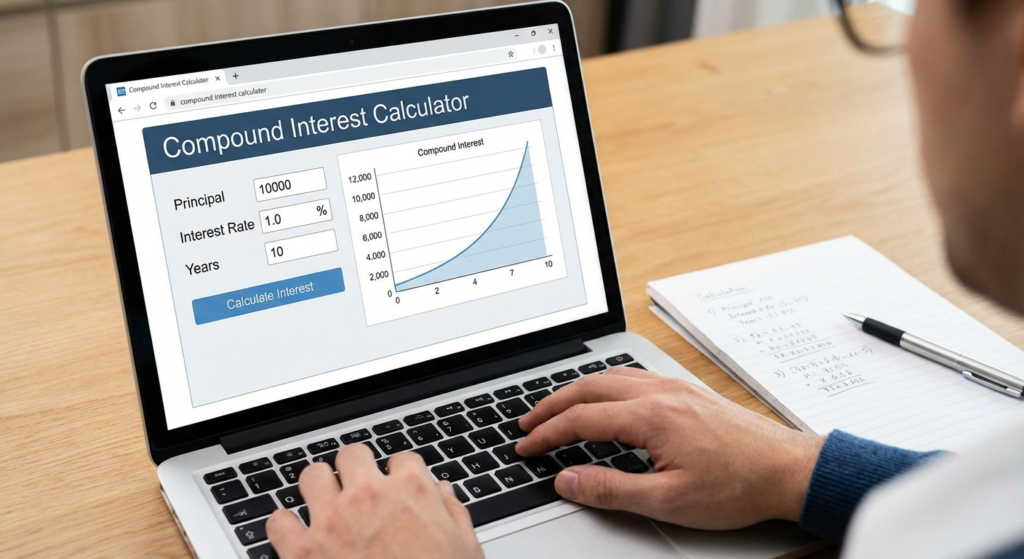
Albert Einstein is often reputed to have said, "Compound interest is the eighth wonder of the world. He who understands it, earns it… he who doesn’t… pays it." Whether or not he actually said it, the mathematical truth remains undeniable: understanding how money grows over time is the cornerstone of building lasting wealth. However, the math can be complex. This is where a Compound Interest Calculator becomes your most valuable financial ally.
In the world of personal finance, relying on guesswork is a recipe for disaster. Whether you are saving for retirement, a child’s education, or a down payment on a house, you need precise projections. A Compound Interest Calculator simplifies complex formulas into actionable insights, showing you exactly how your small contributions today can snowball into a massive fortune tomorrow. In this comprehensive guide, we will explore how to use this tool effectively, the variables that change your outcomes, and strategies to maximize your wealth.
Understanding the Magic Behind the Compound Interest Calculator
Before diving into the mechanics of the tool, it is essential to understand what the Compound Interest Calculator is actually computing. Unlike simple interest, which is calculated only on the principal amount, compound interest is calculated on the principal plus the accumulated interest from previous periods. It is essentially "interest on interest."
When you input data into a Compound Interest Calculator, it uses a specific mathematical formula to project future value:
A = P (1 + r/n)^(nt)
- A: The future value of the investment/loan, including interest.
- P: The principal investment amount.
- r: The annual interest rate (decimal).
- n: The number of times that interest is compounded per unit t.
- t: The time the money is invested for.
While you could do this math on paper, it is tedious and prone to error. The calculator automates this, allowing you to run multiple scenarios in seconds. This speed allows you to visualize the exponential curve of your investments, proving that time is often more valuable than the amount of money you start with.
Exponential Growth
Compound interest creates a snowball effect. As your interest earns its own interest, your wealth grows not linearly, but exponentially. The calculator visualizes this curve, showing how the last few years of an investment often generate the most profit.
The Frequency Factor
Compounding frequency matters. Money that compounds monthly grows faster than money that compounds annually. A good calculator allows you to adjust this frequency to see the tangible difference in your final payout.
Time vs. Money
The calculator often reveals a shocking truth: starting 10 years earlier with less money often beats starting later with more money. This insight is crucial for motivating young investors to begin immediately.
Why You Need a Compound Interest Calculator for Financial Planning
Financial literacy is about making informed decisions, and a Compound Interest Calculator provides the data necessary for those decisions. Many people underestimate how much they need to save to reach a million dollars or overestimate how much their current savings will grow.
Using this tool helps you set realistic goals. For example, if you want to retire with $1 million in 30 years, the calculator can work backward to tell you exactly how much you need to save monthly at an assumed interest rate. It transforms a vague dream into a concrete monthly target.
Furthermore, it serves as a reality check for debt. Just as compound interest works for you in investments, it works against you in debt. By inputting credit card interest rates into a Compound Interest Calculator, you can see how quickly a small debt can spiral out of control, motivating you to pay it off faster.
It is also vital for tax planning. As your money grows, you must consider the net returns after taxes. For strategies on preserving your wealth, you might want to explore 11 powerful tax saving tips without risky schemes to ensure you keep more of what you earn.
How to Use a Compound Interest Calculator Effectively
To get the most out of a Compound Interest Calculator, you need to understand the inputs. Garbage in, garbage out—if your estimates are wild, your results will be useless. Here is a step-by-step approach to using the tool for accurate financial forecasting.
1. Determine Your Initial Investment (Principal)
This is the lump sum you are starting with today. If you are starting from zero, that is fine, but starting with a lump sum gives your compounding a head start.
2. Estimate Your Monthly/Annual Contribution
Consistency is key. How much can you realistically add to this pot every month? The Compound Interest Calculator will show that regular contributions often matter more than the initial lump sum over long periods.
3. Set a Realistic Interest Rate
This is where many people go wrong. The stock market has historically returned about 7-10% annually (before inflation). If you input 15% or 20%, you are setting yourself up for disappointment. For conservative estimates, use 5-6%. For aggressive market estimates, use 8-9%.
Adjusting Variables in Your Compound Interest Calculator
Life is dynamic, and your financial plan should be too. A robust Compound Interest Calculator allows you to tweak variables. What happens if you increase your monthly savings by just $50? What if you retire 5 years later?
You should also consider external factors. For instance, if you are investing in international markets or planning a trip where you might spend your savings, understanding currency values is important. You can learn more about this in our currency converter tips and India travel guide.
Strategies to Maximize Returns Using a Compound Interest Calculator
Once you have run the basic numbers, it is time to use the Compound Interest Calculator to optimize your strategy. The goal is to manipulate the variables of time, rate, and contribution to yield the highest possible result.
One proven strategy is the "Step-Up" approach. Instead of keeping your monthly contribution flat for 30 years, aim to increase it by the percentage of your annual salary raise. If you get a 3% raise, increase your savings contribution by 3%. Running this scenario through the calculator will show a massive increase in the final corpus compared to a flat contribution rate.
The Impact of Time on the Compound Interest Calculator Results
Time is the exponent in the formula, making it the most powerful variable. The Compound Interest Calculator vividly demonstrates the cost of waiting. Let’s look at a comparison.
Investor A: Starts at 25
Invests $500/month for 10 years, then stops contributing but lets the money grow until age 65. Total invested: $60,000.
Investor B: Starts at 35
Invests $500/month for 30 years until age 65. Total invested: $180,000.
The Result
At an 8% return, Investor A (who invested less money but started earlier) often ends up with a higher balance than Investor B. This is the power of the time variable in the calculator.
This comparison highlights why you should never delay. Even small amounts invested early are worth more than large amounts invested late. For authoritative data on investment growth and calculator tools, you can refer to Investor.gov, a resource provided by the U.S. Securities and Exchange Commission.
Common Mistakes When Using Financial Calculators
While the Compound Interest Calculator is a powerful tool, it is not a crystal ball. Users often fall into traps that lead to poor planning. One major error is ignoring inflation. A million dollars in 30 years will not have the same buying power as a million dollars today. Advanced calculators allow you to adjust for inflation to see the "real" value of your future money.
Another mistake is forgetting about fees. Mutual funds and ETFs have expense ratios. If your investments earn 8% but you pay 1% in fees, your effective rate is 7%. This 1% difference can cost you tens of thousands of dollars over decades. Always input the net interest rate (expected return minus fees) into the calculator.
For a deeper understanding of financial terms and investment definitions that you might encounter while using these tools, Investopedia is an excellent resource.
Conclusion
A Compound Interest Calculator is more than just a digital widget; it is a roadmap to financial independence. By clearly visualizing the future value of your current habits, it provides the motivation needed to save more and spend less. It proves mathematically that patience and consistency are the keys to wealth, not necessarily a high income.
Whether you are a seasoned investor or just starting your financial journey, use this tool regularly to track your progress and adjust your course. Start today, let the math work in your favor, and watch your financial goals move from the realm of possibility into reality.
FAQs
Simple interest is calculated only on the principal amount (the original money deposited). Compound interest is calculated on the principal plus the interest that has already accumulated. Over time, compound interest results in significantly higher returns because your interest earns interest.
The math is 100% accurate based on the formula used. However, the results are projections based on the inputs you provide (interest rate, time, contributions). Since market returns fluctuate and are not constant year-over-year, the calculator provides an estimate rather than a guaranteed outcome.
Basic calculators usually show the "nominal" future value, which does not account for inflation. To see the "real" purchasing power of your money, you should subtract the expected inflation rate (e.g., 3%) from your expected investment return rate before inputting it into the calculator.
The more frequently interest is compounded, the higher your returns will be. Daily compounding yields more than monthly, which yields more than annual compounding. Most savings accounts compound daily or monthly, while the stock market effectively compounds continuously as companies grow.
Yes. The same formula applies to debt, working against you. You can use the calculator to see how much interest you will pay over the life of a loan or credit card balance if you only make minimum payments, highlighting the importance of paying off high-interest debt quickly.