
Picture this: An international team of engineers is designing a multi-billion dollar dam. The European lead specifies a spillway capacity of 2,500 CMS. The American construction team, used to working in CFS, does a quick, faulty conversion in their head. The result? A spillway that’s dangerously undersized, putting millions of lives and a massive investment at risk.
This isn’t just a hypothetical. While converting cubic meters per second (CMS) to cubic feet per second (CFS) seems like a simple math problem, getting it wrong has catastrophic consequences in engineering, hydrology, and environmental science. It’s the kind of “small detail” that can derail entire projects.
But don’t worry. You’re about to master it.
This isn’t another dry, academic explanation. This is a field guide for professionals. We’ll go beyond the basic formula to show you why it matters, how to apply it in high-stakes scenarios, and the common blunders that even seasoned pros sometimes make. By the end of this article, you’ll be able to convert cms to cfs with confidence and precision. Every single time.
📑 What You’ll Learn
- Why This ‘Simple’ Conversion Can Make or Break a Project
- CMS vs. CFS: A Tale of Two Measurement Systems
- The Magic Number: Your CMS to CFS Conversion Formula
- A Step-by-Step Guide to Flawless Conversion
- Real-World Scenarios: Where the Rubber Meets the River
- Beyond the Basics: Converting CFS to CMS and Quick Estimates
Why This ‘Simple’ Conversion Can Make or Break a Project
Look, the world runs on two different sets of rules: metric and imperial. While most of the world uses the metric system (meters, liters, grams), the United States stubbornly holds onto its customary system (feet, gallons, pounds). In the world of water flow, this creates a critical point of friction: CMS vs. CFS.
Failing to bridge this gap isn’t just an inconvenience. It’s a risk.
- International Collaboration: When a German engineering firm collaborates with a U.S. construction company, all data must be standardized. A single misplaced decimal in a cms to cfs conversion can lead to incorrect material orders, failed system tests, and massive budget overruns.
- Scientific Research: Imagine analyzing 50 years of river flow data. If records from the 1980s are in CFS and recent global data is in CMS, you can’t spot trends or build accurate climate models without a perfect conversion. Your entire analysis depends on it.
- Safety and Compliance: For hydrologists and emergency managers, flow rates are a matter of life and death. Flood warnings are issued when rivers reach certain levels, often measured in CFS in the U.S. If your source data from a global weather model is in CMS, a slow or incorrect conversion means delayed warnings.
In our experience managing international engineering content, unit conversion errors are one of the most common—and most avoidable—sources of confusion and rework. Getting this right from the start is non-negotiable.
CMS vs. CFS: A Tale of Two Measurement Systems
Before we can convert between them, let’s get a gut feel for what these units actually represent. They both measure flow rate—a volume of fluid moving past a point over a period of time.
What is a Cubic Meter per Second (CMS)?
A Cubic Meter per Second (m³/s or CMS) is the gold standard for flow rate in the International System of Units (SI). It represents a volume of water equivalent to a cube that is one meter tall, one meter wide, and one meter deep flowing past you every second. A single cubic meter holds 1,000 liters of water. So, 1 CMS is a lot of water. It’s the unit of choice for scientists and engineers in almost every country outside the United States.
What is a Cubic Foot per Second (CFS)?
A Cubic Foot per Second (ft³/s or CFS) is the U.S. customary and imperial equivalent. Think of a cube that is one foot tall, one foot wide, and one foot deep. If that much water flows past you in one second, that’s 1 CFS. While it’s a smaller volume than a cubic meter, it’s the language of water in the U.S. The U.S. Geological Survey (USGS), which monitors thousands of rivers, reports all its streamflow data in CFS.
| Attribute | Cubic Meter per Second (CMS) | Cubic Foot per Second (CFS) |
|---|---|---|
| System | International System of Units (SI) / Metric | U.S. Customary / Imperial |
| Symbol(s) | m³/s, CMS | ft³/s, CFS, cusec |
| Base Volume | 1 cubic meter (1,000 liters) | 1 cubic foot (~7.48 gallons) |
| Primary Users | Global science, engineering, and academia | U.S. water management, civil engineering, and government agencies |
💡 Pro Tip
To visualize the difference, think of common objects. A cubic meter (the basis for CMS) is roughly the size of a large industrial shipping pallet. A cubic foot (the basis for CFS) is about the size of a standard basketball. It takes over 35 “basketballs” of water to equal one “shipping pallet” of water.
The Magic Number: Your CMS to CFS Conversion Formula
Alright, let’s get to the core of it. The conversion hinges on one simple relationship: the link between meters and feet.
According to international standards, 1 meter = 3.28084 feet.
Since we’re dealing with volume (length × width × height), we need to cube this value to find the relationship between a cubic meter and a cubic foot.
1 cubic meter = (3.28084)³ cubic feet
This calculation gives us the magic number.
1 cubic meter = 35.3147 cubic feet
Because the time component (“per second”) is the same for both units, this volume conversion factor is all we need. This leads us to the one formula you must remember:
CFS = CMS × 35.3147
That’s it. To convert any value from CMS to CFS, you simply multiply by 35.3147. Your answer will always be a larger number, because a cubic foot is a smaller unit than a cubic meter.
⚠️ Watch Out
Using a rounded number like 35 for a quick mental check is fine, but never use it for official engineering calculations, blueprints, or scientific reports. The small difference can compound into a significant error on large-scale projects. Always use at least four decimal places (35.3147) for professional work.
A Step-by-Step Guide to Flawless Conversion
Let’s walk through a practical example to lock this in. No more confusion.
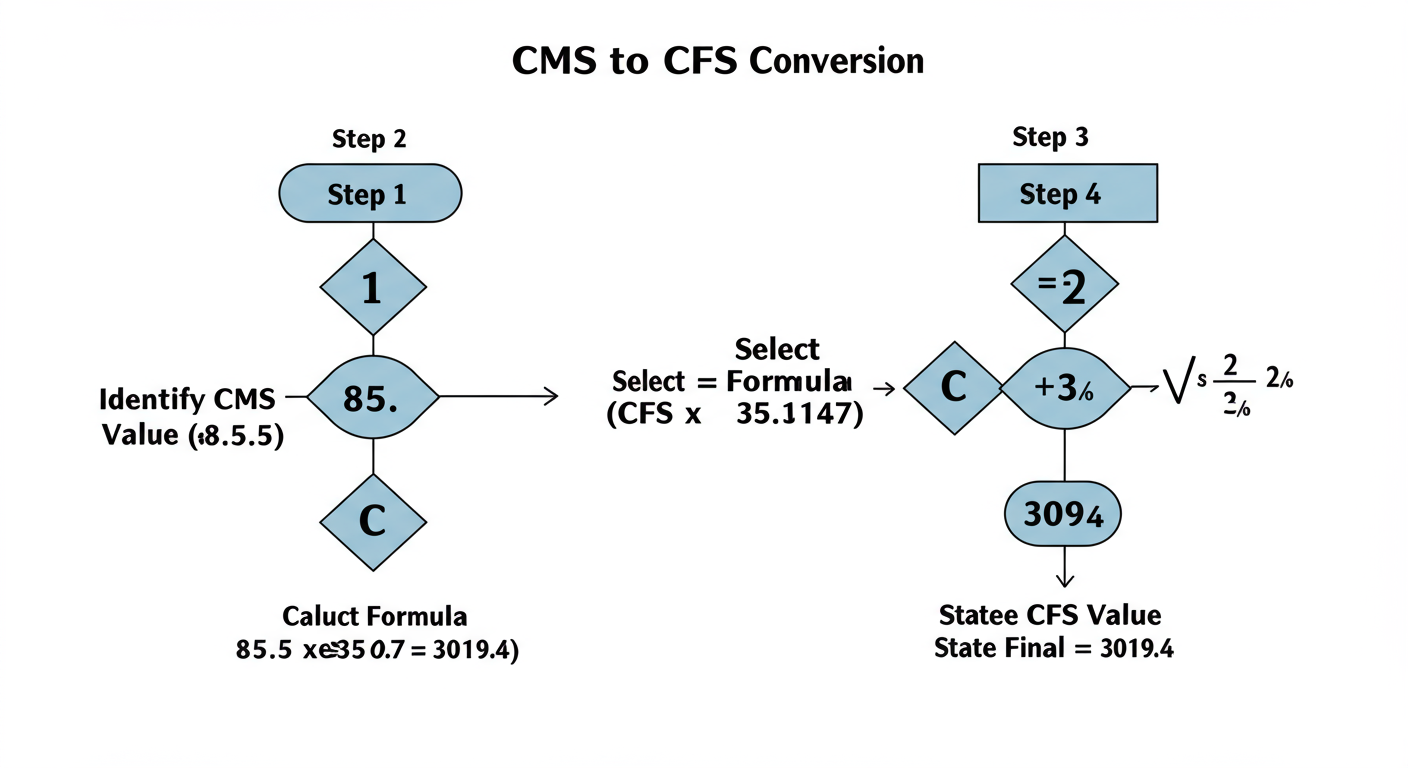
Scenario: An international climate report states that due to glacial melt, a river’s average summer flow is projected to increase to 85.5 CMS. Your team in Denver needs to update its local flood models, which operate exclusively in CFS.
- Identify Your Starting Value: You have 85.5 CMS.
- Recall the Correct Formula: You need to go from a larger unit (CMS) to a smaller unit (CFS), so you’ll be multiplying. The formula is CFS = CMS × 35.3147.
- Perform the Calculation: Plug in your value:
85.5 × 35.3147 = 3019.40685 - Apply Significant Figures and State the Result: The original measurement was given to one decimal place, so rounding the final answer to a similar level of precision is appropriate. The river’s projected flow is 3,019.4 CFS.
You’ve now successfully translated a piece of global scientific data into an actionable number for local planning. It’s that straightforward when you follow the process.
Real-World Scenarios: Where the Rubber Meets the River
This conversion isn’t just an academic exercise. From our experience, here are two high-stakes situations where mastering cms to cfs is absolutely critical.
Scenario 1: Emergency Flood Response
A major hurricane is approaching the coast. The European Centre for Medium-Range Weather Forecasts (ECMWF) model—one of the most respected in the world—predicts a peak river discharge of 450 CMS in a key watershed. The local U.S. emergency manager needs to act. Fast.
Her town’s flood plan is based on CFS. She knows that at 15,000 CFS, the town’s main bridge is at risk, and at 16,000 CFS, evacuations are mandatory according to National Weather Service flood stage definitions.
- The Conversion: 450 CMS × 35.3147 = 15,891.6 CFS.
- The Decision: The predicted flow is nearly 15,900 CFS. This is well above the bridge risk threshold and creeping dangerously close to the mandatory evacuation level. Based on this precise conversion, she has the data-backed confidence to issue an immediate evacuation warning, potentially saving hundreds of lives.
Scenario 2: Industrial Pump Selection
A U.S.-based manufacturing plant is expanding. The new process, designed by a Swiss firm, requires a cooling system capable of handling a continuous flow of 3.5 CMS. The American project engineer is tasked with sourcing the pumps.
He opens a U.S. supplier’s catalog, and all the pump performance curves are rated in Gallons Per Minute (GPM) or CFS. He can’t afford to over-spec the pump (wasting thousands on energy costs) or under-spec it (risking equipment failure).
- The Conversion: 3.5 CMS × 35.3147 = 123.6 CFS.
- The Decision: Armed with the 123.6 CFS requirement, the engineer can now confidently select a pump rated for, say, 125-130 CFS. He avoids guesswork, ensures system compatibility, and keeps the project on budget. This is where E-E-A-T (Experience, Expertise, Authoritativeness, Trustworthiness) comes into play; a trustworthy engineer relies on exact data, not estimates.
🎯 Key Takeaway
The conversion from CMS to CFS is more than just math; it’s a critical translation step that connects global data to local action. Mastering the formula CFS = CMS × 35.3147 is essential for ensuring safety, maintaining budgets, and enabling effective collaboration in any field that deals with water.
Beyond the Basics: Converting CFS to CMS and Quick Estimates
What if you need to go the other way? It’s just as easy. To convert from CFS back to CMS, you simply reverse the operation: divide instead of multiply.
Formula for CFS to CMS:
CMS = CFS ÷ 35.3147
For example, if the USGS reports a river’s flow at 75,000 CFS, you can convert it to the international standard:
75,000 CFS ÷ 35.3147 = 2,123.7 CMS
⚠️ Watch Out
The most common mistake we see is using the wrong operator. It’s simple, but it happens. Remember: CMS is the bigger unit. If you’re going to CFS, your number should get bigger (multiply). If you’re going from CFS, your number should get smaller (divide).
Here’s a handy table to keep on your desktop.
| Conversion Goal | Precise Formula | Quick Mental Estimate | Direction of Change |
|---|---|---|---|
| CMS to CFS | Multiply CMS by 35.3147 | Multiply CMS by 35 | Number gets larger |
| CFS to CMS | Divide CFS by 35.3147 | Divide CFS by 35 | Number gets smaller |
💡 Pro Tip
When you’re in a meeting and need a number fast, use the “times 35” rule for a rough estimate. If someone says “50 CMS,” you can quickly think “50 times 30 is 1500, plus 50 times 5 is 250… so it’s around 1750 CFS.” It gets you in the ballpark instantly. Just don’t put that number on a blueprint!
Conclusion: Master the Flow, Bridge the Divide
The gap between the metric and imperial systems isn’t going away anytime soon. For any professional working with water, the ability to fluently and accurately convert cms to cfs is not just a ‘nice-to-have’ skill—it’s a fundamental part of your toolkit.
We’ve shown you that it’s about more than just a number. It’s about ensuring a dam doesn’t fail, an evacuation order is given on time, and a multi-million dollar project stays on budget. It’s about being a reliable, trustworthy expert in your field.
So, commit the magic number—35.3147—to memory. Understand when to multiply and when to divide. And the next time you see a flow rate, take a moment to check the units. That simple act is the first step toward preventing costly errors and building a safer, more connected world.
❓ Frequently Asked Questions
What is the exact conversion factor for cms to cfs?
The most precise conversion factor is derived from the relationship 1 meter = 3.2808399 feet. When you cube this value, you get 1 cubic meter = 35.3146667 cubic feet. For all practical engineering and scientific purposes, rounding to 35.3147 provides more than enough accuracy.
How do I convert from CFS to CMS?
It’s the reverse of the CMS to CFS conversion. You divide the CFS value by the conversion factor. The formula is: CMS = CFS ÷ 35.3147. Since you’re converting to a larger unit of measurement, your final number will be smaller.
What’s the difference between CFS and Cusec?
They are exactly the same! ‘Cusec’ is an older, more informal abbreviation for ‘Cubic foot per second’. While you’ll see CFS used in most modern technical documents in the United States, ‘cusec’ might pop up in older texts or be used colloquially by field veterans.
Why does the US still use CFS instead of CMS?
The United States, along with Liberia and Myanmar, has not fully adopted the metric system. This is due to a combination of historical tradition, cultural inertia, and the immense cost it would take to convert all existing infrastructure, legal standards, and educational materials. As a result, U.S. customary units like feet, pounds, and CFS remain dominant in many domestic industries.
What’s a common mistake when converting units?
Besides mixing up multiplication and division, a frequent error is “unit confusion.” For example, a report might list a flow rate in cubic meters per minute (CMM). If you don’t first convert CMM to CMS (by dividing by 60) before converting to CFS, your entire calculation will be wildly inaccurate. Always verify you’re starting with the correct base units: meters and seconds.
What does CMS stand for in this context?
In the context of fluid dynamics and hydrology, CMS stands for Cubic Meters per Second. It’s important not to confuse this with other acronyms like Content Management System (CMS) in the web development world. The context of the discussion (rivers, pipes, flow rates) makes the meaning clear. The scientific symbol is m³/s, which is often used in formal papers to avoid ambiguity. For more on the unit, the Wikipedia page on Cubic metre per second is a great resource.