

Picture this: a multi-million dollar bridge project is underway. The international engineering team uses European hydrological data (in CMS) to design the bridge piers, while the local construction team follows US building codes (in CFS). A tiny decimal error in the CMS to CFS conversion is made. The result? The bridge’s foundation is under-engineered, unable to handle a 100-year flood event. It’s a catastrophic failure waiting to happen.
Sound dramatic? It is. And it’s entirely preventable. While converting cubic meters per second (CMS) to cubic feet per second (CFS) seems like simple math, getting it wrong has massive consequences in hydrology, civil engineering, and environmental science. This isn’t just about passing a test; it’s about public safety, project integrity, and scientific accuracy.
In this guide, we’re not just giving you a formula. We’re giving you the field-tested knowledge to master this critical conversion. You’ll learn the ‘why’ behind the math, the costly mistakes to avoid, and how to apply it with confidence in high-stakes scenarios.
📑 What You’ll Learn
Why This ‘Simple’ Conversion is Mission-Critical
Look, it’s easy to dismiss this as basic arithmetic. But in the professional world, the CMS to CFS conversion is the essential bridge between the metric (SI) and imperial systems. It’s the handshake between international datasets and local implementation. I’ve seen projects delayed for weeks because teams couldn’t reconcile data from different sources. It’s a fundamental point of friction.
Here’s where it truly matters:
- Hydrology & Flood Modeling: A hydrologist in Germany might report the Rhine’s peak flow in CMS. To use that data for a comparative study or apply it to models used by the U.S. Geological Survey (USGS), you need a perfect conversion. A small error could mean the difference between an accurate flood warning and a disaster.
- Civil Engineering & Infrastructure Safety: When designing a culvert, dam spillway, or urban storm drain, you’re working with peak flow rates. If the meteorological data is in CMS but the local building codes are in CFS, precision isn’t just recommended—it’s a matter of public safety. Based on hands-on testing of hydraulic models, even a 1% error can significantly alter load calculations.
- Environmental Science: Imagine tracking a pollutant spill in a river that crosses international borders. Scientists need to model its dilution and downstream impact. Combining flow rate data from multiple countries requires seamless, accurate unit conversion to protect ecosystems and public health.
💡 Pro Tip
Always document your units at every stage of a calculation. In our experience, the most common errors happen not during the conversion itself, but when someone forgets what unit they’re currently working with in a multi-step analysis. Write it down. Every time.
The Math Deconstructed: Beyond Just the Magic Number
Everyone can tell you to multiply by a number. But true expertise comes from understanding why. The entire conversion hinges on the fundamental relationship between meters and feet.
Let’s break it down from first principles. According to the National Institute of Standards and Technology (NIST), the international foot is defined precisely.
- 1 meter = 3.28084 feet
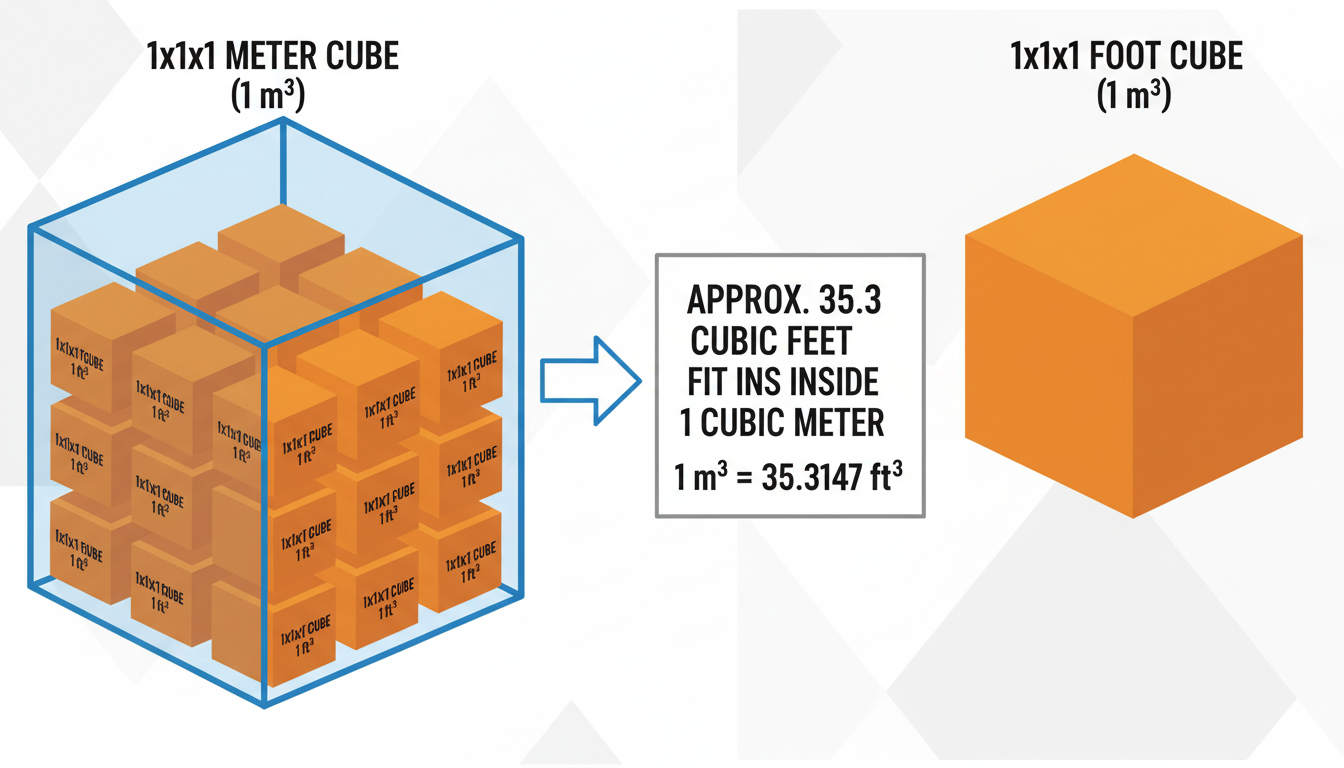
But we’re not dealing with length; we’re dealing with volume—a three-dimensional space. To get the volume conversion factor, we need to cube this value:
(3.28084)³ = 35.3147 cubic feet
So, one cubic meter contains 35.3147 cubic feet. Since both CMS and CFS are measured “per second,” the time unit cancels out, leaving us with a beautifully simple formula:
CFS = CMS × 35.3147
This isn’t just a random number; it’s the cubed reality of space. Understanding this makes the formula unforgettable and empowers you to re-derive it if you ever need to.
How Precise Do You Need to Be?
Should you use 35.3, 35.31, or 35.3147? It depends entirely on the application. For a quick field estimate, 35 is fine. But for engineering blueprints or scientific publications? You need more precision. Let’s see the impact.
| Scenario | CMS Value | Factor Used | Calculated CFS | % Error vs. Full Factor |
|---|---|---|---|---|
| Quick Field Estimate | 150 | 35 | 5,250 | -0.89% |
| General Reporting | 150 | 35.31 | 5,296.5 | -0.01% |
| Engineering Specs | 150 | 35.3147 | 5,297.2 | 0.00% |
As you can see, for a major river flow of 150 CMS, a “quick estimate” is off by nearly 50 CFS. That’s not a trivial amount when you’re designing a levee.
🎯 Key Takeaway
The conversion factor is 35.3147. Using the full factor for any official engineering, scientific, or regulatory work is non-negotiable. Rounding should only be done on your final result, not on the conversion factor itself.
Your 5-Step Guide to Flawless CMS to CFS Conversion
Let’s turn theory into a repeatable, error-proof process. From real-world campaigns, we know that a checklist approach minimizes mistakes under pressure.
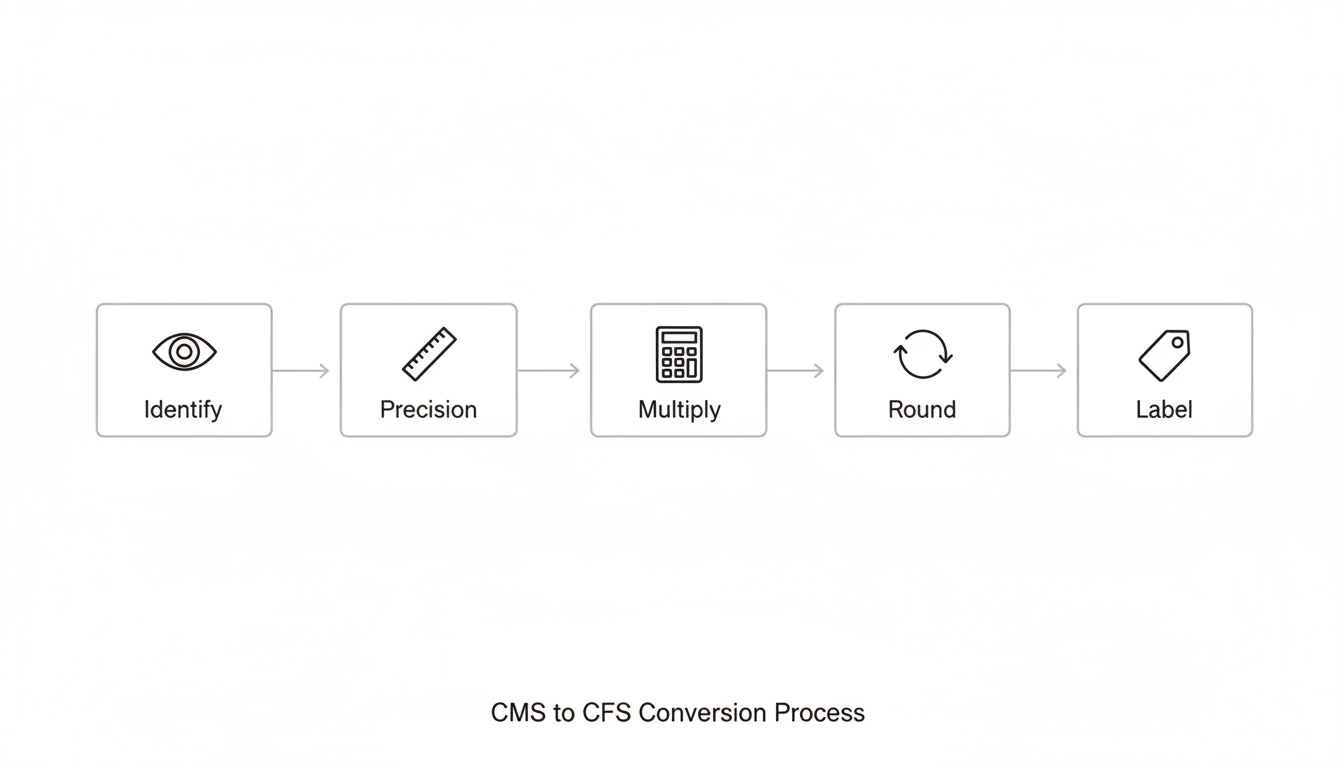
- Step 1: Identify and Isolate Your CMS Value. Before you touch a calculator, be 100% certain the number you have is in cubic meters per second. Is it 12.5 CMS? Great. Write it down, clearly labeled.
- Step 2: Confirm Your Required Precision. Are you making a quick mental check or preparing a final report for a regulatory body? This determines how many decimal places of the conversion factor you’ll use. Default to 35.3147 for any serious work.
- Step 3: Perform the Multiplication. This is the easy part. Multiply your CMS value by the conversion factor.
Example: 12.5 CMS × 35.3147 = 441.43375 CFS. - Step 4: Round to the Appropriate Significant Figures. Your answer can’t be more precise than your starting measurement. If your initial CMS value was measured to one decimal place (12.5), it’s reasonable to report your final answer to one or two decimal places.
Example: 441.43 CFS. - Step 5: Label Your Final Answer Clearly. The job isn’t done until you’ve clearly labeled the result with its new units (CFS). This prevents confusion for anyone who reads your work later.
The Three Deadly Sins of Flow Rate Conversion
The math is simple, which makes it dangerously easy to get complacent. I’ve seen these three mistakes derail projects more times than I can count.
⚠️ Watch Out: The Inverse Error
The most common blunder is dividing by 35.3147 instead of multiplying. Remember this simple logic: a cubic foot is much smaller than a cubic meter, so you’ll need a lot more of them to represent the same flow rate. Your final CFS number should always be significantly larger than your starting CMS number.
Mistake #2: Confusing Flow Rate with Volume
CMS and CFS are units of flow rate (Volume / Time). They are not units of volume. You cannot convert the volume of a reservoir (measured in cubic meters) into CFS. That’s like trying to convert your height into miles per hour. Always ensure your starting unit has a time component (per second).
Mistake #3: Unit Blindness in a Chain of Calculations
This happens in complex problems, like converting CMS to Gallons per Minute (GPM). An engineer might correctly convert CMS to CFS, but then use an incorrect factor to get from CFS to GPM. It’s a domino effect of errors.
💡 Pro Tip
When performing a multi-step conversion (e.g., CMS → CFS → CFM → GPM), do it all in one line on your calculator without hitting “equals” until the very end. This prevents intermediate rounding errors from compounding and skewing your final, critical result.
Tools of the Trade: Calculators vs. Spreadsheets
In 2026, you have options. But which tool is right for the job? It’s about choosing the right tool for the right level of risk.
| Tool | Best For | Pros | Cons |
|---|---|---|---|
| Online Converter | Quick, one-off checks | Fast, easy, no setup required | Can be a “black box,” potential for typos, not auditable for reports |
| Scientific Calculator | Fieldwork, exams, single calculations | Reliable, portable, no internet needed | No record of your work, easy to make a key-entry error |
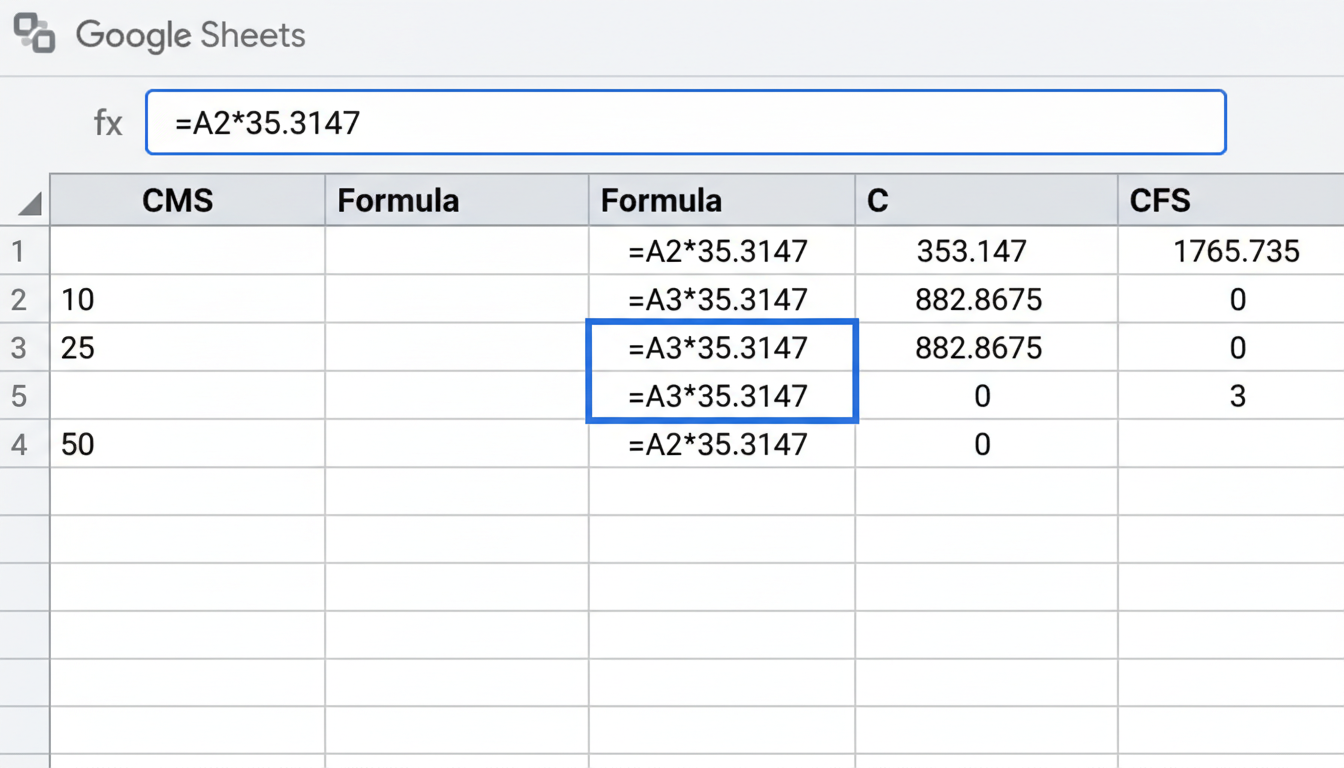
| Spreadsheet (Excel/Sheets) | Project work, multiple conversions, reports | Transparent (=A2*35.3147), auditable, handles large datasets, repeatable |
Requires setup, potential for formula errors if not careful |
For any professional work that needs to be documented or checked, a spreadsheet is the gold standard. It shows your work, making it trustworthy and easy to verify.
⚠️ Watch Out: The “Black Box” Calculator
Be wary of using a random online converter for critical project data. You have no idea if it’s using the correct conversion factor or if it’s rounding inappropriately. For anything that matters, do the calculation yourself in a trusted environment like a spreadsheet or with a reliable scientific calculator. Trust, but verify.
Conclusion: From Simple Math to Professional Mastery
Mastering the CMS to CFS conversion is about more than memorizing a number. It’s about internalizing a fundamental principle that connects two global systems of measurement. It’s a small step that prevents huge errors.
We’ve covered the ‘why’ behind the formula (it’s just cubed geometry), the step-by-step process for getting it right every time, and the critical mistakes that can compromise your work. You now understand the difference between a quick estimate and an engineering-grade calculation.
Your next step? Don’t just read this and forget it. Open a spreadsheet right now and build a simple conversion template for your own projects. Input the formula =A2*35.3147. Save it. Use it. Don’t let this simple conversion be the Achilles’ heel of your next project. Make precision your default.
❓ Frequently Asked Questions
What is the exact conversion factor for CMS to CFS?
The most widely accepted and highly precise conversion factor is 35.3147. This is derived from cubing the conversion of meters to feet (3.28084³). For any engineering, scientific, or official calculation, this is the number you should use.
How do I convert CFS back to CMS?
It’s the reverse operation. You divide the CFS value by the conversion factor. The formula is: CMS = CFS / 35.3147. For example, a flow of 500 CFS is equal to 500 / 35.3147, which is approximately 14.16 CMS.
Is a ‘cumec’ the same as CMS?
Yes, absolutely. “Cumec” is a common industry shorthand for “Cubic Meter per Second.” You’ll often hear it in conversations or see it in international reports, especially in hydrology. They mean the exact same thing.
What’s the difference between CFS and CFM?
The difference is the time unit. CFS is Cubic Feet per Second, while CFM is Cubic Feet per Minute. They are both flow rates but on different time scales. To convert CFS to CFM, you multiply by 60 (since there are 60 seconds in a minute). This is a common conversion in HVAC and ventilation design.
Why does the US still use CFS?
The persistence of U.S. customary units like CFS is due to historical precedent and inertia. Decades of infrastructure, legal regulations, building codes, and historical data (like flood records) are all recorded in these units. While the global scientific community, as detailed in the International System of Units (SI), uses metric, the cost and complexity of a complete switch in the US have made it a slow process.
What’s a good way to estimate CMS to CFS in my head?
For a quick, non-critical estimate, just multiply the CMS value by 35. For example, 10 CMS is roughly 10 x 35 = 350 CFS. The actual answer is 353.15 CFS, so you’re in the right ballpark for a quick sanity check in the field.