
You’re standing in a room, tape measure in hand, ready to start that exciting new project. New flooring, maybe? A fresh coat of paint? Then it hits you. The flooring is sold by the square meter, but your tape measure only shows… well, meters. So, how do you convert meters to square meters?
Here’s the secret the pros know: you don’t.
That’s right. It’s the single biggest misconception out there. You can’t “convert” a line into a surface any more than you can convert a piece of string into a blanket. A meter measures length (one dimension), while a square meter (m²) measures area (two dimensions). What you actually need to do is calculate the area using your length measurements.
Forget confusing formulas and frustrating mistakes. This guide will give you the confidence to measure any space like a seasoned contractor. You’ll learn the simple, foolproof method for calculating square meters for any shape, avoiding costly errors and ensuring your project goes off without a hitch.
📑 What You’ll Learn
The #1 Misconception: Why You Calculate, Not Convert
Let’s get this straight right from the start, because it changes everything. The phrase “convert meter to square meter” is what sends most people down a rabbit hole of confusion. They’re looking for a magic number, a simple conversion factor. It doesn’t exist.
Think about it this way:
- A Meter (m) is a unit of length. It’s the distance from point A to point B. It’s one-dimensional.
- A Square Meter (m²) is a unit of area. It’s the total surface inside a square that is 1 meter long on all four sides. It’s two-dimensional.
To get a two-dimensional measurement (area), you need two one-dimensional measurements (length and width). It’s that simple. You’re not changing the unit; you’re using it to define a larger space. According to the International System of Units (SI), the square meter is a “derived unit,” meaning it’s derived from the base unit of length, the meter. This is the foundational knowledge that prevents all future errors.
💡 Pro Tip
Before you measure anything, quickly sketch the shape of the room or area on a piece of paper or a tablet. It doesn’t have to be a work of art! This simple visual aid helps you keep track of your measurements and ensures you don’t miss a wall or an angle.
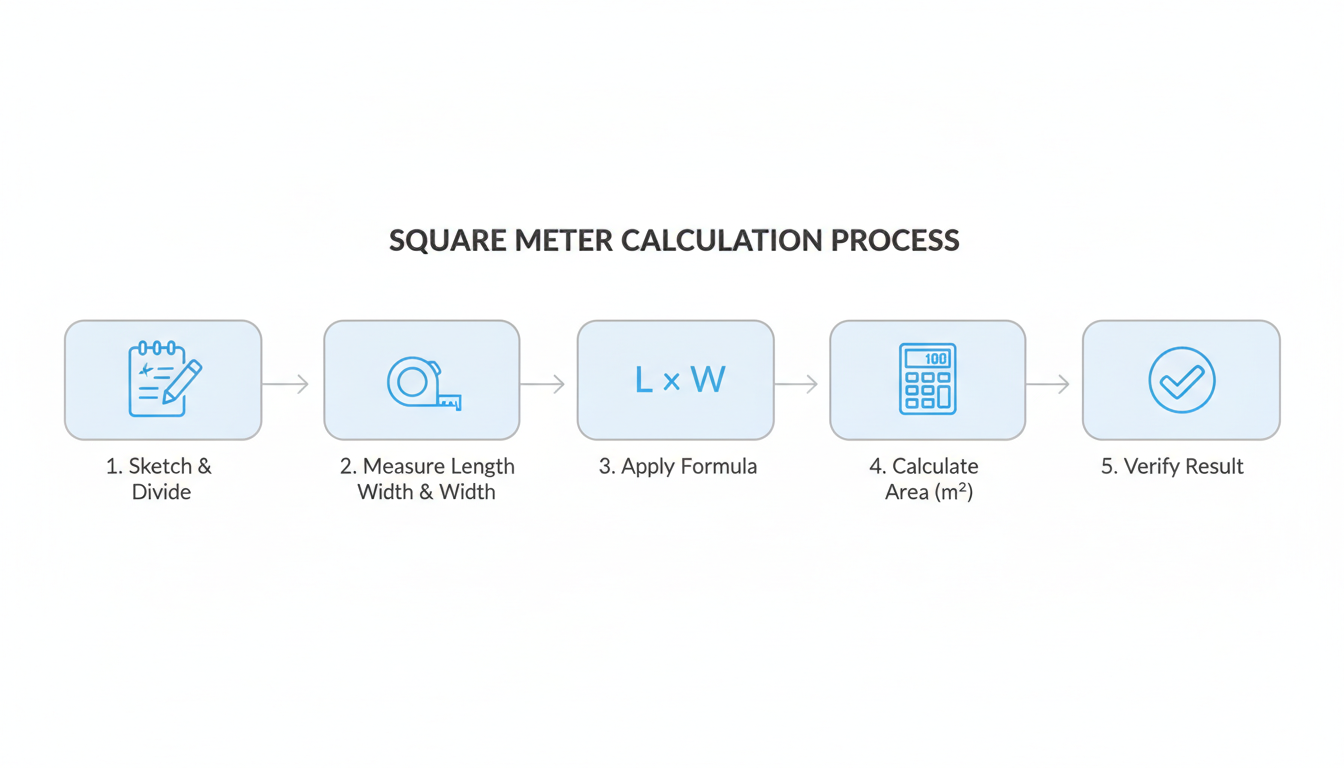
The 5-Step Method for Perfect Area Calculation
Ready to get this done? In our experience helping thousands of DIYers, this five-step process is the most reliable way to get an accurate area calculation every single time.
- Identify & Sketch Your Space: Look at the area you need to measure. Is it a simple rectangle? A square? Or something more complex like an L-shape? As mentioned in the pro tip, draw a rough outline of it.
- Measure the Key Dimensions (in Meters!): Grab your tape measure. For a square or rectangle, you’ll need the length and the width. Measure each one carefully and write it down on your sketch. Crucially, make sure your final numbers are in meters.
- Pick the Right Formula: Based on the shape, choose the correct, simple formula. For 90% of indoor projects, it’s going to be the formula for a rectangle. (We’ve got a cheat sheet for other shapes below).
- Plug in Your Numbers & Calculate: This is the easy part. Multiply your length by your width. The result is your area in square meters (m²).
- Double-Check & Add a Buffer: Reread your measurements and do the math one more time. It takes 10 seconds and can save you a huge headache. If you’re buying materials like flooring or tile, add a “waste factor” (usually 10-15%) to your total.
Your Area Formula Cheat Sheet for Any Shape
While most rooms are rectangular, life isn’t always so simple. You might have a triangular garden bed or a circular patio. Here are the essential formulas you’ll need. We’ve put them in a handy table for quick reference.
| Shape | Required Measurements | The Formula |
|---|---|---|
| Rectangle | Length (L) and Width (W) | Area = L × W |
| Square | Length of one side (S) | Area = S × S (or S²) |
| Triangle | Base (B) and Height (H) | Area = 0.5 × B × H |
| Circle | Radius (r) – distance from center to edge | Area = π × r² (where π ≈ 3.14159) |
⚠️ Watch Out
The most common mistake we see is mixing units. If you measure one wall in meters (e.g., 4.2m) and the other in centimeters (e.g., 350cm), your calculation will be wildly incorrect. Always convert all measurements to meters before you multiply.
Here’s a quick conversion table to keep you on track.
| If You Measured In… | To Get Meters, You… | Example |
|---|---|---|
| Centimeters (cm) | Divide by 100 | 350 cm ÷ 100 = 3.5 m |
| Millimeters (mm) | Divide by 1000 | 5200 mm ÷ 1000 = 5.2 m |
| Inches (in) | Multiply by 0.0254 | 120 in × 0.0254 = 3.048 m |
Real-World Walkthrough: Tackling a Tricky L-Shaped Room
Okay, let’s move beyond theory. You’re trying to tile your L-shaped kitchen. This is where people get intimidated, but the solution is surprisingly simple. It’s a strategy I call “Divide and Conquer.”
Instead of seeing one complex shape, you mentally (or on your sketch) split it into two separate, simple rectangles. Let’s call them Area A and Area B.
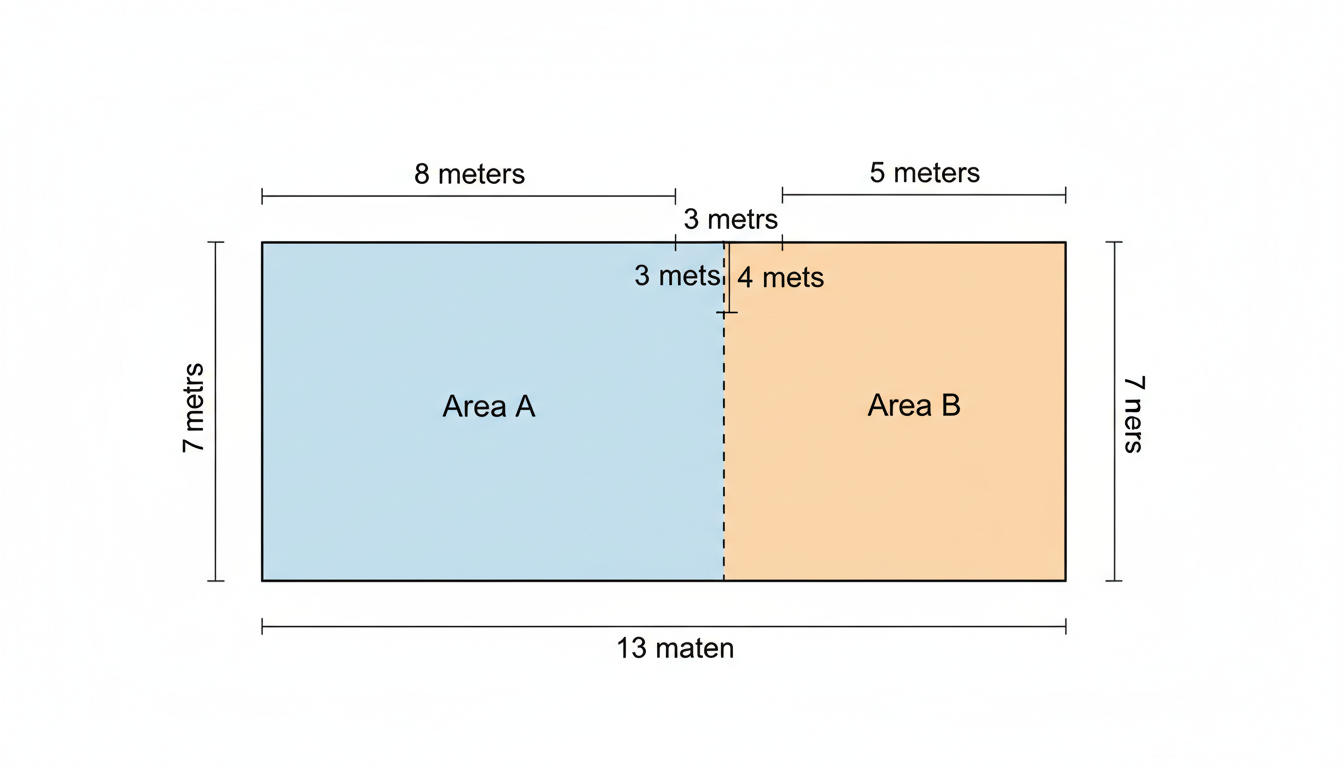
Here’s how it plays out, step-by-step:
- Divide the ‘L’: Look at your sketch and draw a line to create two regular rectangles.
- Measure Area A: Let’s say you measure the first rectangle. Its length is 4 meters and its width is 3 meters.
- Calculation for A: 4 m × 3 m = 12 m²
- Measure Area B: Now, measure the second rectangle. Its length is 2 meters and its width is 3 meters.
- Calculation for B: 2 m × 3 m = 6 m²
- Add Them Together: The final step is to simply add the two areas to get your total.
- Total Area: 12 m² (Area A) + 6 m² (Area B) = 18 m²
And that’s it. No complex geometry needed. You’ve just accurately calculated the area of a complex room by breaking it down into manageable parts. This same logic applies to almost any room with alcoves or unusual extensions.
💡 Pro Tip
When buying materials like flooring, tile, or even turf, always buy 10-15% more than your calculated total. This is called a “waste factor.” It covers cuts, mistakes, and potential damage. Trust me on this one, having to run back to the store for a single box of discontinued tile is a nightmare you want to avoid.
🎯 Key Takeaway
Stop trying to “convert” meters to square meters. Instead, calculate area by measuring the length and width in meters and multiplying them together (Area = Length × Width). This simple shift in thinking is the key to getting it right every time.
Common Blunders That Cost You Time and Money
Based on hands-on testing and years in the field, I’ve seen a few simple mistakes derail entire projects. Here’s what to watch out for.
Forgetting to Subtract Obstructions
Are you tiling a kitchen floor with a permanent island in the middle? You don’t need to tile under the island. Calculate the island’s area (length x width) and subtract it from your room’s total area. This can save you a significant amount on materials, especially in large spaces.
⚠️ Watch Out
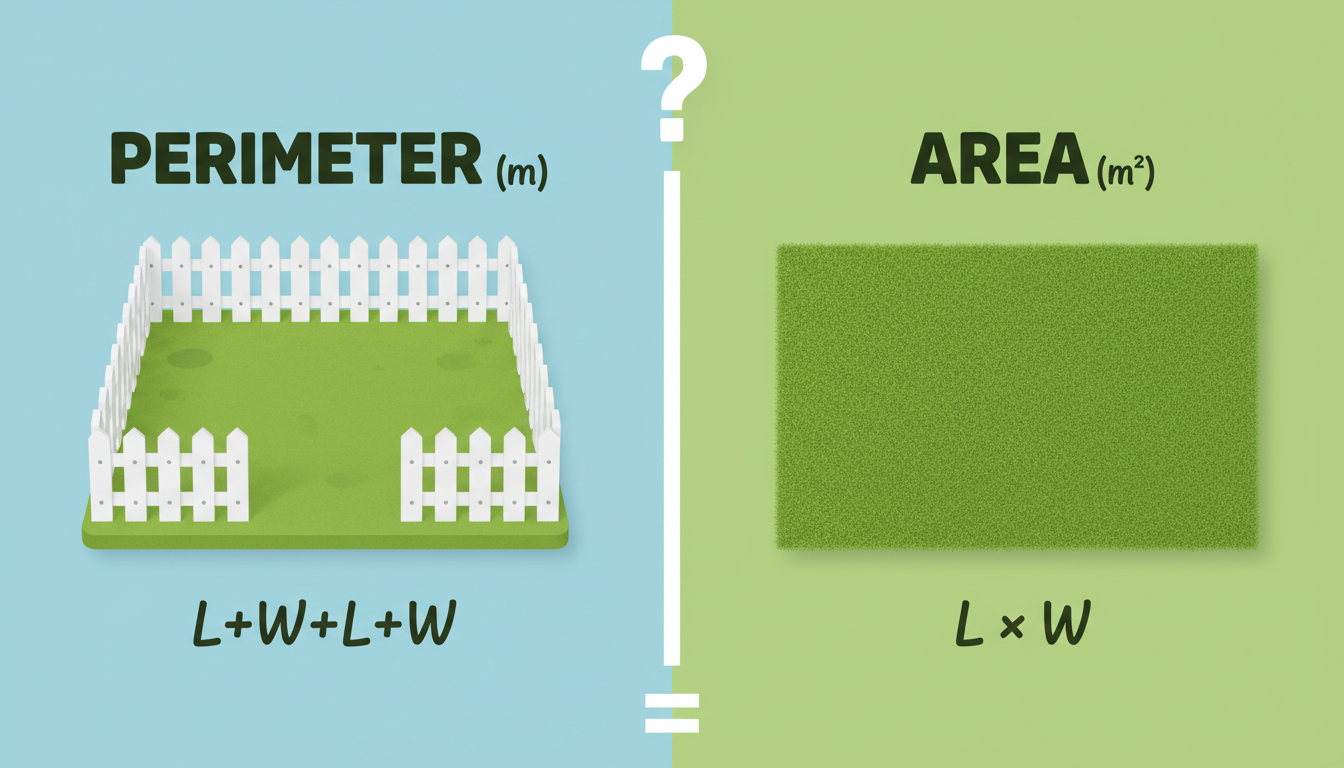
Don’t confuse Perimeter with Area. The perimeter is the distance around the room (you add all the side lengths), used for buying baseboards or trim. The area is the entire surface inside the room (you multiply length by width), used for flooring and paint. Using one for the other is a recipe for disaster.
Relying on Architectural Plans Alone
Blueprints and architectural plans are a great starting point, but they don’t always reflect reality. Walls might not be perfectly straight, and small changes during construction can alter dimensions.
Always, always, always take your own physical measurements before buying materials. As the old carpenter’s saying goes, “Measure twice, cut once.”
This principle is just as critical when buying materials as it is when cutting them.
❓ Frequently Asked Questions
Can I just use an online meter to square meter calculator?
Yes, you can, but they are only as good as the numbers you put in. You still need to understand how to measure your space correctly (length, width, etc.) and which numbers to enter. The calculator does the multiplication, but the critical part—the measuring—is still up to you.
How do I calculate the square meters of a wall for painting?
It’s the exact same principle! Measure the wall’s height (in meters) and its width (in meters). Multiply them together (Height × Width) to get the wall’s area in m². If there’s a large window or door, you can calculate its area separately and subtract it from the total for a more accurate paint estimate.
What if my room isn’t a perfect square and the walls are slightly different lengths?
This is very common in older homes. For a room that’s mostly rectangular, measure the length in two different spots and take the average. Do the same for the width. This gives you a more realistic measurement to use in your area calculation. For more complex shapes, refer to the “Divide and Conquer” method above.
Is ‘square meter’ the same as ‘meter squared’?
Yes, they mean the exact same thing and are used interchangeably. Both refer to the unit of area, written as m². ‘Square meter’ is the more common and officially recognized term, but you’ll hear both in conversation.
How many square meters is a 10 meter by 10 meter room?
To find the area, you multiply the length by the width. So, 10 meters × 10 meters = 100 square meters (100 m²). This is a common calculation for understanding land plots or very large rooms.
Conclusion: You’re Ready to Measure Anything
The task of figuring out square meters is no longer a mystery. You now know the fundamental secret: it’s a calculation, not a conversion. You’re armed with the simple 5-step process, a cheat sheet for any shape, and the “Divide and Conquer” strategy for even the trickiest rooms.
You understand the difference between a meter (length) and a square meter (area). You know to measure everything in meters, use the simple formula Length × Width, and double-check your work. More importantly, you know how to avoid the common, costly mistakes that trip up so many people.
So grab that tape measure. Sketch out your room. Your next project is waiting, and now you have the skills and confidence to get started on the right foot.