
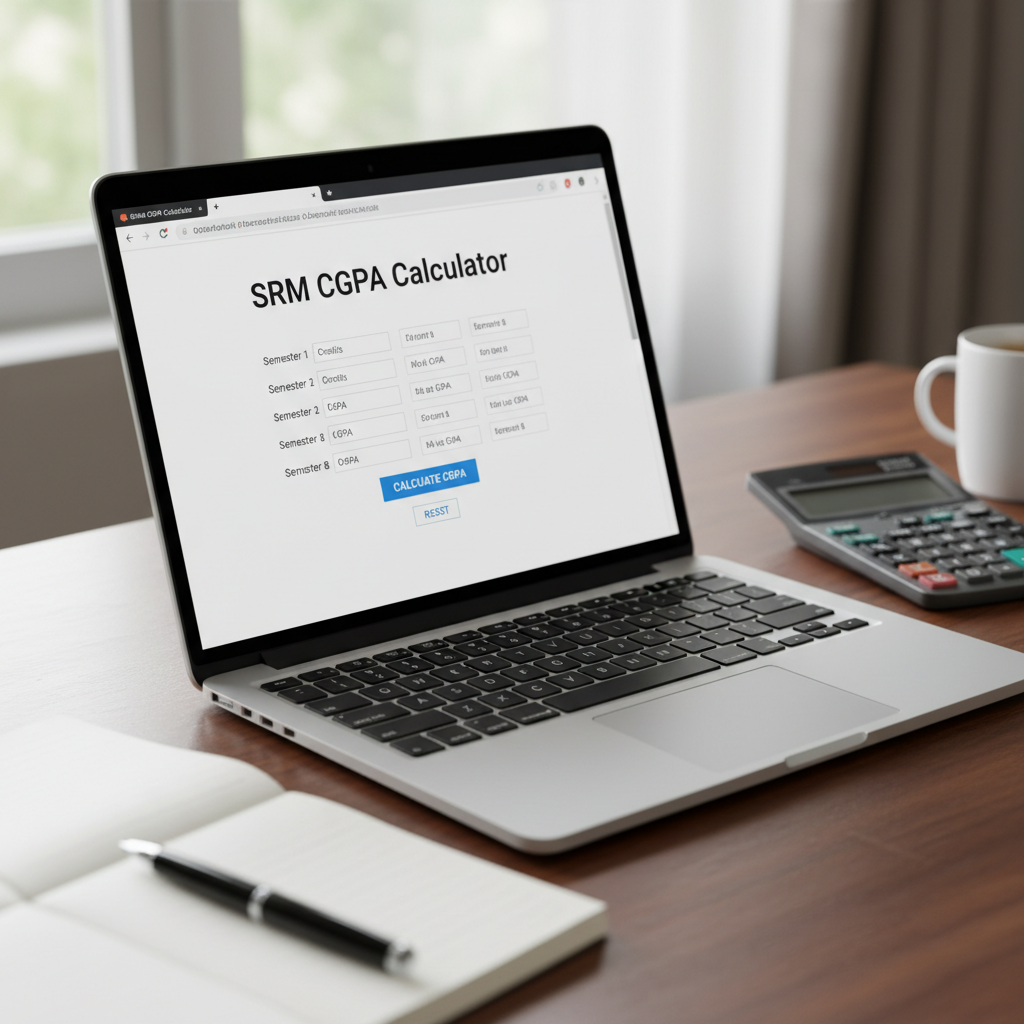
Navigating the SRM Grading System: Understanding SGPA and CGPA
For students enrolled at SRM Institute of Science and Technology (SRMIST), monitoring academic progress is crucial. While Semester Grade Point Average (SGPA) provides a snapshot of your performance in a single semester, the Cumulative Grade Point Average (CGPA) is the metric that truly defines your overall academic standing. Many students struggle with the transition from the semester-specific score to the overall cumulative average. If you are asking how to calculate srm cgpa from sgpa, you are looking for the definitive method to merge your semester results into one meaningful, cumulative score.
Understanding this conversion is not just about satisfying curiosity; it is essential for placements, higher education applications, and internal rankings. This comprehensive guide will break down the precise methodology used by SRMIST to convert SGPA scores into your final CGPA, ensuring you can accurately track your journey through the university.
The Building Blocks: Grade Points and Credits at SRM
Before diving into the complex calculation of how to calculate srm cgpa from sgpa, we must first understand the elements that feed into these averages: Grade Points and Credits.
Understanding Grade Points and Letter Grades
SRMIST employs a 10-point grading scale. Each letter grade you receive in a course corresponds to a specific Grade Point (GP). Grades typically range from ‘O’ (Outstanding) down to ‘F’ (Fail). The Grade Point is the numerical equivalent assigned to the letter grade earned in a subject.
O (Outstanding)
Typically corresponds to 10 Grade Points, representing exceptional performance.
A+ to D Grades
These grades correspond to Grade Points ranging from 9 down to 5, signifying passing marks at various levels.
F (Fail)
Corresponds to 0 Grade Points, indicating the need to re-register and clear the course.
The Role of Course Credits
Credits represent the weight or significance of a course. A core engineering course might carry 4 credits, while a laboratory course might carry 2 credits. The higher the credits, the greater the impact that course’s grade has on both your SGPA and, subsequently, your CGPA. This is the fundamental principle of weighted average calculation used universally in higher education systems, as detailed by bodies regulating academic standards globally. Understanding weighted credit systems is key to academic success.
Calculating SGPA: The Semester Snapshot
The Semester Grade Point Average (SGPA) is calculated at the end of each term. It reflects the weighted average of the Grade Points earned in that specific semester only.
The formula for SGPA is:
$$ text{SGPA} = frac{sum (text{Credit}_i times text{Grade Point}_i)}{sum text{Credit}_i} $$
- Step 1: Calculate Weighted Score (Numerator): For every course, multiply the course Credit by the Grade Point you achieved.
- Step 2: Sum the Weighted Scores: Add up all these products for every course taken in that semester.
- Step 3: Sum the Credits (Denominator): Add up the total credits attempted in that semester.
- Step 4: Divide: Divide the total weighted score (Step 2) by the total credits (Step 3).
Step-by-Step Guide: How to Calculate SRM CGPA from SGPA
The Cumulative Grade Point Average (CGPA) is the weighted average of the Grade Points earned across all semesters attempted up to that point. This is the crucial step where you learn how to calculate srm cgpa from sgpa using the cumulative data.
The calculation is cumulative, meaning you don’t calculate the average of your SGPAs; instead, you calculate the average of all weighted scores and credits earned across all semesters.
The formula for CGPA is:
$$ text{CGPA} = frac{text{Total Accumulated Weighted Score (All Semesters)}}{text{Total Accumulated Credits (All Semesters)}} $$
Phase 1: Accumulate Weighted Scores
For each semester (S1, S2, S3, etc.), you need the total weighted score calculated during the SGPA process (Credit x Grade Point). Keep a running tally of these scores.
Phase 2: Accumulate Total Credits
Keep a running tally of the total credits attempted in all semesters combined. This includes credits for courses you may have failed and retaken (though only the cleared attempt contributes to the weighted score).
Phase 3: Final Division
Divide the Total Accumulated Weighted Score by the Total Accumulated Credits. The result is your current CGPA. This average is calculated up to two decimal places.
Practical Example of How to Calculate SRM CGPA from SGPA
Let’s use a simplified example across three semesters to illustrate the process of how to calculate srm cgpa from sgpa cumulatively.
| Semester | SGPA Achieved | Total Credits Attempted (C) | Total Weighted Score (W) = SGPA × C |
|---|---|---|---|
| Semester 1 | 8.50 | 22 | 8.50 × 22 = 187.00 |
| Semester 2 | 9.10 | 24 | 9.10 × 24 = 218.40 |
| Semester 3 | 7.80 | 20 | 7.80 × 20 = 156.00 |
The Cumulative Calculation:
- Total Accumulated Weighted Score (W_total): 187.00 + 218.40 + 156.00 = 561.40
- Total Accumulated Credits (C_total): 22 + 24 + 20 = 66
- CGPA: W_total / C_total = 561.40 / 66 ≈ 8.506
Thus, the cumulative CGPA after three semesters is approximately 8.51.
The Importance of Credit Weighting in CGPA Calculation
A common misconception is that if your SGPA improves, your CGPA will automatically increase significantly. However, the impact of a high SGPA in a later semester depends heavily on the total accumulated credits already earned. Early semesters often define the baseline for your CGPA because subsequent semesters have to overcome the inertia of the previous weighted scores.
As academic standards evolve, institutions like SRMIST ensure that students are evaluated holistically. The weighting system reflects the effort and time investment required for different courses, giving a true picture of academic rigor. For more context on how CGPA standardization impacts global academic mobility, you can refer to established educational authorities like the Ministry of Education in India regarding grading norms.
Leveraging the SRM CGPA Calculator for Accuracy
While mastering the manual calculation of how to calculate srm cgpa from sgpa is a valuable skill, accuracy and speed often require dedicated tools. Maintaining a semester-by-semester log of weighted scores and credits can become tedious, especially across eight semesters.
To bypass the risk of calculation errors and save valuable time, students can utilize specialized online resources. You can leverage a dedicated SRM CGPA Calculator designed specifically for the SRM grading structure. These tools only require you to input the SGPA and the total credits for each semester, instantly providing your precise current CGPA.
Using a digital tool offers several advantages:
- Instant Results: Immediate calculation, eliminating manual effort.
- Error Reduction: Removes the possibility of human error in summation or division.
- Projection: Many calculators allow you to input projected SGPA for future semesters, helping you set realistic academic goals.
Strategies for CGPA Improvement and Maintenance
Once you understand the mechanism behind how to calculate srm cgpa from sgpa, you can implement targeted strategies to boost your overall score. Since CGPA is a cumulative measure, every semester contributes significantly.
Target High-Credit Courses
Focus intensively on courses with 4 or more credits. A Grade Point of 10 in a 4-credit course has double the impact of a 2-credit course, offering the biggest boost to your CGPA.
Address Early Semester Deficits
If your CGPA is low due to poor performance in the first year, you need exceptionally high SGPAs (9.5+) in subsequent years to significantly pull the average up. Early recovery is key.
Utilize Re-registration Wisely
If you fail a course (F grade), clearing it with a high grade point in the next attempt is essential, as the new grade and corresponding weighted score replace the previous zero contribution.
Track Progress Constantly
Don’t wait for official transcripts. Calculate your projected SGPA halfway through the semester based on internal assessments and use the cumulative method to estimate your current CGPA. This proactive approach helps you identify where effort is lacking, similar to how professionals track performance metrics. For example, understanding data tracking is vital in many fields, including complex SEO analysis, where tools track multiple data points simultaneously, much like how credits and weighted scores accumulate. This proactive tracking is comparable to the techniques discussed in content related to GST Input Tax Credit Calculator, where accurate tracking prevents financial errors.
Conclusion: Taking Control of Your Academic Metrics
Mastering the methodology of how to calculate srm cgpa from sgpa empowers you to take complete control of your academic narrative. The CGPA is more than just a number; it is a weighted representation of your commitment and performance across your degree program. By meticulously tracking your total weighted scores and accumulated credits, you ensure that you are always aware of your standing and can make informed decisions about where to focus your efforts for maximum academic return. Whether you rely on manual calculation or the speed of an automated tool, consistent monitoring is the hallmark of a high-achieving student.
FAQs
SGPA (Semester Grade Point Average) is a measure of a student’s performance only during a single academic semester. CGPA (Cumulative Grade Point Average) is the measure of the student’s average performance across all semesters completed up to that point in the degree program. CGPA is the overall official metric of academic standing.
A failed course (F grade) initially contributes 0 Grade Points but still adds its credit weight to the denominator (Total Credits Attempted). This lowers the CGPA significantly. However, once you re-register and clear the course, the new Grade Point replaces the ‘0’ in the numerator, and the course is counted only once in the denominator, effectively improving the CGPA.
SRMIST typically provides guidelines for CGPA-to-percentage conversion, often involving a multiplier. A common, though unofficial, industry standard often suggests multiplying the CGPA by 10 (e.g., 8.5 CGPA ≈ 85%). However, for official purposes, always refer to the specific conversion formula provided in the SRM academic handbook or transcript documentation.
CGPA is a weighted average based on all accumulated credits. If you have already completed six semesters with 120 total credits, a single semester (20 credits) with a high SGPA will only constitute about 1/7th of the overall calculation. The more credits you accumulate, the harder it is for a single semester’s performance to drastically change the overall average.
Yes, the fundamental formula for calculating SGPA and then deriving CGPA from the cumulative weighted scores and credits remains consistent across all engineering, arts, and science branches at SRMIST, as the core 10-point grading system and credit structure are standardized across the institution.
Read Also:
- Optimizing Your Gains: How to Use a Daily Protein Intake for Muscle Growth Calculator
- The Ultimate Guide: Using an Income Tax Calculator New Regime vs Old Regime for Maximum Savings (2024-25)
- Mastering the Math: A Comprehensive Guide on How to Convert SGPA to Percentage
- The Ultimate Guide: How to Create Robots.txt for WordPress and Master Crawl Control
- Order Gravel Right in 2026