
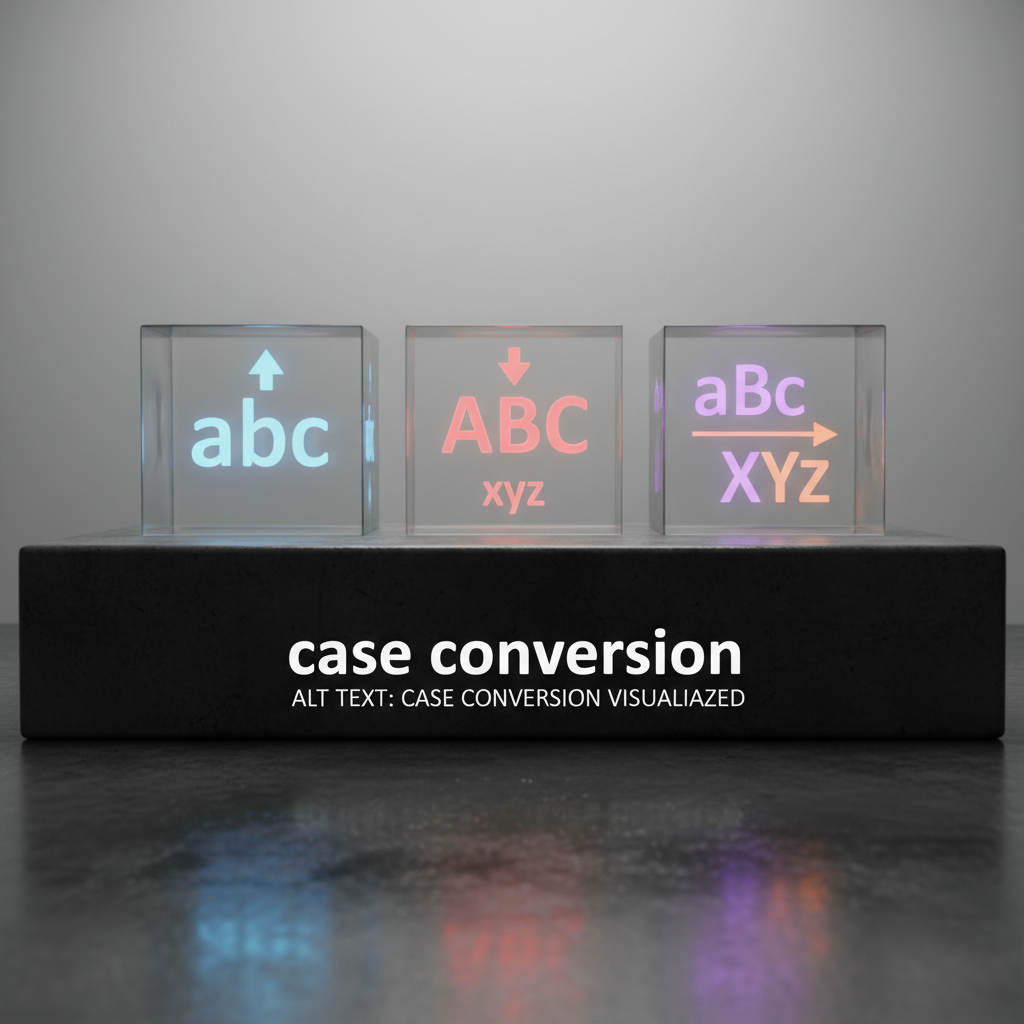
The Imperative Need to Convert Uppercase to Title Case Online
In the digital age, clear, professional communication is paramount. Whether you are crafting a compelling blog title, organizing database headers, or finalizing an academic paper, inconsistent capitalization can instantly detract from your credibility. Often, text is accidentally entered in all caps, creating a jarring visual effect that is difficult to read. The necessity to convert uppercase to title case online is not just about aesthetics; it is a fundamental requirement for readability and search engine optimization (SEO).
Title case, also known as headline style capitalization, ensures that important words are capitalized while minor words (like articles and prepositions) remain lowercase. This article serves as your comprehensive guide to understanding title case rules, identifying why manual conversion often fails, and demonstrating the simplest, most effective methods to convert uppercase to title case online instantly.
Why You Need to Convert Uppercase to Title Case Online for Professionalism
The difference between shouting (uppercase) and speaking clearly (title case) in written form is huge. When dealing with large volumes of text, especially data imported from various sources, achieving consistency is a massive headache without automated tools.
Understanding Different Text Cases and Their Uses
Before diving into conversion, it is helpful to clearly define the major case formats used across web and print media. Recognizing these differences helps you choose the correct target format when you decide to convert uppercase to title case online.
Uppercase (ALL CAPS)
Used primarily for emphasis, acronyms (NASA, UNESCO), or database constants. In general writing, it is considered shouting or aggressive. Example: THIS IS A HEADLINE.
Lowercase (all lowercase)
Common in some modern branding, programming variables (camelCase), or specific contexts where aesthetics dictate minimal capitalization. Example: this is a body paragraph.
Sentence Case
The standard for normal paragraphs. Only the first word of a sentence and proper nouns are capitalized. Example: The dog ran quickly to the park.
Title Case (Proper Case)
Used for titles, headings, and subheadings where major words are capitalized according to specific style guides (e.g., APA, Chicago). Example: The Quick Brown Fox Jumps Over the Lazy Dog.
Title case is essential for maximizing click-through rates (CTRs) on search engine results pages (SERPs) and maintaining journalistic standards. A well-formatted title communicates authority and attention to detail.
Mastering the Rules of Title Case Conversion
While automated tools handle the heavy lifting, understanding the underlying rules is vital for proofreading and ensuring accuracy, especially with complex titles containing proper nouns or hyphenated words. Title case is governed by strict, but sometimes confusing, conventions.
The Importance of Minor Words in Title Case
The primary challenge in title case conversion lies in determining which words should remain lowercase. These are typically short articles, conjunctions, and prepositions (A, An, The, And, But, Or, For, Nor, On, At, To, etc.).
- Always Capitalize: The first and last word of the title, regardless of their length or grammatical function.
- Major Words: Nouns, pronouns, verbs, adjectives, and adverbs must always be capitalized.
- Minor Words (Generally Lowercase): Articles (a, an, the), coordinating conjunctions (and, but, or, nor, for, so, yet), and prepositions (at, by, in, of, on, to, up, as).
- Exception for Minor Words: If a minor word is five letters or longer (e.g., Through, Between), it is usually capitalized, depending on the style guide used.
Different style guides (like APA, MLA, or Chicago) have slightly varying rules, particularly concerning prepositions. For example, the Chicago Manual of Style is very specific about capitalization in titles. It is recommended to check specific institutional requirements, but for general web content, the standard major/minor word rule applies.
How to Convert Uppercase to Title Case Online Instantly
Attempting to manually apply title case rules to hundreds of lines of ALL CAPS text is tedious and highly prone to error. Fortunately, robust online tools are designed specifically to handle this transformation accurately and efficiently. The fastest way to convert uppercase to title case online is by utilizing a dedicated Case Convertor Tool.
Here is a simple, three-step process for instant conversion:
- Locate the Tool: Navigate to a reliable text utility platform. For comprehensive and accurate case transformation, we recommend using a reliable Case Convertor Tool.
- Paste Your Text: Copy the text that is currently in uppercase (or any other undesired case) and paste it into the input box of the online tool.
- Select and Convert: Choose the “Title Case” option from the available conversion types and click the conversion button. The tool instantly applies the correct capitalization rules, transforming your text from, for example,
THIS IS A GREAT ARTICLE ABOUT CAPITALIZATIONtoThis Is a Great Article About Capitalization.
Speed and Efficiency
Automated tools process thousands of characters instantly, saving hours of manual editing time, especially when dealing with large datasets or imported spreadsheets.
Rule Consistency
Online converters adhere strictly to defined title case algorithms, eliminating human error associated with forgetting to capitalize a major word or mistakenly capitalizing a short preposition.
Accessibility
These tools are typically free and accessible from any device (desktop, tablet, or mobile), allowing formatting fixes on the go without specialized software.
The automation of tasks like case conversion is essential for modern content workflows. If you frequently handle data or text processing, exploring other specialized utilities, such as a JSON to CSV converter, can further streamline your operations.
Common Pitfalls When You Convert Uppercase to Title Case Online Manually
While the goal is simply to convert uppercase to title case online, the complexities of the English language often trip up manual conversion attempts. Relying solely on your memory for every style guide nuance is unrealistic.
One major hurdle is handling proper nouns and acronyms. If your text includes names like “eBook” or acronyms like “AI,” a simple search-and-replace function will likely miscapitalize them, turning “EBOOK” into “Ebook” and “AI” into “Ai.” Professional case converters often include exceptions lists or smart detection features to preserve these specific formats.
Another common mistake involves hyphenated words. According to most style guides, both parts of a hyphenated compound should be capitalized if they are major words. For example, “STATE-OF-THE-ART” must become “State-of-the-Art,” not “State-of-the-art.” Manual conversion often misses the second element of the compound.
Hyphenation Errors
Failing to capitalize the second element of a compound word (e.g., converting ‘WELL-BEING’ to ‘Well-being’ instead of ‘Well-Being’).
Preposition Mismanagement
Incorrectly capitalizing a short preposition (like ‘of’ or ‘to’) when it should be lowercase, or failing to capitalize a long preposition (like ‘Throughout’).
Acronym Over-Correction
Losing the intended capitalization of acronyms or initialisms (e.g., converting ‘NASA’s RESEARCH’ to ‘Nasa’s Research’).
As experts at the University of Oxford’s style guide note, consistency is the bedrock of good formal writing. Automated tools provide that consistency across vast amounts of text, ensuring your titles look polished every time. For detailed technical guidance on specific capitalization rules in English, resources like the Chicago Manual of Style offer comprehensive authority.
Case Conversion Beyond Titles: Programming and Data Integrity
While the primary need for most content creators is to convert uppercase to title case online for headlines, case conversion plays a critical role in technical fields like software development and database management. In these contexts, case sensitivity is paramount.
For example, in many programming languages (like Python or C++), variables named username and USERNAME are treated as entirely different entities. Developers frequently use online converters to transform text into formats like camelCase, PascalCase, or snake_case to maintain coding standards. Database administrators rely on consistent case formats to ensure accurate queries and prevent data integrity errors.
Maintaining high standards of text formatting and data consistency is crucial for system reliability. According to the W3C, standardization in data presentation, including casing, is a core component of web accessibility and interoperability. This level of precision is why reliable, high-speed tools are essential, helping professionals avoid technical debt caused by formatting inconsistencies.
The applications extend even to areas like financial analysis and reporting. When presenting complex data, such as visualizing key metrics using an area chart generator, the axis labels and titles must adhere to strict case standards to maintain professional clarity.
Conclusion: Achieving Perfect Case Consistency
Whether you are optimizing content for SEO or finalizing a professional report, the ability to seamlessly convert uppercase to title case online is a non-negotiable skill. Manual conversions introduce errors, waste valuable time, and detract from the professionalism of your work. By leveraging a high-quality online case converter, you ensure that every title, heading, and label adheres to the rigorous standards of proper capitalization, allowing you to focus on the content’s message rather than its formatting mechanics. Adopt automated tools today to achieve flawless text presentation effortlessly.
FAQs
Title Case (Headline Case) capitalizes all major words in a title or heading (Nouns, Verbs, Adjectives). Sentence Case only capitalizes the first word of the sentence and any proper nouns. For example, Title Case: “The Importance of Case Conversion”; Sentence Case: “The importance of case conversion.”
Yes, major style guides like APA (American Psychological Association), MLA (Modern Language Association), and Chicago (Chicago Manual of Style) have slightly different rules, particularly concerning the capitalization of prepositions and conjunctions. Most general online tools use a standard web-friendly version of Title Case, but it’s important to cross-reference against your required style guide for academic or formal publishing. For advanced style guide variations, consult reliable sources such as the APA Style website.
If the input text is entirely in uppercase (e.g., NASA IS IN ORBIT), a standard title case conversion algorithm might treat “NASA” as a regular word and convert it to “Nasa.” The best online converters often use exception lists or context clues to maintain the intended capitalization of common acronyms (like USA, NATO, or SEO).
Absolutely. Most comprehensive online case converters offer bidirectional functionality, allowing you to switch easily between uppercase, lowercase, title case, sentence case, and even specific programming cases like camelCase or snake_case.
Reputable online text conversion tools process the text locally in your browser or through secure servers that do not store the input data. Always use tools from trusted providers to ensure privacy and data security when handling sensitive information.
Read Also:
- YouTube Channel Banner Extractor
- Image Resizer
- Beyond Chance: Comprehensive Uses of a Random Number Generator, Including the Google Random Number Generator 1-100 Tool
- 7 Creative Ways to Use an Online Collage Maker for Stunning Visuals
- 7 Essential Uses of a Temperature Converter: A Complete Guide to Celsius, Fahrenheit, and Kelvin
- Readability Tool: Skyrocket Content SEO & Engagement
- Seconds to Sense: Your 2026 Time Guide
- Unlock Any PDF Instantly in 2026
- Your 2026 Hydration Guide: Unlock Peak Health
- White Meme Formats: The Ultimate Guide to Going Viral (2026)
- Unlock Your 2026 Calorie Code

