
Staring at ‘sy’ on a spec sheet and your calculator is giving you a blank look? You’re not alone. That simple two-letter abbreviation has stumped countless project managers, DIY enthusiasts, and even seasoned pros.
Here’s the truth: ‘sy’ is not a standard unit of weight.
This isn’t a simple conversion; it’s a puzzle. But don’t worry, you’ve found the definitive guide to solving it. We’re going to ditch the confusion and give you the exact methods to get the right number, every single time. We’ll show you how to play detective, uncover what ‘sy’ *really* means in your context, and perform the correct calculation with confidence.
By the end of this article, you’ll be able to instantly diagnose the ‘sy to tons’ problem and have the formulas to solve it, whether it’s a simple typo or a complex construction calculation.
📑 What You’ll Learn
The “SY” Mystery: Cracking the Code
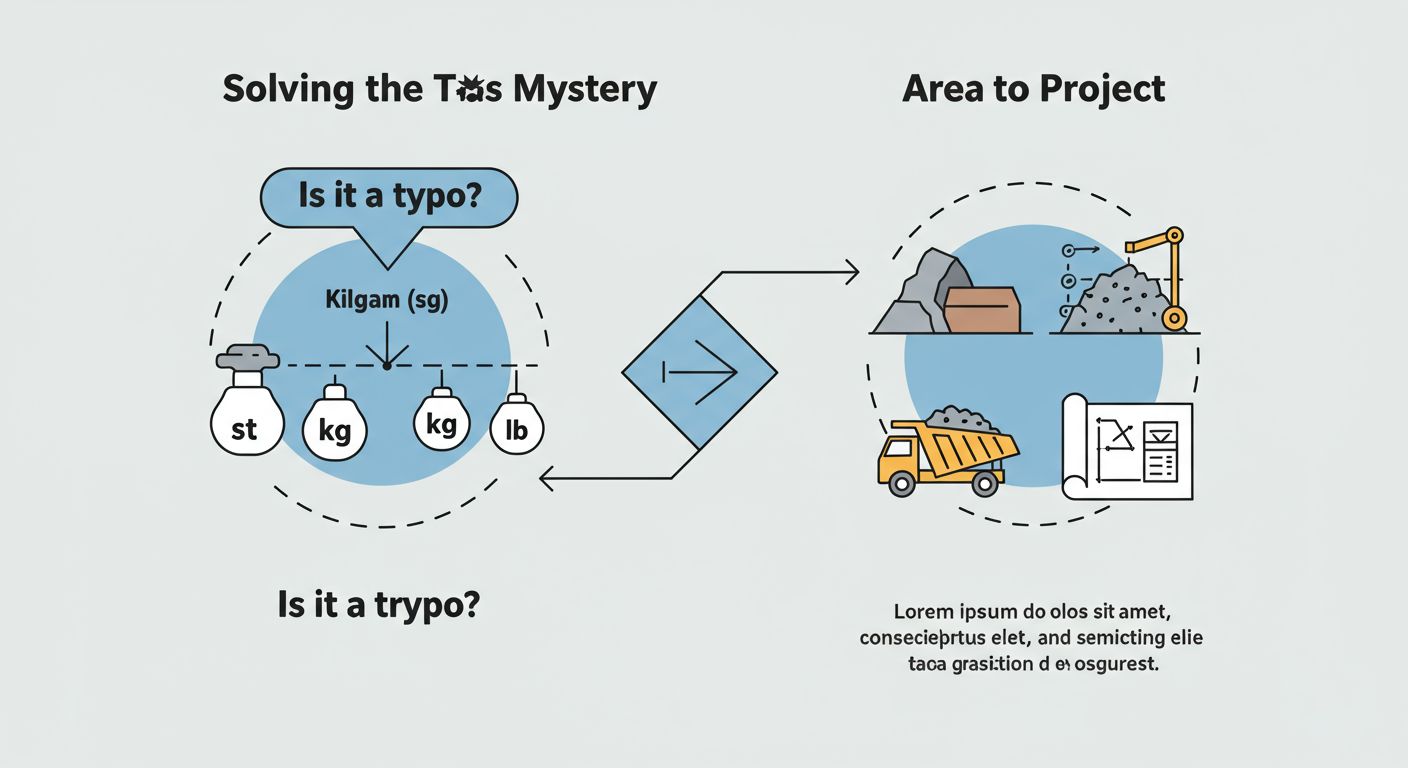
Let’s get straight to the point. When you see ‘sy’ in a context that implies weight, it almost always means one of two things:
- It’s a typo. The most common culprit is ‘st’, the abbreviation for stone, a unit of mass. The ‘y’ key is right next to the ‘t’ on a standard keyboard, making this an easy mistake.
- It’s a reference to area. In industries like construction, paving, and landscaping, ‘sy’ is the standard abbreviation for square yards. The user is trying to figure out how many tons of material (like gravel or soil) are needed to cover a specific area.
Your first job is to figure out which scenario you’re in. Are you dealing with a person’s weight or a small object? It’s probably a typo for stone. Are you planning a driveway, a garden, or a construction project? You’re dealing with square yards.
First, A Word on “Tons”: Not All Are Created Equal
Before we can convert anything, we have to be crystal clear about our target unit: the ‘ton’. Using the wrong one can throw your calculations off by over 10%. Trust me on this one, I’ve seen this exact mistake lead to costly ordering errors on real-world projects.
There are three main types of tons you’ll encounter:
| Type of Ton | Weight (Pounds) | Weight (Kilograms) | Primary Use |
|---|---|---|---|
| Short Ton (US Ton) | 2,000 lbs | ~907.18 kg | Standard in the United States |
| Long Ton (Imperial Ton) | 2,240 lbs | ~1,016.05 kg | Used in the UK, common in shipping |
| Tonne (Metric Ton) | ~2,204.62 lbs | 1,000 kg | International standard (SI unit) for science and trade |
The difference between a short ton and a long ton is 240 pounds. That’s not pocket change. Always, always confirm which ‘ton’ is required for your project or calculation. If you’re in the US, it’s almost always the short ton. For international shipping or scientific contexts, it’s the tonne.
⚠️ Watch Out
Many basic online conversion tools don’t specify which ‘ton’ they use. They often default to the US short ton (2,000 lbs), which can cause major errors if you need a metric tonne or long ton. Never trust a converter that doesn’t clearly label its units.
Scenario 1: The Typo Theory (Converting Weight to Tons)
Okay, let’s assume ‘sy’ was a simple keyboard slip-up. Based on our experience, the most likely intended unit was stone (st), a unit of mass equal to 14 pounds, still used informally in the UK and Ireland. You can learn more about its history on its Wikipedia page. Here’s how to make the conversion.
From Stone (st) to Tons
- To Short Tons (US): Divide the number of stone by 142.86.
(Formula: Short Tons = st / 142.86) - To Long Tons (UK): Divide the number of stone by 160.
(Formula: Long Tons = st / 160) - To Tonnes (Metric): Divide the number of stone by 157.47.
(Formula: Tonnes = st / 157.47)
Example: You have a measurement of 500 ‘sy’, which you believe is 500 stone.
500 st / 142.86 = 3.5 Short Tons
While less likely, ‘sy’ could also be a typo for pounds (lbs) or kilograms (kg). The math is even more direct for these.
Quick Conversion Formulas:
- Pounds (lbs) to Short Tons:
lbs / 2000 - Kilograms (kg) to Tonnes:
kg / 1000
💡 Pro Tip
Before converting, look at the source of the number. Is it from a UK-based document? It’s more likely to be stone. Is it from a scientific paper or an international shipping manifest? It’s probably kilograms. Context is your best friend.
The Area Problem: Calculating Tons from Square Yards
This is where things get interesting. If you’re in construction, landscaping, or agriculture, your ‘sy to tons’ query isn’t about conversion—it’s about calculation. You need to determine the weight of material required to cover a specific area (in square yards) to a certain depth.
You can’t “convert” area to weight. It’s like asking how to convert miles to pounds. Impossible. Instead, you need to calculate volume and then use the material’s density to find the weight.
Step-by-Step Guide: From Square Yards to Tons
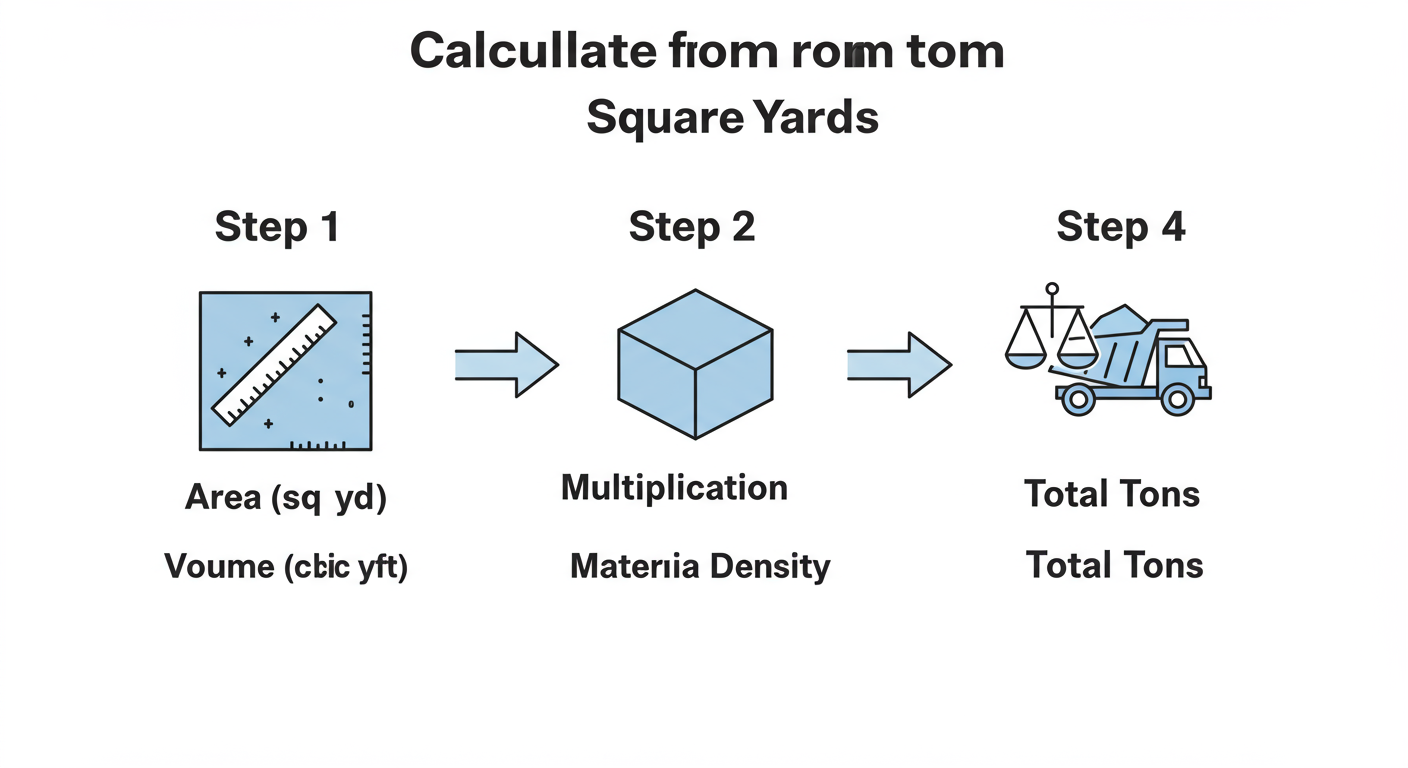
Follow these three steps. Don’t skip any.
Step 1: Calculate the Volume in Cubic Yards
First, you need the volume. You have the area in square yards (sy), but you also need the depth of the material in feet. If your depth is in inches, divide it by 12 to get feet.
Volume (cubic yards) = Area (sq. yards) × Depth (feet) / 3
Example: You want to cover a 150 sq. yard driveway with a 4-inch layer of gravel.
First, convert depth to feet: 4 inches / 12 = 0.333 feet.
Now, calculate volume: (150 sy × 0.333 ft) / 3 = 16.65 cubic yards.
Step 2: Find Your Material’s Density
Every material has a different weight-to-volume ratio, or density. Mulch is light; crushed concrete is heavy. This value is usually measured in tons per cubic yard. You can get this number from your material supplier—it’s the most accurate way. If not, you can use a standard estimate.
| Material | Average Density (Tons per Cubic Yard) |
|---|---|
| Gravel / Crushed Stone | 1.2 to 1.4 tons |
| Sand (Dry) | 1.3 to 1.5 tons |
| Topsoil (Screened) | 0.8 to 1.1 tons |
| Asphalt (Compacted) | 1.8 to 2.0 tons |
| Mulch (Wood Chips) | 0.2 to 0.4 tons |
Note: These are estimates. Always confirm with your supplier for precise calculations.
Step 3: Calculate the Total Weight in Tons
This is the easy part. Just multiply your volume by the density.
Total Tons = Volume (cubic yards) × Density (tons per cubic yard)
Continuing our example: We have 16.65 cubic yards of space. Let’s say our gravel supplier confirms the density is 1.35 tons per cubic yard.
16.65 cubic yards × 1.35 tons/cubic yard = 22.48 tons.
You’ll need to order approximately 22.5 tons of gravel. See? No magic, just simple math.
💡 Pro Tip
Always order about 5-10% extra material than your calculation suggests. This covers any inconsistencies in depth, ground settling, or minor measurement errors. It’s far cheaper to have a little extra than to pay for a second delivery fee for a small amount.
⚠️ Watch Out
The density values in the table are for loose material. Some materials, like soil and asphalt, will compact after being laid and rolled. According to industry standards, you might need to account for 15-25% compaction. For large, critical projects, consult an engineer or your supplier to get the correct compaction factor.
🎯 Key Takeaway
The term ‘sy’ is a clue, not a unit of weight. Your first task is to determine the context. If it’s a simple weight, it’s likely a typo for stone (st). If it’s for a construction or landscaping project, it means square yards, and you must perform a volume-to-weight calculation.
❓ Frequently Asked Questions
What’s the most common ‘ton’ used in the USA?
In the United States, the standard is the short ton, which is exactly 2,000 pounds. If a contract or material sheet from a US company just says “tons,” it’s almost certainly referring to short tons.
Can I just ask Google to convert SY to tons?
You can try, but you’ll likely get a confusing or incorrect answer. Google’s automated tools may not understand the ambiguity of ‘sy’. It’s much safer to use the two-scenario method in this guide to identify the right context and apply the correct formula yourself.
How many pounds are in a tonne?
A tonne, or metric ton, is defined as 1,000 kilograms. Since one kilogram is approximately 2.20462 pounds (a value established by bodies like the National Institute of Standards and Technology), a tonne is equal to about 2,204.62 pounds.
Why is there a difference between a short ton and a long ton?
The difference is historical, stemming from the US Customary system and the British Imperial system. The long ton (2,240 lbs) was traditionally used in the UK, aligning with the stone system (160 stone = 1 long ton). The US standardized on the simpler 2,000-pound short ton. You can read more on the history of these units in resources like the Encyclopedia Britannica.
What if I’m not sure if it’s a typo or a square yard?
Look for clues. Is the number associated with a person, an animal, or a small package? It’s a typo. Is it on a construction blueprint, a landscaping quote, or a materials order form? It’s square yards. If you’re truly stuck, the safest bet is to ask the person who provided the number for clarification.
Conclusion: From Confusion to Clarity
The ‘sy to tons’ puzzle isn’t so puzzling once you know the secrets. It’s never a direct conversion. It’s a two-part investigation: identifying the *real* unit and then applying the correct math.
You’re now equipped to handle both scenarios like a pro. You can spot the likely typo and convert from stone, pounds, or kilograms with ease. More importantly, you have the step-by-step framework to calculate material needs for any project, moving confidently from square yards to an exact tonnage.
So the next time you see ‘sy’, don’t get stuck. You’re not just guessing anymore. You’re a conversion detective, and you know exactly how to crack the case.

