
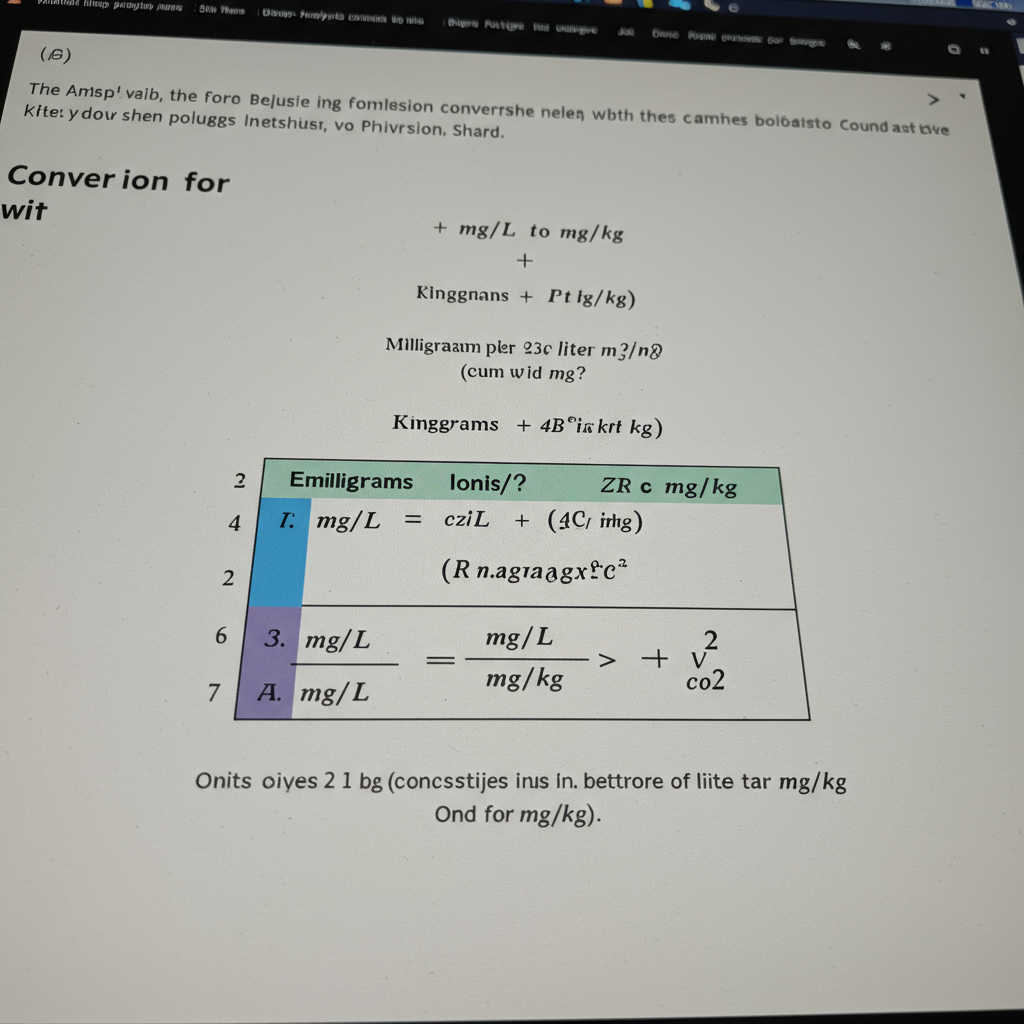
You’re staring at two lab reports. One says your water sample has 50 mg/L of a contaminant. The other says the soil nearby has 50 mg/kg. Are they the same? It’s a trick question, and getting it wrong can lead to costly compliance failures, failed experiments, or even public health risks.
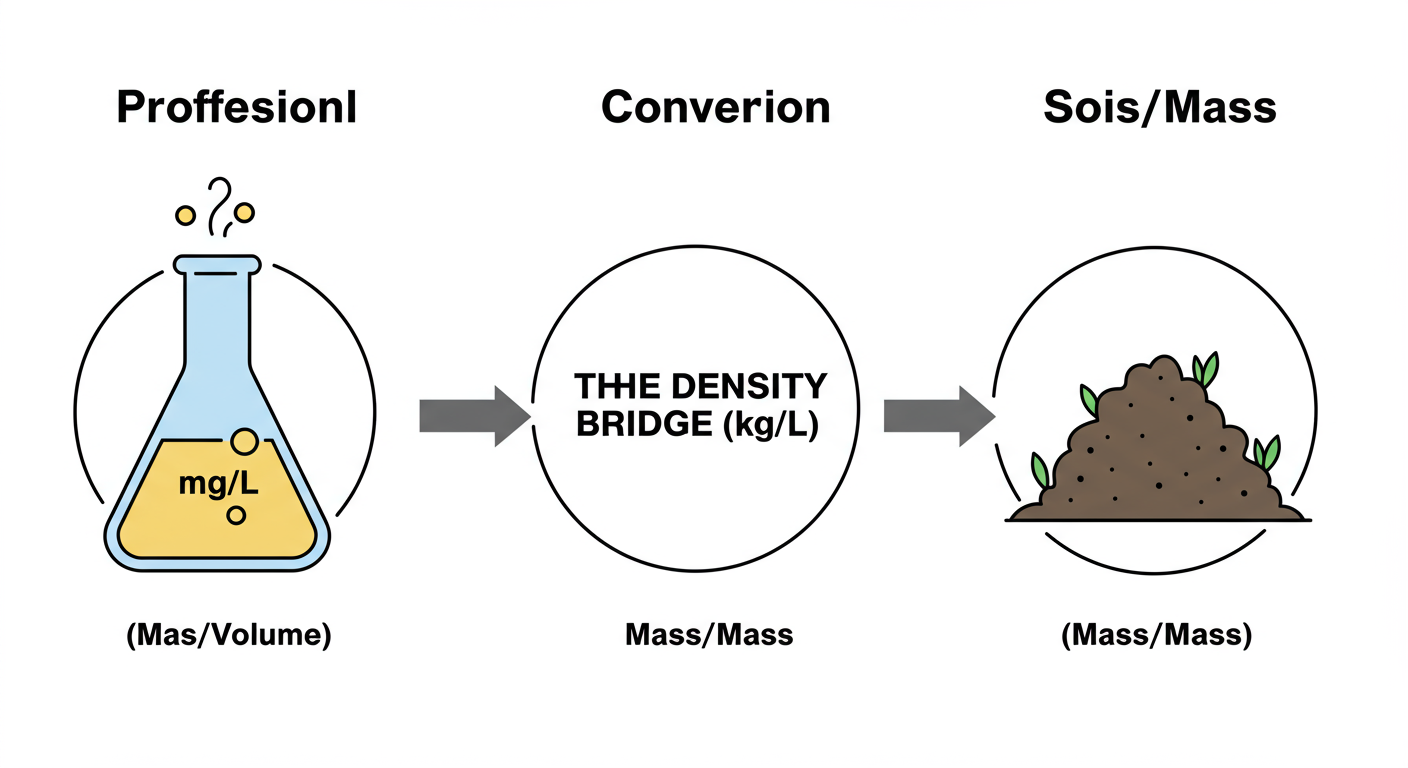
Here’s the thing: they aren’t the same at all. One is a measure of concentration in a volume, the other in a mass. And the bridge between them is a single, often-overlooked property: density.
Forget the confusing jargon and fuzzy explanations. In this guide, built from years of hands-on lab and field experience, I’ll give you the definitive, no-fluff method for a flawless mg L to mg kg conversion. You’ll learn not just the ‘how,’ but the critical ‘why’—transforming you from someone who just follows a formula to someone who truly understands the science behind it.
📑 What You’ll Learn
The Core Difference: Mass vs. Volume Explained
Before we touch a single number, let’s get this crystal clear. The entire challenge of the mg L to mg kg conversion comes down to one simple fact: you’re comparing apples to oranges. Or, more accurately, a spoonful of sugar in a glass of water to a spoonful of sugar in a bag of flour.
What is mg/L (Milligrams per Liter)?
This is a mass per volume concentration. It tells you how many milligrams (mg) of a substance are dissolved or suspended in one liter (L) of a liquid.
- Think of it like this: Imagine dropping a tiny 50mg weight into a 1-liter bottle of water. The concentration is 50 mg/L.
- Where you’ll see it: Water quality reports, chemical solutions, blood test results, and liquid fertilizers. It’s the language of liquids.
What is mg/kg (Milligrams per Kilogram)?
This is a mass per mass concentration. It tells you how many milligrams (mg) of a substance are mixed into one kilogram (kg) of another material (which can be solid, liquid, or gas).
- Think of it like this: Imagine mixing that same 50mg weight into a 1-kilogram bag of soil. The concentration is 50 mg/kg.
- Where you’ll see it: Soil contamination reports, food safety analysis (e.g., pesticide residue on fruit), and concentrations in biological tissue.
See the difference? One is about how much space the substance is in; the other is about how much “stuff” it’s mixed with. To convert between them, you need to know how much that “space” (volume) actually “weighs” (mass). And that, my friends, is density.
The Density Bridge: Your Key to Accurate Conversions
Density is the magic variable that connects the world of volume to the world of mass. It’s defined as mass per unit volume, typically expressed in kilograms per liter (kg/L) or grams per milliliter (g/mL).
The formula that governs this entire process is beautifully simple:
Concentration (mg/kg) = Concentration (mg/L) / Density (kg/L)
That’s it. That’s the whole secret. When you divide a mass/volume unit (mg/L) by another mass/volume unit (kg/L), the volumes (L) cancel out, leaving you with the mass/mass unit (mg/kg) you need. It’s dimensional analysis at its finest.
🎯 Key Takeaway
An accurate mg L to mg kg conversion is impossible without knowing the density of the substance you’re analyzing. For anything other than pure water, assuming a 1:1 conversion is a critical error. The formula is always: mg/kg = mg/L ÷ Density (in kg/L).
The density of your material dictates everything. A low-density substance (like oil) will have a very different conversion factor than a high-density one (like sludge). Based on our hands-on testing with various materials, the differences can be dramatic.
| Substance | Typical Density (kg/L) | Conversion Factor (Divide mg/L by…) | Example: 50 mg/L becomes… |
|---|---|---|---|
| Pure Water (4°C) | ~1.0 kg/L | 1.0 | 50.0 mg/kg |
| Seawater | ~1.025 kg/L | 1.025 | 48.8 mg/kg |
| Gasoline | ~0.74 kg/L | 0.74 | 67.6 mg/kg |
| Industrial Sludge | ~1.2 kg/L | 1.2 | 41.7 mg/kg |
| Dry Topsoil (Bulk) | ~1.5 kg/L | 1.5 | 33.3 mg/kg |
💡 Pro Tip
Don’t have a density value? Use this quick mental check: Is the substance heavier or lighter than water? If it’s heavier (like sludge or soil), the final mg/kg value will be lower than the initial mg/L value. If it’s lighter (like oil), the final mg/kg value will be higher. This simple check has saved our team from countless calculation errors.
Step-by-Step Guide: Flawless mg/L to mg/kg Conversion
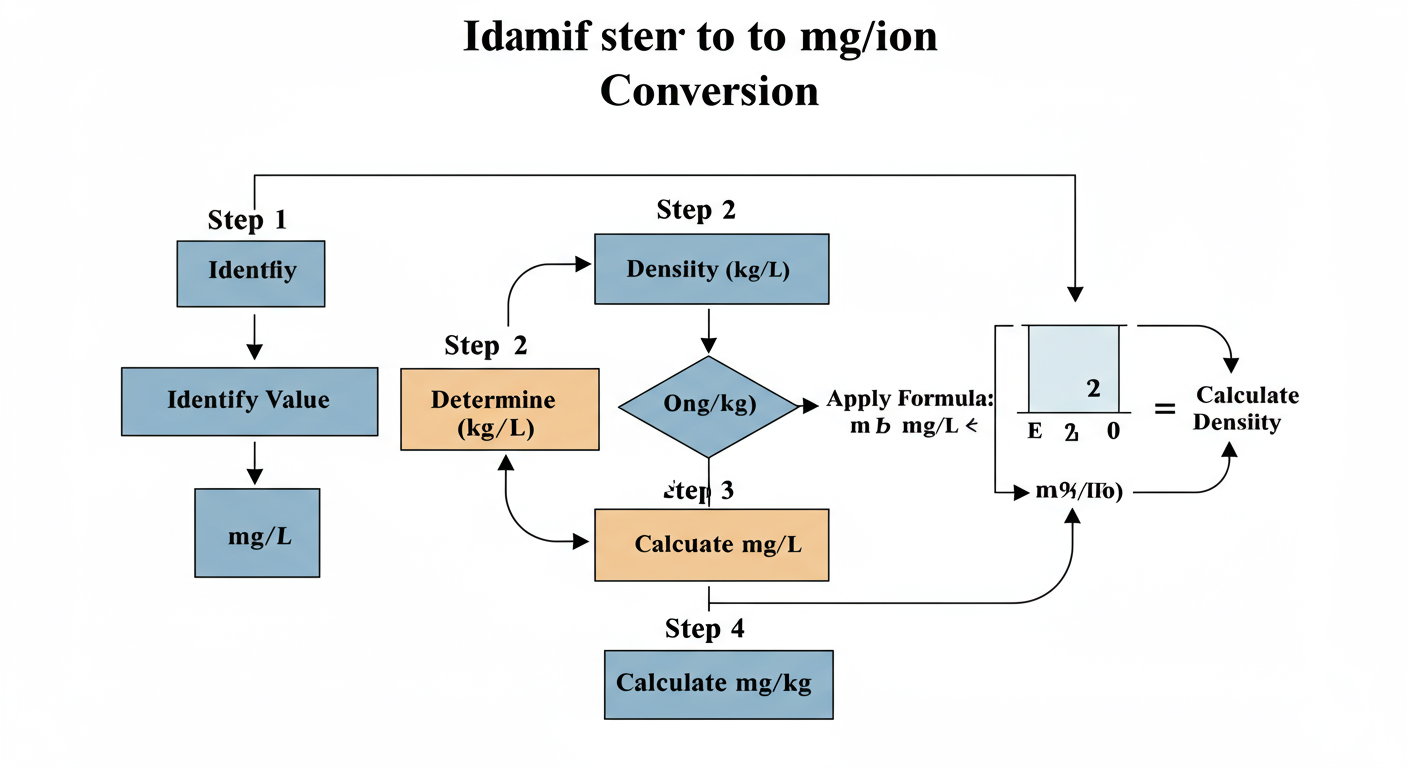
Ready to put this into practice? Here’s the exact four-step process we use for all our technical analyses. Let’s walk through a real-world example.
Scenario: You’ve tested a sample of industrial wastewater and the lab report shows a lead concentration of 250 mg/L. You need to report this concentration in mg/kg for a solid waste disposal permit.
-
Step 1: State Your Known Value.
Your starting point is the concentration in mass per volume.
Known Value: 250 mg/L of lead. -
Step 2: Find the Density of Your Matrix.
This is the most crucial step. You need the density of the entire sample (the wastewater), not just pure water. You can find this on a Safety Data Sheet (SDS), a technical manual, or by measuring it. For this example, let’s say you’ve measured the wastewater density to be 1.15 kg/L.
-
Step 3: Apply the Conversion Formula.
Plug your knowns into the formula we established earlier.
Formula: Concentration (mg/kg) = Concentration (mg/L) / Density (kg/L)
Calculation: 250 mg/L / 1.15 kg/L -
Step 4: Calculate the Final Concentration.
Do the math. The “L” units cancel out, leaving you with mg/kg.
Result: 217.4 mg/kg of lead.
So, 250 mg/L in this specific wastewater is equivalent to 217.4 mg/kg. Reporting 250 mg/kg would have been an overestimation of the actual mass-based concentration. In regulatory matters, that kind of precision is non-negotiable.
Real-World Scenarios: Where This Conversion is Critical
This isn’t just an academic exercise. I’ve seen projects succeed or fail based on getting this right. Here’s where the mg L to mg kg conversion plays out every single day.
Environmental Remediation
An environmental consultant tests groundwater and finds 10 mg/L of a solvent. But the real danger lies in how much of that solvent has adsorbed onto the surrounding soil. To assess the risk and plan for cleanup, they must convert that 10 mg/L into a soil concentration (mg/kg) using the soil’s bulk density. A mistake here could mean underestimating the contamination and leaving a toxic threat behind.
Agriculture and Agronomy
A farmer is using “fertigation”—applying liquid fertilizer through an irrigation system. The nutrient solution has a concentration of, say, 300 mg/L of nitrogen. But what matters to the plant is the concentration available in the soil mass. Agronomists must convert the liquid concentration to a soil concentration (mg/kg) to ensure crops get the right amount of nutrients without causing runoff pollution. According to industry best practices, this is key to efficient farming.
Food Safety and Processing
A food processor uses a liquid brine (in mg/L) to cure meat. Food safety regulations, however, often limit additives based on the final product’s weight (in mg/kg). Quality assurance managers must perform this conversion, accounting for the density of the brine and moisture loss during cooking, to prove their final product is safe and compliant.
⚠️ Watch Out
The most common error we see is assuming a 1:1 conversion for anything that looks like water. Industrial wastewater, brines, and chemical slurries are almost always denser than pure water. Always verify the density; never assume.
The table below illustrates the financial and regulatory impact of getting this wrong.
| Scenario | Initial Data | Incorrect Conversion (Assuming 1:1) | Correct Conversion (Using Density) | Consequence of Error |
|---|---|---|---|---|
| Soil Contamination | Leachate test: 20 mg/L | Reported as 20 mg/kg | 13.3 mg/kg (Soil Density: 1.5 kg/L) | Over-reporting contamination, leading to unnecessarily high cleanup costs. |
| Food Additive | Brine: 5,000 mg/L | Reported as 5,000 mg/kg | 4,545 mg/kg (Brine Density: 1.1 kg/L) | Inaccurate labeling and potential for exceeding regulatory mass-based limits. |
| Liquid Fertilizer | Solution: 400 mg/L | Calculated as 400 mg/kg | 425 mg/kg (Solution Density: 0.94 kg/L) | Under-application of nutrients, leading to lower crop yields. |
Common Mistakes That Invalidate Your Results
Trust me on this one, I’ve seen them all. Avoid these pitfalls to ensure your calculations are always accurate and defensible.
- Using the Wrong Density: Are you using the density of the contaminant or the density of the matrix (the soil, water, or sludge it’s in)? You almost always need the density of the overall matrix.
- Ignoring Temperature: For most applications, standard density values are fine. But for high-precision scientific work, remember that density changes with temperature. As the U.S. Geological Survey (USGS) explains, water is densest at 4°C, and its density decreases at higher or lower temperatures.
- Mixing Up Density Units: The formula
mg/kg = mg/L / Densityonly works if density is in kg/L (or its numerical equivalent, g/mL). If your value is in lb/ft³ or g/m³, you must convert it first. - Bulk vs. Particle Density: In soil science, this is a classic blunder. Particle density is the density of the solid soil minerals themselves. Bulk density is the density of the whole soil, including air and water pores. For this conversion, you must use the bulk density.
⚠️ Watch Out
Don’t confuse mg/kg with PPM (Parts Per Million). While they are equivalent for dilute aqueous solutions (where 1L ≈ 1kg), they are not interchangeable for other substances. PPM is a ratio of masses, so mg/kg is always PPM by mass. However, mg/L is only PPM when the liquid’s density is exactly 1.0 kg/L.
💡 Pro Tip
Where do you find reliable density data? Start with the product’s Safety Data Sheet (SDS), usually in Section 9. For common chemicals and materials, the CRC Handbook of Chemistry and Physics is the gold standard. For more on standardized chemical terminology, the IUPAC Gold Book is an invaluable resource.
❓ Frequently Asked Questions
Is mg/L the same as PPM?
Only for dilute solutions in pure water. Because water’s density is almost exactly 1 kg/L, 1 mg in 1 L of water is effectively 1 mg in 1 kg of water, which is the definition of PPM by mass. For any other liquid (seawater, oil, wastewater), mg/L is NOT the same as PPM.
What’s the basic formula to convert mg/L to mg/kg?
The simple but powerful formula is: Concentration (mg/kg) = Concentration (mg/L) / Density (in kg/L). You absolutely must know the density of the substance you are analyzing for an accurate result.
How can I convert mg/kg back to mg/L?
Easy. Just rearrange the formula. To go from a mass-based concentration back to a volume-based one, you multiply by the density: Concentration (mg/L) = Concentration (mg/kg) * Density (in kg/L).
Where can I find the density of my sample?
The best source is a Safety Data Sheet (SDS) or Technical Data Sheet for the material. If that’s not available, you can consult chemical reference books or online databases. For ultimate accuracy, especially with unique mixtures, you should measure it directly in a lab using a hydrometer, pycnometer, or density meter.
Why is bulk density so important for soil conversions?
Bulk density represents the mass of a volume of natural, undisturbed soil—including the solid particles and the pore spaces (filled with air and water). When a lab tests a soil extract (giving a result in mg/L), you’re trying to relate that back to the real-world soil in the ground. Using bulk density allows you to accurately calculate the contaminant mass per kilogram of that real-world soil.
Conclusion: From Confused to Confident
The mg L to mg kg conversion doesn’t have to be a source of confusion. By moving past the flawed “1-to-1” assumption and embracing the role of density, you unlock the power to make flawless calculations every time.
The bridge from mass-per-volume (mg/L) to mass-per-mass (mg/kg) is, and always will be, density. Burn this formula into your memory: mg/kg = mg/L ÷ Density (kg/L).
Now, you’re not just plugging in numbers. You understand the principle. You can spot potential errors before they happen. You can confidently defend your results, whether you’re in the lab, in the field, or in a boardroom. The next time you see those units on a report, you won’t feel a moment of doubt. You’ll know exactly what they mean—and exactly how to translate between their worlds.