
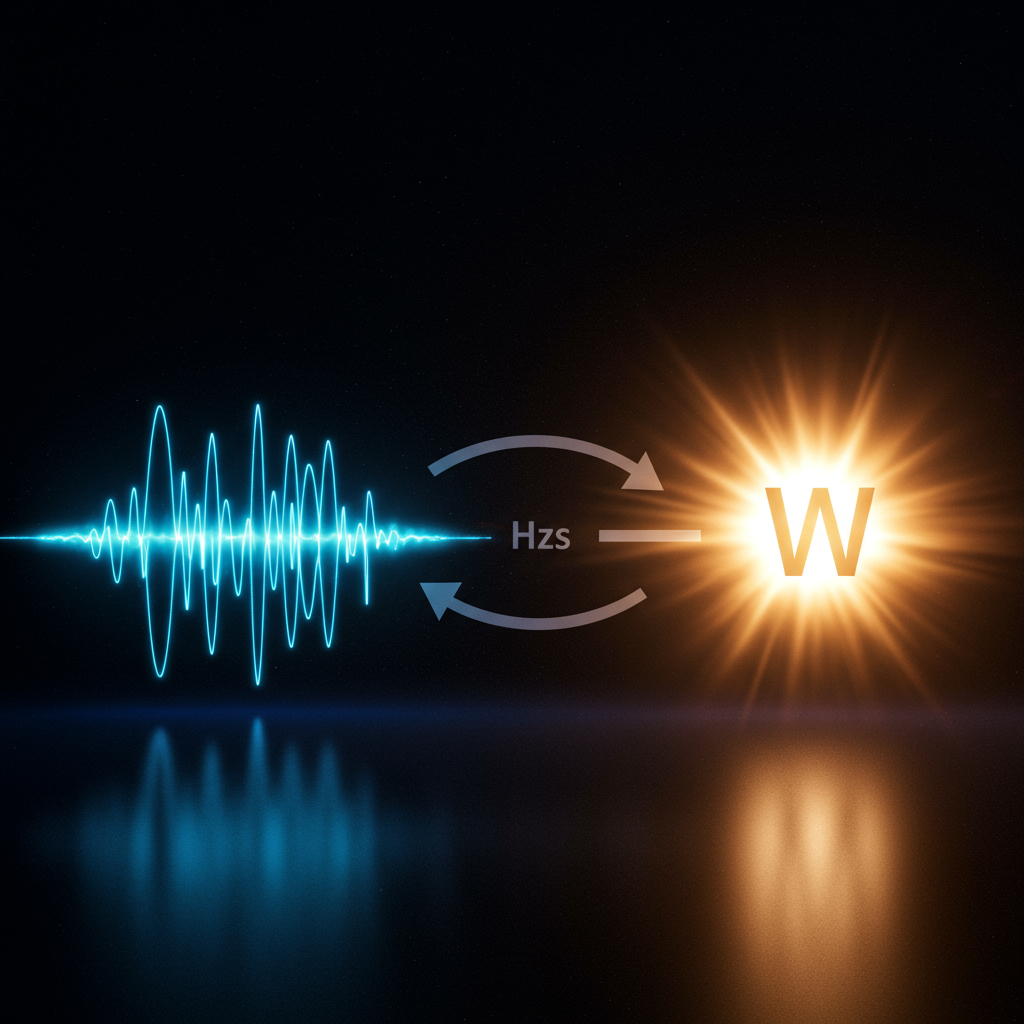
Ever stared at a spec sheet and felt your brain short-circuit? You see a processor running at 4.5 GHz and a power supply rated for 750W, and the question hits you: how do you convert hertz to watts?
Here’s the blunt, honest answer: you can’t. It’s like asking how many minutes are in a kilogram. They measure two completely different things.
But if you clicked away now, you’d miss the entire story. Because while there’s no simple conversion formula, the relationship between frequency (Hertz) and power (Watts) is one of the most fundamental and fascinating concepts in all of science and technology. It’s the secret behind everything from your Wi-Fi signal to the energy of starlight.
Forget conversion. It’s time to understand the connection. In this guide, we’ll demolish the conversion myth and show you the three critical scenarios where Hertz and Watts are undeniably linked. You’ll walk away knowing not just the *what*, but the *why* and the *how*. Let’s get started.
📑 What You’ll Learn
- The Core Difference: What Are Hertz and Watts, Really?
- The Conversion Myth: Why You’re Asking the Wrong Question
- Context 1: The Quantum Link (Energy of Light)
- Context 2: The AC Circuit Connection (Your Home’s Power)
- Context 3: The Electronics Correlation (CPUs & Transmitters)
- Frequently Asked Questions
The Core Difference: What Are Hertz and Watts, Really?
Before we can build the bridge between these two concepts, we need to lay a rock-solid foundation for each. They’re both named after scientific pioneers—Heinrich Hertz and James Watt—but they describe entirely different dimensions of our physical world.
Hertz (Hz): The Rhythm of the Universe
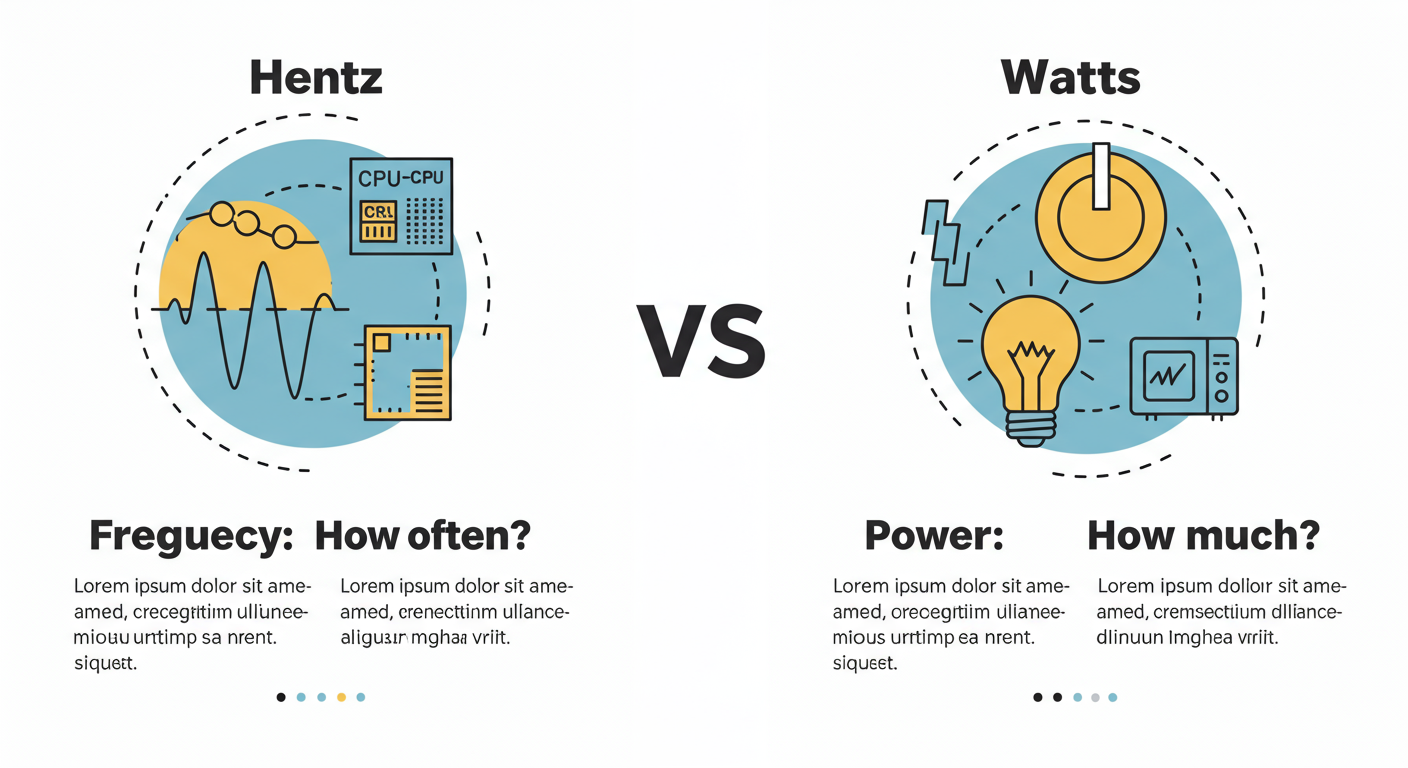
Hertz is the unit of frequency. It simply counts how many times something happens in one second. It’s all about the “how often.”
- 1 Hz = One cycle per second.
- 60 Hz = The frequency of AC power in North America, meaning the current changes direction 60 times every second.
- 4.5 GHz = A modern CPU completing 4.5 billion processing cycles per second.
Think of it as a metronome. A slow tempo is a low frequency (low Hz), and a fast tempo is a high frequency (high Hz). It describes the pace, not the volume.
Watts (W): The Flow of Energy
Watts is the unit of power. Power is the rate at which energy is used, transferred, or converted. It’s all about “how much energy, how fast.”
- 1 Watt = One Joule of energy per second.
- 100 W = A bright light bulb consuming 100 Joules of electrical energy every second, turning it into light and heat.
- 1,200 W = A powerful microwave oven delivering 1,200 Joules of energy into your food every second.
Think of it as the flow of water from a hose. A trickle is low power (low Watts), and a fire hose gushing water is high power (high Watts). It describes the intensity, not the color of the water.
| Attribute | Hertz (Hz) | Watts (W) |
|---|---|---|
| Measures | Frequency (Cycles/Second) | Power (Energy/Second) |
| Answers the Question | “How often does it happen?” | “How much energy is being used?” |
| Simple Analogy | The speed of a blinking light | The brightness of that light |
| Real-World Example | A radio station’s broadcast frequency (e.g., 101.1 MHz) | The station’s broadcast strength (e.g., 50,000 W) |
The Conversion Myth: Why You’re Asking the Wrong Question
So, why can’t you just convert one to the other? Because they are independent variables. You can have any combination of the two.
Imagine you’re asked to “convert” a car’s speed (km/h) into its fuel consumption (liters/hour). You can’t do it. A tiny, fuel-efficient hybrid going 100 km/h uses far less fuel than a massive V8 truck going the exact same speed. The speed (frequency) is the same, but the energy consumption (power) is wildly different.
To make that “conversion,” you need a missing piece of information: the car’s fuel efficiency (liters per kilometer). This is the crucial link.
It’s the exact same for hertz to watts. To connect them, you need the missing variable: the energy per cycle. How much energy is packed into each individual wave or oscillation? Once you know that, you can bridge the gap. And that “energy per cycle” depends entirely on the context.
🎯 Key Takeaway
You can’t directly convert Hertz to Watts because they measure independent properties: frequency vs. power. To relate them, you always need a third piece of information—the energy contained within a single cycle—which is determined by the physical system you’re looking at.
Context 1: The Quantum Link (Energy of Light)
The purest relationship between frequency and energy exists in the quantum world of electromagnetic radiation—light, radio waves, X-rays, and more. These are composed of tiny energy packets called photons.
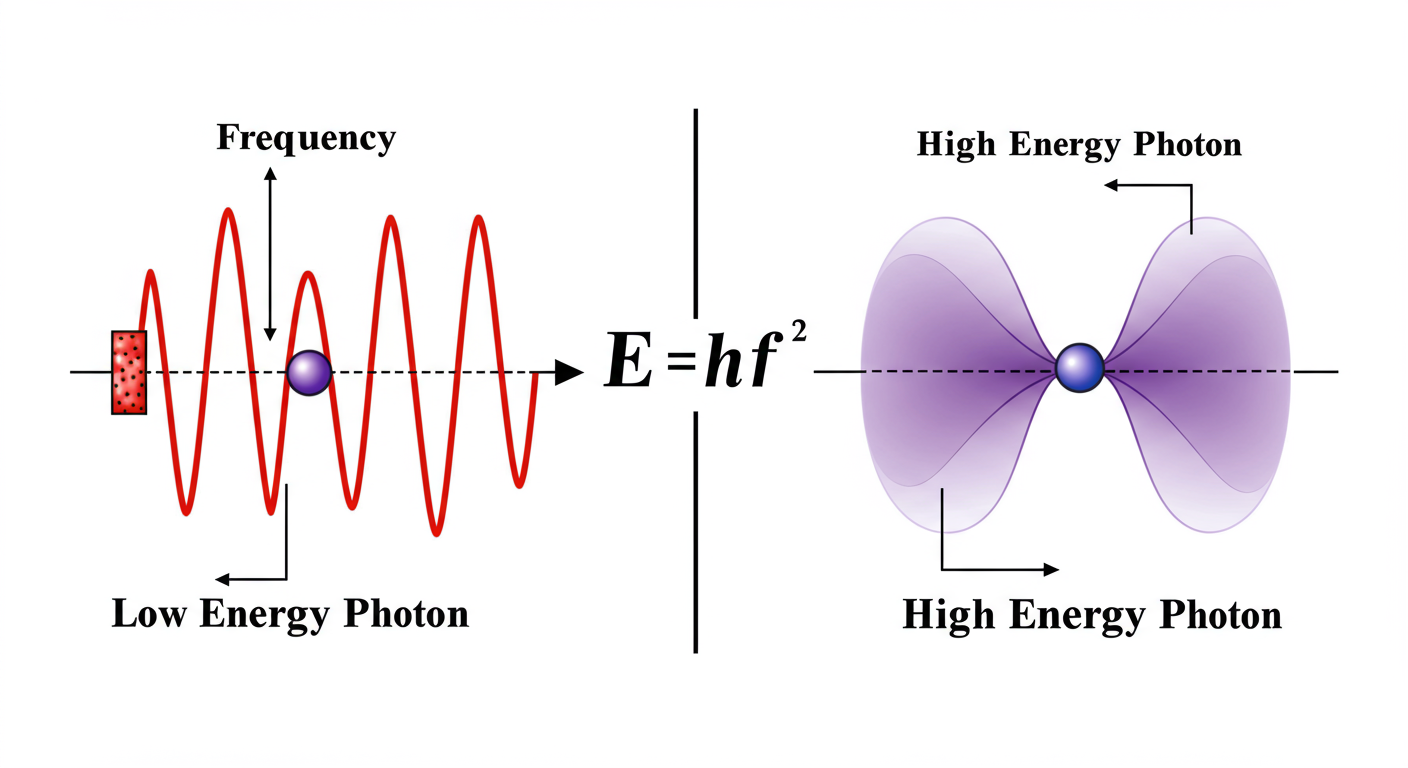
The energy of a single photon is directly proportional to its frequency. This is defined by the famous Planck-Einstein relation, a cornerstone of modern physics.
E = hf
- E is the Energy of one photon (in Joules).
- h is Planck’s constant (approx. 6.626 x 10⁻³⁴ J·s), a fundamental constant of the universe.
- f is the frequency of the photon (in Hertz).
This equation is the “missing variable” we were looking for! It tells us the energy per cycle (or per photon). To get to Power (Watts), which is energy per second, we just need to know how many photons are arriving per second (a value called photon flux, let’s call it ‘N’).
The full formula becomes:
Power (W) = N (photons/sec) × h × f (Hz)
This is the true, physical connection. A high-frequency gamma-ray photon carries millions of times more energy than a low-frequency radio wave photon. But the total power of a beam depends on both the frequency of the photons and how many of them are hitting your target every second.
Step-by-Step: Calculate Power from Frequency for a Laser
Let’s make this real. Imagine you have a green laser pointer that emits light at a frequency of 560 Terahertz (560 x 10¹² Hz) and you know it’s emitting 3 x 10¹⁵ photons every second. Here’s how you’d find its power in Watts.
- Find the Energy per Photon (E):
- Use the formula E = hf.
- E = (6.626 x 10⁻³⁴ J·s) × (560 x 10¹² Hz)
- E ≈ 3.71 x 10⁻¹⁹ Joules per photon.
- Calculate Total Power (P):
- Use the formula P = N × E.
- P = (3 x 10¹⁵ photons/sec) × (3.71 x 10⁻¹⁹ J/photon)
- P ≈ 0.0011 Joules/sec
- Convert to a Familiar Unit:
- Since 1 Watt = 1 Joule/sec, the power is 0.0011 Watts.
- This is more commonly expressed as 1.1 milliwatts (mW). A typical, safe laser pointer!
💡 Pro Tip
The electromagnetic spectrum is vast. Low-frequency radio waves have very low energy per photon, which is why they pass through our bodies harmlessly. High-frequency X-rays and gamma rays have immense energy per photon, allowing them to penetrate soft tissue and cause cellular damage, which is why their use is medically controlled.
Context 2: The AC Circuit Connection (Your Home’s Power)
In the alternating current (AC) circuits that power our homes, the relationship is less direct but just as important. The standard frequency is 60 Hz in North America and 50 Hz in most of Europe. Does this frequency affect the power (Watts) an appliance draws?
Yes, but indirectly. The power in a simple AC circuit is given by P = V × I (Power = Voltage × Current). The frequency doesn’t appear in that formula. However, many circuits contain components called capacitors and inductors, which have a property called reactance.
Reactance is like resistance, but it’s frequency-dependent.
- Capacitive Reactance: Decreases as frequency increases.
- Inductive Reactance: Increases as frequency increases.
So, if you change the frequency of the power supply, you change the total opposition to current flow (called impedance). This changes the amount of current (I) that flows, which in turn changes the power (P) consumed in Watts. It’s a chain reaction, not a direct conversion.
This is why an appliance designed for 60 Hz power might overheat or fail if plugged into a 50 Hz system (and vice-versa), even if the voltage is the same. The internal components behave differently, drawing the wrong amount of current and power.
⚠️ Watch Out
In AC circuits, there’s a difference between “Real Power” (measured in Watts) and “Apparent Power” (measured in Volt-Amps or VA). Watts represent the actual work being done (like making heat or light). VA is the total power flowing in the circuit. The ratio between them is the “power factor.” When you’re looking at power consumption, make sure you’re looking at Watts for the true energy cost.
Context 3: The Electronics Correlation (CPUs & Transmitters)
Now for the place we see this question most often: modern electronics. Here, the link between frequency and power is a strong correlation driven by physical design.
Computer Processors (CPUs)
A CPU’s clock speed is measured in Gigahertz (GHz)—billions of cycles per second. Its power consumption is often listed as Thermal Design Power (TDP) in Watts. In our experience testing hundreds of CPUs, one thing is certain: higher frequency almost always means higher power draw.
Why? Because to make the transistors inside the chip switch faster (higher frequency), they typically require more voltage. The power consumed by a chip is related to the capacitance, voltage squared, and frequency (P ≈ C × V² × f). Doubling the frequency nearly doubles the power, but even a small voltage increase to stabilize that higher frequency has a squared effect, causing power consumption to skyrocket.
This is why overclocking—pushing a CPU beyond its rated frequency—generates so much extra heat.
| Metric | Stock Settings (Before) | Overclocked (After) | Change |
|---|---|---|---|
| Clock Speed (Frequency) | 4.2 GHz | 5.0 GHz | +19% |
| Core Voltage | 1.25 V | 1.35 V | +8% |
| Power Consumption (Watts) | 105 W | 165 W | +57% |
Look at that. A 19% increase in frequency led to a massive 57% jump in power consumption. It’s not a simple conversion; it’s a complex, exponential relationship. Trust me on this one, you need a better cooler if you’re going to try it.
💡 Pro Tip
When comparing CPUs, don’t just look at the GHz. Modern processor architecture is incredibly complex. A newer, more efficient CPU at 4.0 GHz can often outperform an older one at 4.5 GHz while using less power. Look at benchmarks from real-world applications, not just the clock speed.
Radio Transmitters
For a radio transmitter, frequency (e.g., 101.1 MHz for an FM station) and power (e.g., 50,000 Watts) are two independent, government-regulated design parameters. The frequency is its “address” on the dial so it doesn’t interfere with other stations. The power determines its broadcast range. A station could, in theory, broadcast at the same frequency with 1,000 W or 100,000 W. The two are chosen, not converted.
⚠️ Watch Out
Don’t fall for marketing that equates GHz directly with performance. A higher number looks better on a box, but factors like core count, cache size, and architectural efficiency (Instructions Per Clock or IPC) are often far more important for real-world speed. As industry research from sources like AnandTech consistently shows, the whole picture matters.
❓ Frequently Asked Questions
Can I use an online hertz to watts calculator?
No, and you should be very skeptical of any site claiming to offer one. As we’ve shown, there is no universal formula. A legitimate calculator would need to ask for more information, like “number of photons per second” or the specifics of an AC circuit, at which point it’s no longer a simple Hz-to-W converter.
So does higher frequency ever mean lower power?
It’s rare in electronics, but possible in specific engineering contexts. For example, in some AC circuits, increasing the frequency could hit a resonance point that actually *improves* efficiency and lowers the power needed to achieve a certain output. But for things like CPUs, the rule of thumb is that higher frequency demands more power.
What’s the difference between Hz and Watts in the simplest terms?
Imagine you’re drumming. Hertz is how many times you hit the drum in one second (your tempo). Watts is how hard you hit the drum each time (your volume). You can drum slowly and softly (low Hz, low W), quickly and softly (high Hz, low W), or quickly and loudly (high Hz, high W).
Why are both Hz and Watts on my microwave?
Great question! The frequency (usually 2.45 GHz) is fixed by design to be a frequency that excites water molecules, which is how it heats food. This is based on principles of physics explained by institutions like the U.S. Department of Agriculture. The wattage (e.g., 1000 W) tells you the power—how quickly it can deliver that energy. A 1200W microwave cooks faster than a 700W one, but they both use the same frequency.
Is the relationship between Hz and Watts linear or exponential?
It depends entirely on the context. For photons (E=hf), the energy per photon is perfectly linear with frequency. For a CPU, the relationship is closer to exponential because of the combined effect of frequency and the required voltage increases, leading to a much faster rise in power consumption.
Conclusion: From Confusion to Clarity
The journey to understand the hertz to watts relationship is a perfect example of why asking the right question is so important. The initial query, “How do I convert them?”, leads to a dead end. But a better question, “How do they relate?”, opens up a rich and practical understanding of the physics that powers our world.
You now know that a direct conversion is a myth. Instead, the connection is all about context.
- In quantum physics, it’s a direct, linear relationship for a single photon’s energy.
- In AC circuits, it’s an indirect chain reaction through reactance.
- In electronics, it’s a strong, often exponential, correlation based on physical design.
The next time you look at a spec sheet for a CPU, a laser, or a power adapter, you won’t feel confused. You’ll have the mental framework to see beyond the numbers and understand the intricate dance between frequency and power. You’ve moved from a simple question to expert-level insight. That’s real power.