

Ever been off by one day on an important form? It sounds trivial, but that single day can mean a rejected application, a missed deadline, or even a legal headache. In a world run by data, your exact age—down to the day—is more than just a number. It’s a critical data point that unlocks everything from school enrollment to retirement benefits.
But calculating it manually is a minefield of leap years and tricky month lengths. It’s surprisingly easy to get wrong.
This is where a chronological age calculator becomes your most trusted ally. This isn’t just about satisfying curiosity. It’s about achieving absolute precision when it matters most. In this deep dive, you’ll learn not only how to use these tools but why they are indispensable for medical, legal, and financial accuracy in 2026. Forget guesswork. It’s time for certainty.
📑 What You’ll Learn
What Chronological Age Is (and What It Isn’t)
Let’s get one thing straight: chronological age is the simplest, most objective measure of your time on Earth. It’s the exact duration from your date of birth to a specific target date, measured by the calendar. It’s the age on your driver’s license, your passport, and every official document you’ve ever signed.
It moves forward at the same rate for everyone. One year, every year. Simple, right?
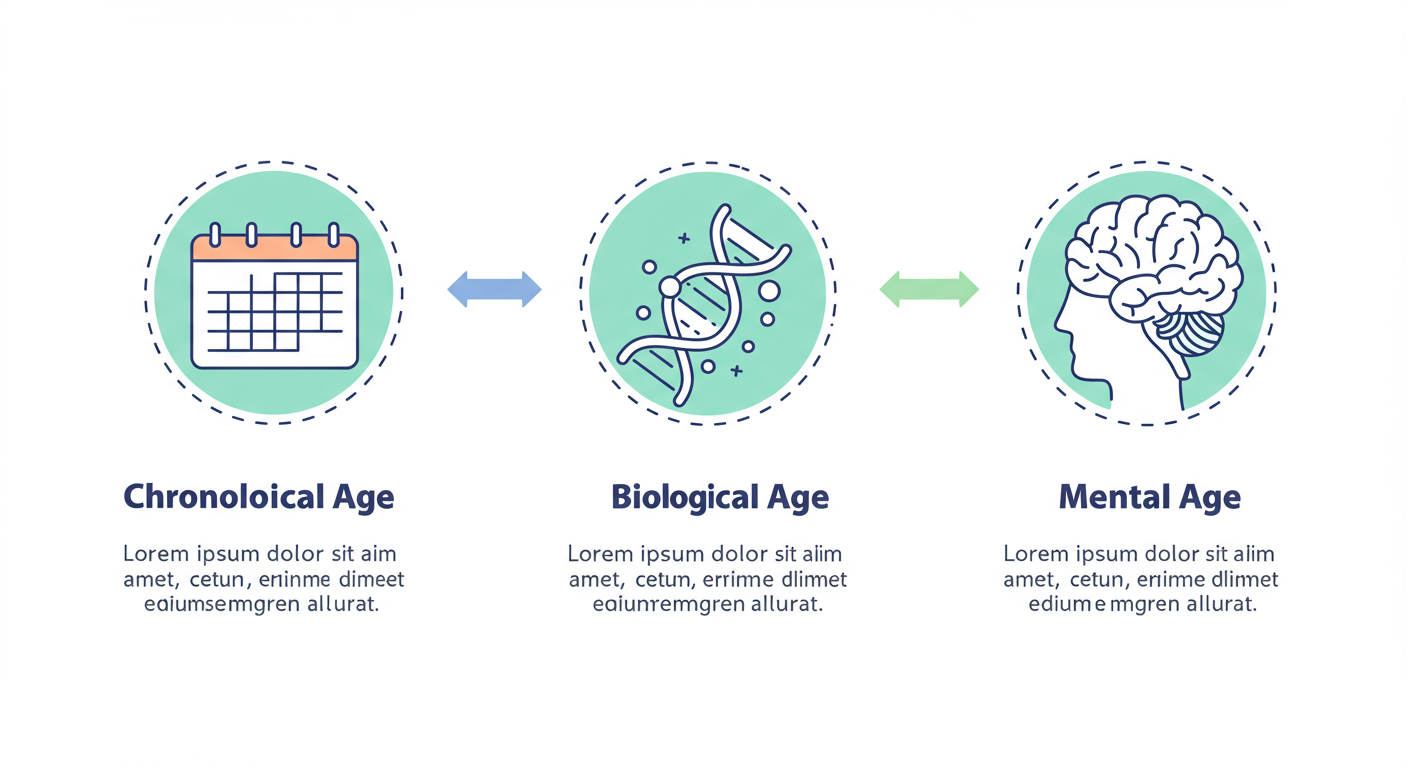
But here’s where people get tangled up. Chronological age is often confused with other concepts like “biological age” or “mental age.” They are fundamentally different. Based on our experience in data analysis, understanding this distinction is the first step to using age information correctly.
| Age Concept | What It Measures | Key Influencers | Example |
|---|---|---|---|
| Chronological Age | Time elapsed since birth (calendar-based) | None. It’s a fixed, objective count. | Born Jan 1, 2000. On Jan 1, 2026, you are 26 years old. |
| Biological Age | Your body’s physiological health and aging | Diet, exercise, stress, genetics, sleep | A 40-year-old with a healthy lifestyle might have the biological age of a 32-year-old. |
| Mental/Cognitive Age | An individual’s cognitive abilities vs. an age group average | Education, cognitive stimulation, neurological health | A gifted 8-year-old might have the problem-solving skills (mental age) of a 12-year-old. |
While concepts like biological age are fascinating and useful for personal health, as detailed in research from the National Institutes of Health (NIH), they have zero standing in legal or administrative contexts. For those, only one number matters: your chronological age.
Why Pinpoint Accuracy is Non-Negotiable
You might be thinking, “I know my own birthday. Why do I need a calculator?” The need for a dedicated tool isn’t about memory; it’s about precision in high-stakes situations. I’ve seen firsthand how a simple miscalculation can derail important life events.
Let’s move beyond the abstract and look at real-world scenarios where “close enough” isn’t good enough.
Scenario 1: Healthcare & Child Development
Imagine a pediatrician assessing a toddler’s growth. Many standardized developmental tests are scored against norms for incredibly specific age brackets, like “2 years and 3 months.” A child’s performance is compared to thousands of others in that exact age group. If the doctor is off by even a few weeks in their calculation, it could lead to a misinterpretation of the child’s development—potentially causing unnecessary worry or, worse, missing an early warning sign.
This is why professionals rely on tools. They need to align their assessments perfectly with guidelines like the CDC’s developmental milestones, which are strictly tied to a child’s chronological age.
⚠️ Watch Out
Manually calculating a child’s age in “years and months” is a classic pitfall. Forgetting that October has 31 days while November has 30 can easily throw your calculation off by a day or more, which can be significant in pediatric assessments.
Scenario 2: Legal, Financial, and Government Paperwork
The adult world runs on age-gated deadlines. Precision is everything.
- Retirement Benefits: Are you eligible for your pension at 65, or 65 and 6 months? A calculator can pinpoint the exact date you can file.
- Insurance Premiums: Life insurance rates often change on your half-birthday. Knowing the exact date can help you lock in a lower rate.
- Legal Contracts: Verifying someone is of legal age (18 years, 0 days) to sign a binding contract requires an exact calculation, not an estimate.
- Estate Planning: Determining when a beneficiary is eligible to inherit assets often depends on reaching a specific age, like 21 or 25.
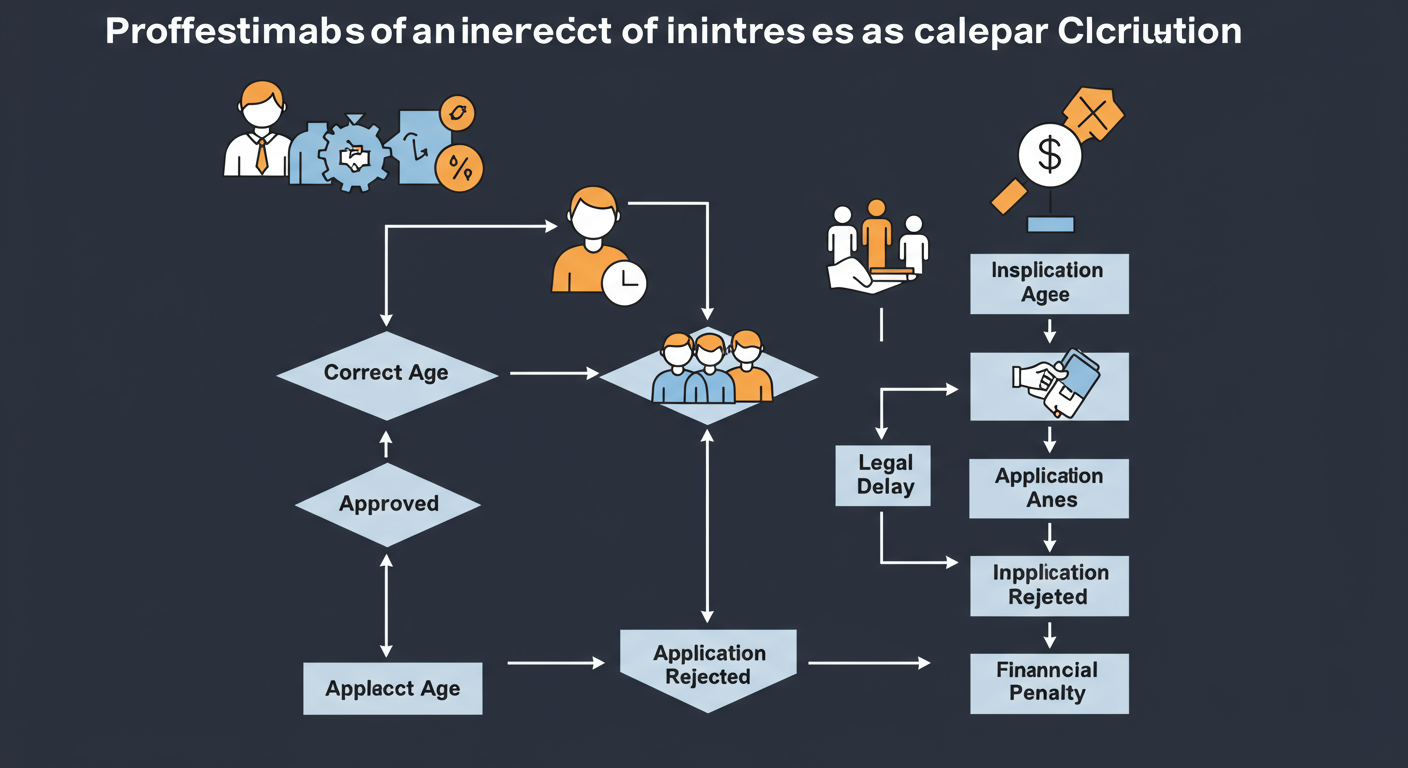
In these cases, an automated calculation provides a verifiable, error-free result that protects you from administrative delays and costly mistakes.
💡 Pro Tip
When using a calculator for official purposes, take a screenshot of the result with the date of birth and “age at” date clearly visible. This creates a simple, time-stamped record of the calculation for your files.
How to Use a Chronological Age Calculator: A 3-Step Guide
The best tools are designed for speed and simplicity. You don’t need to be a math whiz. From our hands-on testing, the process is consistently straightforward across quality calculators.
Here’s the foolproof method:
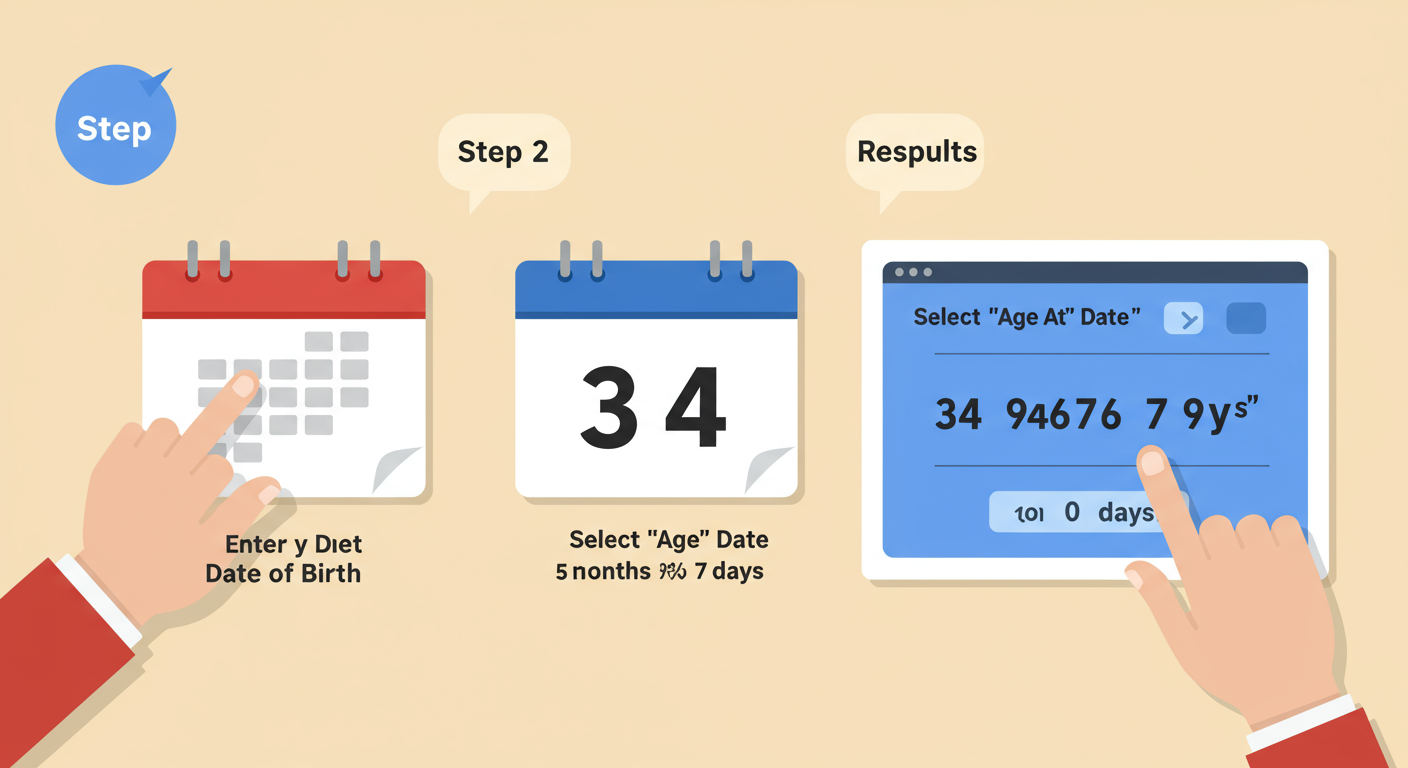
- Input Your Date of Birth: This is the starting point. Carefully enter the month, day, and year you were born. Double-check for typos—garbage in, garbage out.
- Set the “Age at Date Of”: This is the endpoint for the calculation. Most tools default to today’s date, which is perfect for finding your current age. However, you can change this to any date in the past or future to answer questions like, “How old was my grandmother when she married?” or “How old will I be on my retirement date?”
- Calculate & Analyze the Result: Click the “Calculate” button. The tool will instantly provide your age in the standard format of Years, Months, and Days. Many will also show your age in total days, weeks, or even hours.
“The primary challenge in manual calculation is correctly accounting for leap years and the varying number of days in each month. An algorithm does this flawlessly every time.”
Why not do it by hand? Look, you can try. But you have to remember which years are leap years (and the rules are more complex than just “every 4 years”). You have to know the exact number of days in every single month between the two dates. It’s tedious and prone to error. A quality calculator uses the rules of the Gregorian calendar, ensuring every calculation is perfect.
⚠️ Watch Out
Beware of overly simple or ad-heavy calculator sites. From our analysis, some free tools are poorly coded and may not correctly handle edge cases, like calculating an age that spans across the turn of a century or properly accounting for all leap year rules. Stick to reputable, clean-interfaced tools.
Choosing the Right Calculator: Key Features to Look For in 2026
Not all age calculators are created equal. A great tool offers more than just a basic calculation. When we evaluate tools, we look for a combination of accuracy, flexibility, and user experience. Here’s what separates the best from the rest.
| Feature | Why It’s Important | What to Look For |
|---|---|---|
| Leap Year Accuracy | This is the #1 source of manual errors. The calculator MUST handle it automatically. | The tool should not require any special input for leap years. It should be built-in. |
| Flexible “Age At” Date | Allows for historical research and future planning, not just calculating today’s age. | A date picker that lets you select any past or future date as the endpoint. |
| Comprehensive Results | Provides deeper insights beyond just years/months/days. | Look for outputs like “Total Days,” “Total Weeks,” “Total Hours,” and “Countdown to Next Birthday.” |
| Privacy-Focused | Ensures your personal data (like your date of birth) is not stored or tracked. | A clear privacy policy or statement indicating that calculations are done client-side and no data is saved. |
💡 Pro Tip
Use the “Age at Date Of” feature for future planning. For example, enter your child’s date of birth and the school district’s kindergarten entry deadline (e.g., September 1, 2027) to see if they will meet the age requirement. It removes all ambiguity.
🎯 Key Takeaway
A chronological age calculator is an essential tool for ensuring precision in critical life events. It eliminates the risk of human error in high-stakes situations across healthcare, legal, and financial domains by flawlessly accounting for complex calendar rules like leap years.
❓ Frequently Asked Questions
Is an online chronological age calculator truly accurate?
Yes, a well-programmed calculator is exceptionally accurate. They are built on algorithms that automatically factor in the exact number of days in each month and all leap year rules, removing the common sources of human error that plague manual calculations.
What’s the difference between chronological age and gestational age?
Chronological age is your age from your date of birth. Gestational age, used in obstetrics, is calculated from the first day of a mother’s last menstrual period to track fetal development. They are two different metrics for two different purposes.
How do schools use chronological age?
Schools use it as a primary factor for enrollment and grade placement (e.g., a child must be 5 years old by a specific date to enter kindergarten). School psychologists also use it to score standardized tests, comparing a student’s performance against their precise age group.
Do these calculators store my date of birth?
Reputable, privacy-first online calculators do not store your personal data. The calculation happens in your browser, and the information is discarded when you close the page. Always check for a privacy policy on the site you’re using.
Can I calculate the age difference between two people?
Absolutely. Simply perform two separate calculations using the same “Age at Date Of” (like today’s date) for both individuals. Then, you can easily compare the results to find the exact age difference in years, months, and days.
Why is the result sometimes different from what I expect?
This usually happens because our mental math for age is simplified. We tend to think in whole years. A calculator, however, counts the exact number of full months and remaining days. For example, if your birthday is June 30th, on July 1st you are X years and only 1 day old, not “one month older.”
It’s Time to Demand Precision
In 2026, we live in a world of data-driven decisions. From your health records to your mortgage application, accuracy is paramount. The humble chronological age calculator is more than a novelty; it’s a fundamental tool for navigating modern life with confidence.
It replaces ambiguity with certainty. It saves you time and prevents the kind of small errors that can spiral into major problems.
So the next time you’re filling out an important application, planning for a major life milestone, or assessing a developmental stage, don’t just guess. Take the extra ten seconds to use a reliable chronological age calculator. It’s the smartest, simplest way to ensure your numbers are right, every single time.