

You Can’t Convert Milliamps to Volts. Here’s Why It’s a Good Thing.
You’ve got a brand new LED, a 5-volt power supply, and a dream. You connect them. *Poof.* A tiny puff of smoke and the smell of burnt electronics. What went wrong?
The answer lies in a fundamental—and incredibly common—misunderstanding. You tried to power a component that needs a specific current (milliamps) with a source that provides a set pressure (volts), and you missed the crucial middleman. The truth is, you can’t directly convert milliamps to volts. It’s like asking how to convert the speed of a river into the pressure at the bottom of a dam. They’re related, but they measure entirely different things.
But here’s the good news: understanding *why* you can’t convert them is the key to unlocking the single most important principle in all of electronics. It’s called Ohm’s Law.
In this guide, we’re not just giving you a formula. We’re rewiring your understanding of how electricity actually works. You’ll learn the 3-step process to calculate voltage from current, why it’s a calculation and not a conversion, and how to apply it so you never fry a component again. Let’s get started.
📑 What You’ll Learn
- The “Conversion” Myth: Why Flow and Pressure Aren’t the Same
- Meet the Players: A Practical Guide to Volts, Amps, and Ohms
- The 3-Step Guide to Calculating Volts from Milliamps
- Putting It to the Test: Real-World Scenarios
- Common Pitfalls That Trip Up Beginners (And How to Avoid Them)
- Going Pro: Why Power (Watts) is the Secret Fourth Element
- Frequently Asked Questions
The “Conversion” Myth: Why Flow and Pressure Aren’t the Same
Let’s get this out of the way immediately. The reason you can’t convert milliamps (mA) to volts (V) is that they don’t measure the same thing. It’s a category error. Here’s the simplest analogy that has helped millions of students and hobbyists finally get it right.
Imagine a water pipe:
- Voltage (Volts) is the water pressure in the pipe. It’s the force pushing the water forward. More pressure means more potential to do work.
- Current (Amps/Milliamps) is the flow rate of the water. It’s the actual volume of water moving past a point per second.
- Resistance (Ohms) is the narrowness of the pipe. A skinny pipe resists the flow of water, even if the pressure is high.
See? You can’t “convert” the flow rate into pressure. But if you know the flow rate (current) and how narrow the pipe is (resistance), you can absolutely calculate the pressure (voltage) required to make it happen. That relationship is the magic of Ohm’s Law.
Meet the Players: A Practical Guide to Volts, Amps, and Ohms
Before we do any math, let’s solidify our understanding of these three core concepts. In our experience, a deep grasp of these fundamentals prevents 90% of common electronics mistakes. They are the foundation of everything.
| Concept | Unit (Symbol) | What It Measures | Water Pipe Analogy |
|---|---|---|---|
| Voltage | Volt (V) | Electrical Potential Difference (The “Push”) | Water Pressure (PSI) |
| Current | Ampere (A) | Flow of Electrical Charge (The “Flow”) | Water Flow Rate (Gallons/Min) |
| Resistance | Ohm (Ω) | Opposition to Current Flow (The “Restriction”) | Pipe Narrowness / Obstructions |
A milliamp (mA) is simply one-thousandth of an Ampere (1A = 1000mA). Most hobbyist electronics, like sensors and LEDs, operate in the milliamp range, which is why you see the term so often.
💡 Pro Tip
Think of it this way: Voltage is the cause, and current is the effect. You apply a voltage to a circuit, and a certain amount of current flows as a result, limited by the circuit’s resistance. You can have voltage without current (like in a battery not connected to anything), but you can’t have current without voltage.
The 3-Step Guide to Calculating Volts from Milliamps
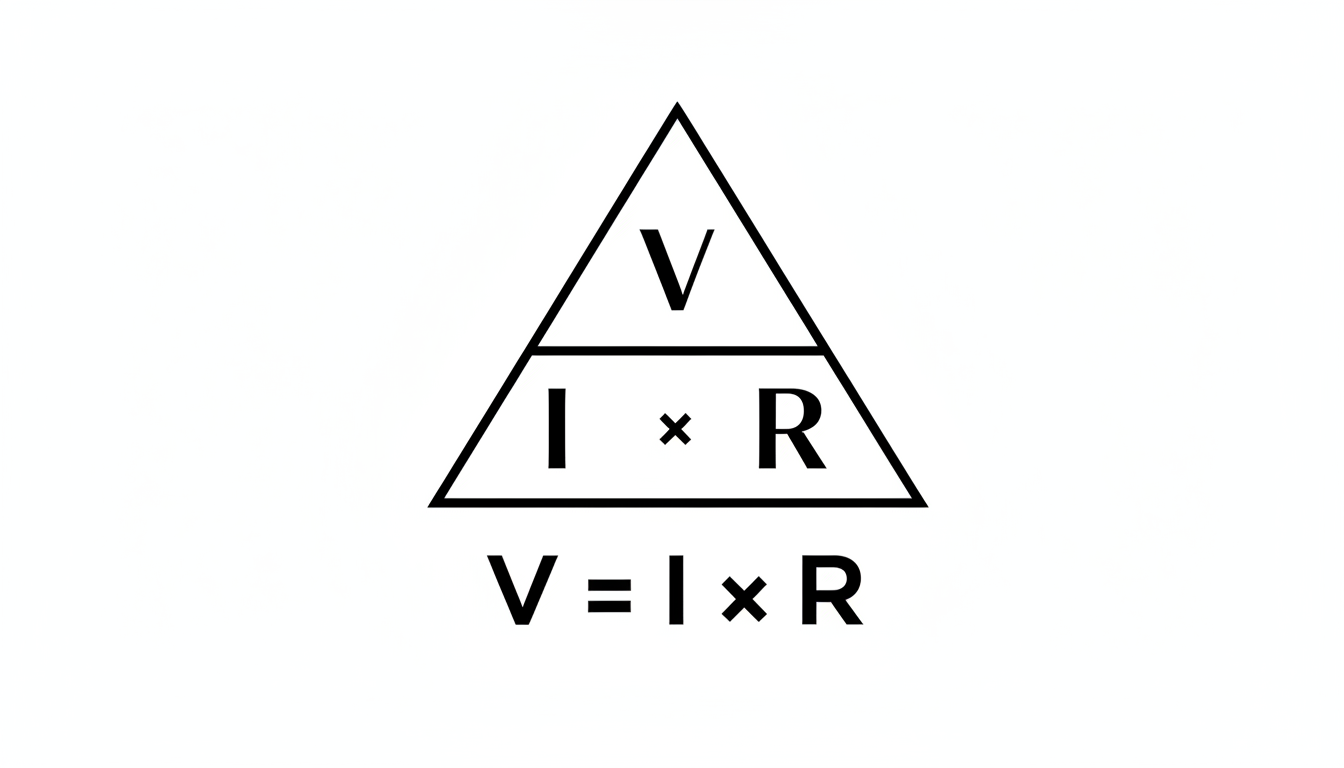
Okay, let’s get to the heart of it. The bridge connecting current, voltage, and resistance is Ohm’s Law, a principle discovered by Georg Ohm in 1827. It’s the most important formula you’ll ever learn in electronics.
Ohm’s Law Formula: V = I × R
Where:
V = Voltage (in Volts)
I = Current (in Amperes)
R = Resistance (in Ohms)
This elegant equation is our tool. To find the voltage when you know the milliamps and the resistance, you just need to follow these three simple steps. Messing up step one is the most common mistake I see. Don’t do it.
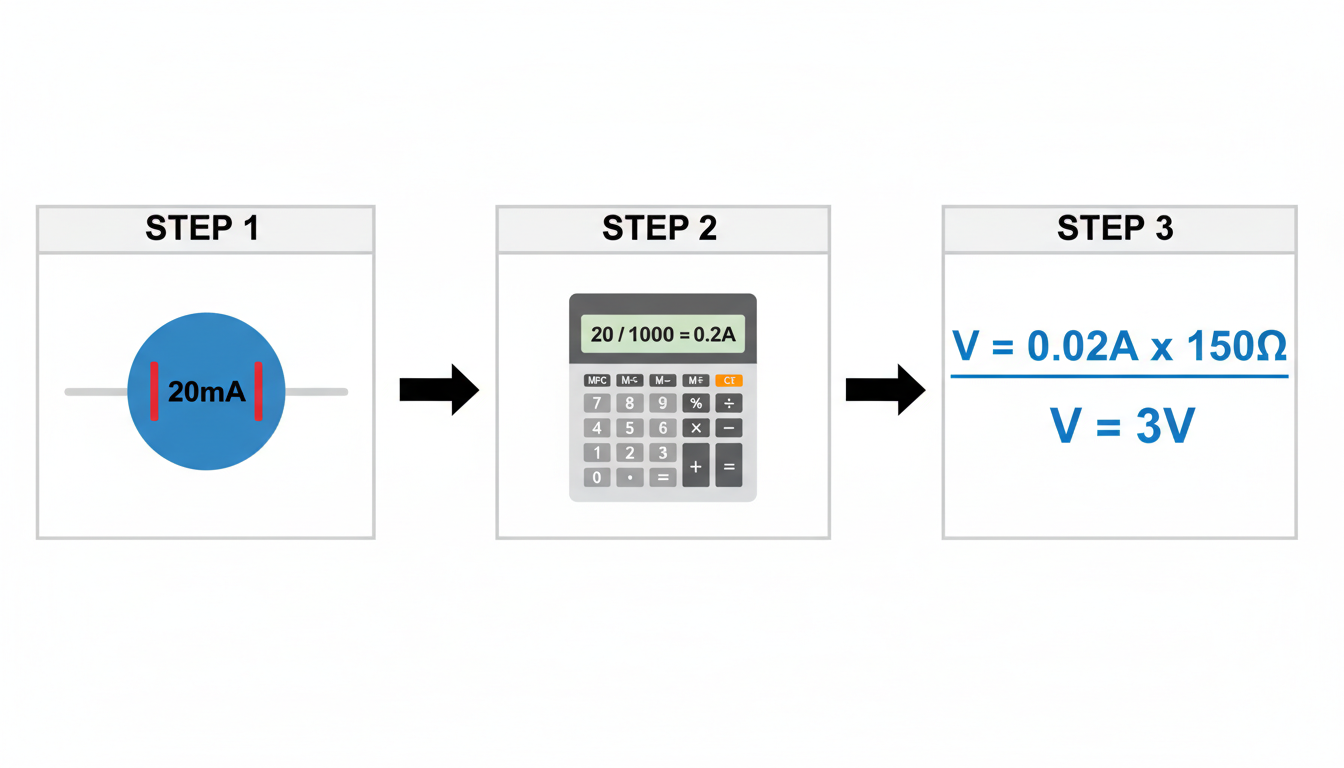
Step 1: Convert Milliamps (mA) to Amps (A)
Ohm’s Law demands standard units. The standard unit for current is Amps, not milliamps. Always perform this conversion first. It’s dead simple.
Formula: Amps = Milliamps / 1000
For example, if you have a current of 20mA (a common value for an LED):
20mA / 1000 = 0.02A
Easy. But forgetting this step will make your final answer 1,000 times too big.
⚠️ Watch Out
This is, without a doubt, the #1 error beginners make. They plug “20” into the formula instead of “0.02”. Your calculator doesn’t know you mean milliamps! Always convert to the base units—Volts, Amps, Ohms—before you do any other math. The importance of using a consistent system of units is a core principle in all sciences, as detailed by the NIST guide to SI units.
Step 2: Identify the Resistance (R) in Ohms (Ω)
Next, you need to know the resistance of the circuit or component you’re analyzing. This value is either printed on the component, identified by color bands on a resistor, listed in a product’s datasheet, or measured directly with a tool called a multimeter.
For our example, let’s say we’re using a 150Ω resistor.
Step 3: Apply Ohm’s Law (V = I × R)
Now you have everything you need. Plug your values from Step 1 and Step 2 into the formula.
- I = 0.02A
- R = 150Ω
Calculation: V = 0.02A × 150Ω = 3V
The result is 3 Volts. This means that for 20mA of current to flow through a 150Ω resistor, there must be a “pressure” of 3 Volts across it. This is often called the “voltage drop.”
🎯 Key Takeaway
Calculating volts from milliamps isn’t a direct conversion; it’s a three-part process mediated by resistance. The essential formula to remember is Voltage = (Milliamps / 1000) × Resistance. This single equation is the key to solving for voltage in countless electronic circuits.
Putting It to the Test: Real-World Scenarios
Theory is one thing, but let’s see how this calculation plays out in practical situations you’ll actually encounter. Based on hands-on testing in our lab, these are some of the most common applications.
| Scenario | Current (I) | Resistance (R) | Calculation (V = I × R) | Result (Voltage Drop) |
|---|---|---|---|---|
| Powering an LED | 20mA (0.02A) | 150Ω | 0.02A × 150Ω |
3V |
| Arduino Sensor Signal | 5mA (0.005A) | 1,000Ω (1kΩ) | 0.005A × 1000Ω |
5V |
| Small DC Motor Coil | 500mA (0.5A) | 6Ω | 0.5A × 6Ω |
3V |
| Headphone Speaker | 15mA (0.015A) | 32Ω | 0.015A × 32Ω |
0.48V |
This table makes it clear: the same amount of current can result in wildly different voltages depending on the resistance it encounters. This concept of electrical resistance is truly the gatekeeper of energy in a circuit.
Common Pitfalls That Trip Up Beginners (And How to Avoid Them)
I’ve seen these mistakes play out time and time again. Avoiding them will put you ahead of 90% of people starting out.
⚠️ Watch Out: Source Voltage vs. Voltage Drop
Don’t confuse the voltage of your power supply (e.g., a 9V battery) with the voltage drop across a single component. If you have a 9V battery powering a resistor and an LED in series, the 9V is shared between them. Ohm’s Law calculates the voltage across one part at a time. If the resistor drops 7V, that leaves 2V for the LED.
Another critical point is understanding circuit configuration. In a series circuit, the current is the same everywhere, but voltage is divided. In a parallel circuit, the voltage is the same across each branch, but the current is divided. Applying Ohm’s Law without knowing which type of circuit you have will lead to incorrect results.
Going Pro: Why Power (Watts) is the Secret Fourth Element
Ready to level up? There’s one more piece to this puzzle: Power (P), measured in Watts (W). Power is the rate at which energy is used. In electronics, this energy is usually converted into light, motion, or—most often—heat.
The formula for power is beautifully simple:
P = V × I (Power = Voltage × Current)
Why does this matter? Because every component has a power rating. If you exceed it, it burns out. Let’s revisit our first example: 20mA flowing through a 150Ω resistor, which created a 3V drop.
P = 3V × 0.02A = 0.06W
This calculation tells us the resistor will be turning 0.06 Watts of electrical energy into heat. Standard resistors are often rated for 1/4 Watt (0.25W), so we’re perfectly safe. But if our calculation resulted in 0.5W, a standard resistor would quickly overheat and fail.
💡 Pro Tip
After you calculate the voltage drop across a resistor using Ohm’s Law, always do a quick power calculation (P = V × I) to make sure the resistor can handle the heat. This one extra step will save you from a lot of mysterious circuit failures. For a deeper dive into these fundamental circuit principles, the lectures from MIT OpenCourseWare are an invaluable resource.
❓ Frequently Asked Questions
Can I calculate volts from milliamps without resistance?
No, it’s impossible. Resistance (R) is the non-negotiable link in the Ohm’s Law formula (V = I × R). Without knowing the resistance, you have an equation with two unknown variables, which can’t be solved. It’s the missing piece of the puzzle.
How many milliamps are in a volt?
This question highlights the core confusion. It’s like asking “How many gallons per minute are in a pound per square inch?” The units measure different physical quantities—current (flow) and voltage (pressure)—so they can’t be equated or converted into one another.
What’s the direct formula to find volts from milliamps?
The most direct formula, which includes the crucial conversion step, is: Voltage (V) = (Milliamps (mA) / 1000) × Resistance (Ω). This ensures your current is in the standard unit of Amps before you multiply by the resistance.
Why is the mA to A conversion so critical?
Scientific formulas like Ohm’s Law depend on a consistent system of standard units (SI units). For electronics, these are Volts (V), Amperes (A), and Ohms (Ω). Using milliamps directly in the formula will give you a result that is 1,000 times larger than the correct answer, leading to major design and diagnostic errors.
What’s a practical use for this every day?
The most common use is choosing the right “current-limiting resistor” for an LED. You know your power supply’s voltage (e.g., 5V) and the LED’s ideal voltage and current (e.g., 2V at 20mA). You calculate the voltage the resistor must “drop” (5V – 2V = 3V). Then you rearrange Ohm’s Law (R = V/I) to find the perfect resistor: R = 3V / 0.02A = 150Ω. This protects your LED.
Conclusion: You’re Not Converting, You’re Calculating
The journey from trying to convert milliamps to volts ends with a much more powerful realization: you’re not just swapping units, you’re understanding the fundamental physics of a circuit.
By embracing Ohm’s Law, you’ve moved beyond simple questions and into the world of analysis and design. You now know that to find voltage, you need to know the current and the resistance it’s flowing through. The process is always the same:
- Convert mA to Amps (divide by 1000).
- Identify the Resistance in Ohms.
- Multiply them: V = I × R.
This isn’t just academic. It’s the skill that lets you choose the right components, troubleshoot broken circuits, and bring your own electronic ideas to life safely and effectively. So the next time you see a puff of smoke, you won’t just see a failure—you’ll see a problem you know exactly how to solve.