
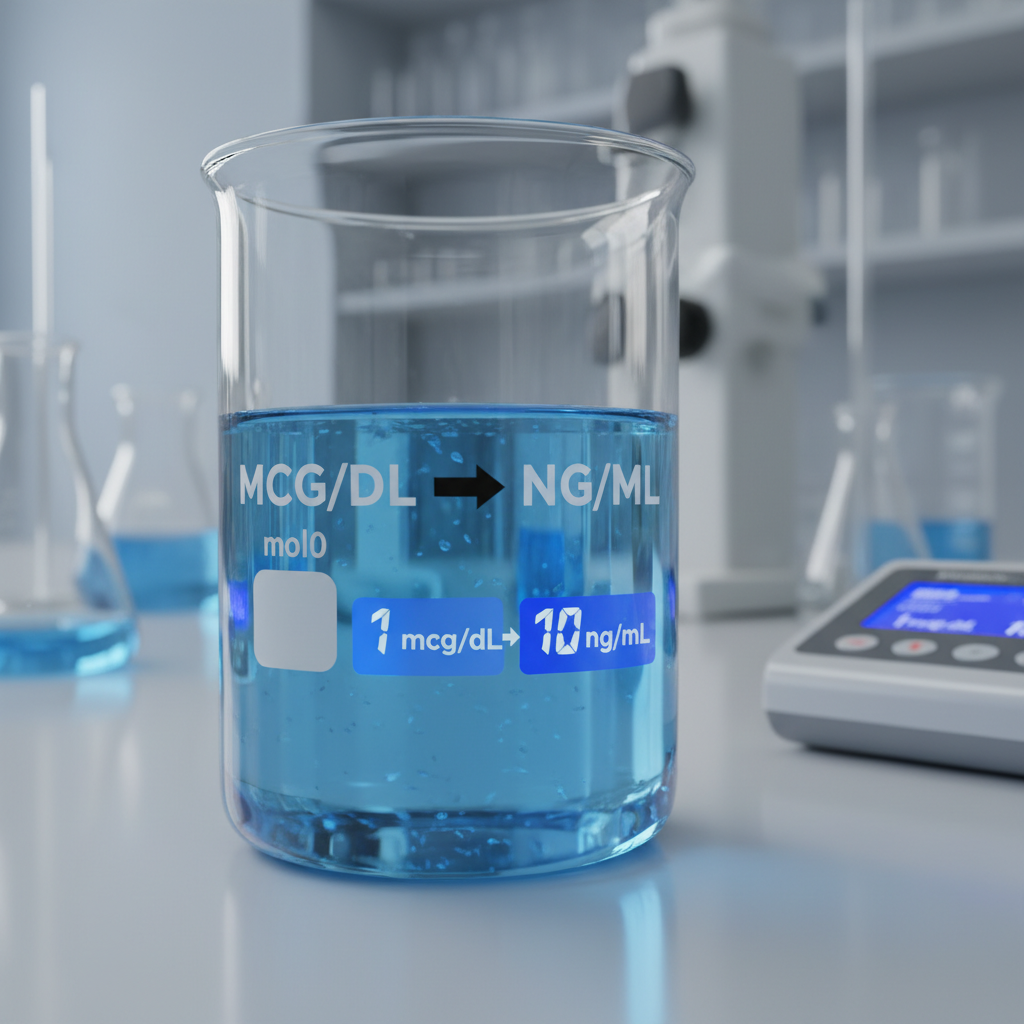
You’re staring at a lab report. One number is listed in mcg/dL, but the reference chart—the one that tells you if everything’s okay—is in ng/mL. It feels like trying to compare apples and oranges, and a tiny bead of sweat forms. Get it wrong, and the interpretation could be off by a factor of ten. A huge deal.
Sound familiar? You’re not alone. This exact scenario plays out in clinics, research labs, and homes every single day. But here’s the secret: the conversion between mcg/dL and ng/mL isn’t complex scientific jargon. It’s one simple, unforgettable number.
In this guide, we’re going to completely demystify this conversion. You’ll learn not just the ‘how,’ but the ‘why’ behind it. By the end, you’ll be able to convert these units in your head, interpret lab results with confidence, and understand the critical impact this tiny piece of math has on patient care and scientific accuracy.
📑 What You’ll Learn
Breaking Down the Units: What Are mcg, dL, ng, and mL?
Before we can do any math, we have to get comfortable with the language. These aren’t random letters; they represent incredibly specific amounts of mass and volume. Think of them as the ingredients in our conversion recipe.
The core of our challenge is that we’re dealing with two different scales for both mass (micrograms vs. nanograms) and volume (deciliters vs. milliliters).
The Mass Units: Micrograms (mcg) vs. Nanograms (ng)
Both mcg and ng measure mass, but they operate on a mind-bogglingly small scale. To put it in perspective:
- A microgram (mcg or µg) is one-millionth of a gram. It’s the weight of a single eyelash.
- A nanogram (ng) is one-billionth of a gram. It’s a thousand times smaller than a microgram.
The relationship is simple: 1 mcg = 1,000 ng. It’s like comparing a dollar to a thousand pennies. Same value, different units.
The Volume Units: Deciliters (dL) vs. Milliliters (mL)
These units measure the liquid that the substance is dissolved in, which in medicine is often blood plasma.
- A deciliter (dL) is one-tenth of a liter. It’s about the volume of a small box of juice (100 mL).
- A milliliter (mL) is one-thousandth of a liter. It’s the standard unit you see on measuring spoons and syringes.
The key here is: 1 dL = 100 mL. Easy enough, right?
Here’s a quick summary to keep things straight:
| Unit | Abbreviation | Type | Relative Size |
|---|---|---|---|
| Microgram | mcg or µg | Mass | 1,000 times LARGER than a nanogram |
| Nanogram | ng | Mass | 1,000 times SMALLER than a microgram |
| Deciliter | dL | Volume | 100 times LARGER than a milliliter |
| Milliliter | mL | Volume | 100 times SMALLER than a deciliter |
💡 Pro Tip
Notice the pattern: the units on the left (mcg, dL) are the “bigger” units in each pair. The units on the right (ng, mL) are the “smaller” ones. This mental model will be a huge help in just a moment.
The Magic Number: Deriving the Conversion Factor
Okay, we have our ingredients. Now, how do we combine them to get our conversion factor? We want to find out what 1 mcg/dL equals in ng/mL. It’s a simple two-part puzzle.
Part 1: Convert the Mass (the top part of the fraction)
We need to change mcg to ng. We already know that 1 mcg = 1,000 ng.
Part 2: Convert the Volume (the bottom part of the fraction)
We need to change dL to mL. We also know that 1 dL = 100 mL.
Now, let’s substitute these into our original unit:
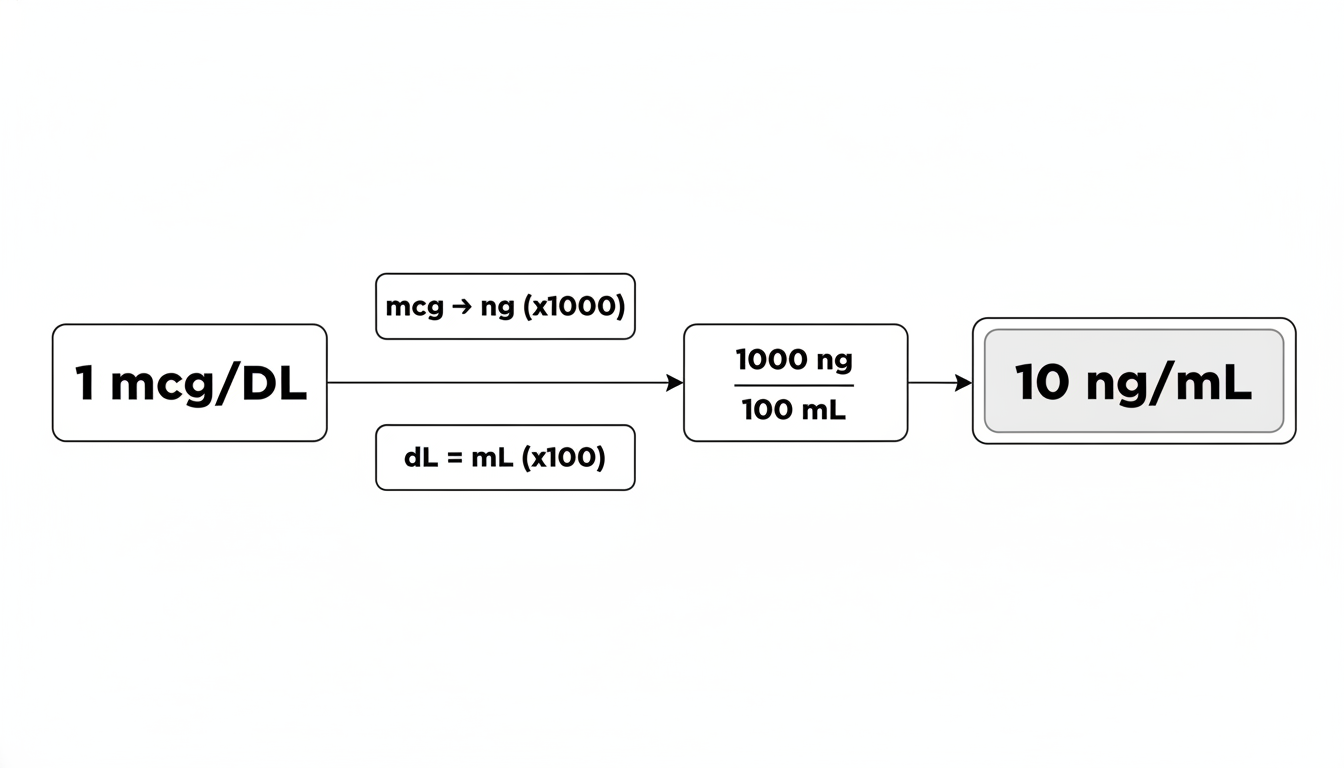
1 mcg / 1 dL = 1,000 ng / 100 mL
Do the simple division: 1,000 divided by 100. What do you get?
10
That’s it. That’s the magic number. The entire, seemingly complex conversion boils down to this one, beautiful, simple relationship:
1 mcg/dL = 10 ng/mL
This is the key to everything. To convert from mcg/dL to ng/mL, you just multiply by 10.
🎯 Key Takeaway
To convert a value from mcg/dL to ng/mL, you simply multiply by 10. To go the other way, from ng/mL to mcg/dL, you do the opposite: divide by 10. That’s the entire process in a nutshell.
Your 3-Step Guide to Flawless Conversion
Now that you know the secret, let’s put it into a repeatable, foolproof process. Trust me on this one, after doing this twice, it’ll become second nature.
- Identify the Starting Value (in mcg/dL).
Look at your lab report, research paper, or data set. Find the number you need to convert. Let’s use a common Vitamin D level as an example: 42 mcg/dL. - Multiply by the Magic Number (10).
Take your starting value and perform the one required calculation. This is the core of the mcg/dL to ng/mL conversion.
Calculation: 42 x 10 = 420 - State the Result with the New Units (ng/mL).
This step is crucial for clarity and avoiding errors. The number you just calculated is your value in nanograms per milliliter. Don’t forget to label it correctly!
Final Answer: 420 ng/mL
That’s all there is to it. No complicated formulas, no calculators needed. Just move the decimal point one place to the right.
⚠️ Watch Out
The most common mistake we see in practice is a simple decimal slip. Multiplying 4.2 by 10 gives you 42, not 420. When you’re dealing with critical health data, always take a second to double-check your mental math. A misplaced decimal can lead to a tenfold error in interpretation.
Real-World Scenarios: Where This Conversion is Critical
This isn’t just a textbook exercise. This conversion is a daily reality in many fields, and understanding it is non-negotiable for accurate interpretation. The reason you see both units is often due to different laboratory standards, regional preferences, or historical conventions. According to guidelines from organizations like the World Health Organization (WHO), standardizing units is a major goal, but local practices often persist.
Here are a few areas where you’ll see this constantly:
- Endocrinology (Hormones): Testing for hormones like Cortisol, Testosterone, and Estradiol often involves these units. A doctor might see a Cortisol level of 18 mcg/dL, which they need to compare to a standard range often cited in ng/mL. (18 mcg/dL = 180 ng/mL).
- Nutrition (Vitamins & Minerals): Vitamin D (25-hydroxyvitamin D) is the classic example. In the United States, labs frequently report in ng/mL, while some international labs may use mcg/dL or other units.
- Pharmacology & Toxicology: When monitoring the level of a drug in a patient’s bloodstream, precision is everything. A therapeutic window might be defined in ng/mL, but the lab report comes back in mcg/dL. An accurate conversion is essential for correct dosing.
Let’s look at a “Before & After” table for some common lab tests.
| Analyte (Substance) | Common Value (mcg/dL) | Conversion (x 10) | Converted Value (ng/mL) |
|---|---|---|---|
| Cortisol (AM) | 15 mcg/dL | 15 x 10 | 150 ng/mL |
| Testosterone (Total, Female) | 0.04 mcg/dL | 0.04 x 10 | 0.4 ng/mL |
| 25-Hydroxy Vitamin D | 30 mcg/dL | 30 x 10 | 300 ng/mL |
| Tacrolimus (Drug Level) | 0.001 mcg/dL | 0.001 x 10 | 0.01 ng/mL |
Note: The values above are for illustrative purposes only and do not represent official medical advice or reference ranges.
💡 Pro Tip
When you get a lab result, the first thing you should do is check the units for both your result and the provided reference range. They must match. If they don’t, perform the conversion before you start interpreting the numbers. This single habit, based on our hands-on experience, prevents 99% of interpretation errors.
The Danger Zone: Common Mistakes and How to Avoid Them
The math is simple, which ironically can make it easy to get complacent. I’ve seen these simple mistakes lead to significant confusion in both clinical and research settings. Here’s what to watch for.
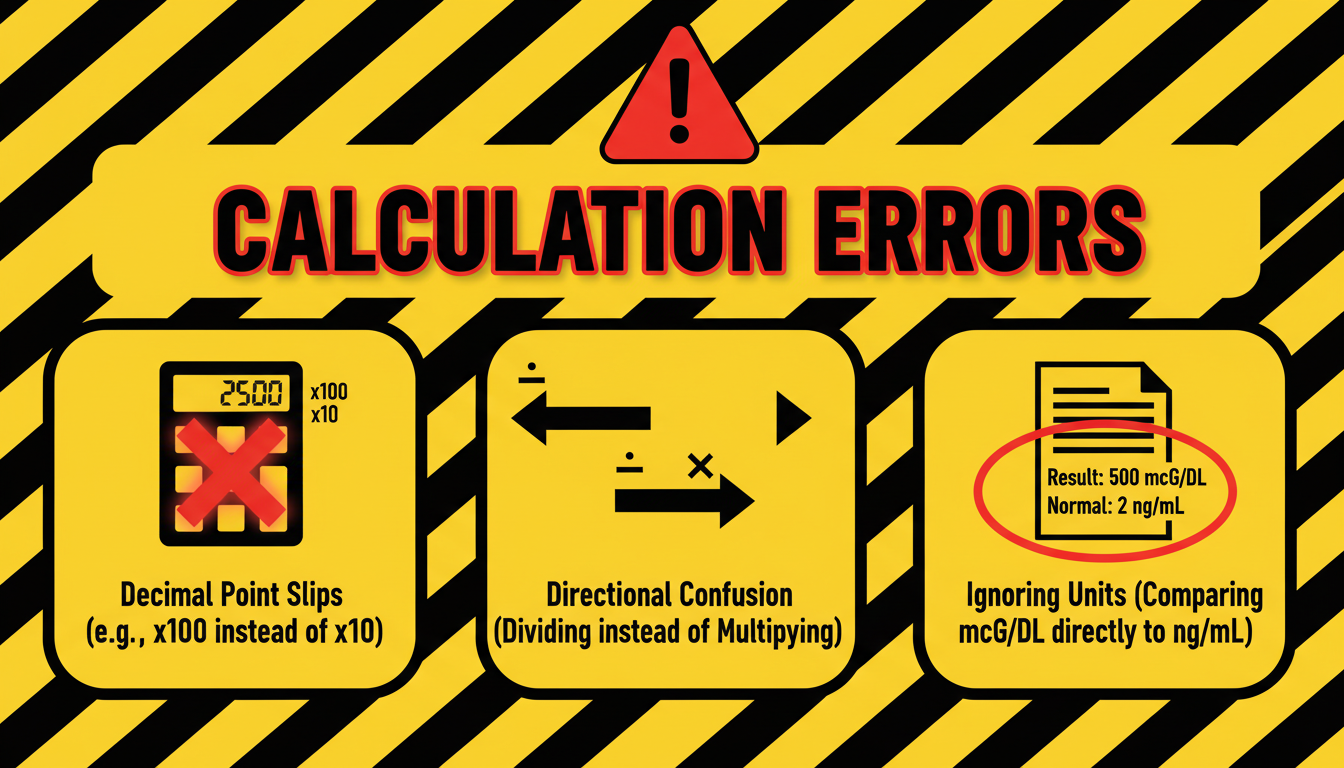
1. Directional Confusion
This is the big one. You know the number is 10, but do you multiply or divide? Remember the mental model from earlier: you’re going from a “bigger” unit combination (mcg/dL) to a “smaller” one (ng/mL), so the number should get bigger. Therefore, you multiply.
mcg/dL → ng/mL : Multiply by 10
ng/mL → mcg/dL : Divide by 10
2. Ignoring the Units Altogether
This is the most dangerous mistake. A person sees a result of “35” and compares it to a reference range of “30-100” without noticing the units are different (e.g., the result is 35 mcg/dL and the range is in ng/mL). They might think the result is normal, when in reality, 35 mcg/dL is 350 ng/mL—a value that could be critically high. As the Merck Manual emphasizes, reference ranges are meaningless without their corresponding units.
3. Confusing mcg with mg
It’s a classic typo, but one with a thousand-fold consequence. A microgram (mcg) is 1,000 times smaller than a milligram (mg). Always read the units carefully. The official symbol for microgram is the Greek letter mu (µg), but ‘mcg’ is widely used in medicine to prevent it from being misread as ‘mg’ in handwritten notes. This is a great example of a practical safety measure recognized by institutions like the Institute for Safe Medication Practices.
⚠️ Watch Out
Never assume the units are what you expect them to be. Labs can and do change their reporting methods. A test you ordered last year might come back with different units this year. The golden rule is to always verify the units on every single report. It takes five seconds and can prevent a catastrophic error.
❓ Frequently Asked Questions
What is the direct formula to convert mcg/dL to ng/mL?
The simplest formula is: Value in ng/mL = Value in mcg/dL × 10. You just multiply the number by ten.
Why is the conversion factor 10 and not 100 or 1000?
It’s a two-part calculation. You multiply by 1,000 to convert micrograms (mcg) to nanograms (ng), but you also have to account for the volume, dividing by 100 to convert deciliters (dL) to milliliters (mL). The net effect (1000 ÷ 100) simplifies to a factor of 10.
Is mcg the same as µg?
Yes, they are identical. Both are abbreviations for microgram. The Greek symbol ‘µg’ is the official scientific notation, but ‘mcg’ is often preferred in medical settings to avoid any possible confusion with ‘mg’ (milligram), especially in prescriptions.
Where will I most likely encounter this conversion?
You’ll see it most often in endocrinology (hormone levels like cortisol or testosterone), nutritional biochemistry (especially for Vitamin D), and therapeutic drug monitoring, where precise blood concentrations are vital for patient safety.
How do I convert ng/mL back to mcg/dL?
You just reverse the process. Instead of multiplying by 10, you divide the ng/mL value by 10 to get the equivalent in mcg/dL. For example, a lab result of 250 ng/mL is equal to 25 mcg/dL (250 ÷ 10).
Can I use an online calculator for this?
You can, but the math is so simple (just move the decimal point) that it’s often faster and better to understand the principle yourself. Relying on a calculator for a simple multiplication by 10 can introduce typing errors. Learning the rule empowers you to check results on the fly.
Conclusion: From Confusion to Confidence
That intimidating string of letters—mcg/dL to ng/mL—is intimidating no more. We’ve stripped it down to its core components and revealed the simple logic that governs it. It all comes down to one action: multiply by 10.
By internalizing this simple rule, you’ve equipped yourself with a skill that is absolutely essential for anyone navigating the world of medical data. You can now look at a lab report with mismatched units not with confusion, but with the confidence of knowing exactly how to bridge the gap.
Your next step? The next time you see these units, don’t freeze. Take a breath, remember the magic number, and do the quick math. You’ve got this.