
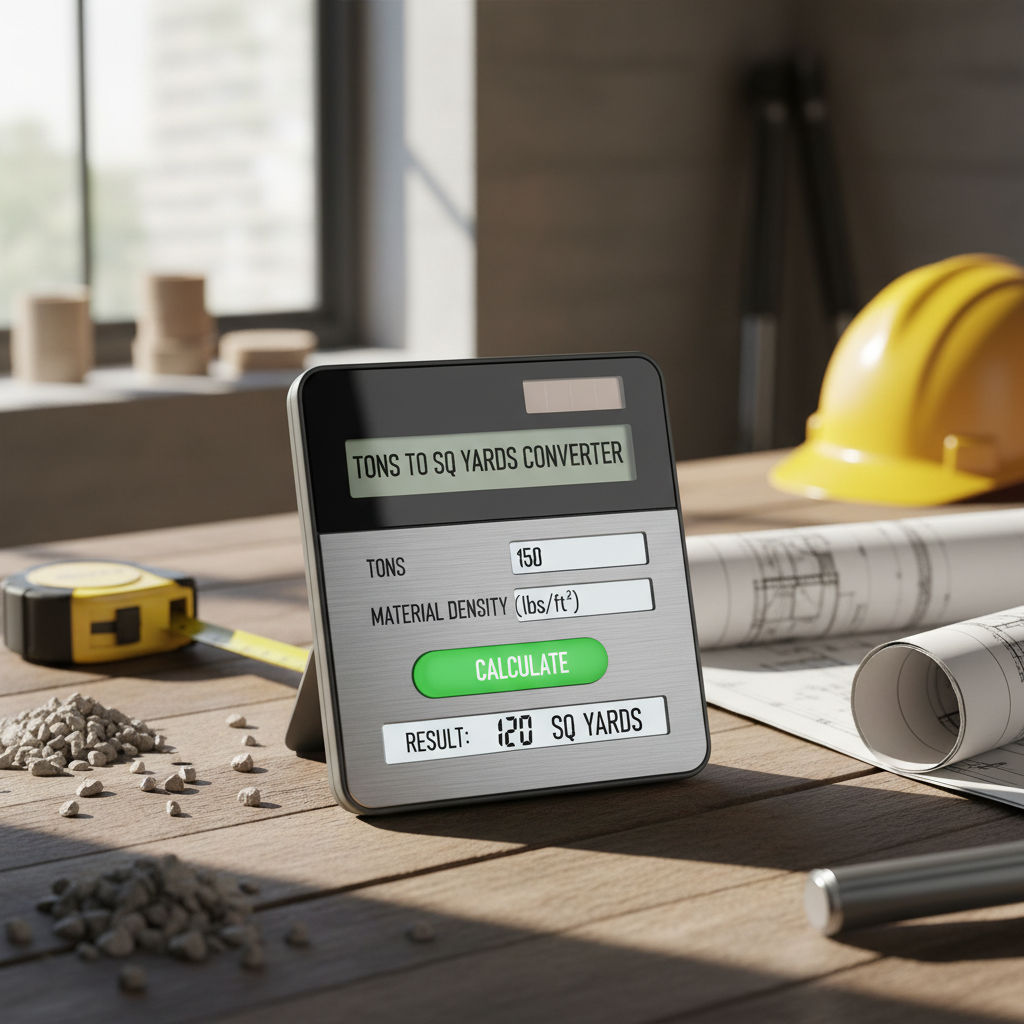
You’ve been there. The wheelbarrow is empty, the sun is beating down, and you’re staring at a half-finished gravel driveway with a sinking feeling. You ran out. Now you’re facing another delivery fee and a weekend project that’s bleeding into next week. Or worse, you over-ordered, and now a mountain of expensive topsoil is sitting in your yard with nowhere to go.
It’s a classic DIY headache. You buy materials like gravel, sand, and mulch by weight (tons), but you need to cover a specific area (square yards). Getting this conversion wrong is the single fastest way to blow your budget and your schedule.
But it doesn’t have to be this way. This guide breaks down the simple science behind the conversion. You’ll learn the foolproof method to calculate exactly what you need, turning project anxiety into confident execution. No more guesswork. No more waste.
📑 What You’ll Learn
Why You Can’t Directly Convert Tons to Square Yards
Let’s get one thing straight right away: asking “how many square yards does a ton cover?” is like asking “how much does a shadow weigh?” The question is missing a critical piece of the puzzle.
You’re trying to connect two different types of measurement:
- Tons: A measure of mass (how heavy something is).
- Square Yards: A measure of area (a flat, two-dimensional space).
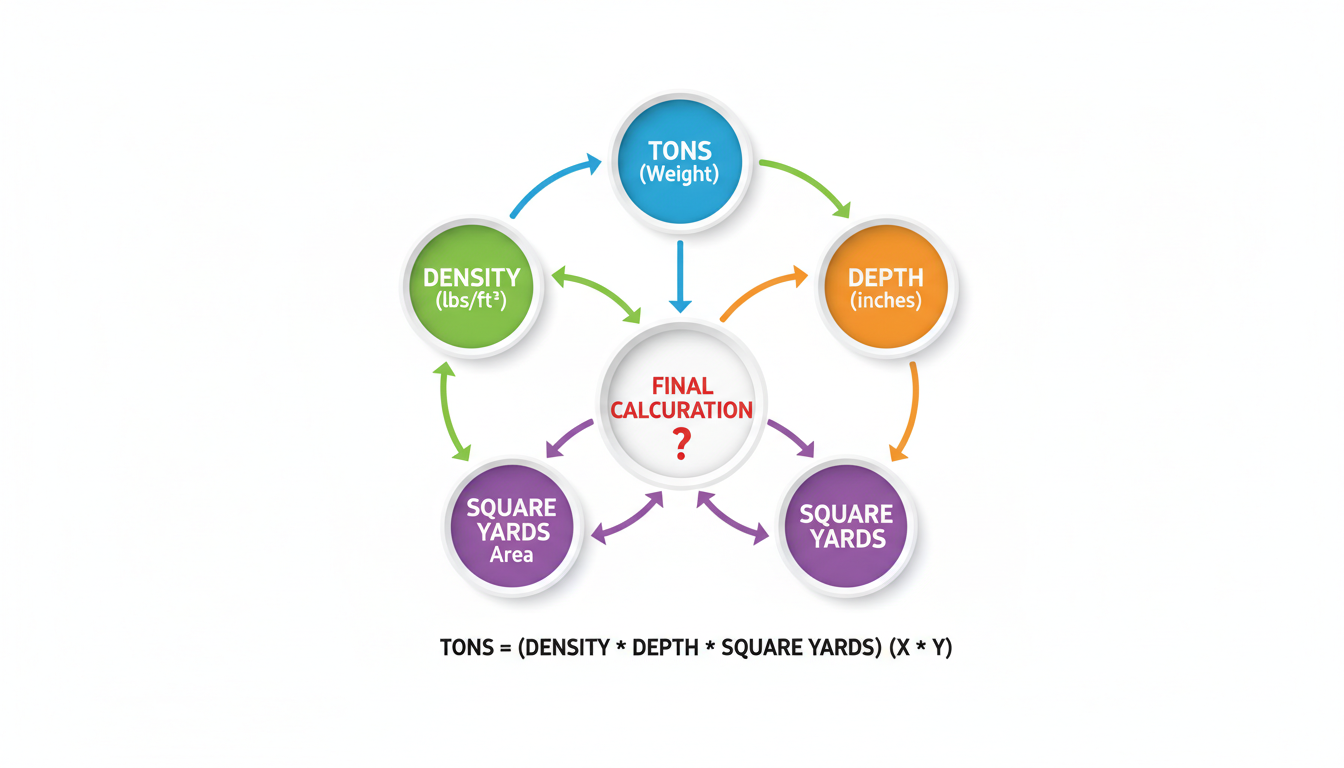
To bridge this gap, you absolutely need two more variables. Without them, any calculation is pure fantasy.
- Depth (or Thickness): How deep will your layer of material be? A one-ton pile of mulch will cover a massive area if spread 1 inch deep, but a tiny patch if spread 12 inches deep.
- Density: How much does a specific volume of your material weigh? A cubic foot of light, airy wood chips weighs far less than a cubic foot of dense, compacted crushed stone.
Think of it this way: Weight doesn’t cover area. Volume does. The first step is always to use the material’s density to figure out the volume your tonnage represents. Only then can you calculate the area it will cover at your desired depth.
The Secret Ingredient: Understanding Material Density
Density is the unique fingerprint of your material. It’s the single most important variable in your calculation, and using the wrong one is the #1 mistake we see people make. The density, often called “unit weight” by suppliers, tells you how many pounds one cubic foot of the material weighs (lbs/ft³).
Why does it vary so much? Because of composition, particle size, moisture, and compaction. A ton of large, airy river rock takes up more space than a ton of fine, dense sand.
Here’s a quick-reference chart for common landscaping materials. Based on our experience, these are solid starting points, but always confirm with your supplier for the most accurate numbers.
| Material | Average Density (lbs/ft³) | Common Uses & Notes |
|---|---|---|
| Crushed Stone / Gravel | 95 – 105 lbs/ft³ | Very dense. Ideal for driveways and drainage. Compaction is a major factor. |
| Sand (Dry) | 90 – 110 lbs/ft³ | Heavy and dense. Used for paver bases and play areas. Wet sand is much heavier. |
| Topsoil / Loam (Dry) | 75 – 90 lbs/ft³ | Lighter than stone. Used for lawns and gardens. Density changes with moisture. |
| Wood Mulch / Bark Chips | 15 – 30 lbs/ft³ | Very light and airy. A ton covers a huge area, making it great for garden beds. |
💡 Pro Tip
When you call your supplier, don’t just ask for a price per ton. Ask them for the material’s “unit weight” or “pounds per cubic foot.” Using their specific number instead of a generic estimate is the key to a hyper-accurate calculation.
Your 5-Step Guide to a Perfect Material Order
Ready to see it in action? Let’s walk through a real-world project. You’re building a new gravel path in your backyard and need to figure out how much material to order.
Your Goal: Cover a path that is 3 feet wide and 50 feet long with a 3-inch layer of crushed stone.
Step 1: Calculate Your Total Area in Square Feet
First, ignore the depth. Just find the total area you need to cover. For a simple rectangle, it’s just length times width.
Formula: Area (ft²) = Length (ft) × Width (ft)
- 50 ft (Length) × 3 ft (Width) = 150 square feet (ft²)
Step 2: Convert Your Desired Depth to Feet
Your depth is in inches, but the density is in cubic feet. You need them to match. To convert inches to feet, simply divide by 12.
Formula: Depth (ft) = Depth (in) / 12
- 3 in / 12 = 0.25 feet
Step 3: Calculate the Total Volume Needed in Cubic Feet
Now, multiply your area by the depth in feet to find the total volume of material you need to fill that space.
Formula: Volume (ft³) = Area (ft²) × Depth (ft)
- 150 ft² × 0.25 ft = 37.5 cubic feet (ft³)
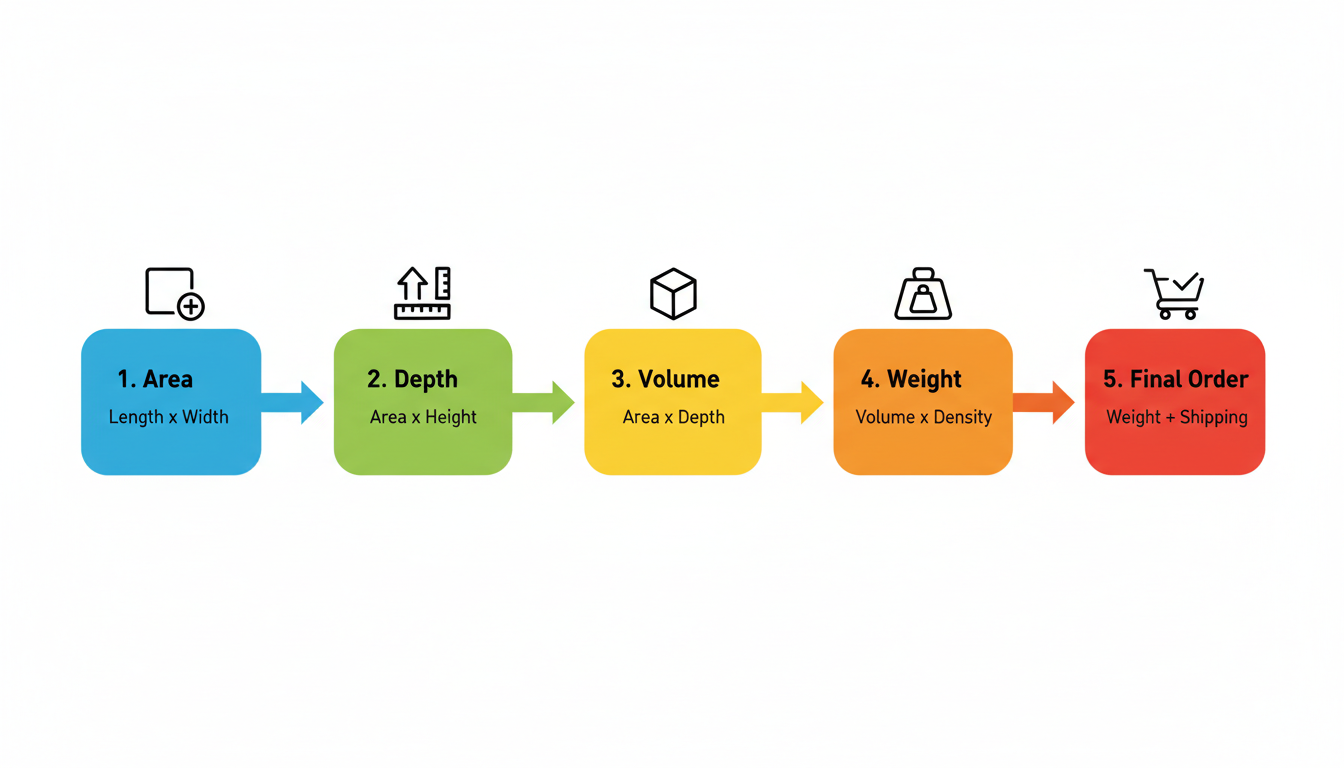
Step 4: Convert Volume to Pounds Using Density
Here’s where density comes in. Let’s say your supplier confirms their crushed stone has a density of 100 lbs/ft³. Multiply your required volume by this density to find the total weight in pounds.
Formula: Total Pounds = Volume (ft³) × Density (lbs/ft³)
- 37.5 ft³ × 100 lbs/ft³ = 3,750 pounds
Step 5: Convert Pounds to Tons
This is the final step! Since there are 2,000 pounds in one US ton, divide your total pounds by 2,000.
Formula: Total Tons = Total Pounds / 2,000
- 3,750 lbs / 2,000 = 1.875 tons
The Result: You need to order approximately 1.875 tons of crushed stone for your path. Easy, right?
⚠️ Watch Out
Materials like gravel and soil will settle and compact, especially after you tamp them down or walk on them. This reduces their final volume. From real-world campaigns, we’ve found it’s a rock-solid practice to order 10% extra material to account for this. In our example, you’d order about 2.06 tons (1.875 x 1.10).
🎯 Key Takeaway
The conversion from tons to square yards isn’t a direct formula; it’s a process. You must first use the material’s density to convert weight (tons) into volume (cubic feet). Only then can you use your desired depth to calculate the final coverage area (square yards).
Beyond the Math: Real-World Factors to Consider
The calculator gets you 90% of the way there. But as any seasoned contractor knows, the real world has a few curveballs. Here’s what to keep in mind for a truly successful project.
The Cost of Guessing vs. Calculating
Still tempted to just “eyeball it”? Let’s look at the real financial impact on a 500 sq ft driveway project requiring a 4-inch base of gravel.
| Scenario | Calculation | Tons Ordered | Potential Cost (@ $50/ton + $100 delivery) |
|---|---|---|---|
| The Accurate Planner | Calculates 8.33 tons, adds 10% for compaction. | 9.2 tons (orders 9.5) | $575 (1 delivery) |
| The Under-Guesser | Guesses “maybe 7 tons?” and runs out. | 7 + 2.5 tons | $675 (2 deliveries, project delay) |
| The Over-Guesser | Panics and orders “12 tons to be safe.” | 12 tons | $700 (plus cost/hassle of leftover material) |
As you can see, a few minutes of calculation can easily save you $100 or more. It’s a no-brainer.
⚠️ Watch Out for Water Weight
You buy material by the ton. If that pile of sand or topsoil was just rained on, a significant portion of the weight you’re paying for is water, not product. If possible, try to purchase materials when they’re dry. According to Penn State Extension, moisture content can dramatically alter soil weight.
Measuring Irregular Shapes
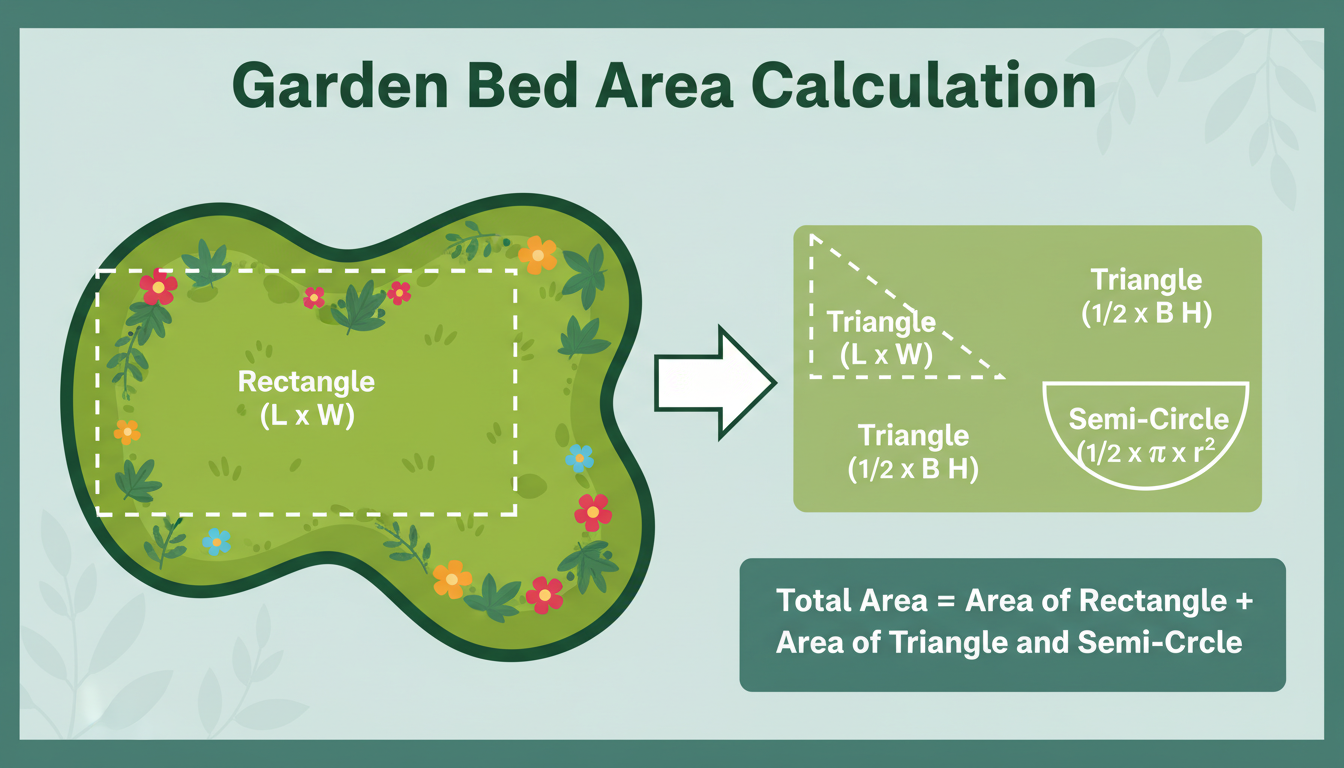
Not every project is a perfect rectangle. What if you have a curved pathway or a kidney-shaped garden bed? Don’t panic. The trick is to break the complex shape down into simpler ones (rectangles, circles, triangles).
- Measure the area of each simple shape individually.
- Add all the areas together to get your total square footage.
- Proceed with the calculation from Step 2 onwards.
💡 Pro Tip
For quick area calculations, use an online area calculator. There are plenty of free tools that can handle complex shapes if you just plug in the dimensions. This eliminates human error in your initial, most important measurement.
❓ Frequently Asked Questions
How many square yards does 1 ton of gravel cover?
There’s no single answer! It depends entirely on depth. For typical gravel (100 lbs/ft³), 1 ton covers about 120 sq ft at a 2-inch depth, but only 60 sq ft at a 4-inch depth. Always calculate based on your specific project depth.
What is the basic formula to convert tons to square yards?
While it’s better to think of it as a process, the all-in-one formula is: Square Yards = (Tons × 2000) / (Depth in feet × Density in lbs/ft³ × 9). Remember there are 9 square feet in a square yard, which is why the 9 is at the end.
Where can I find the most accurate density for my material?
The absolute best source is your material supplier (the quarry or landscape yard). They know the exact properties of their products. General charts are great for estimates, but the supplier’s number is ground truth. Industry bodies like the National Stone, Sand & Gravel Association also provide standards, but your local source is best.
How do I convert my desired depth from inches to feet?
Simply divide the number of inches by 12. For example, a 3-inch depth is 3 ÷ 12 = 0.25 feet. A 6-inch depth is 6 ÷ 12 = 0.5 feet. This is a critical step for the formula to work correctly.
Does compaction really make that much of a difference?
Yes, absolutely. For materials like gravel, crushed stone, and soil that form the foundation of a project, compaction is non-negotiable for stability. This process can easily reduce the volume by 10-15%. Forgetting to account for this is why so many people run out of material before the job is done.
What’s the difference between a US ton and a metric tonne?
A US ton (or “short ton”) is 2,000 pounds. A metric tonne is 1,000 kilograms, which is about 2,204.6 pounds. In the United States, landscape and construction materials are almost always sold by the US ton. For more on material properties, the U.S. Geological Survey (USGS) is an excellent resource.
Build with Confidence, Not Guesswork
Mastering the tons-to-square-yards conversion elevates you from a hopeful DIYer to a savvy project manager. It’s not about complex math; it’s about a logical process that saves you time, money, and a whole lot of frustration.
You now have the framework to tackle any project with precision. You understand that the magic lies in connecting weight to area through the crucial lenses of density and depth.
So, here’s your next step: Grab your tape measure, define your project area, and call your supplier for that all-important density figure. You’re no longer guessing—you’re calculating. And that’s how successful projects are built from the ground up.