
Ever stand in a lumber aisle, staring at a price listed “per linear foot,” and feel a wave of uncertainty? You’re not alone. I’ve seen this simple term trip up countless weekend warriors, leading to budget-busting miscalculations and extra trips to the hardware store.
They ask themselves, “How do I convert a linear foot to feet? Is there some secret formula I’m missing?”
Let’s cut through the noise right now. The conversion is 1-to-1. But that’s not the real story. The real story is why this term exists and how understanding it separates the amateurs from the pros. This isn’t just about a definition; it’s about learning to think in dimensions, prevent costly errors, and plan your projects with absolute confidence.
By the end of this article, you won’t just know the answer. You’ll master the concept, calculate your material needs like a seasoned contractor, and sidestep the common traps that plague DIY projects.
📑 What You’ll Learn
The 1-to-1 Secret: Why Linear Foot to Feet is So Simple
Alright, let’s get the big question out of the way immediately so we can move on to what really matters.
One linear foot is exactly equal to one foot.
That’s it. No complex math. No hidden variables. It’s a direct, 1-to-1 relationship. If you need 80 linear feet of crown molding, you need 80 feet of crown molding. Simple.
1 Linear Foot = 1 Foot
So, why does the term “linear foot” even exist? It’s not meant to confuse you. It’s meant to give you clarity. The word “linear” is a qualifier. It specifies that you are measuring one thing and one thing only: length.
Think of it like ordering coffee. You don’t just say, “I’ll have a coffee.” You say, “I’ll have a large coffee” or an “iced coffee.” The words “large” and “iced” are qualifiers that prevent you from getting a small, hot coffee you didn’t want. In the world of construction and materials, “linear” is that critical qualifier. It tells the person at the lumberyard you’re talking about a straight-line measurement, not area or volume.
🎯 Key Takeaway
The conversion from linear foot to feet is 1:1. The term “linear” isn’t a different unit of measurement; it’s a specific instruction to measure only the length of an object, ignoring its width and thickness.
Thinking in Dimensions: Linear vs. Square vs. Cubic Feet
The real power of using “linear feet” comes from distinguishing it from its two- and three-dimensional cousins: square feet (area) and cubic feet (volume). In any project, from building a shed to planting a garden, you’re constantly working with these three dimensions. Mixing them up is where the real trouble starts.
Let’s break it down. Imagine you’re building a raised garden bed:
- You need to know the length of the boards for the frame. That’s measured in linear feet.
- You need to know the area inside the bed to plan your planting. That’s measured in square feet.
- You need to know the volume of soil required to fill it. That’s measured in cubic feet.
See how each term describes a completely different aspect of the same project? Saying you need “24 feet of wood” is ambiguous. But saying you need “24 linear feet of wood” is crystal clear. It means you need boards that, if laid end-to-end, would stretch 24 feet.
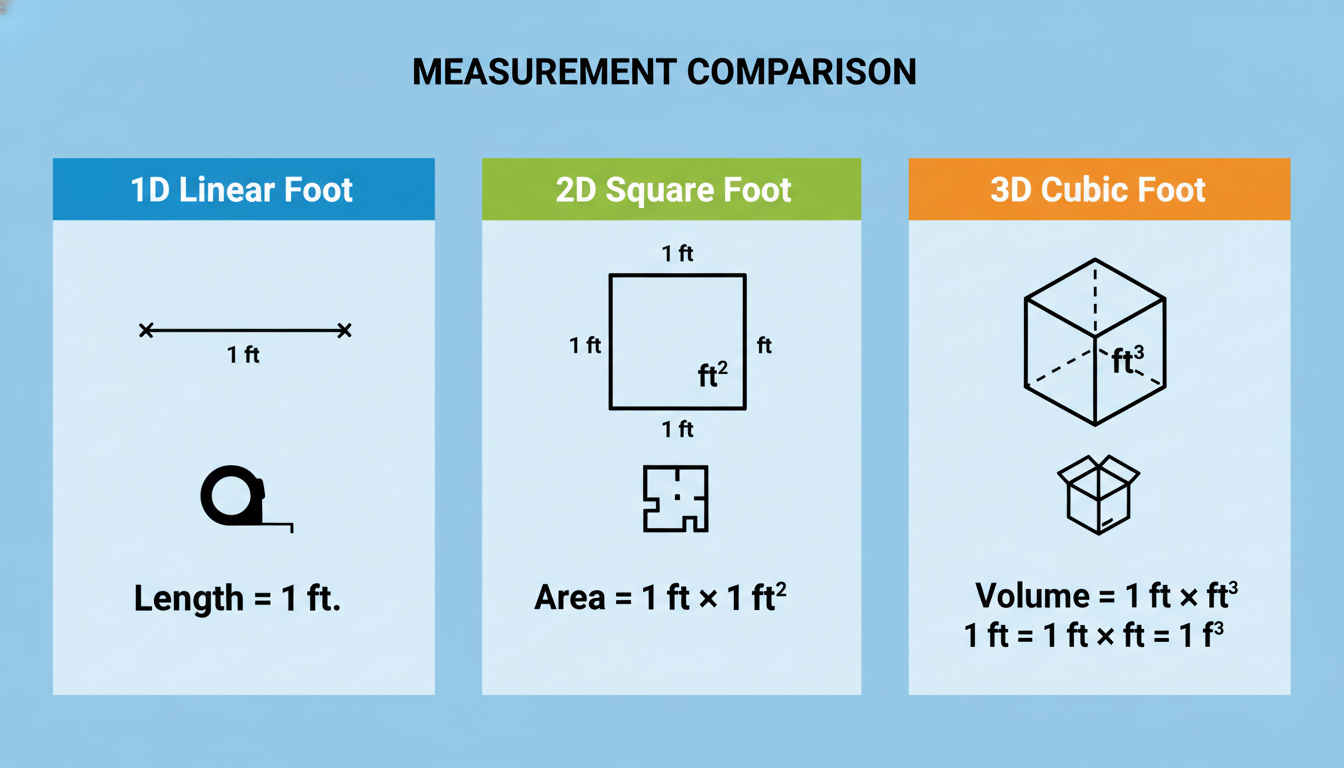
Here’s a simple table to keep on hand. From our hands-on experience, printing this out and keeping it in your workshop can be a lifesaver.
| Measurement Type | Dimensions | Measures… | Common Use Case |
|---|---|---|---|
| Linear Foot (LF) | 1D (Length) | A straight line | Fencing, trim, pipes, lumber |
| Square Foot (SF) | 2D (Length × Width) | A flat surface area | Flooring, paint coverage, tiling |
| Cubic Foot (CF) | 3D (Length × Width × Height) | The space inside an object | Concrete, soil, insulation volume |
⚠️ Watch Out
Never confuse linear feet with board feet. A linear foot is a measure of length. A board foot is a specialized unit of volume for lumber, representing a piece of wood that is 1 ft long x 1 ft wide x 1 inch thick. They are not interchangeable.
The Pro’s Playbook: How to Calculate Linear Feet for Any Project
Knowing the definition is one thing; applying it in the real world is another. Let’s walk through a common project—installing baseboards in a room—to see how a pro calculates their needs versus how a novice might.
The Scenario: A rectangular room measuring 15 feet long by 10 feet wide, with one 3-foot doorway.
Step-by-Step Guide to Calculating Baseboard Needs
-
Calculate the Perimeter: This is the total length of all your walls.
(15 ft + 10 ft + 15 ft + 10 ft) = 50 feet
-
Subtract Openings: You don’t run baseboards across doorways.
50 ft – 3 ft (doorway) = 47 feet
So, you need 47 linear feet of baseboard material. But you’re not done yet.
-
Calculate the Professional Waste Factor: This is the most overlooked step. Every cut you make creates waste. Mitered corners create angled waste. A board might have a split end you need to cut off. Industry best practice, confirmed by years of our own project work, is to add 10-15% to your total for waste.
47 linear feet × 0.15 (15%) = 7.05 feet
-
Determine Your Final Purchase Amount: Add the waste to your measured length.
47 ft + 7.05 ft = 54.05 linear feet
You can’t buy 54.05 feet of wood. You buy it in standard lengths (e.g., 8 ft, 10 ft, 12 ft, 16 ft). So, you’d round up and plan your purchase to get at least 55 feet of material. This might mean buying five 12-foot boards (60 feet total), which gives you a healthy buffer.
💡 Pro Tip
Before you buy, measure the lengths of the walls you need to cover. If you have a 15-foot wall, buying a 16-foot board is far more efficient than cutting a 10-foot and a 5-foot piece. Planning your cuts to match the standard lengths sold at the store dramatically reduces waste and saves you money.
Here’s how that planning makes a tangible difference:
| Calculation Step | Novice Approach (The “Eyeball” Method) | Professional Approach (The “Measure Twice” Method) |
|---|---|---|
| Measurement | “It’s about 50 feet around.” | Perimeter (50 ft) – Doorway (3 ft) = 47 linear feet |
| Waste Factor | “I’ll just buy a little extra.” | 47 ft * 15% = 7.05 ft. Total needed: 54.05 linear feet |
| Purchase Plan | Buys 50 feet of material. Runs out mid-project. | Buys five 12-foot boards (60 total feet). Has enough to cover mistakes. |
| Outcome | Frustrating second trip to the store. Wasted time and gas. | Project completed smoothly in one go. Minimal stress. |
The #1 Conversion Trap: Turning Square Feet into Linear Feet
Here it is. The single biggest point of confusion when dealing with the linear foot to feet concept. Someone knows they need to cover a 200-square-foot deck, so they go to the store and ask for 200 feet of decking. Wrong.
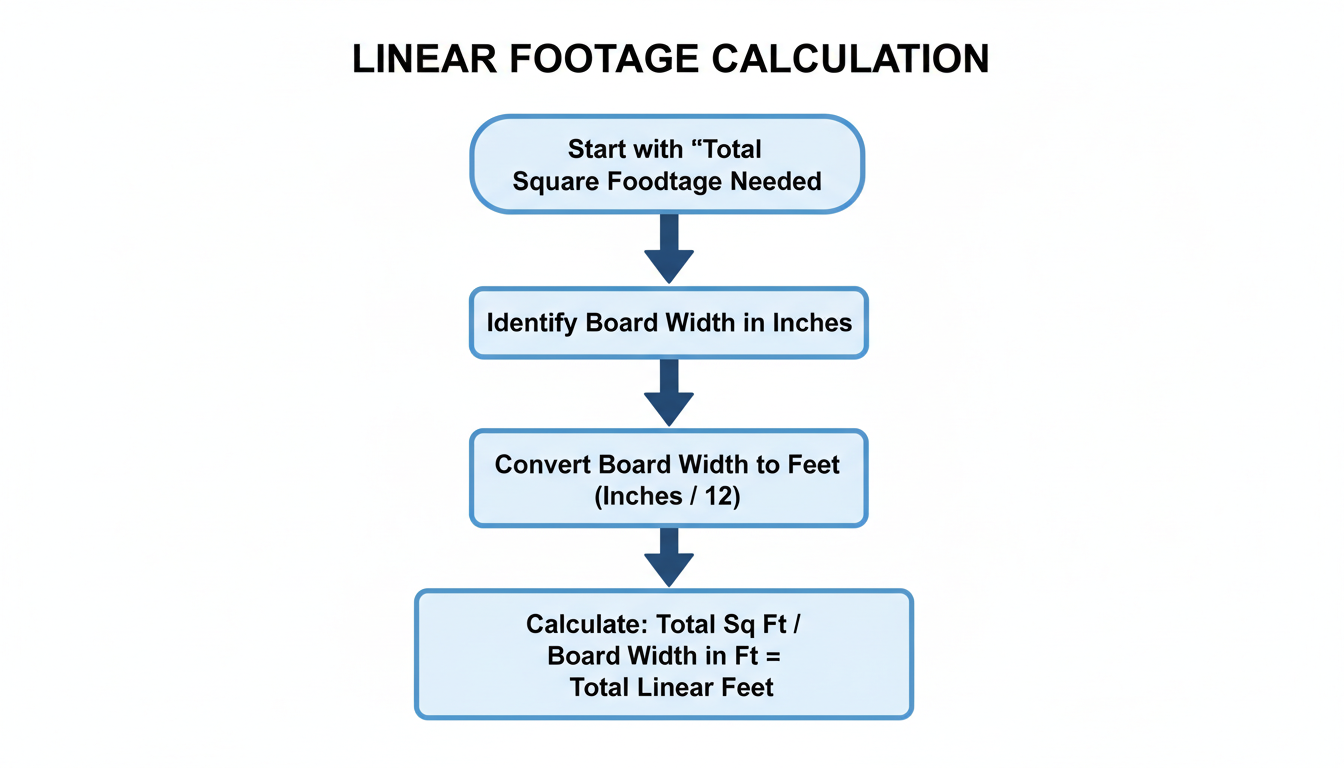
You cannot directly convert area (square feet) to length (linear feet) without one critical piece of information: the width of your material.
Think about it. You could cover a 100 sq ft area with many narrow boards or a few very wide boards. The total length required would be completely different in each case. This is a fundamental concept in applied geometry, as outlined in educational resources from institutions like the University of Toronto’s Department of Mathematics.
The formula is your best friend here:
Total Linear Feet = Total Square Feet ÷ Width of one board (in feet)
Let’s Try a Real-World Example: Decking
You need to cover a 160 square foot deck surface. You’ve chosen standard deck boards that are 5.5 inches wide.
-
Convert the board width to feet. This is a non-negotiable step.
5.5 inches ÷ 12 inches/foot = 0.458 feet
-
Apply the formula.
160 sq ft ÷ 0.458 ft = 349.3 linear feet
-
Add the waste factor (10% for decking is standard).
349.3 ft × 0.10 = 34.9 feet
-
Calculate your final purchase amount.
349.3 ft + 34.9 ft = 384.2 linear feet
You’ll need to buy approximately 385 linear feet of decking. A huge difference from the 160 you might have guessed initially, right? This single calculation can save you hundreds of dollars and a massive headache.
⚠️ Watch Out
Always use the actual width of your lumber, not the nominal width. For example, a “2×4″ piece of lumber is not actually 2 inches by 4 inches. Its true dimensions are closer to 1.5″ x 3.5”. Using the nominal size in your calculations will throw off your entire estimate. Always measure the board yourself or check the specs.
💡 Pro Tip
When calculating linear feet for a project like decking or siding, also account for the “kerf”—the thickness of your saw blade. A standard blade removes about 1/8th of an inch (0.125”) with every cut. Over dozens of cuts, this can add up. Including it in your waste factor is a sign of meticulous planning.
❓ Frequently Asked Questions
How many feet are in a linear foot?
There is exactly one foot in a linear foot. The conversion is 1:1. The word “linear” is a descriptor, not a different unit. It clarifies that you are measuring length in a straight line.
Why is it called a linear foot?
It’s called a “linear foot” to explicitly distinguish it from a square foot (a 2D measure of area) and a cubic foot (a 3D measure of volume). In commerce and construction, this precision prevents costly misunderstandings. This terminology is part of the standardized U.S. Customary System.
How do I calculate the linear feet I need for a fence?
Measure the total length of the perimeter you want to enclose. Subtract the width of any gates or openings. Finally, add a waste factor of 5-10% for cuts and mistakes. The final number is the total linear feet of fencing material you should purchase.
Can I convert square feet to linear feet?
Yes, but you must know the width of the material you’re using. The formula is: Total Linear Feet = Total Square Feet ÷ Width of Material (in feet). This is essential for flooring, decking, and siding projects.
Is a linear foot the same in the US and the UK?
Yes, the concept is the same. A foot is a standard unit of length in the imperial system used in both countries. A linear foot is simply one of those feet measured for length. The key difference is the UK’s more widespread official use of the metric system (meters) for trade.
Your Next Project, Measured with Confidence
So, the linear foot to feet conversion is the simplest thing in the world. It’s 1-to-1. But as we’ve seen, that’s just the tip of the iceberg.
True mastery comes from understanding the context—the “why” behind the term. It’s about thinking in dimensions, planning for waste, and knowing how to convert area into length when a project demands it. You’re no longer just buying materials; you’re engineering a solution. You’re preventing the frustrating mid-project trip to the hardware store and protecting your budget from costly errors.
The next time you walk into that lumber aisle, you’ll see “per linear foot” not as a point of confusion, but as a mark of clarity. You have the knowledge. You have the formulas. Now go build something great.