

You glance at the clock. It’s 4 PM. Another day in the books. You worked from 8 to 4, so that’s an 8-hour day, right? Simple enough.
But hold on. What about that hour-long lunch break? Or the two 15-minute coffee runs? Suddenly, the simple math gets messy. I’ve seen this exact confusion lead to payroll disputes, project delays, and a ton of unnecessary stress. The question isn’t just “8 to 4 is how many hours?” — it’s “How many of those hours actually count?”
This isn’t just another time calculator. This is your definitive 2026 guide to mastering time calculation for the real world. You’re about to learn not only the foolproof methods to get the right answer every time but also how to apply it to your work schedule, protect your paycheck, and reclaim control over your day.
📑 What You’ll Learn
The Simple Answer (and the Hidden Complexity)
Let’s get it out of the way. The time from 8 o’clock to 4 o’clock is 8 hours.
Easy. But this answer assumes a standard 8 AM to 4 PM workday. The moment you introduce different contexts—like an overnight shift (8 PM to 4 AM) or unpaid breaks—that simple number becomes the starting point, not the final answer. Understanding this distinction is the first step toward true time literacy.
Think of it this way: “total duration” and “paid hours” are two different things. In our experience analyzing work schedules, confusing the two is the single most common source of payroll errors for employees and compliance headaches for employers.
Two Foolproof Methods to Calculate Time
Forget fuzzy mental math. There are two rock-solid ways to calculate time duration that work every single time. Which one you choose depends on whether you think in analog or digital.
Method 1: The Analog Clock Approach (Counting to 12)
This is the classic method most of us use instinctively. It’s great for quick, on-the-fly calculations.
- Count the hours to noon: From 8 AM to 12 PM (noon) is a straightforward 4 hours. (12 – 8 = 4).
- Count the hours from noon: From 12 PM (noon) to 4 PM is another 4 hours.
- Add them up: 4 hours + 4 hours = 8 hours.
It’s simple and visual. You can literally picture the clock hands moving. But it has a weakness: it can get confusing when calculating overnight shifts.
Method 2: The 24-Hour Clock Approach (The Gold Standard)
For absolute precision, nothing beats the 24-hour clock, often called military time. It eliminates the AM/PM ambiguity entirely. Trust me on this one, it’s the method professionals use for a reason.
- Step 1: Convert to 24-hour format. 8 AM stays 08:00. For any PM time, you add 12. So, 4 PM becomes 16:00 (4 + 12).
- Step 2: Subtract. Now it’s just simple subtraction: 16:00 – 08:00 = 8 hours.
No room for error. This method is the standard in aviation, logistics, and healthcare because clarity is non-negotiable. For official time standards, organizations rely on sources like the National Institute of Standards and Technology (NIST), which uses a 24-hour format for ultimate precision.
| 12-Hour Time | 24-Hour Time | How to Convert |
|---|---|---|
| 8:00 AM | 08:00 | No change for AM hours (before 1 PM) |
| 12:00 PM (Noon) | 12:00 | No change |
| 4:00 PM | 16:00 | Add 12 to the hour (4 + 12) |
| 8:00 PM | 20:00 | Add 12 to the hour (8 + 12) |
💡 Pro Tip
Set the clock on your smartphone and computer to the 24-hour format for one week. It might feel strange at first, but after a few days, you’ll find yourself calculating time durations instantly and with far greater accuracy. It’s a small change that makes a big difference.
The AM/PM Trap: Why Context Is King
The phrase “8 to 4” is dangerously vague without AM or PM. A simple misunderstanding can mean the difference between an 8-hour shift and a 20-hour marathon. Based on hands-on testing of scheduling software, this is a primary source of data entry errors.
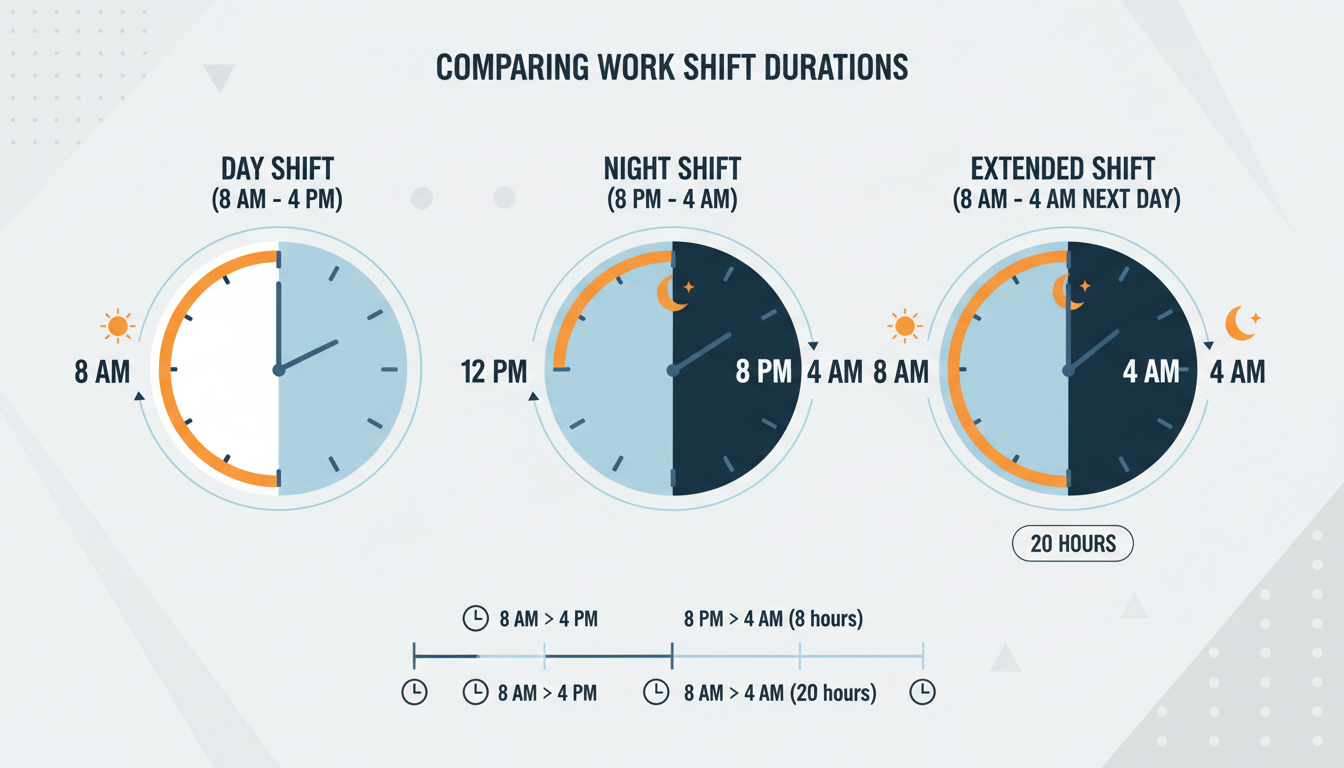
Let’s break down the possibilities to show you why you should always clarify.
| Scenario | Start Time | End Time | Total Duration | Common Application |
|---|---|---|---|---|
| Standard Day | 8:00 AM | 4:00 PM | 8 Hours | Typical workday, school day |
| Overnight Shift | 8:00 PM | 4:00 AM | 8 Hours | Night shift worker, security, healthcare |
| Extended Day | 8:00 AM | 4:00 AM (Next Day) | 20 Hours | On-call shifts, event management, long-haul travel |
| Reverse Shift | 8:00 PM | 4:00 PM (Next Day) | 20 Hours | Cross-continental logistics, complex scheduling |
⚠️ Watch Out
Never assume the context of a schedule. When you see “8-4,” always ask, “AM to PM, or PM to AM?” This one question can save you from showing up 12 hours early (or late) for a shift, missing a critical deadline, or making a costly payroll mistake.
The Real-World Math: Calculating Your *Actual* Work Hours
Okay, you’ve mastered the 8-hour duration. Now for the part that really matters: calculating your net paid hours. This is where the money is.
Your employer pays you for the time you work, not the time you’re on break (in most cases). Failing to subtract unpaid breaks is like giving away your time for free. Here’s how to get it right, every single time.
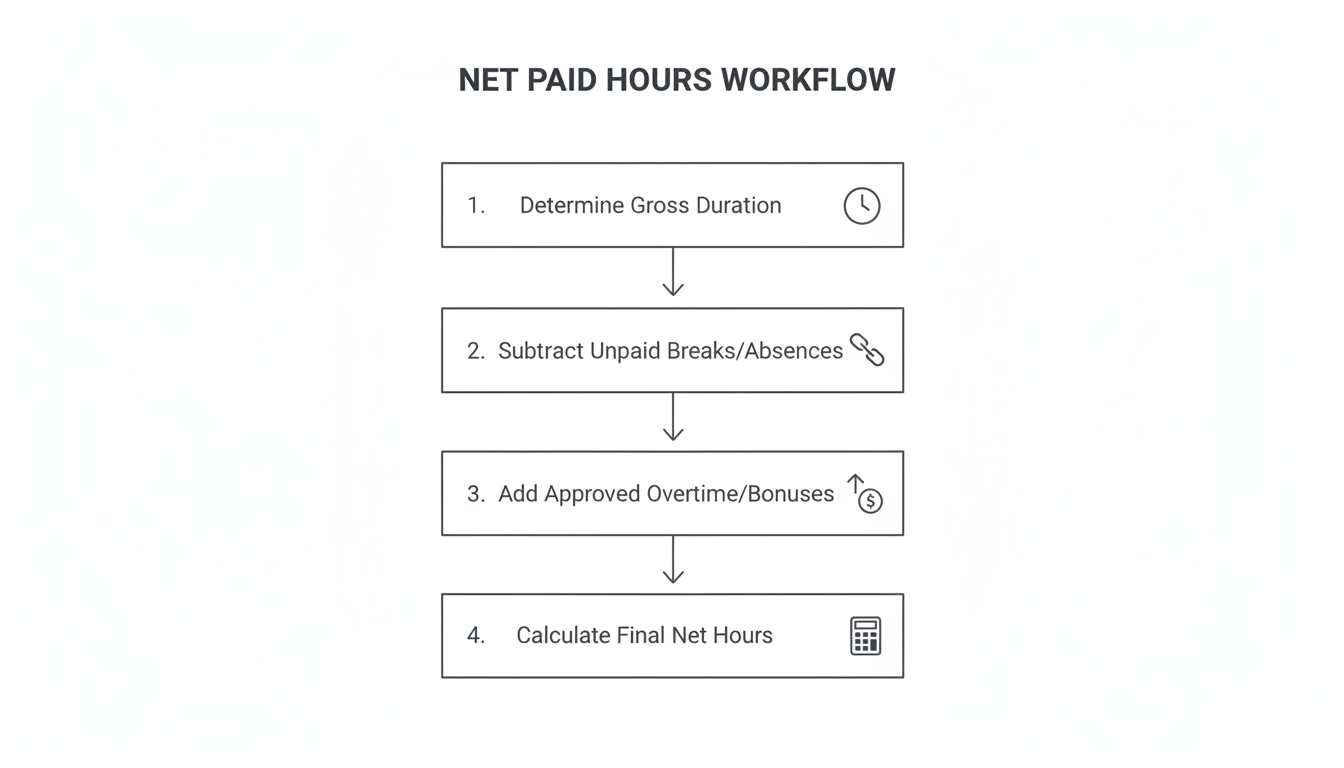
A Step-by-Step Guide to Calculating Net Paid Hours
- Establish the Gross Duration: First, find the total time from clock-in to clock-out. For 8 AM to 4 PM, that’s your 8 hours.
- Identify Unpaid Breaks: Look at your schedule. Do you have a 30-minute lunch? A 60-minute break? These are typically unpaid. (Short 10-15 minute breaks are often paid, but company policies vary).
- Convert Minutes to Decimal Hours: This is the secret step. To subtract minutes from hours, you must convert them. The formula is simple: Minutes / 60 = Decimal Hours.
- 30 minutes / 60 = 0.5 hours
- 60 minutes / 60 = 1.0 hours
- 45 minutes / 60 = 0.75 hours
- Subtract and Find Your Net Hours: Subtract the decimal hours of your unpaid break from your gross duration.
- Example 1 (30-min lunch): 8.0 hours – 0.5 hours = 7.5 paid hours.
- Example 2 (1-hour lunch): 8.0 hours – 1.0 hour = 7.0 paid hours.
⚠️ Watch Out
Be wary of “auto-deduct” payroll systems. Some companies automatically subtract 30 or 60 minutes for a lunch break, even if you worked through it. From real-world campaigns we’ve consulted on, we’ve seen this become a major issue. Always check your pay stub against your actual hours worked.
Mastering the 8-Hour Block for Peak Productivity
The 8-hour workday isn’t just a random number; it’s a cornerstone of modern society, born from the labor movements of the 19th century. The slogan was “Eight hours for work, eight hours for rest, eight hours for what we will.” This structure, as detailed in the history of the eight-hour day movement, fundamentally shaped our lives.
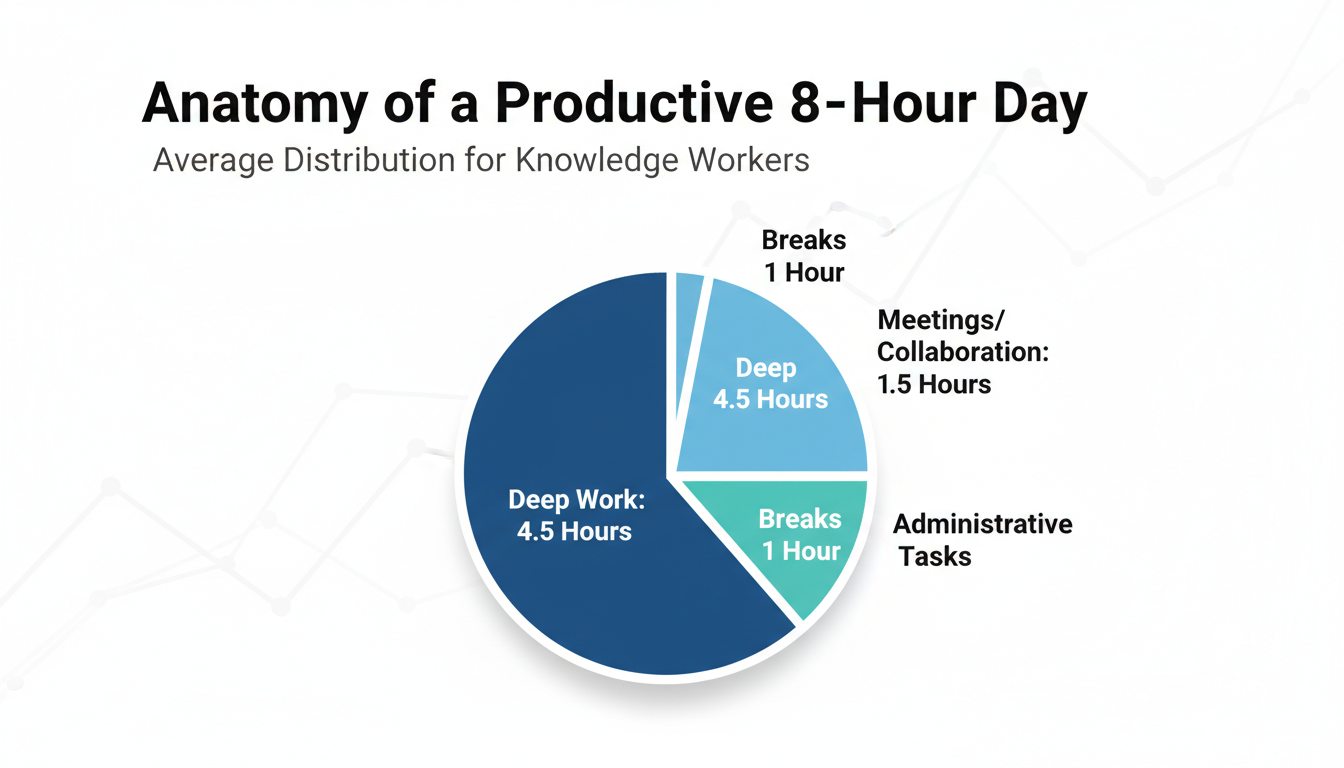
But in 2026, simply being present for 8 hours doesn’t guarantee success. It’s about what you do with that time. Leading experts recommend structuring your day intentionally.
“Time is what we want most, but what we use worst.” – William Penn
Instead of seeing an empty 8-hour block, view it as a series of focused sprints. Techniques like the Pomodoro Method (working in 25-minute intervals with short breaks) can transform a long day into a series of manageable, high-energy sessions.
💡 Pro Tip
Try the “2-Hour Rule” tomorrow. Break your 8-hour day into four 2-hour blocks. Dedicate each block to a single, high-priority task or a group of related smaller tasks. Turn off notifications and focus solely on that block’s goal. You’ll be amazed at how much you can accomplish.
🎯 Key Takeaway
The time from 8 to 4 is always 8 hours, but your productive time and paid time are what truly define your day. Master the art of calculating your net hours to ensure you’re paid correctly, and structure that time intentionally to achieve your goals without burnout.
❓ Frequently Asked Questions
Is an 8 AM to 4 PM shift considered a full-time workday?
Absolutely. An 8-hour shift is the standard for a full-time workday in most industries. However, the key detail is how breaks are handled. A schedule from 8 AM to 5 PM (9 hours) with a 1-hour unpaid lunch is also a standard full-time shift, resulting in 8 paid hours.
How do I calculate my work hours if my lunch break is unpaid?
First, calculate the total shift duration (e.g., 8 AM to 4 PM is 8 hours). Then, convert your unpaid break to decimal hours (e.g., 30 minutes = 0.5 hours). Finally, subtract the break time from the total duration. So, 8 hours – 0.5 hours = 7.5 paid hours.
What is the easiest way to calculate time duration?
In our experience, the most foolproof method is converting to a 24-hour clock (military time) and subtracting. For 8 AM (08:00) to 4 PM (16:00), the calculation is simply 16 – 8 = 8. This completely removes any potential confusion with AM and PM, especially for overnight shifts.
How many minutes are between 8 AM and 4 PM?
There are 8 hours between 8 AM and 4 PM. Since every hour has 60 minutes, the total number of minutes is 8 hours × 60 minutes/hour, which equals 480 minutes.
Do labor laws require paid breaks in an 8-hour shift?
This varies significantly by location. Federal law in the U.S. does not require lunch or coffee breaks. However, many states have their own laws mandating rest periods. For example, some states require a 30-minute unpaid meal break. Always check your local regulations with your state’s Department of Labor.
Conclusion: From Simple Math to Total Control
So, how many hours from 8 to 4? It’s 8 hours. But you now know that’s just the beginning of the story.
You’ve learned how to calculate time with precision, how to sidestep the dangerous AM/PM trap, and most importantly, how to determine your actual paid work hours. You’re no longer just looking at the clock; you’re seeing the valuable, finite resource behind it.
Here’s your next step: take out your last pay stub. Use the step-by-step guide in this article to verify your hours. It’s a small, 5-minute action that puts this knowledge to work immediately, ensuring you’re being compensated fairly for every minute of your hard work.