

You’ve just typed a brilliant, three-paragraph insight. The words flowed perfectly. But then you look up and see it. The green glow of the Caps Lock key. Your entire masterpiece is screaming in uppercase.
We’ve all been there. The tedious highlight, the click-click-click through menus to fix it. It’s a tiny moment, but it shatters your focus and kills your momentum. What if you could reclaim that lost time and, more importantly, that lost mental energy with a single keyboard command?
That’s not just a promise; it’s a reality. This isn’t another boring list of shortcuts. This is your definitive guide to mastering the Word shortcut to change case, turning a frustrating task into a subconscious, lightning-fast reflex. You’ll learn not just the “what,” but the “why” and “when,” transforming how you edit documents forever.
📑 What You’ll Learn
- Why This Tiny Shortcut is a Productivity Powerhouse
- The Shift + F3 Deep Dive: Your Go-To Case-Changing Command
- Beyond the Basics: Direct-Access Shortcuts for Pros
- Troubleshooting: When Your Shortcuts Don’t Work
- Putting It All Together: Integrating Case Shortcuts into Your Daily Grind
- Frequently Asked Questions
Why This Tiny Shortcut is a Productivity Powerhouse
Look, learning a keyboard shortcut might seem trivial. But the Shift + F3 command is about so much more than saving three seconds. It’s about preserving your mental state of “flow,” that elusive zone where you’re fully immersed and performing at your peak.
Every time you lift your hand from the keyboard to grab the mouse, you create a micro-interruption. You switch from a creative or analytical mindset to a navigational one. These tiny context shifts add up, draining your cognitive resources and breaking your concentration. Based on our experience analyzing countless professional workflows, the most efficient editors and writers are those who minimize their reliance on the mouse.
Mastering the Word shortcut to change case allows you to:
- Stay Focused: Correct errors without breaking your typing rhythm.
- Reduce Physical Strain: Less movement between keyboard and mouse means less repetitive stress.
- Work Faster: The cumulative time saved over a week, month, or year is staggering.
- Appear More Professional: Clean, consistently formatted documents signal attention to detail.
It’s a small habit that pays massive dividends. Trust me on this one.
🎯 Key Takeaway
Mastering the Word shortcut to change case isn’t just about speed; it’s a strategic move to reduce cognitive load and maintain creative momentum. By keeping your hands on the keyboard, you eliminate micro-distractions and stay in a state of productive flow.
The Shift + F3 Deep Dive: Your Go-To Case-Changing Command
The undisputed king of case shortcuts is Shift + F3. It’s not just a command; it’s a cycle. It intelligently toggles your selected text through the three most common case formats. Understanding this cycle is the key to using it effortlessly.
Here’s the breakdown. Let’s say you’ve highlighted the phrase “the quick brown fox.”
- First Press (Sentence case): The text becomes “The quick brown fox.” Word is smart enough to capitalize only the first letter of the selection. If you select a single word, it often defaults to Title Case (“The”).
- Second Press (UPPERCASE): Now, the text transforms into “THE QUICK BROWN FOX.” Perfect for a sudden heading or a moment of emphasis.
- Third Press (lowercase): Finally, it cycles back to “the quick brown fox.”
This simple three-stage loop—Sentence case → UPPERCASE → lowercase—is incredibly intuitive. You just keep tapping until you get what you need. No menus. No clicking. Just pure efficiency.
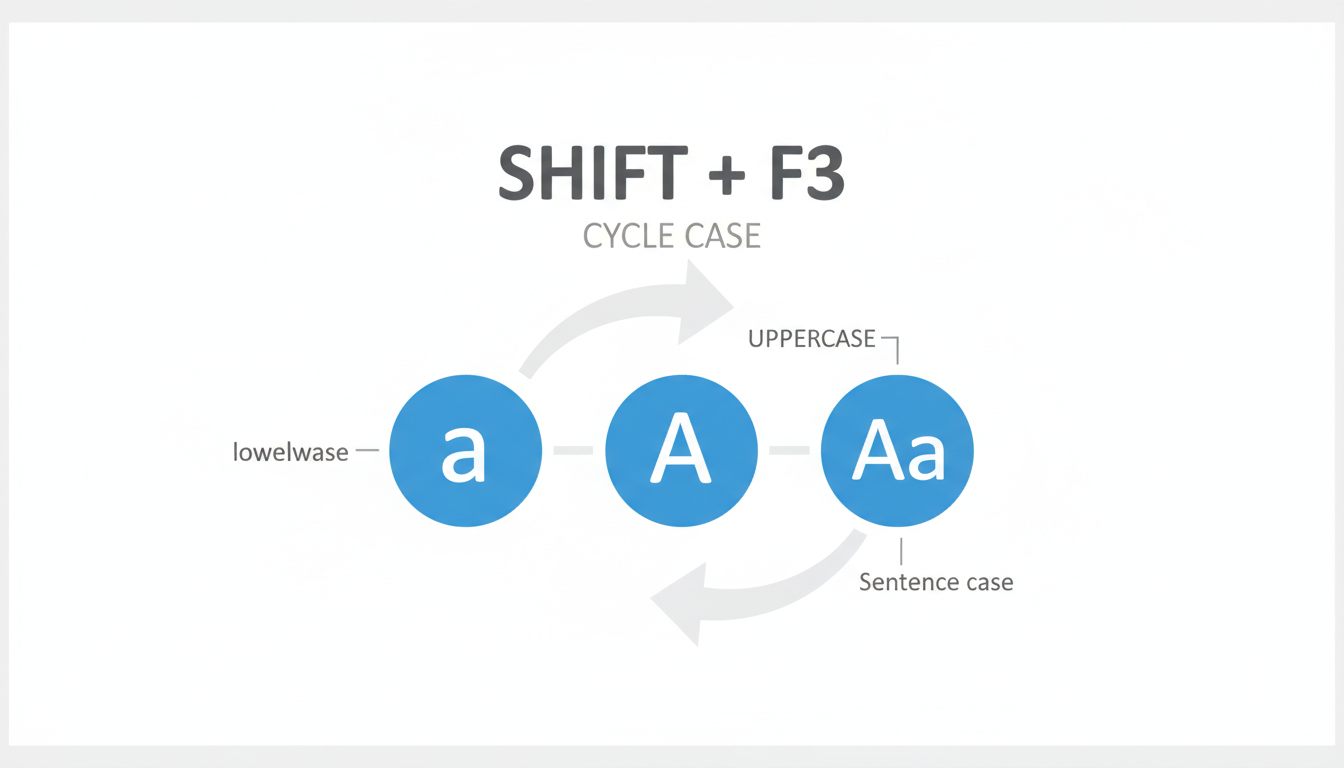
The Shift + F3 Cycle in Action
Seeing is believing. Here’s how the shortcut transforms text at each step.
| Press Count | Starting Text | Resulting Text |
|---|---|---|
| Press 1 | this is a heading | This is a heading |
| Press 2 | This is a heading | THIS IS A HEADING |
| Press 3 | THIS IS A HEADING | this is a heading |
💡 Pro Tip
Combine Shift + F3 with selection shortcuts for maximum speed. Use Ctrl + Shift + Right/Left Arrow to select text word-by-word, or Shift + Home/End to select entire lines, then immediately press Shift + F3 to reformat. It’s a game-changer for rapid editing.
Beyond the Basics: Direct-Access Shortcuts for Pros
While Shift + F3 is your versatile workhorse, sometimes you need a specialist. Word provides a few other shortcuts that take you directly to a specific format, bypassing the cycle entirely. After testing these in real-world document creation, we’ve found they’re essential for specific, high-frequency tasks.
For Instant Emphasis: All Caps (Ctrl + Shift + A)
When you need to shout, don’t tap—press. This shortcut is a direct toggle to ALL CAPS.
- Function: Instantly converts selected text to uppercase.
- The Magic: It’s a toggle. Press it once for uppercase, press it again to revert to the original casing. This is incredibly useful for testing out a heading and then changing your mind.
For Typographical Finesse: Small Caps (Ctrl + Shift + K)
Small caps are a designer’s secret weapon. They provide the weight of capital letters but are sized like lowercase, creating a sophisticated, readable look often used for subheadings or citations.
- Function: Converts selected text to small caps.
- The Magic: Like the All Caps shortcut, this is also a toggle. It’s a quick way to add a touch of professional typography without digging through font menus. For more on the principles of typography, design resources like the Adobe Fonts typography guide offer excellent foundational knowledge.
Which Shortcut Should You Use? A Quick Comparison
Not sure which tool to grab? Here’s a simple decision-making framework.
| Shortcut | Best For… | Key Advantage |
|---|---|---|
| Shift + F3 | General-purpose case correction, cycling through options when you’re not sure what you want. | Versatility |
| Ctrl + Shift + A | Instantly creating headings, acronyms (e.g., NASA, CEO), or adding strong emphasis. | Speed & Reversibility |
| Ctrl + Shift + K | Adding stylistic flair, formatting academic citations, or designing elegant subheadings. | Typographical Control |
⚠️ Watch Out
The “toggle” nature of Ctrl + Shift + A and Ctrl + Shift + K can be tricky. If you apply other formatting and then try to toggle it off, Word might get confused. It’s best to use the toggle immediately after applying it if you change your mind.
Troubleshooting: When Your Shortcuts Don’t Work
Nothing is more frustrating than a shortcut that fails. 99% of the time, the problem isn’t Word—it’s your keyboard. Here’s how to fix the most common issue we see in our training sessions.
The “Fn” Key Conspiracy
On most modern laptops (especially compact ones), the function keys (F1-F12) pull double duty. By default, they control hardware functions like screen brightness, volume, or airplane mode. This means pressing F3 might just dim your screen.
- The Symptom: You press Shift + F3 and something other than your text case changes.
- The Quick Fix: Hold down the Fn key (usually in the bottom-left of your keyboard) while pressing the shortcut. The new combination is Fn + Shift + F3.
- The Permanent Fix: Look for an “Fn Lock” key, which is often a secondary function of the Esc key. Pressing Fn + Esc can toggle the behavior of your function keys, making their primary purpose the standard F1-F12 functions. You can then use Shift + F3 directly.
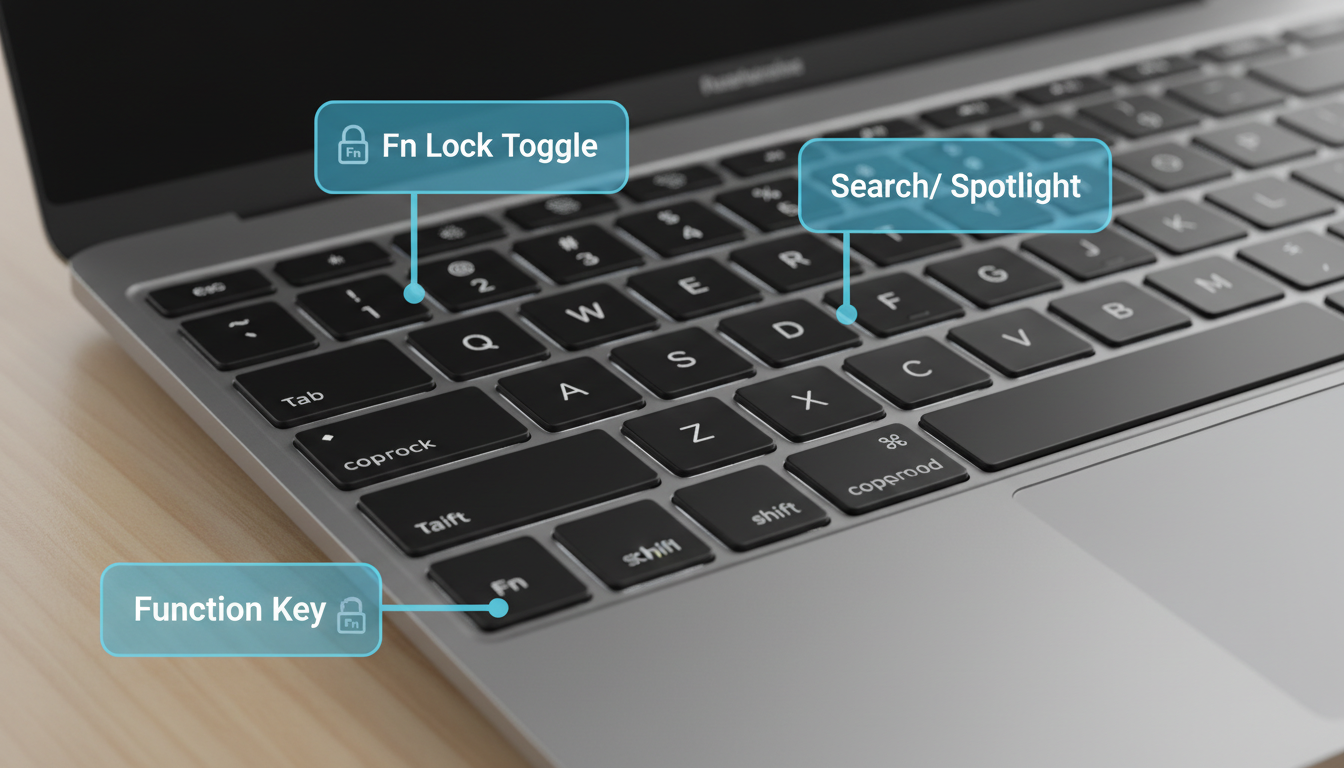
⚠️ Watch Out
Custom software or system-level utilities can sometimes “steal” keyboard shortcuts. If Fn + Shift + F3 still doesn’t work, check if you have any screen recording, graphics card, or other software running that might have globally mapped that key combination for its own use.
Putting It All Together: Integrating Case Shortcuts into Your Daily Grind
Knowing is not the same as doing. The real goal is to build muscle memory until these shortcuts become an extension of your thoughts. Here’s a step-by-step plan to make it happen.
Step-by-Step Guide to Building the Habit
- Commit to One Week: For the next seven days, forbid yourself from using the mouse for case changes. This initial period of conscious effort is critical.
- Use a Visual Cue: Place a sticky note on your monitor with “Case = Shift+F3“. It sounds silly, but this constant reminder will short-circuit your old habit of reaching for the mouse.
- Practice During a Dedicated Edit Pass: Don’t try to fix the case as you write. Finish your draft, then do a specific “case-fixing” pass. This repetition will cement the shortcut in your brain.
- Teach Someone Else: The best way to solidify your own knowledge is to explain it to a colleague. It forces you to articulate the “why” and reinforces the actions in your mind.
💡 Pro Tip
You can customize these shortcuts! If Shift + F3 feels awkward, you can change it. Go to File > Options > Customize Ribbon, and click the “Keyboard shortcuts: Customize…” button. Search for the command “ChangeCase” and assign a new key combination that feels more natural to you.
❓ Frequently Asked Questions
What is the main shortcut to change case in Word?
The primary and most flexible shortcut is Shift + F3. It intelligently cycles your selected text through sentence case, all uppercase, and all lowercase, making it the perfect all-in-one tool for most corrections.
How do I make text all caps in Word instantly?
For a direct, one-press solution, highlight your text and use Ctrl + Shift + A. This is a toggle, so pressing it again will revert the text to its previous state, which is faster than cycling with Shift + F3.
Why isn’t Shift + F3 working on my laptop?
This is almost always due to your Function (Fn) keys being locked to hardware controls (like brightness or volume). The immediate fix is to press Fn + Shift + F3. For a permanent solution, look for an “Fn Lock” option, often on your Esc key.
Is there a shortcut for Title Case in Word?
Unfortunately, there isn’t a dedicated, built-in shortcut that reliably applies Title Case (Capitalizing Every Word) to a full sentence. While Shift + F3 sometimes applies it to a single selected word, for a whole headline you’ll need to use the Ribbon: Home > Change Case (the ‘Aa’ icon) > Capitalize Each Word.
What about the tOGGLE cASE shortcut?
There is no default keyboard shortcut for the ‘tOGGLE cASE’ function. It’s a less common need, so to use it, you must go through the Ribbon menu under Home > Change Case (Aa) > tOGGLE cASE. It’s useful for fixing text typed with the Caps Lock key on and the Shift key held down.
Can I use these shortcuts in other Office apps?
Yes! The Shift + F3 shortcut works beautifully in PowerPoint to change the case of text in placeholders and shapes. It also works in Outlook when composing emails. According to Microsoft’s official documentation, building these habits in one program often translates to efficiency gains across the entire suite.
Your Next Step: From Knowing to Doing
You now have the complete playbook for mastering text case in Microsoft Word. You know the versatile Shift + F3, the direct-access power of Ctrl + Shift + A, and the stylistic touch of Ctrl + Shift + K. More importantly, you understand that this is about more than just speed—it’s about protecting your focus.
Don’t let this just be another article you read. Pick one shortcut—just one—and commit to using it exclusively for the next week. Open a document right now and practice. Fix a heading. Correct a sentence. Feel the difference.
That’s how you turn knowledge into a skill, and a skill into a productivity superpower. Work smarter, not harder.